
I spend a lot of time here talking about the serious parts of business. Numbers. Capacity. Risk. Systems. Cash flow. Planning. Decision-making. Pricing.
The part where you stare at a spreadsheet with the emotional range of a haunted Victorian child and ask, “Is this strategy or am I simply being punished by decimals?”
All of that matters. Obviously.
But business gets to be fun, too.
And sometimes, the fun is remembering that the product or service you sell is not just a product or service. It has a story. It has a past.
It may have a weird little trail through human behavior, politics, trade, culture, logistics, and, apparently, excellent Revolutionary-era penmanship.
Because business can be serious and still be interesting. It can require discipline and still have delight. It can demand planning and still give you a story worth telling. It can be hard and still be something you love.
In my case, coffee has a way of doing this to me.
So, let me tell you some fun things about coffee and the American Revolution.
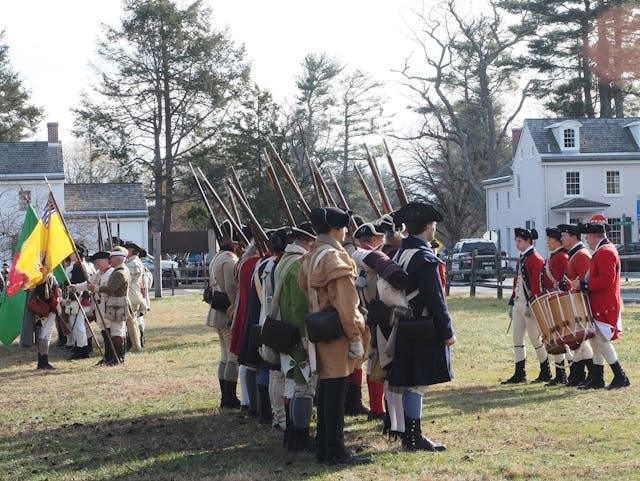
Coffee was never just coffee. The fact is that coffee is a daily ritual for billions of people. It is identity, hospitality, comfort, energy, and culture. It is the thing people gather around, gift, argue about, depend on, and build into the beginning of their day.
And when you start following coffee through history, you realize pretty quickly that it does not politely stay in the “beverage” lane.
Coffee wanders.
Coffee gets itself tangled up in politics, shows up in trade routes, appears in military life, and becomes part of social rituals.
Coffee walks into the American Revolution wearing a little tricorn hat and says, “I suppose you need me now?”
Very dramatic.
Very American.
Very on brand.
A while back, I went deep into the history of coffee around the American Revolution for a video series.
And when I say “deep,” I mean the kind of deep where you start out looking for one detail and somehow end up reading about tea politics, merchant records, coffeehouses, Caribbean trade routes, shipping risk, insurance, wartime provisions, and diary entries written with penmanship that makes your own grocery list feel personally attacked.
The Museum of the American Revolution’s Coffee Nation excerpt notes that coffee was becoming more available in North America by the mid-18th century, with newspaper advertisers selling coffee increasing 25% between 1765 and 1770, and another 60% by 1775.
After the Boston Tea Party, tea became politically loaded. Coffee had room to become something else: not just a practical drink, but a signal. A way to separate yourself from the tea culture associated with British authority.
Now, I am not saying every colonial breakfast table turned into a fully developed political exercise. But imagine your morning beverage becoming a statement. There you are, in your powdered wig, looking at a cup of tea and thinking, “Well, this is complicated now.” Suddenly, your morning cup has a political opinion.
And coffee was not simply “the tea company’s other product.” It moved through a broader Atlantic world: Caribbean plantations, port cities, merchants, shipping routes, insurance risk, newspaper advertisements, retail access, and the whole messy system of getting a small bean from one part of the world into someone’s cup in another.
That is fascinating to me. Because coffee carries meaning whether we notice it or not. Sometimes it is simply, “This is what we drink now because that other thing has become a whole other contentious thing.”
It was the bean.
I’m telling you.
The American Battlefield Trust notes that, after the war, colonists regarded tea drinking as unpatriotic, and that this helped shift cultural attitudes toward coffee as a preferred drink among Americans.
And then there are the human moments.
The National Park Service has a transcription of Moses Sleeper’s Revolutionary War diary. In April 1775, after alarm, drums, firing, and movement, the entry includes a stop in Menotomy, now Arlington, where they drank coffee at the Black Horse Tavern before returning to camp.
That detail gets me. Not because I am saying coffee won the Revolution. Although emotionally, I remain open to the argument.
It gets me because coffee shows up exactly where humans always seem to need it: in the middle of fatigue, uncertainty, logistics, politics, movement, and “well, this day has become a situation.”
Later American war coffee stories get even more dramatic. By the Civil War, soldiers were roasting green coffee over fires, grinding it with rifle butts, and stretching or replacing it with things like chicory, roasted corn, peanuts, acorns, rye, and dandelion when supply got tight.
Which is both horrifying and deeply on brand for coffee people.
Because apparently, even under terrible conditions, someone was still trying to solve the question:
“How do we get a cup of coffee out of this?”
And as a business owner, that delights me.
Maybe your product does not involve Revolutionary-era coffee drama.
Maybe there are no trade routes, insurance records, or colonial beverage politics involved.
Lucky you, perhaps. But I would bet there is something.
A tool, method, material, tradition. A story. A tiny detail that makes you smile because it reminds you this work is not just output. It is connected to something.
That is the part I want us to make more room for.
Not instead of the serious business work. Alongside it.
This may be the bigger point.
There is a version of business ownership that gets so focused on pressure that it forgets delight.
It forgets curiosity.
It forgets the part where the owner is allowed to find the work interesting.
It forgets that customers can feel the difference between a business that is merely selling something and a business that is inviting them into a richer experience.
At Convoy Road Coffee Roasters, coffee is not just something we roast and sell.
It is something we study. It is something we teach. It is something we taste, pair, argue with, write about, experiment with, and occasionally blame for sending us into a historical research tunnel with no snacks.
And I love that.
I love that a bag of coffee can lead to farming practices, processing methods, geography, food pairing, chemistry, trade, war, ritual, hospitality, and one very stubborn question:
How is this little bean connected to so much human life? That is fun.
And business gets to be fun.
Not every day. Not every minute. Not when payroll is due and the system is down and the delivery is late and someone needs a decision five minutes ago.
But sometimes. Sometimes business gets to be fun. Remember, you are carrying a story.
What is one fun fact about your product, service, industry, craft, material, method, tool, ingredient, customer, or weird little corner of your business that still makes you smile?
Not the official elevator pitch. Not the polished marketing copy. The thing you nerd out about.
The thing you tell people when you remember that business is allowed to be interesting.
The thing that makes you say:
“Okay, yes, this is hard. But also? This part is really cool.”
For me, apparently, it is coffee, rebellion, trade routes, insurance, and the firm belief that somewhere in the middle of American history, someone needed a hot cup of coffee, and everything made sense for about three minutes.
It was the bean.
I’m telling you.
Sources:
Museum of the American Revolution — “Coffee Nation”
https://www.amrevmuseum.org/read-the-revolution/coffee-nationNational Park Service — “Revolutionary War Diary of Moses Sleeper”
https://www.nps.gov/articles/000/revolutionary-war-diary-of-moses-sleeper.htmAmerican Battlefield Trust — “Sip Sip Hurray! How Coffee Shaped Revolutionary America”
https://www.battlefields.org/learn/head-tilting-history/sip-sip-hurrah-how-coffee-shaped-revolutionary-america
No posts
Comments
Nothing yet. Say the first thing.
Sign in to join the conversation.