
You almost never meet reality naked.
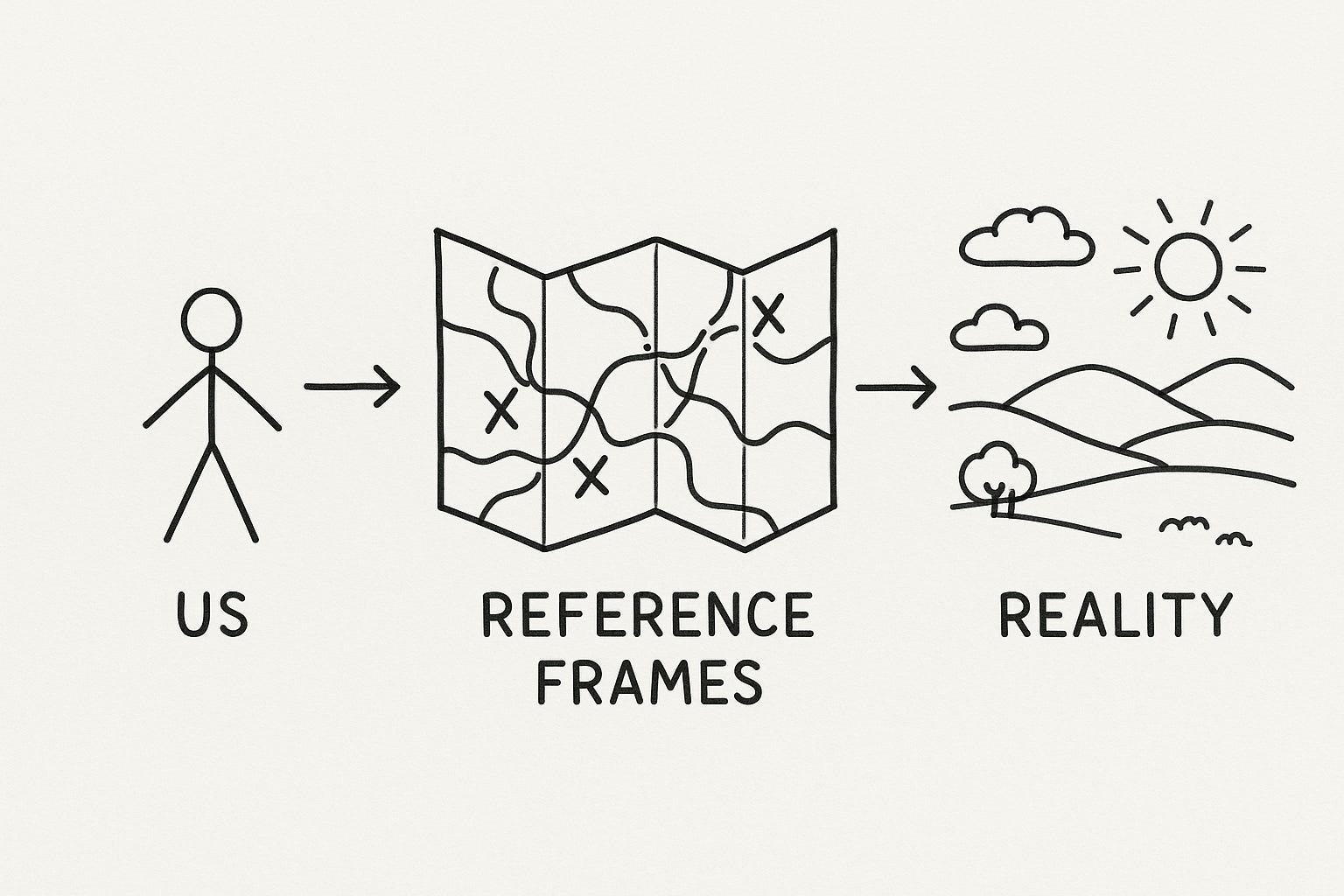
Instead, you meet reality through your reference frames: the maps, concepts, constructs, narratives, and stories that you construct (or that you pick up from others) to filter and compress reality into something thinkable.
You use these reference frames because you have to. The immense scale and depth of reality would be overwhelming otherwise. There is only so much that you can take in. Your reference frames compress reality down into something that your bandwidth-limited brain can handle. Your reference frames are useful precisely because they ignore most of reality.
It’s a big topic, and hard to get at because you need to use reference frames to bootstrap yourself out of thinking your reference frames are real. Or at least to loosen their grip.
The payoff for doing so is immense. The gap between your reference frames and the reality they’re supposed to represent causes so many problems. And for most people, the gap between the two seems to be widening every day.
People talk of ‘my truth’ versus ‘your truth’ or ‘truth versus facts’. Much of the conversation around this topic has been muddied. So let’s start with some definitions.
Reality is what would still exist even if you didn’t have words, concepts, maps, or other abstractions for it. Note that this does not mean that reality exists independent of you, you are part of reality and so are constantly interacting with reality and changing it. But it does mean that it would still exist even if you didn’t have words to describe it. This includes everything in the material world and every life form, but also non-material things that would still exist even if you didn’t have a name for them, like a relationship with a friend or the love you have for your child.
Reference frames are the mental concepts, maps, and stories that you map onto that reality to make sense of it. These reference frames simplify reality, allow us to communicate, and help us control it. Reference frames are interlinked, with one stacking on the next to build your overall worldview.
You can also create super complicated reference frames that are not even trying to map onto reality. The Marvel Cinematic Universe, for example, is a big complicated stack of reference frames that link together, but, unless you are realllly into Spider-man, you are probably under no illusions that the MCU is real. In this post, we’re going to talk about the reference frames that are trying to map onto reality. The frames that you could easily mistake for reality.
The most common analogy for this idea is that of the map and the territory, so let’s start there. If you have heard this one before and it seems stale, please bear with me. Even if it seems familiar to you, it’s very likely you still haven’t fully integrated its implications. Almost every day I recognise new ways I haven’t fully integrated the implications yet, and I’m writing this whole post about them.
Imagine you are navigating a wide-open land, and you have a map to help.
The territory is the reality you can see before you, what you can hear, smell, and feel: from the big rolling hills, trees, and grasslands, all the way down to the small critters, worms, and dirt. All of this territory is the actual reality.

The map that you’re using to navigate is what I’ll be referring to throughout this piece as a reference frame.
The map is something that you create (or that you pick up from someone else). The map starts out living in your head. You might draw it on paper, like a physical map, so that you can ease your cognitive load. But the main thing to know about the map is that it is not reality itself - only a representation of that reality, and that it is something that you make.
The map is useful precisely because it ignores most of reality.
Imagine that you didn’t ignore most of reality and attempted to create a map that was completely 1:1 aligned with reality. It would have to be monstrously large, at least the same size as the territory itself. The usefulness of reducing the territory to a map that you can hold in your hands would immediately disappear and be replaced with an impossibly unwieldy sheet of paper the size of the landscape.
It’s also impossible for a map to be completely aligned with reality.
The territory is constantly changing, but a map is static. Even if it were somehow perfectly aligned at a given point in time, reality would be constantly drifting away from it. The territory is also filled with living creatures with their own agency who are forever changing the territory in unpredictable ways.
The map analogy also highlights that you can hold different maps for the same territory depending on how you are trying to use it.
Imagine that there is a large mountain1 in the centre of the territory you are navigating. If your purpose is to hike, then the mountain is a beautiful piece of scenery and your map will show the hiking trails and walking hazards. If you are prospecting for gold, then the map will show potential mineral deposits and the mountain becomes a resource to be extracted. If you are trying to build a ski resort, then the map will show slopes, accessibility, and snowfall.
Your entire conception of the territory changes depending on the map that you are using. The territory doesn’t change, but the way you think about the territory can change radically depending on your map. The maps that each of us use are different because we are all trying to use reality in different ways. A blind man would create a very different map of the same territory than I would, relying much more on touch than sight.
The map versus territory analogy is a great place to get started. You can immediately understand that the two are different and you usually have some personal experience with those differences that you can relate to. It allows you to pry open some space in your brain to see the gap between your concepts and reality.
However, this analogy undersells just how monumental this realisation is.
It is very easy to see it and dismissively think “oh cool, yeah that’s true isn’t it, I’ll now make sure to remember that when navigating some bit of reality”.
But this is about way more than navigating, it affects every interaction that you have with reality. The gap that it is exposing is bigger, more widespread, and more profound, than the analogy leads you to think.
The term ‘reference frame’ is both a better fit with what your brain seems to actually be doing when it models reality, and broad enough to encapsulate all the ways that your brain uses these frames.
The Thousand Brains theory of neuroscience2 suggests that your brain evolved reference frames so that you could create and use tools (something humans are uniquely good at). These reference frames were originally designed to map objects in 3D space and how the position and orientation of those objects relate to you. Which is the core skill of tool use. But as civilisation developed, your brain had a lot more to process, and it used this same internal process of reference frames to map almost everything that you think about (more on that in a moment).
Similar to a map, your brain is constantly creating reference frames that you put onto the messiness of reality, reducing its complexity and allowing your brain (your left-hemisphere mode of thinking at least) to process it.
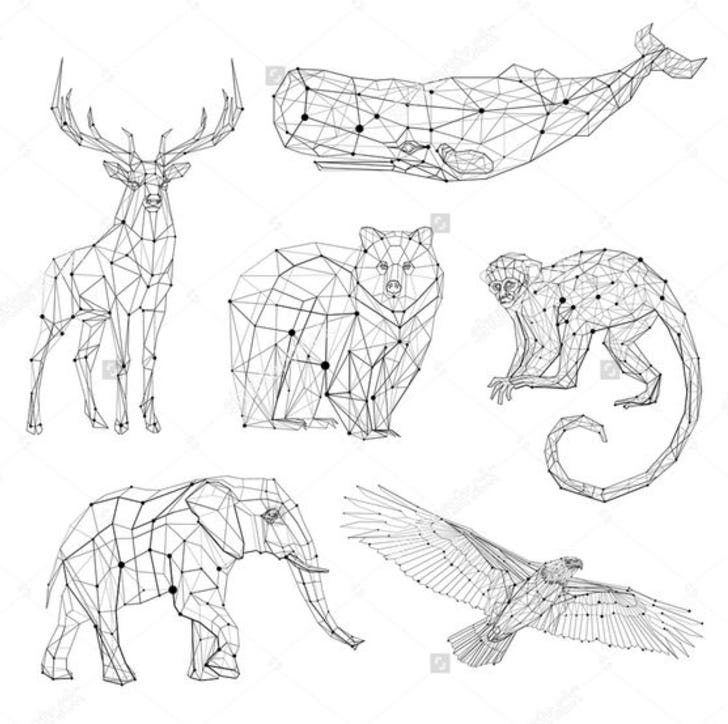
I like to visualise this reference frame as a 3D wireframe that you are mapping onto and around a real thing that you encounter. Reference frames cover much more than just 3D space, but it’s a helpful starting point.
Imagine you are walking through a grassy field on a bright spring morning, the fresh green grass crunching under your feet, when a fluffy little creature crosses your path.

Pause for a moment and try to ponder what is the reality of this moment? What would exist if you did not have words for it?
Before you there is a bundle of around a trillion cells that are interacting with each other in complex ways to keep a multicellular organism alive. There are about ten trillion other bacterial cells that support that organism’s function, in quintillions of complex interactions. This bundle of cells is made up of some hundred septillion (give or take) atoms, with chemical bonds that are vibrating, and water molecules that are hydrogen-bonding and re-breaking around a trillion times per second per atom.
This only describes a small fraction of what is actually happening in reality and yet obviously all of this is much-too-much reality for your brain to handle.
So you put a reference frame over that bouncing bundle of cells and say, “Oh, cute, a rabbit!” (unless you are a hungry hunter-gatherer in which case you might put a different reference frame over it and say “Oh, yum, a rabbit!”).
The 3D-space part of your “rabbit” reference frame might look something like this:
![RABBIT WIREFRAME - 3D model by DTA DESIGN STUDIO (@dtadesignstudio) [036ff88]](https://substackcdn.com/image/fetch/$s_!CZ8X!,f_auto,q_auto:good,fl_progressive:steep/https%3A%2F%2Fsubstack-post-media.s3.amazonaws.com%2Fpublic%2Fimages%2F99a1dc97-2136-4c15-a305-f1605a7cf0ee_1920x1080.jpeg "RABBIT WIREFRAME - 3D model by DTA DESIGN STUDIO (@dtadesignstudio) [036ff88]")
You see that the frame seems to fit the creature. You also see that the creature matches this frame in a bunch of other ways, like its behaviours, movement, and smell. All of these different attributes are part of the overall frame that you call “rabbit” and are themselves links to other reference frames.
By classifying this bit of reality as a “rabbit”, you gain the power to interact with the reality of the creature in useful ways. For example, the reference frame of “rabbit” links to the “fur” reference frame, which links to the “soft” reference frame. And so being the big softie that you are, you might decide to exercise some of your mighty power in the world to bend down and give this cute creature a pat.
Your reference frames are all interconnected into one giant sprawling web of reference frames that is sometimes called your map of the world, or your world view. At any given moment, your brain is deciding which reference frame to apply to the reality that you are encountering before you. Ideally, it is also updating those reference frames to be a better fit with reality.
The reference frame that you use at any given moment can be a better or a worse fit with the underlying reality that sits before you, and a better fit will typically (but only typically, more on this in a later post) give you more power over that reality.
For example, if instead of using the reference frame “rabbit”, you used the reference frame “animal”, it would be a broader frame, one that includes all sorts of different living creatures.
The creature that you see before you would fit within the reference frame of “animal”, but it wouldn’t fit well. The “animal” frame would still be a little useful. That frame would tell you that the creature was alive (unlike a rock), and so it could probably move (unlike a plant), and it could possibly be food (like a rabbit) but could also possibly hurt you (like a bear).
So “animal” is a much more useful reference frame than nothing. You immediately understand that the bundle of cells can move and could hurt or help you, both of which are key to your goals as a living creature yourself. But this reference frame is clearly not as useful as the reference frame “rabbit”.
The reference frame “animal” is like an oversized coat that hangs off the rabbit. The rabbit would fit within it, but so would a lot of other things, and so the reference frame “animal” is less useful to you than the reference frame “rabbit”.
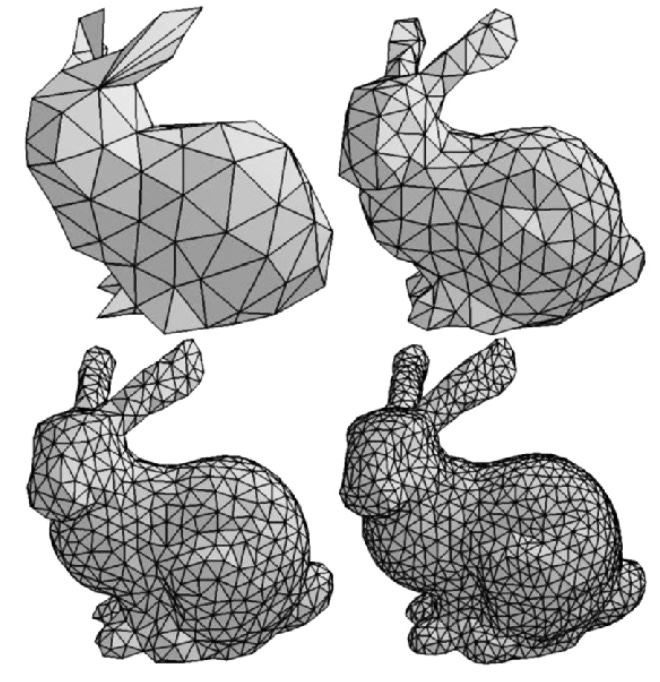
A reference frame can also be a better or worse fit in terms of how fine-grained/detailed it is. A toddler’s reference frame of “rabbit” might look more like the top-left frame in the image below. It is blocky and lacks detail. It also lacks many links to other reference frames.
An adult’s reference frame for “rabbit” looks more like the bottom-right. Tight and closely fitting with reality, and probably with a whole lot of other associated reference frames like “burrow”, “mammal”, and “reproduces quickly”.
The whole point of reference frames is that they give you power over the world. They allow you to orient and make sense without being overwhelmed by stimuli. They enable you to radically simplify reality, down to what is most useful to you.
How you choose to use that power (from patting to hunting) is up to you and your goals.
You have the gift of free will and the ability to step out of the reference frame that you are using and select a different one that will better suit your goals and values. A new frame gives you new forms of power. This act of metacognition and big-picture thinking is what your brain’s right-hemisphere mode of thinking excels at.
A big part of wisdom is asking better questions. Changing perspective helps you to find a new solution to a problem. These are both examples of your ability to change the reference frame that you are using. Like putting down one type of map to pick up another which is more useful for the task at hand. A hiking map won’t help you find gold, and a gold geological map won’t help you find the best hiking trail.
So far in this whirlwind tour of reference frames, we’ve established these ideas:
your reference frames are different from underlying reality
your reference frames are created (totally made up) by you in your head (or in someone else’s head, who then gives the frame to you)
your reference frames simplify a reality that would otherwise be unfathomably complex and overwhelming
once you’ve decided on a reference frame it brings a lot of linked reference frames along with it
your reference frames give you power over the world around you
you have the power to choose what reference frame you will use to understand and interact with reality in a given moment
That’s already a lot to process, but it gets weirder.
Because the weirder thing to think about is that it’s way bigger than rabbits or physical reality. Almost everything you think and talk about is actually you thinking or talking about a reference frame and not the underlying reality itself.
When your brain’s left-hemisphere mode of attention is in charge — and it is for most people most of the time — it is constantly scanning reality around you, and fitting everything into a reference frame of some kind. It’s like Arnie’s vision in Terminator 2, scanning the environment looking for items, which it classifies, and determines if they are helpful or harmful to you.
![Terminator 2 - I Need Your Clothes, Your Boots & Your Motorcycle [HD]](https://substackcdn.com/image/fetch/$s_!PejW!,f_auto,q_auto:good,fl_progressive:steep/https%3A%2F%2Fsubstack-post-media.s3.amazonaws.com%2Fpublic%2Fimages%2Fde8ee7d2-27cc-4d82-9b03-447a00686834_1280x720.jpeg "Terminator 2 - I Need Your Clothes, Your Boots & Your Motorcycle [HD]")
Or, like any modern machine vision classifier.
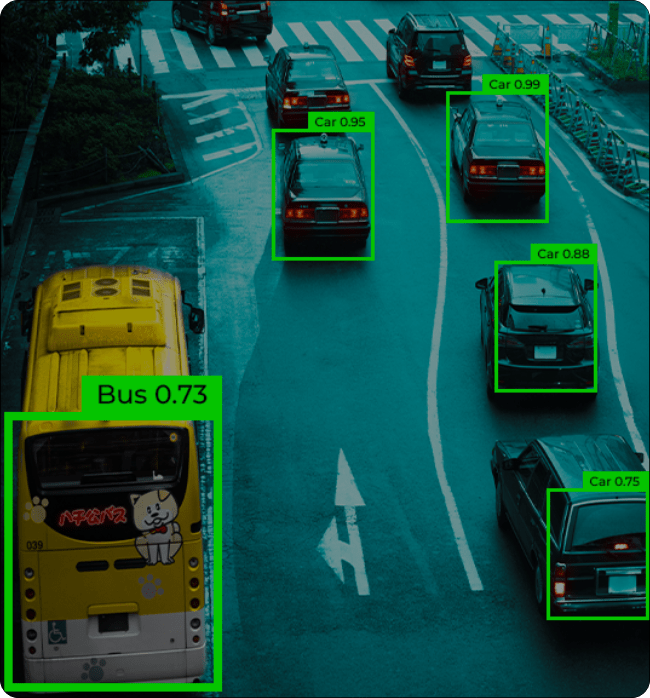
Except your left-hemisphere attention mode is not just scanning moving objects and putting reference frames on them; it’s scanning literally everything around you.
It scans not just the physical world but also every concept like “government” or “family” or “marriage”, every idea like “justice” or “business” or “physics”. All of these are reference frames that someone has made up (invented) to simplify and process the world. These are all areas of reality that you have thrown a reference frame over the top of, like a hunter throwing a net over a wild creature.

Once you really get what reference frames are, you start to realise that they rule everything around us.
Your analytical left-hemisphere mode of thinking processes the world in reference frames, understands the world in reference frames, and communicates to others in reference frames. Each reference frame stacks on top of the next so that a “rabbit” (reference frame) is a type of “mammal” (reference frame), which has four “legs” (reference frame), and lives in a “burrow” (reference frame). You get the idea.
In your left-hemisphere mode, it’s reference frames all the way down.
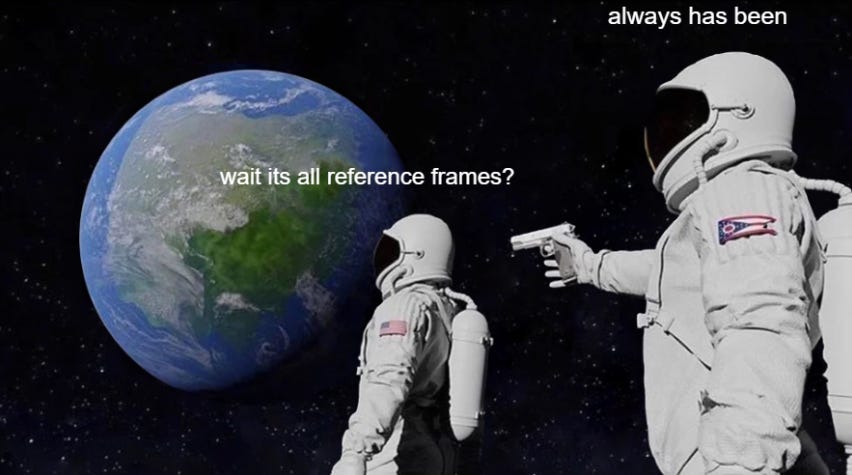
The mountain of knowledge that our civilisation has built up over the past tens of thousands of years is little more than reference frames stacked on top of reference frames.
It’s an incredibly powerful stack. Reference frames enable humans to explore space, treat disease, split the atom, and feed over eight billion people. The point is not that reference frames are bad — they can be incredibly useful and good — it’s that reference frames are not reality.
Humanity had to create reference frames to enable us to communicate anything complex with each other. Each reference frame allows us to grab a bit of reality by the net we have thrown over it and talk about it. If I want to tell you “there are a lot of rabbits in the next valley that we should go hunt”, we each need to have a roughly similar reference frame for what a “rabbit” is. We also need a reference frame for a bunch of other concepts, like “next valley”, “go hunt”, “we”, “should” and “there are”.
Each word, each concept, each idea, is itself a reference frame — a net thrown over a bit of reality to capture it.
If you’re following along this far then you might start to recognise some of this idea because there is a school of thought called postmodernism that sounds very similar, but is oh-so-different. Most people don’t think about postmodernism as a philosophy much. But postmodernism’s beliefs, views, and general vibe have permeated global culture so deeply that it is the default worldview for many people without them even realising it.
Postmodernists don’t use the word ‘reference frame’. They instead say ‘social construct’, but they are talking about the same thing. Postmodernists point out (correctly) that most of human society is built on shared reference frames (social constructs) and that those shared reference frames are just made up, invented words.
If you’ve read Sapiens by Yuval Noah Harari and come away thinking ‘wow, everything is just a story’ then you have tasted postmodernism’s flavour.
But where the postmodernists are wrong — at times horrifically wrong — is that they go on to say that since social constructs are made up then everything is made up, and there is no real reality out there. They suggest that we can choose new constructs and make them whatever we want them to be. Since its all made up then we can just make up anything we want.
But there are two big reasons this is kind of obviously wrong.
The first is that there is a big logical flaw of assuming that because reference frames aren’t real therefore nothing is real. Sure, the Marvel Cinematic Universe is all reference frames, all made up, and isn’t trying to map onto any bit of reality. But most reference frames aren’t the MCU. The MCU and other pure fiction is a tiny subset of the reference frames that we use. Most reference frames, at least the ones you care about, are actually trying to map onto underlying reality.
The idea that ‘everything is a story’ is only true if by ‘everything’ you mean ‘every story’. But that is circular reasoning and much less interesting when it is restated as ‘every story is a story’. Cool story bro.
Not everything is a story. Reality exists, and it would go on existing if we had no story for it.
The second is that the reference frames we create can in fact fit better or worse with underlying reality. We don’t get to just make everything up, because if we do try to make something up that doesn’t fit well with underlying reality, then things will start to go badly for us.
If a restaurant tried to change our social construct around the word “food” to include rocks within the “food” reference frame, then we would quickly have a mouth full of broken teeth.
The love you have for your child is not ‘just a reference frame’ or ‘just a social construct’ any more than the moon is ‘just a social construct’. The moon would still be shining there in the night sky if you did not have a word for it. The love you have for your child would still be beating in your chest, even if you didn’t have a word, concept, or other abstraction for it. Like many mammals, we humans loved our children immensely, long before we had any words for that love. Indeed, long before we had any words for anything at all.
The postmodernists got so lost in the reference frames that they forgot that there is an actual underlying reality that the frames are supposed to map to.
You can step out of these reference frames. Your right-hemisphere mode of attention is expansive, broad, and open. It provides you with the ability to directly relate to reality, to intuit a felt sense of the wonder of reality around you.
Let’s return to the field.
You see the furry, impossibly intricate complex web of biology hopping towards you. But this time instead of throwing a net of logical processing over it and classifying it into a frame you pause and simply observe
You notice a light fog rising off the dewy grass. There is the smell of lavender and earth and cut grass. You feel yourself tense on the balls of your feet, scared to move lest you scare away this visitor. You relax and it hops a little closer. Is it a domestic rabbit? Is that why it’s trusting you? You realise all these thoughts are just more frames. You relax into the present moment, slowly lowering your weight as you feel the earth press up into your feet. You stretch out your hand. The creature cautiously sniffs your hand, then licks. You feel its warm, wet breath on your fingers. You are pulled out of the moment, like waking from a dream you desperately wanted to remain in, as you wonder where your phone is, how you can capture this moment. Then you remember you can never really capture a moment, only be with it. You stop trying to frame everything and just feel. You feel the earth holding you, the gentle breeze on your forehead, the breath of this new friend. You run your hand through its fur, its damp but warm and soft.
With a whoosh, you are expanded by a calm sense of joy. For a moment your net drops and you meet reality itself. For a moment you are free of all frames. For a moment you are free.
I got this analogy from a talk Iain McGilchrist gave on hemispheric theory, though he probably worded the rest of the examples better. If you want to dive into hemispheric theory Iain is by far the best source and biggest influence on my thinking on the topic.
Check out the book A Thousand Brains by Jeff Hawkins for a great overview of this theory. I don’t agree with the theory fully - I think it doesn’t address that we can also sense/attune to/relate to reality directly. But I did find it incredibly stimulating and Jeff is an impressive guy - inventor of the Palm Pilot who has since then dedicated his life to pursuing this neuroscience theory.
No posts
Comments
Nothing yet. Say the first thing.
Sign in to join the conversation.