
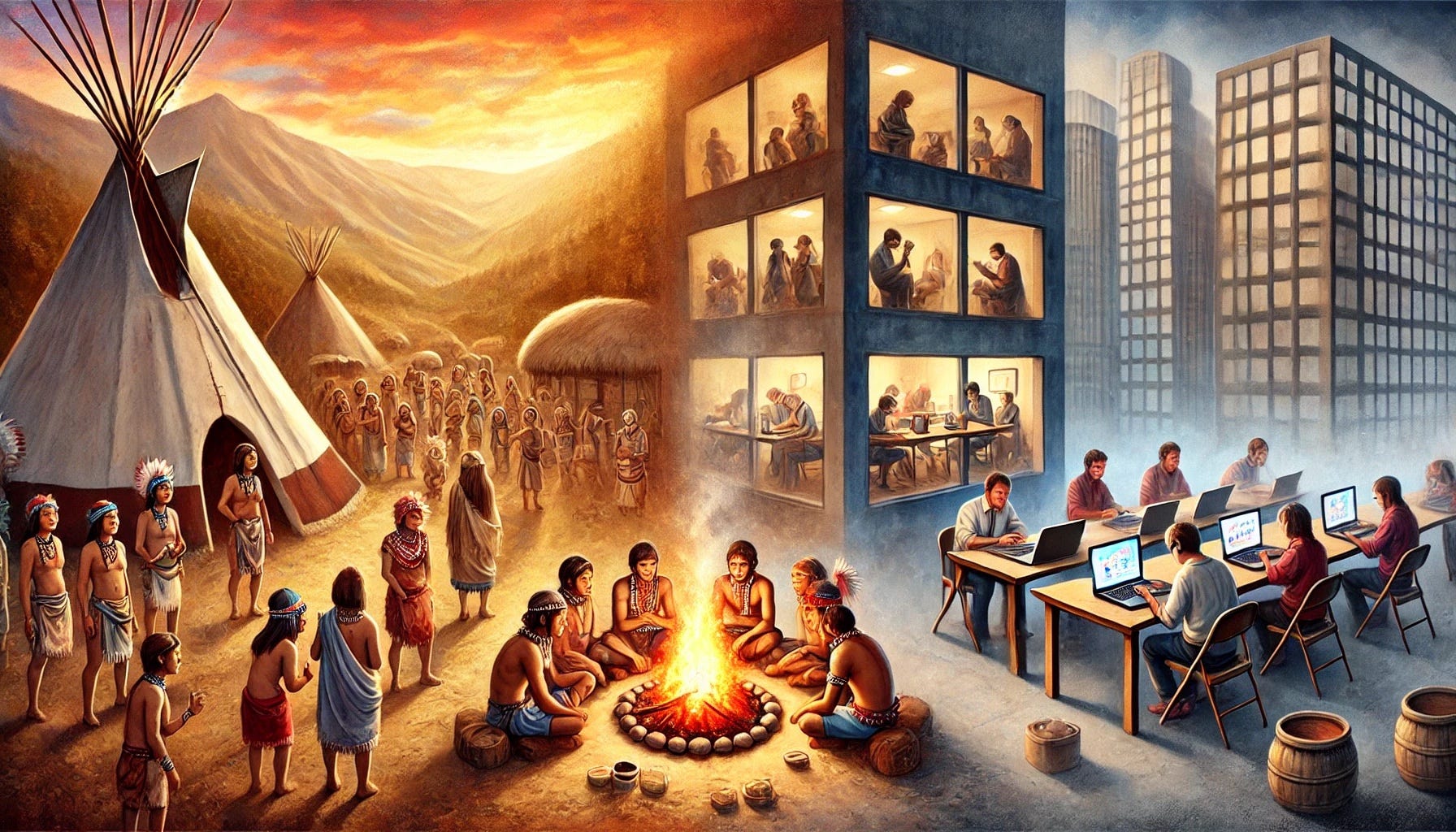
In a world increasingly defined by isolation despite digital connectivity, we find ourselves at a crossroads between two profound worldviews: the individualism that has defined Western society and the collectivism inherent in indigenous cultures. This tension creates both challenges and opportunities as we reimagine what community means in our global society. The wisdom of indigenous perspectives on community building offers striking counterpoints to modern Western living arrangements, yet the deep-seated Western need for personal space and autonomy remains essential to our identity. How might we integrate these seemingly contradictory approaches to create flourishing communities for our future?
This research is very much alive and evolving. I invite all readers to participate in ongoing interviews about your experiences with community and co-living spaces. Your insights are invaluable in understanding how we can balance collectivism and individualism in our modern world. 🌱
Share your experiences through a one-on-one conversation: https://calendly.com/connect-to-kindred
Complete our research survey: https://forms.gle/tU6xH3isjWvBqfLcA
Subscribe to this newsletter for regular insights and updates @CoLiveWell
Please share your thoughts in the comments section below—your perspective may illuminate aspects of this complex topic that research alone cannot capture. 💚
Lynne Twist, co-founder of the Pachamama Alliance and author of "The Soul of Money," identifies a peculiar paradox of our times: "Obviously, COVID was a very difficult time for people... Most people were isolated. Most people couldn't touch, couldn't hug, couldn't be in communion in the way we want to physically." Yet this isolation occurred in an era where we are ostensibly more connected than ever through technology.
This disconnection extends beyond human relationships. "We've separated ourselves from nature," Twist observes, "and that's really a serious blind spot in the human journey right now." Once part of what she calls "the community of life"—not just human life but all life—modern humans have distanced themselves from other species and the Earth itself.
The result is a society that feels increasingly lonely despite unprecedented technological connections. This loneliness appears to be the symptom of a deeper ailment: the loss of genuine community, both with other humans and with the broader natural world.
Cultural psychology has long recognised the distinction between individualistic and collectivistic cultures. Western societies, particularly in North America and Europe, have developed a strong emphasis on individualism—prioritising personal goals, self-reliance, and individual rights. This orientation has yielded remarkable achievements in innovation and creative expression, allowing for the development of unique identities and the freedom to pursue individual dreams.
My research with co-living participants reveals the depth of this individualistic orientation. Among those interviewed, an overwhelming 83.9% explicitly mentioned the need for individual time and space, even within communal living arrangements. When asked why they valued solitude, 73% cited personal well-being and mental health, while 58% mentioned work-life balance and focus. As one participant put it, "If I don't get my alone time, I start feeling overwhelmed. I need space to meditate, to just breathe without being in a shared room."
This need for personal space manifests in concrete ways. In urban co-living setups, participants reported finding it "harder to achieve" solitude’ because spaces were smaller, shared amenities were more crowded, and people felt a stronger social obligation to interact." One community member shared: "Even when I try to have time for myself, I can hear people in the kitchen or the common area. It's hard to switch off completely."
These findings align with broader research on co-living in Western contexts, which consistently highlights the importance of balancing communal living with individual needs. Even in intentionally shared living environments, private rooms or designated quiet zones provide essential retreats for personal well-being and sanity. "I love community, but I also need to focus on my work. Having a space where I can close the door and not be disturbed is essential," expressed one interviewee focused on maintaining work-life balance.
In stark contrast to Western individualism, indigenous cultures around the world tend to emphasize collectivism—prioritizing group harmony, interdependence, and social obligations. As Lynne Twist explains, "In indigenous communities, the health and well-being of the whole community is their highest ethic. And then within that, all the individuals are healthy and well."
This communal orientation extends to language itself. Twist notes that many indigenous languages don't have words for "I" or "me"—only "we" or "us." She observes that "indigenous languages are primarily verbs, which connect. English is rooted in nouns, which separate." Even more telling is that "there isn't a word for 'separate' in indigenous languages," reflecting a worldview where interconnection is the fundamental reality.
This collectivist approach shapes every aspect of indigenous community life. Rather than prioritizing individual achievement or accumulation, indigenous communities focus on shared well-being. "Everything's in common trust," Twist explains. "People don't have things that are 'theirs.'" Community size is intentionally limited—typically around 120 people—ensuring that "every single person" is known and cared for.
If someone falls ill, "everybody's responsible for caring for them." This shared responsibility creates a safety net that modern Western societies often lack, where isolation can lead to individuals falling through the cracks of social support systems.
At the heart of our individualistic culture lies what Twist calls the "scarcity mindset"—the belief that there is never enough to go around. "We believe so profoundly in scarcity," she says, "that it has us terrified of each other." This fear drives competition, accumulation, and the relentless pursuit of "more," often at the expense of genuine connection and community.
Indigenous cultures, by contrast, operate from what Twist calls the "Principle of Sufficiency." This principle recognizes that "there is enough for everyone, everywhere, to have a healthy and productive life." Rather than chasing more of what we don't need, the sufficiency mindset encourages us to appreciate what we already have—and "what you appreciate, appreciates."
This shift from scarcity to sufficiency has profound implications for community building. "When you know you have enough, that you are enough," Twist observes, "all you want to do is share." This natural impulse toward generosity forms the foundation of resilient communities, where resources flow freely among members rather than being hoarded by individuals.
My research with co-living participants reveals an intriguing pattern: Those in nature-based co-living spaces reported higher satisfaction with solitude than those in urban settings. In nature-based communities, solitude was described as "more accessible and fulfilling" because people could "retreat into nature" for walks, outdoor meditation, or quiet work spaces. As one participant shared, "When I need time alone, I just walk into the forest. I never feel trapped here, and the silence helps me reset."
This finding suggests a potential bridge between Western individualism and indigenous collectivism. By reconnecting with nature—a central aspect of indigenous worldviews—Western individuals may find ways to satisfy their need for personal space while simultaneously experiencing a deeper connection.
Several modern community models attempt to navigate this balance:
Intentional Communities: These modern co-living spaces aim to create a sense of belonging while respecting individual needs for privacy and autonomy.
Biophilic Design: Incorporating nature into living spaces addresses both the indigenous connection to the environment and the Western need for personal well-being.
Flexible Communal Areas: Successful co-living designs incorporate adaptable common areas that can be used for both social interaction and individual pursuits.
How might we apply indigenous principles of community health and collective responsibility in our modern contexts? Lynne Twist suggests several key approaches:
Prioritizing community health over individual well-being: Rather than focusing solely on individual needs, foster a mindset of collective responsibility where the overall health and well-being of the community become a top priority.
Cultivating a sense of shared trust and resources: Encourage a culture where people view resources as communal rather than individually owned, promoting sharing and mutual support.
Maintaining manageable community sizes: Strive to keep communities at a scale where everyone knows and cares for each other—similar to the indigenous practice of communities around 120 people.
Emphasizing relationships and interconnectedness: Counteract the tendency toward individualism by emphasizing our relational nature and interdependence with each other and the natural world.
The key lies in adapting these principles to modern contexts while maintaining the core values of community, shared responsibility, and connection.
For communities to thrive, they must foster environments of trust and free expression. Twist suggests several practical steps:
Prioritizing the Common Good: Shifting focus from individual success to collective well-being creates a foundation of trust.
Encouraging Deep Listening: When people feel truly heard and valued, trust naturally flourishes.
Creating Rituals of Connection: Regular gatherings where people can express themselves safely build stronger bonds between community members.
Shifting from Ownership to Stewardship: Viewing resources, spaces, and ideas as shared rather than individually owned nurtures collective responsibility.
Allowing for Vulnerability: A culture of honesty and openness enables people to express themselves without fear of rejection.
These practices help bridge the gap between individualism and collectivism by creating spaces where people can maintain their sense of self while experiencing genuine belonging.
Twist frames our current moment as an evolutionary opportunity. The COVID-19 pandemic, she suggests, was like "morning sickness for a species that's pregnant with a new kind of human being." This evolution involves moving away from what she calls "human supremacy"—the belief that humans are superior to other life forms—toward a more balanced relationship with all life.
Indigenous cultures never subscribed to this belief in human supremacy, instead practicing what Twist calls "sacred reciprocity" with nature. The vision of the Pachamama Alliance, which she co-founded, is to catalyze "an evolutionary leap from dominance to responsibility," fostering a world where humans live in harmony with all life.
This evolutionary leap may also involve bridging the gap between Western individualism and indigenous collectivism—finding ways to honor both our need for individual expression and our fundamental interconnectedness.
My research reveals a hunger for community models that respect individual needs while fostering genuine connection. Among co-living participants, the most common activities people engaged in during alone time were meditation, yoga or exercise, and reflection (61%), followed by reading and creative activities (55%). These practices suggest a desire for inner development that, paradoxically, may enhance rather than detract from community life.
Yet the balance remains delicate. As one participant noted, "Sometimes I feel guilty for not joining group activities, but if I don't take time alone, I burn out fast." This social burnout represents a real challenge for community living in cultures steeped in individualism.
What emerges is the possibility of a new paradigm—one that integrates the wisdom of indigenous collectivism with the respect for individual autonomy characteristic of Western cultures. This integration isn't about erasing cultural differences but about learning from diverse perspectives to create more balanced and fulfilling ways of living together.
Modern co-living spaces that successfully navigate this balance typically provide:
Private spaces for individual retreat and rejuvenation
Communal areas for shared activities and spontaneous interaction
Natural settings that allow for solitude without isolation
Clear communication protocols about boundaries and expectations
Shared rituals that foster connection while respecting individual choice
These features create environments where both individual and collective needs can be met, pointing toward a more integrated approach to community.
As we navigate the tension between individualism and collectivism, several principles emerge as guides for creating more balanced communities:
Honor both autonomy and interconnection: Recognize that genuine community must respect individual needs while fostering meaningful connection.
Slow down to build relationships: As Twist notes, "Things are moving so quickly and with such velocity that we don't take the time that it takes to deepen our relations with each other." Creating resilient communities requires patience and presence.
Reconnect with nature: Bridging the gap between human and non-human communities can help heal the loneliness of modern life.
Shift from scarcity to sufficiency: Replacing the fear-based belief that there's never enough with a mindset of abundance creates the foundation for generosity and sharing.
Create intentional spaces for both solitude and connection: Design physical environments that support both individual retreats and communal gatherings.
By integrating these principles, we can begin to envision and create communities that honor both the indigenous wisdom of collectivism and the Western value of individual expression.
The dichotomy between Western individualism and indigenous collectivism ultimately presents a false choice. The future of thriving communities lies not in choosing one over the other but in finding the balance between them—creating spaces where people can be both fully themselves and deeply connected.
As Lynne Twist reminds us, "When you know you have enough, that you are enough, all you want to do is share." Perhaps this is the key insight that can help us bridge these seemingly divergent worldviews: When we feel secure in our individuality, we naturally turn toward connection and community.
The evolutionary leap before us involves integrating these perspectives to create a new paradigm for community—one that honors our interconnectedness with all life while respecting the unique journey of each individual. In this integration lies the promise of communities that are not just sustainable but truly regenerative, fostering both personal flourishing and collective well-being.
This research journey continues, and your voice matters in shaping our understanding of how to create balanced communities for our shared future. What aspects of individualism and collectivism do you value most? How have you found the balance between personal space and community connection? Your experiences and insights contribute to this evolving conversation about what it means to belong in our modern world. 💭
No posts
Comments
Nothing yet. Say the first thing.
Sign in to join the conversation.