
Breaking news! We interrupt your day to bring you a special public service announcement: Germans are lazy and take too many sick days.
Yes, folks, it is true. Say goodbye to your preconceived notions of stern, hardworking Germans. According to Germany’s resident boomer and past-retirement-age Chancellor Friedrich Merz, "With a four-day week and an exaggerated work-life balance, prosperity cannot be maintained.”1
Since I usually tend to disagree with Merz on various political issues, most of what he says goes in one ear and out the other. But upon reading this statement, I have to admit that I felt personally victimized by Friedrich Merz. You see, I belong to the 31% of employees2 and the 49% of women3 who are employed part-time in Germany. Working part-time while still receiving benefits like health and retirement insurance is one of the reasons I actually like living in Germany. For example, I am paid to work 32 hours a week at my first job, which I leave at any time between 15:00 and 16:00 to go to my second job, which is the unpaid task of taking care of my kids and household.
Furthermore, I, the emancipated working woman that I am, send my kids to Kindergarten while I am at work. Unfortunately, sending my children to spend six to seven hours a day with other snot-nosed, germ-infested kids in an enclosed space is scientifically proven to be the most effective way to spread diseases. And as a result, my kids and I are often sick.
In fact, the average employee in Germany takes 14.5 sick days per year.4 But Merz criticized this, too! Earlier this year, during an election campaign appearance in Baden-Württemberg, Merz asked, “Is that really necessary?”5
Well, what should it be, Friedrich? Should I work to support the stagnant economy and contribute to the German pension system, or should I stay home with my kids so we all don’t get sick?
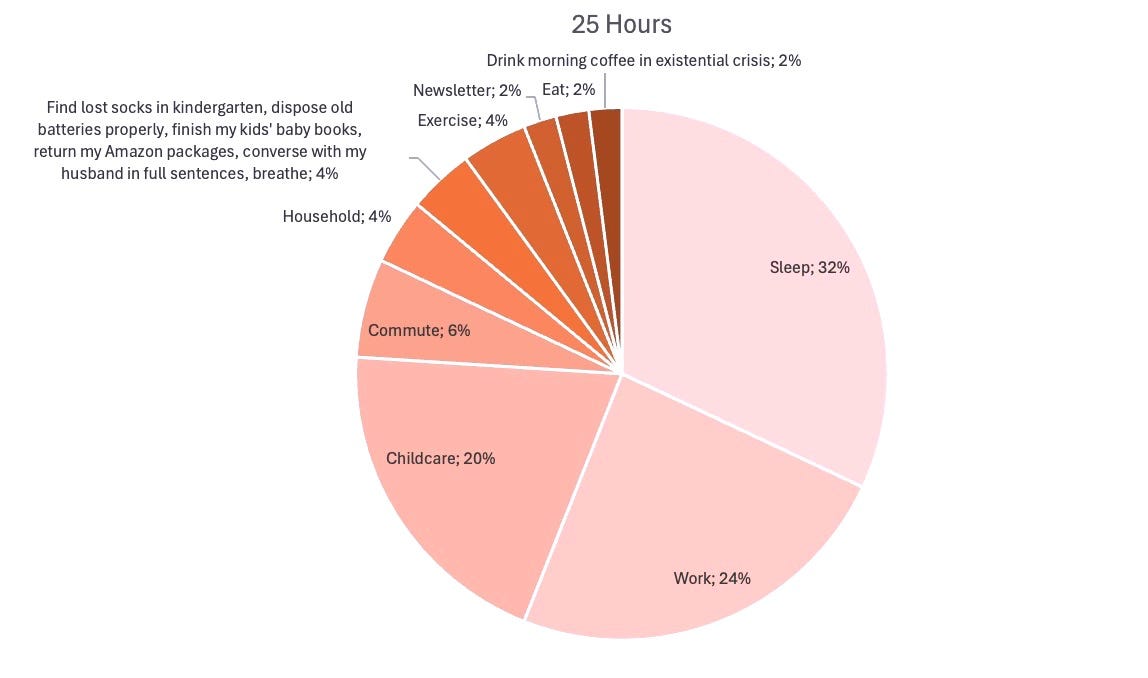
But have no fear. The German government has no shortage of ideas on how to make Germany efficient again. Markus Söder, CSU leader and living proof that working longer does not necessarily yield better results, suggested that everyone should collectively work one additional hour per week.6 This is a great idea. In an equally effective measure, I would like to suggest that the German government simply add one extra hour to each day to increase productivity. Just imagine all the things I could do with one more hour every day…
To be fair, the comments made by Merz about part-time work and sick days are just a fraction of a larger debate going on in Germany right now. In yet another attack on us work-life-balance millennials, conservative politicians briefly introduced the idea of restricting the right to work part-time. Because, apparently, Lifestyle-Teilzeit is to blame.
Let’s take a look at how Teilzeitarbeit is defined in Germany. According to the Gesetz über Teilzeitarbeit und befristete Arbeitsverträge (Law on Part-Time Work and Fixed-Term Employment Contracts), which has been in effect since 2000, part-time work is defined as regular working hours that are shorter than those of a comparable full-time employee. For example, the 32 hours a week that I work are considered part-time, since full-time working hours are set at 40 hours a week. Furthermore, under this law, employees in Germany have the right to request that their contractually agreed working hours be reduced for a certain period of time, i.e. work part-time. However, employers may refuse such requests if part-time work is not feasible for operational reasons.7
And just last month, the economic wing (Wirtschaftsflügel) of the CDU, Merz’s own party, proposed restricting the legal right to part-time work, arguing that such lifestyle choices are hurting the economy. According to the proposal, the shortage of skilled workers in Germany should be offset by only allowing part-time work for specific reasons, such as caregiving responsibilities. Perhaps their whole argument would have come across a bit better if not for the blatantly aggressive, finger-pointing title, “No legal right to a lifestyle of part-time work,” which understandably outraged many people.8 Not surprisingly, the proposal has not yet been adopted.
But why tackle real problems like unnecessary bureaucracy and lack of investment when you can go for an easy fix like Lifestyle-Teilzeit? While those in support of part-time work were clearly upset, it is important to note that German law does not require employees to provide a reason for working part-time. And, quite frankly, the reason doesn’t matter. If someone wants to work part-time and their employer agrees, then what’s the problem?
These allegations led me to wonder about my own so-called part-time lifestyle. Come to think of it, I don’t think I’ve been able to give my fully undivided attention to anything in the last five years since having children. I partly work. I partly raise my kids. I partly get a good night’s sleep. Working part-time, for whatever reason, doesn’t magically conjure up more hours in the day. This leads me to raise a simple question: Do German politicians really understand what they mean when they use the phrase Lifestyle-Teilzeit?

In case anyone was wondering, here is a list of some of the things I do part-time.
Part-time employee
Part-time mother
Part-time wife
Part-time friend
Part-time daughter
Part-time sister
Part-time cook
Part-time cleaner
Part-time grocery shopper
Part-time laundry service
Part-time gardener
Part-time hobby writer
Part-time attempt at regular exercise
Part-time everything
Critics may view working part-time as though it is a matter of simple convenience. But isn’t it funny how, when I add everything up, it seems like a lot more than 100%?
https://www.dw.com/en/cdu-merz-target-lifestyle-part-time-work-in-germany/a-75695779
https://www.destatis.de/DE/Presse/Pressemitteilungen/2024/04/PD24_N017_13.html
https://www.destatis.de/DE/Presse/Pressemitteilungen/2025/05/PD25_175_13.html
https://www.dw.com/en/public-health-businesses-seek-to-cut-sick-pay-in-germany/a-71266243
https://www.deutschlandfunk.de/bundeskanzler-merz-kritisiert-zahl-der-fehltage-wegen-krankheit-100.html
https://www.fr.de/verbraucher/soeder-fordert-eine-stunde-mehr-arbeiten-was-das-fuer-ihre-rente-bedeutet-94115708.html#google_vignette
https://www.gesetze-im-internet.de/tzbfg/BJNR196610000.html
https://www.spiegel.de/politik/deutschland/lifestyle-teilzeit-unions-wirtschaftsfluegel-chefin-bedauert-formulierung-a-d66ffdc9-54e4-4a7d-9d2d-11197db4505f
Comments
Nothing yet. Say the first thing.
Sign in to join the conversation.