
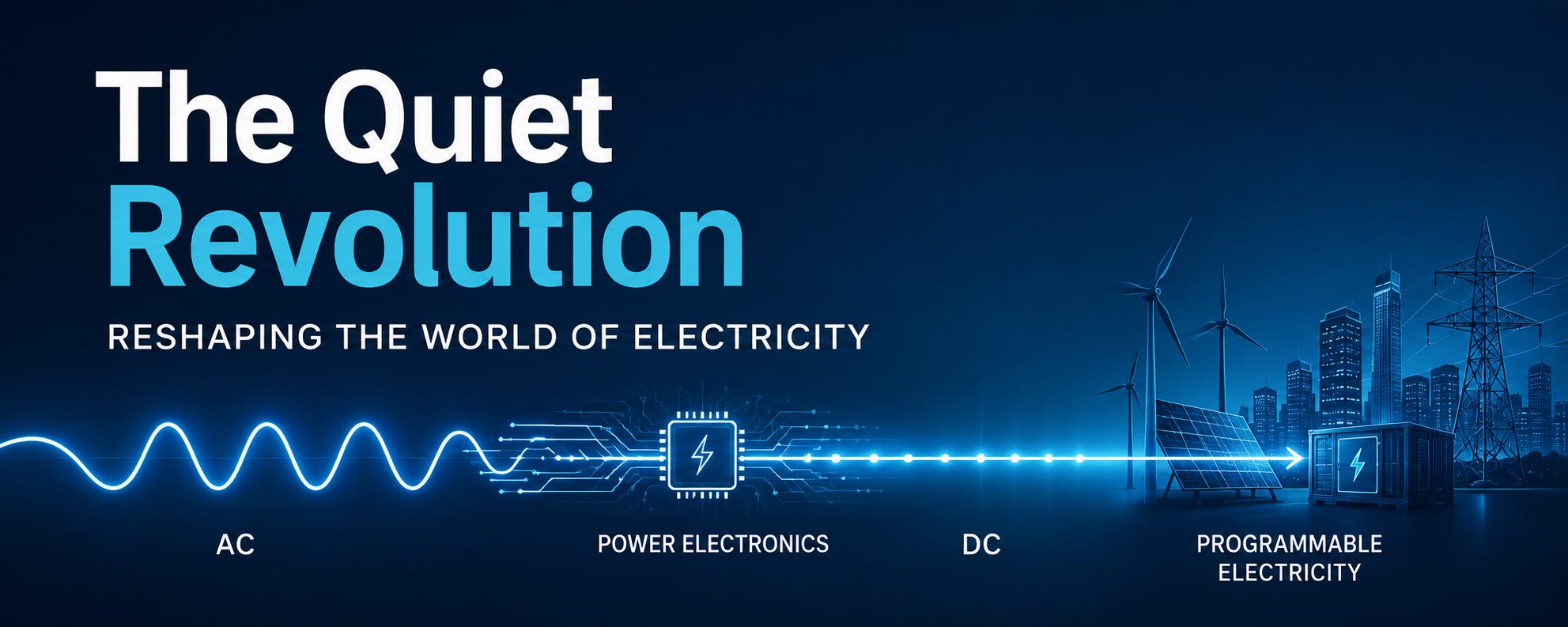
One of the things that has fascinated me over the last few years is that while the world has become obsessed with batteries, AI and data centres, very few people have noticed that another technological revolution is quietly taking place underneath them all. It is a revolution in how we move, convert and control electricity and in my opinion it could fundamentally reshape not only the electricity system but also the worlds of AI, data centres and electrification over the coming decade.
For more than a century our electricity system has been built around alternating current or AC as it is more commonly known. Ever since the AC system championed by Nikola Tesla and George Westinghouse prevailed over Thomas Edison and his DC system in the famous War of the Currents in the late nineteenth century, AC has been the dominant architecture for generating, transmitting and distributing electricity around the world. But today we live in very different times and an increasing share of the devices sitting at the edge of those electricity networks, from LED lighting to smartphones, laptops and televisions, not to mention electric vehicles and data centres, ultimately operate internally on Direct Current or DC power. At the same time, the fastest growing source of new electricity generation in the world, solar, naturally generates DC power, while batteries also store and discharge electricity as DC.
For decades this really did not matter because the benefits of an AC transmission and distribution system far outweighed the costs and losses involved in converting electricity from AC into DC. Today, however, I increasingly believe that the economics are beginning to shift, not because AC has suddenly become obsolete but rather because of the revolution taking place in power electronics.
To understand why this is happening, it is worth first understanding why AC won the original War of the Currents in the first place. AC did not win simply because alternating current was inherently better than direct current. Its great advantage was that transformers made it relatively simple and cheap to change voltage which meant that electricity could be stepped up to very high voltages for efficient transmission over long distances and then stepped down again close to where it was needed. Higher voltages meant lower currents and therefore lower electrical losses and less copper. For most of the twentieth century DC had no equally cheap and flexible equivalent but power electronics are changing that.
Put simply, power electronics allow us to control and convert electricity into whatever form we require. They can convert AC electricity into DC, DC into AC, change one DC voltage into another or change the voltage and frequency of AC power. The charger plugged into the wall for your mobile phone is a simple example. Electricity arrives at the socket as AC but your phone and its battery require DC, so the charger uses power electronics to convert that electricity before it reaches the phone. The same basic process happens inside a data centre, an electric vehicle, a battery storage system or a solar inverter, only at vastly different scales.
This matters because every time we convert electricity from one form to another we lose some of it, usually in the form of heat, which is why your phone charger gets warm. Individual conversion losses may be relatively small but multiply them across billions of electronic devices, millions of electric vehicles and increasingly gigawatts of data centres and suddenly they become very significant. More importantly, every additional conversion stage also requires equipment, cooling, space and ultimately money. The challenge for power electronics is therefore remarkably simple and that is to convert and control electricity while losing as little of it as possible.
And this is where the semiconductor revolution becomes so important. Power electronics use semiconductors as extraordinarily fast electronic switches, turning electricity on and off thousands or even millions of times every second and thereby allowing voltage, current and frequency to be precisely controlled. The better those semiconductor switches become, the smaller, lighter and more efficient the entire electrical system around them can become. For decades silicon has been the dominant material used for these devices, but we are now seeing the emergence of a new generation of so called wide bandgap semiconductors, particularly silicon carbide and gallium nitride, which can operate at higher temperatures and switching frequencies and, depending on the application, at higher voltages while reducing energy losses and ultimately saving money for the end user.
I first began thinking seriously about this revolution almost a decade ago when Tesla became one of the first major carmakers to embrace silicon carbide at scale in the Model 3 inverter. At the time it looked like a relatively obscure engineering decision but it helped improve vehicle efficiency, range and cooling requirements. Looking back, I now think Tesla was showing us something much more important and that was that better power electronics were not simply improving the design of a car but beginning to change the economics of electricity itself.
Today we can see exactly the same trend spreading throughout the electricity system. For very long distance bulk transmission and particularly subsea connections, High Voltage Direct Current or HVDC is increasingly becoming the preferred solution because it can move enormous quantities of electricity efficiently over long distances while also giving grid operators much greater control over power flows. Modern HVDC systems are themselves enormous power electronic systems, using sophisticated converters to turn AC into DC at one end and back into AC at the other.
At the same time solar and battery inverters are becoming cheaper, more powerful and much more sophisticated. The latest generation of so called grid forming inverters can do much more than simply convert electricity from DC into AC. They are increasingly capable of establishing voltage and frequency and providing some of the system stability functions historically supplied by the enormous synchronous generators inside coal, gas, hydro and nuclear power stations. This is a profound change because we are beginning to move from an electricity system whose stability was largely determined by the physical characteristics of huge rotating machines towards one where an increasing amount of that stability can be provided electronically by semiconductors and software.
What is particularly interesting is that the biggest driver of this shift may ultimately not be transport electrification or renewable energy but artificial intelligence. The next generation of AI data centres will require massive amounts of electricity concentrated within very small areas and every percentage point of efficiency gain matters when individual facilities are drawing hundreds of megawatts or potentially gigawatts of power. At the same time AI data centre racks are moving from tens of kilowatts towards hundreds of kilowatts and potentially beyond a megawatt, which makes moving that amount of electricity around a data centre using traditional low voltage architectures increasingly difficult, expensive and inefficient.
And now we have perhaps the clearest evidence yet that the economics are changing. Nvidia is developing an 800 volt DC architecture for the next generation of AI factories, designed to support racks consuming one megawatt or more from 2027. Rather than repeatedly converting electricity through different voltages and between AC and DC as it moves through the data centre, the idea is to make a central conversion from AC into high voltage DC and then distribute that DC electricity much closer to where it is actually consumed.
The reason is simple physics. Power is voltage multiplied by current, which means that if you increase the voltage you can deliver the same amount of power using less current. Lower current means less heat, lower electrical losses and significantly less copper, while eliminating unnecessary conversion stages can further improve efficiency and reduce the amount of electrical equipment required. When you are building an AI data centre containing hundreds of thousands of extremely power hungry semiconductor chips, those savings become enormous.
This is why the technology industry is becoming one of the most important drivers of innovation in power electronics. Electricity availability, efficiency, power density and increasingly the ability to move enormous quantities of electricity around relatively small physical spaces are rapidly becoming constraints on AI development. The semiconductor industry is therefore not only creating the chips that power artificial intelligence, it is increasingly developing the technologies required to power those chips. And this will have consequences far beyond the walls of the data centre. The enormous investment being made by the technology industry will accelerate innovation, increase manufacturing volumes and reduce the cost of power electronics, and those technologies will then spread throughout the wider electricity system. We will see more HVDC, more sophisticated inverters, more electronic transformers, more solid state switching and much more intelligent control of electricity.
Every part of the electricity system will become more electronic and less electromechanical and that, in my opinion, is the really important point because what we are witnessing is not simply the return of DC but instead we are start to make electricity ‘programmable’.
For most of the history of electricity, the behaviour of the power system was largely determined by physics and enormous pieces of electromechanical equipment. Increasingly it will be determined by semiconductors and software. Power electronics will determine how electricity is converted and moved, software will determine how those power electronics behave and artificial intelligence will increasingly optimise the entire system in real time. Which brings us back to the War of the Currents.
The first War of the Currents asked a relatively simple question: should electricity be transported and distributed using AC or DC? AC won because it had an enormous technological advantage in the transformer and because that made it possible to build the large centralised electricity networks that powered the twentieth century.
The second War of the Currents is different. It asks whether in a world increasingly dominated by renewables such as solar as well as batteries, electric vehicles, artificial intelligence and semiconductors whether it still makes sense to keep converting electricity backwards and forwards between AC and DC every time we generate, store, move and use it?
In my opinion, the boundary between AC and DC will become increasingly less relevant because low-cost power electronics combined with increasingly intelligent control systems will allow electricity to move seamlessly between the two. And there is a wonderful irony in all of this. The company that arguably did more than almost anyone else to accelerate this second War of the Currents is Elon Musk’s Tesla, a company named after Nikola Tesla, the man who helped AC defeat Thomas Edison and DC a century ago. This time, however, I do not think there will be a clear winner between AC and DC because the real winner will be the technology that allows us to move seamlessly between them and that is power electronics.
No posts
Comments
Nothing yet. Say the first thing.
Sign in to join the conversation.