
The European Commission’s new draft Electrification Action Plan is an important and welcome step forward and, as Jan Rosenow points out in his excellent analysis, it contains many of the right ideas around accelerating electrification, reducing energy costs, improving competitiveness and strengthening Europe’s energy system. The report recognises something that many policymakers have been slow to appreciate and that is that electrification is no longer simply a climate change and wider environmental goal but an economic and strategic imperative. In that respect the Commission deserves credit for producing a serious piece of work that moves the conversation in the right direction, but if I be honest Europe needs to think and act much bigger!
For most of the last century, oil was the strategic commodity that determined economic growth, industrial competitiveness and geopolitical influence. Countries that secured access to abundant and affordable oil prospered and those that did not struggled. Increasingly, however, that strategic role is shifting towards electricity. The nations that can generate abundant, reliable and affordable electricity will attract industry, artificial intelligence, advanced manufacturing, data centres and investment while those that cannot will find themselves at a growing competitive disadvantage. This is why Europe should not think of electrification simply as an energy policy but also an economic strategy.
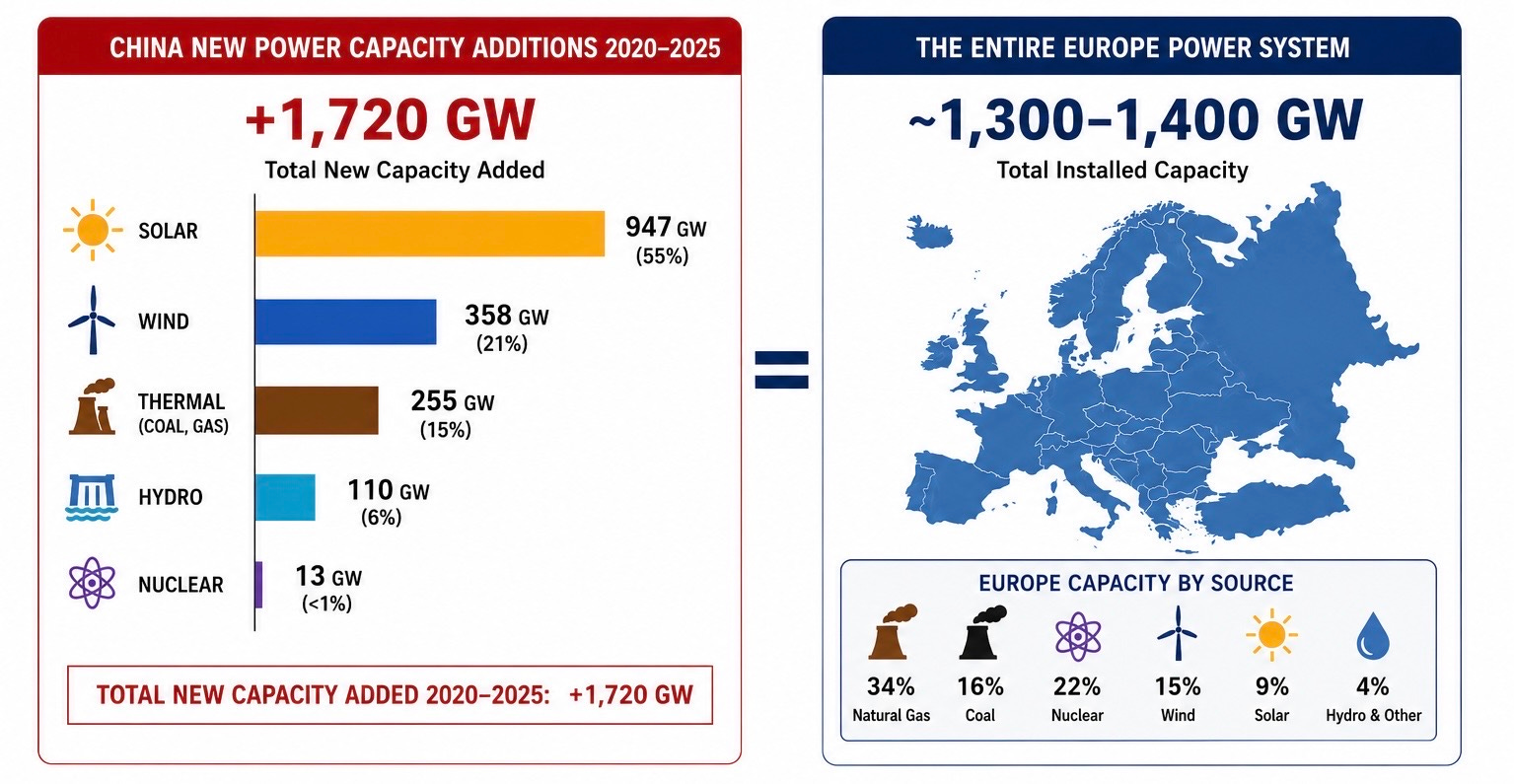
China already understands this and over the last two decades has pursued the most ambitious electrification program in human history. In the last five years alone China has added more than 1,500 GW of new generating capacity, which is broadly equivalent to the entire installed power system of the European Union. It is building the electricity system that will underpin its industrial economy, its transport system, its manufacturing base and increasingly its artificial intelligence ambitions. At the same time, China dominates the global manufacturing of solar panels, wind turbines, batteries, electric vehicles, power electronics and increasingly the broader electricity supply chain including key raw materials. The bottom line is that China has always understood that electricity is not simply an energy issue but a key driver of industrial policy, technology policy, national security policy and increasingly AI policy.
Europe should learn from this experience. The objective should not simply be to increase the share of electricity in final energy demand but instead to electrify as much of the economy as possible and to do so as fast as possible. Industry, transportation, heating and cooling represent the largest remaining opportunities for electrification and should become strategic priorities for European and national government policymakers. However, achieving this goal requires a shift in focus. The challenge is no longer primarily about building generation, an area where Europe has been very successful particularly with regards renewables with an installed base of more than 1000GW. Europe has shown that it can build from scratch a battery park in under 2 years, a utility-scale solar project in 3 years, an onshore wind farm in around 5 years and an offshore wind project in less than a decade. Yet the transmission infrastructure needed to connect these assets can take 15 to 20 years. Case in point Ireland’s North-South Connector which started development in 2006 and Germany’s Suedline which was started in 2012. Both are still not operational and understandably both Ireland and Germany have massive amounts of renewable curtailments as the power cannot be sent to where it is needed. This is why the grid is increasingly becoming the critical path for Europe’s economic future. Without faster investment in transmission and distribution networks, electrification targets will remain aspirations rather than reality.
Yet building more grid infrastructure is only part of the solution. We also need to use the infrastructure we already have more efficiently. Electricity networks are designed to meet peak demand and as a result many network assets are utilised only a fraction of the time. Average utilisation rates across much of the European electricity system are often below 30%, meaning that much of the infrastructure sits underused for large parts of the year. The traditional response has been to build more capacity, but the technologies now exist to make better use of the assets we already have. Smart charging of electric vehicles, battery storage, flexible industrial demand, dynamic pricing and AI-enabled network management can significantly increase utilisation rates and unlock capacity without waiting decades for new infrastructure. Europe’s challenge is therefore not simply to build more grid, but to build a smarter grid that extracts more value from every kilometre of wire, every transformer and every substation. This is why Europe now needs an infrastructure strategy for electrification.
Just as feed-in tariffs, auctions and contracts for difference helped accelerate renewable deployment over the last two decades, Europe should create a new framework designed not only to accelerate investment in electricity infrastructure but also to encourage far more efficient utilisation of existing assets. Today most network operators are rewarded primarily based on the size of their regulated asset base, which naturally encourages the construction of more infrastructure. While Europe undoubtedly needs significant investment in transmission and distribution networks, the future system should reward outcomes rather than simply assets. Network operators should increasingly be incentivised based on metrics such as capacity utilisation, connection speed, congestion reduction, reliability and the integration of flexibility resources. In other words, Europe should increasingly reward network performance rather than network ownership.
This also matters for another reason that receives surprisingly little attention and that is that artificial intelligence will be the defining technology of the twenty-first century, and that it is ultimately an electricity story. Every AI model, data centre, semiconductor fabrication plant and digital service ultimately depends on reliable and affordable electricity. The countries that can provide abundant electricity will attract AI investment while those that cannot will watch that investment go elsewhere which also means that energy sovereignty and AI sovereignty are becoming increasingly intertwined.
This is why Europe should stop thinking about energy policy, industrial policy and technology policy as separate discussions as they are now one and the same, and the future competitiveness of Europe will depend on its ability to build intelligent electricity infrastructure, deploy capital efficiently, attract industrial investment, build AI infrastructure and support the next generation of digital technologies.The Commission’s Electrification Action Plan is therefore an important step in the right direction. It recognises the scale of the challenge and many of the actions it proposes deserve strong support. But Europe should view this not as the destination but as the starting point. The real objective should be much larger and Europe should aim to become the most electrified and digitalised major economy in the world because in the years ahead electricity will become the foundation of economic prosperity, industrial competitiveness, technological leadership and geopolitical power.
No posts
Comments
Nothing yet. Say the first thing.
Sign in to join the conversation.