
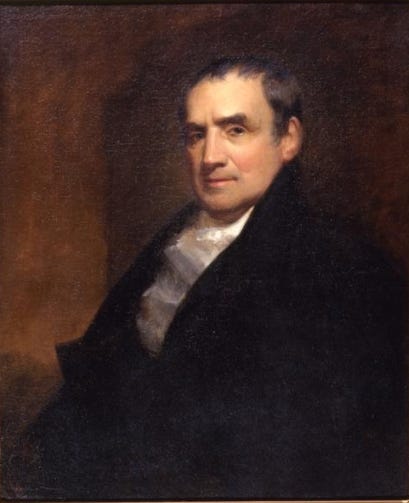
Portrait of Mathew Carey, by John Neagle (1825)
Dr. Smith’s maxim, discussed in our first number, inevitably involves in its consequences, as we have proved, the destruction of those manufacturing establishments, which produce articles that can be purchased ‘cheaper abroad than they can be made at home’; and its necessary result is, to deprive those engaged in them of employment. The doctor, after having inflicted a deadly wound by this maxim, undertakes to provide a sovereign and infallible remedy for the evil which, to do him and his system justice, we shall exhibit in his own words: — It remains to examine how far the prescription applies a remedy to the evil.
I. “Though a number of people should, by restoring the freedom of trade be thrown all at once out of their ordinary emfloyment and common method of subsistence, it would by no means follow, that they would thereby be deprived either of employment or subsistence.”*
[* Wealth of Nations, Hartford, 1818, I. 329.]
II. “To the greater part of manufactures, there are other collateral manufactures of so familiar a nature, that a workman can easily transfer his industry from one to the other.”
III. “The greater part of such workmen, too, are occasionally employed in country labour.”
IV. “The stock, which employed them in a particular manufacture before, will still remain in the country, to employ an equal number of people in some other way.”
V. “The capital of the country remaining the same^ the demand for labour will still be the same though it may be exerted in different places, and for different occupations.”*
[* Idem. 330.]
Here are five distinct propositions, more clear and plain than Dr. Smith’s usually are; but, as we hope to make appear, all highly erroneous, calculated to lead those statesmen astray, who square their system by them, and pregnant with ruin to those nations which may be unfortunate enough to carry them into operation.
The main point is the facility of ‘transferring industry’ from one branch to a ‘collateral manufacture’. All the rest are but subsidiary to, or explanatory of this fallacious assumption.
Two questions arise here, both important, and both demanding affirmative answers, in order to support the doctor’s hypothesis.
I. Are there such ‘collateral manufactures’ as he assumes, in which men, bereft of employment in those departments of manufacture, which are to be destroyed by the doctor’s grand and captivating idea of ‘restoring the freedom of commerce’ may ‘transfer their industry’?
It may be conceded, that there is an affinity between the weaving of cotton and woollen, and a few other manufactures. But this cannot by any means answer the doctor’s purpose. Where will he, or any of his disciples, find ‘collateral manufactures’ to employ printers, coach-makers, watch-makers, shoe-makers, hatters, paper-makers, bookbinders, engravers, letter-founders, chandlers, saddlers, silver-platers, jewellers, smiths, cabinet-makers, stonecutters, glass-makers, brewers, tobacconists, potters, wiredrawers, tanners, curriers, dyers, rope-makers, brickmakers, plumbers, chair-makers, glovers, umbrellamakers, embroiderers, calico-printers, paper-stainers, engine-makers, turners, wheel-rights, and the great variety of other artists and manufacturers? There is no such affinity as he has presumed. And it may be asserted, without scruple, that if, by what the doctor speciously styles ‘restoring the freedom of trade’, five hundred, or a thousand, or ten thousand hatters, shoe-makers, printers, or chandlers, are ‘thrown out of their ordinary employment’, there is no ‘collateral manufacture of so familiar a nature’ that they ‘can easily transfer their industry from one to another’.
We state a case, plain and clear. We will suppose five hundred workmen, and a capital of five hundred thousand dollars, employed in the manufacture of watches, coaches, and silverplate; and that Switzerland, or Paris, or London, fills our markets at such rates as to overwhelm at once all competition, and suppress the manufactories. Where are the ‘collateral manufactures’ to receive those oppressed and forlorn workmen, whose prospects, and those of their families, are thus blasted? Are they to become hatters, or shoemakers, or tailors, or saddlers, or weavers or smiths, or carpenters? Is there a man who can persuade himself into the belief of such an order of things? Is there a man who can persuade himself, that ‘the general industry of the country will not thereby be diminished’? No: and it is a matter of inexpressible astonishment, that such an idea could have ever been hazarded, in a sober and serious book, which has been so long regarded as a guide to statesmen and legislators. It will not stand the test of a moment’s investigation. As well might we suppose, that, on shutting up the courts of justice, and expelling the whole corps of lawyers, they might at once commence the medical profession, without any previous study, as that hatters, or tailors, or shoemakers, or weavers, or watch-makers, or printers, whom the grand system of ‘purchasing commodities cheap’ and the equally grand system of ‘restoring the freedom of commerce’ might bereave of employment, should find those ‘collateral manufactures’ which Dr. Smith has so kindly provided for them.
We explicitly declare, that we are far from charging the doctor with an intention to mislead or deceive. We believe him, like many other theorists, to have been duped by his own system. But be this as it may, we trust it will appear that a more deceptious ground never was assumed. We use strong and unequivocal language; as the political heresy we combat is of the most pernicious tendency; is supported by the most imposing and formidable name in the whole range of political science; and ranks among its disciples a large portion of those of our citizens whose situations as legislators of the Union and of the several states, render their errors on this vital point pregnant with the most destructive and ruinous consequences.
II. Suppose every branch of manufactures, without exception, to have some ‘collateral manufacture’: can those who are devested of employment by ‘restoring the freedom of trade’, ‘transfer their industry’ so ‘easily’ as Dr. Smith supposes?
We answer distinctly. No: or, at all events, on so small a scale, as to be unworthy of notice, in discussions involving the best interests and the happiness of nations. To test the correctness of this opinion, let it be observed, that, in manufacturing countries, all the departments are generally full, and not only full, but there are almost always supernumeraries in abundance: and therefore, had these ‘collateral manufactories’ really existed to the full extent the doctor’s theory would require, and not been ‘fancy sketches’, derived from his fertile imagination, there would be no vacancy, to which the objects of the doctor’s care could ‘transfer their industry’.
Although this appears so plain and palpable, as not to admit contradiction or dispute, yet, on a point of such magnitude, it cannot be time ill-spent, to illustrate it by example.
There are very few branches between which there is so much affinity as the cotton and woollen. And if the doctor’s theory would ever stand the ordeal of examination, it would be in the case of these two ‘collateral manufactures’. Suppose, then, that, by the introduction of East India muslins, four or five hundred thousand persons, (about one-half of the whole number engaged in the cotton manufacture) in England, are at once thrown out of employment. Can any man be led to believe, that they could find a vacuum in the ‘collateral’ woollen ‘manufacture’ to which ‘they could easily transfer their industry’? Fatuity alone could harbour the supposition. They would find all the places full and overflowing.
But the strongest argument against the doctor’s ‘collateral manufactures’ and ‘transfers of industry’ remains. He obviously did not calculate the results of his own system, nor take into consideration, that, to give it free operation, its pernicious effect would not be confined to one or two branches of industry, it would extend to the whole body. The flood of importation would bear down in one mass of ruin, all those articles within his description of being ‘purchased cheaper elsewhere’. What then becomes of his ‘collateral manufactures’, and ‘transfers of industry’, and ‘employment of capital’, and all those elegant, sounding phrases, with which he rounds off his paragraphs? Are they not swept away ‘like the baseless fabric of a vision’, not leaving ‘a trace behind’?
The doctor with great gravity informs us, that ‘the greater part of such workmen are occasionally employed in country labour’. This is most extravagantly erroneous; for of all the manufacturers in England or any other country, there is not probably one in five, that has ever been in his life twelve months at ‘country labour’. Their habits and manners wholly incapacitate them for that kind of employment. A jeweller, a watchmaker, a hatter, a shoemaker, or a weaver, would be almost as unfit for ‘country labour’, as a ploughman, or a gardener, or a shepherd, to make hats or coats.
But suppose for a moment, through courtesy, we admit with Dr. Smith, that all these different manufacturers are so much accustomed to ‘country labour’, as to be adepts at it, what inference is to be drawn from the admission? Did the doctor believe, did he intend the world to believe, or does there live a man who can believe, that when, by the grand project of ‘restoring the freedom of trade’, and ‘buying commodities from foreign countries’, which can supply us with them ‘cheaper than we our-selves can make them’, thousands and tens of thousands of people are ‘all at once thrown out of their ordinary employment y and common means of subsistance’ they can find employment at ‘country labour’? However extravagant and childish the idea is, the doctor must have meant this, or the words were introduced without any meaning whatever.
But it is well known, that except in harvest time, there is in the country no want of auxiliaries. The persons attached to farms are generally, at all other seasons, amply adequate to execute all the ‘country labour’ that is necessary.
Dr. Smith, in order to prove the impropriety of those laws whereby rival manufactures are wholly excluded, observes,
“If the domestic produce can be brought there as cheap, the regulation is evidently useless. If it cannot, it is evidently hurtful.”*
[* Wealth of Nations, I, 319.]
This passage is ambiguous, and written in a style very different from that usual with Dr. Smith, who is as lavish of words as any writer in the English language, and equally lavish of explanations and amplifications. But here he falls into the contrary extreme. He does not condescend to give us the reason for those assertions. He leaves the reader to divine why ‘the regulation is useless?’ why ‘hurtful?’ We must, therefore, endeavour to explore the meaning. It appears to be, if we understand the first sentence of this maxim, that ‘all restrictions or regulations’, in favour of domestic industry, to the exclusion of rival manufactures, are ‘useless’, if ‘the articles can be made at home as cheap’ as the imported ones; because in that case the domestic manufacturer is secure from injury by the competition.
This is extravagantly erroneous. Suppose our woollen manufacturers sell their best broadcloth at eight dollars per yard, and that foreign broadcloth to an immense amount is imported ‘as cheap’. Is it not obvious, that the glut in the market, and the ardent competition between the two parties, would produce the effect which such a state of things has never failed to produce, that is, a reduction of the price below the minimum at which the manufacturer could support himself by his labours, and that he would therefore be ruined?
We now proceed to consider the last proposition:—
“The capital of the country remaining the same, the demand for labour will still be the same, though it be exerted in different places, and in different occupations.”*
[* Wealth of Nations, I. 330.]
To prove the extreme fallacy of this position, we will take the case of any particular branch, in which there are one hundred master manufacturers, each worth ten thousand dollars, forming together, ‘a capital’, of one million, whose business is destroyed by the ‘restoration of the freedom of commerce’ and ‘the purchase of articles from abroad cheaper than we ourselves can make them’.
It is well known that the property of manufacturers generally consists in buildings for their works, machinery, raw materials, manufactured goods, and outstanding debts. The result of ‘the restoration of the freedom of commerce’, on Dr. Smith’s plan, would be to reduce the value of the four first items, from twenty to fifty per cent. and to bankrupt a large proportion of the proprietors.
As this is a point of considerable importance, we shall take a single instance, which is always more easily comprehended than a number, and yet affords as clear an illustration.
We will suppose the case of a tanner, worth thirty thousand dollars; of which his various vats, buildings, and tools amount to ten thousand; his hides and leather, ten thousand; and his outstanding debts, an equal sum. By the inundation of foreign leather, sold, we will suppose, at half price, he is unable to carry on his business which sinks the value of his vats and buildings three fourths, and of his stock one-half. At once, his fortune is reduced twelve thousand five hundred dollars: and thus, with a diminished capital and broken heart, perhaps in his old age, he has to go in quest of, but will not find, a ‘collateral manufacture’, to employ that diminished capital. Analogous cases without number would occur, by the doctor’s system of ‘restoring the freedom of trade’: and let us add, as we can with perfect truth, and we hope it will sink deep into the minds of the citizens of the United States, that throughout this country there are numberless cases equally strong, which no man of sound mind and heart can regard without the deepest sympathy for the ill-fated sufferers, and regret at the mistaken policy which produced such a state of things.
It therefore irresistibly follows, that Dr. Smith’s idea that ‘the capital of the country will be the same’, after the destruction of any branch of manufacture, is to the last degree unsound: and, of course, that the superstructure built on it partakes of its fallacy.
The doctor gravely informs us ‘The tailor does not make his own shoes, but buys them of the shoemaker. The shoemaker does not attempt to make his own clothes but employs a tailor’.*
[* Wealth of Nations, I. 320]
And he adds farther,
“By means of glasses, hot-beds, and hot-walls, very good grapes can be raised in Scotland, and very good wine too can be made of them, at about thirty times the expense for which at least equally good can be brought from foreign countries. Would it be a reasonable law to prohibit the importation of all foreign wines, merely to encourage the making of Claret and Burgundy in Scotland?”*
[* Idem, 320.]
From these positions, to which no man can refuse assent, he deduces the specious, but delusory maxim of ‘restoring the freedom of trade’, which, in fact and in truth, is nothing more nor less than impoverishing a nation, and sacrificing its domestic industry at the shrine of avarice, in order to purchase goods ‘cheaper than they can be made at home’.
But by what process of sound reasoning does it follow, because the shoemaker will not become a tailor, or the tailor a shoemaker; or because it would be folly and madness to exclude foreign wines, in order to introduce the culture of the vine into Scotland, a country wholly unfit for that object; that therefore thousands of men, employed in useful branches of business, diffusing happiness among tens of thousands of workmen and their numerous families, and enriching their country, are to have their usefulness destroyed, their prospects blasted, their workmen with their families reduced to distress, and the country exposed to a ruinous drain of specie?
These maxims are the basis on which a large portion, indeed the most important part of Dr. Smith’s work, depends. If the basis be solid and impregnable, the fabric will stand firm: but if the foundation be sandy, the superstructure will crumble into ruins. We trust we have fully proved that the foundation is thus sandy; and that the necessary and inevitable consequence follows, that the theory itself is wholly untenable and pernicious.
With one more extract, we shall conclude this review:
“That foreign trade enriched the country, experience demonstrated to the nobles and country gentlemen, as well as to the merchants; but, how, or in what manner^ none of them knew! The merchants knew perfectly in what manner it enriched themselves. It was their business to know it. But to know in what manner it enriched the country was no part of their business! The subject never came into their consideration, but when they had occasion to apply to their country for some change in the laws respecting foreign trade.”*
[* Wealth of Nations, I. 303.]
It is hardly possible to conceive of a passage more absurd or erroneous than this. That ‘the nobles, and gentlemen, and merchants’, were ignorant ‘how foreign trade enriched their country’ is almost too ludicrous to be assailed by argument, and is a strong instance of the delirium, in which enthusiastic theorists are liable to be involved, by the ignis fatuus [will-o’-the-wisp] of their visionary views. Can there be found a man, in the wide extent of the United States, to believe that sir Joshua Gee, Josiah Child, Theodore Janssen, Charles King, Thomas Willing, Robert Morris, George Clymer, Thomas Fitzsimons, Governeur and Kemble, and the thousands of other merchants, of equal mind, who have flourished in Great Britain and this country, were ignorant ‘in what manner foreign commerce enriched a country’, without the aid of the Wealth of Nations? It is impossible. Take any man of sound mind, who has followed the plough, or driven the shuttle, or made shoes all his life, and clearly state the operations of trade to him, and he will rationally account for the ‘manner in which foreign trade enriches a country’. Indeed a merchant’s apprentice of six months standing, could not mistake ‘the manner’. Any one of them would at once pronounce, that foreign trade enriches a country, exactly as farmers, planters, or manufacturers are enriched; that is, by the very simple process of selling more than they buy. No nation ever was, none will ever be enriched in any other way. And it is unaccountable that Dr. Smith should have supposed that it was reserved for him to make the grand discovery. The principle was well understood by the merchants of Tyre, 3000 years before Adam Smith was born. And if Spain be one of the most forlorn and wretched countries in Europe, it has not arisen from ignorance of the true principles of political economy, but from neglecting them, as well as the counsels of her wisest statesmen. Ustariz, who flourished about a hundred years since, in that ill-fated and impoverished country, has ably developed the grand principles of that noble science, in a system as far superior to Dr. Smith’s as the constitution of the United States is superior to the form of government of Spain.
[for those wishing to read more of Mathew Carey ‘Addresses of the Philadelphia Society for the Promotion of National Industry’, visit Internet Archive.
No posts
Comments
Nothing yet. Say the first thing.
Sign in to join the conversation.