
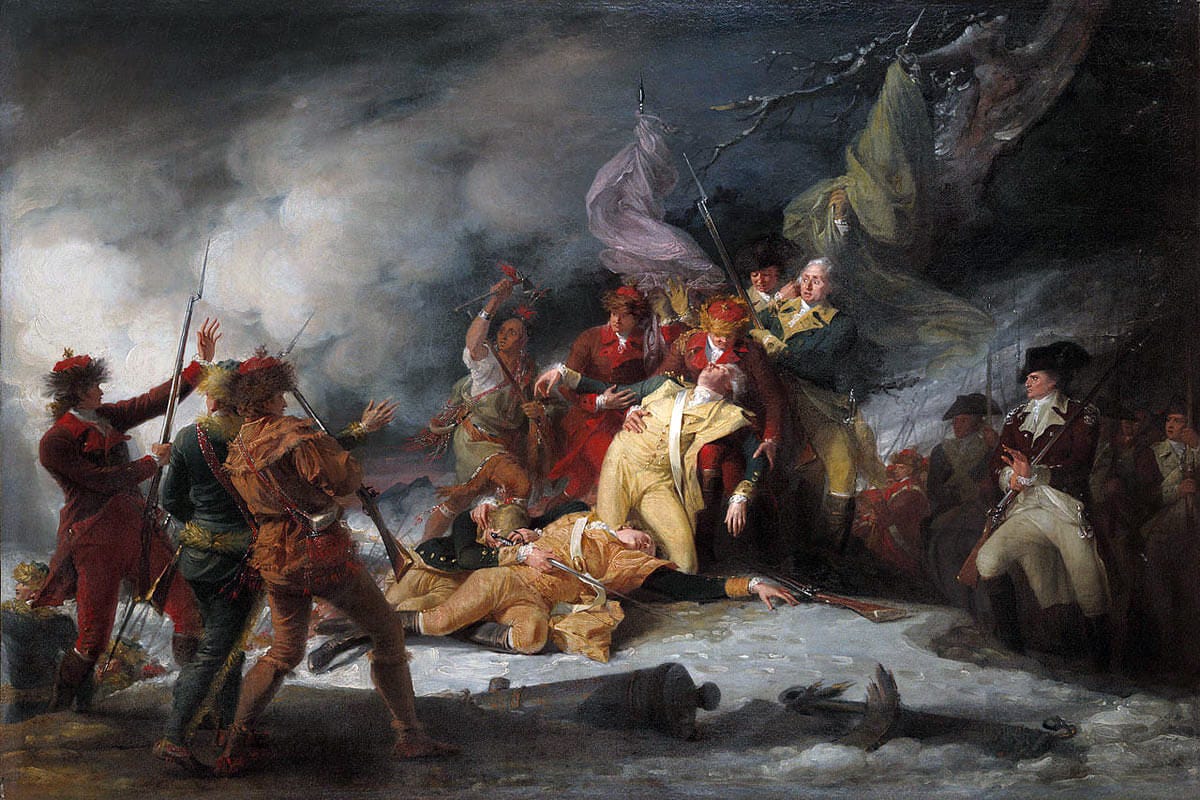
‘The Death of General Montgomery in the Attack on Quebec’, by John Trumbull (1786)
While Laurens(18) and Jay(19) would return to the United States in 1784, Dr. Franklin and Adams(20) would remain in Paris, and would later be joined by Thomas Jefferson(21). After the signing of the definitive treaty in September 1783 and before the arrival of Jefferson at Paris in August 1784 with Congress’s new instructions, Dr. Franklin would at last have some time for leisure.
On July 19th 1783, Dr. Franklin’s soon-to-be 14-year-old grandson, Benjamin ‘Benny’ Franklin Bache, had returned from 4½ years schooling in Geneva to Passy, and Dr. Franklin arranged for a printing apprenticeship for Benny at the press he had established at Passy – replacing his former apprentice, Matthew Carey.(22)
On August 27th 1783 (a week before the definitive treaty was signed) Dr. Franklin, along with another 50,000 onlookers at the Champ-de-Mars, watched as Jacques-Alexandre Charles and the Robert brothers (Anne-Jean and Nicholas-Louis) launched the first hydrogen balloon (made by pouring oil of vitriol onto iron fillings) that flew for about 45 minutes and landed 21 kilometres away.
On September 19th, the Montgolfier brothers (Joseph-Michel and Jacques-Etienne), flew their hot air balloon (inflated with heated air from burning straw) that now carried the first living beings in a basket attached to the balloon – a sheep, a duck and a rooster, before a crowd at the royal palace in Versailles, including the King and Queen. (Dr. Franklin was too ill to attend.) The flight lasted approximately eight minutes, covered 3 kilometres, and obtained an altitude of about 460 metres, before safely landing. (The Montgolfier brothers had launched their first balloon, earlier on June 4th, near Lyons.)
On November 21st, at the Chateau de LaMuette in Passy (200 paces from his back door) Dr. Franklin watched the first manned flight, as Jean-Francois Pilatre and the Marquis d’Arlandes, burning straw in a grate hung underneath the Montgolfier brothers’ balloon, rose 900 metres in the air and flew 9 kilometres, landing in Paris, 17 minutes later. That evening Arlandes and Montgolfier visited Dr. Franklin.
On December 1st, Dr. Franklin, along with 200,000 people at the Tuileries, watched as Charles and Nicholas Robert rose 550 metres in a hydrogen balloon and travelled 36 kilometres, and lasted 2 hours.
On January 26th 1784, Dr. Franklin wrote to his daughter Sarah, concerning some newspapers she had sent him that were full of the Society of Cincinnati. He wrote of his displeasure to ‘form an order of hereditary knights’, ‘of establishing ranks of nobility’ and that membership was to be hereditary. Here he wrote his famous comparison of the eagle and the turkey.
“Others object to the Bald Eagle, as looking too much like a Dindon, or Turkey. For my own part I wish the Bald Eagle had not been chosen as the Representative of our Country. He is a Bird of bad moral Character. He does not get his Living honestly. You may have seen him perch’d on some dead Tree near the River, where, too lazy to fish for himself, he watches the Labour of the Fishing Hawk; and when that diligent Bird has at length taken a Fish, and is bearing it to his Nest for the Support of his Mate and young Ones, the Bald Eagle pursues him and takes it from him. With all this Injustice, he is never in good Case but like those among Men who live by Sharping and Robbing he is generally poor and often very lousy. Besides he is a rank Coward: The little King Bird not bigger than a Sparrow attacks him boldly and drives him out of the District. He is therefore by no means a proper Emblem for the brave and honest Cincinnati of America who have driven all the King birds from our Country, tho’ exactly fit for that Order of Knights which the French call Chevaliers d’Industrie. I am on this account not displeas’d that the Figure is not known as a Bald Eagle, but looks more like a Turkey. For in Truth the Turkey is in Comparison a much more respectable Bird, and withal a true original Native of America. Eagles have been found in all Countries, but the Turkey was peculiar to ours, the first of the Species seen in Europe being brought to France by the Jesuits from Canada, and serv’d up at the Wedding Table of Charles the ninth. He is besides, tho’ a little vain and silly, a Bird of Courage, and would not hesitate to attack a Grenadier of the British Guards who should presume to invade his Farm Yard with a red Coat on”.
Dr. Franklin later drew this letter out into an essay, but the Abbe Morellet, who had translated it, advised that it might offend in France and in America, and so it was never published. Parts of Dr. Franklin’s argument were later incorporated by Mirabeau in his ‘Considerations sur l’Ordre de Cincinnatus’.
Early in 1784, Dr. Franklin wrote in his ‘Remarks concerning the Savages of North America’ that":
“Savages we call them, because their Manners differ from ours, which we think the Perfection of Civility. They think the same of theirs. Perhaps if we could examine the Manners of different Nations with Impartiality, we should find no People so rude as to be without Rules of Politeness, nor any so polite as not to have some Remains of Rudeness…”
He also wrote ‘Information to Those Who Would Remove to America’, for the reason that:
“Many Persons in Europe having directly or by Letters, express’d to the Writer of this, who is well acquainted with North-America, their desire of transporting and establishing themselves in that Country; but who appear to him to have formed thro’ Ignorance, mistaken Ideas & Expectations of what is to be obtained there; he thinks it may be useful, and prevent inconvenient, expensive & fruitless Removals and Voyages of improper Persons, if he gives some clearer & truer Notions of that Part of the World than appear to have hitherto prevailed…”
On April 26th, the Journal de Paris published Dr. Franklin’s ‘An Economical Project’, a satire on the discovery that the sun gives light as soon as it rises! And if the people of Paris would wake when the sun rose instead of at noon, they could save money by not having to burn so many candles at night.
On March 12th, the king appointed a commission to investigate the latest fad, Friedrich Mesmer’s theory of animal magnetism. The commission was composed of 4 doctors from the Faculty of Paris, and of 4 members of the Academy of Science, including Dr. Franklin, Le Roy, De Bory, Bailly and Lavoisier. Regarding the delusion of animal magnetism, Dr. Franklin wrote that:
“That Delusion may however in some cases be of use while it lasts. There are in every great rich City, a Number of Persons who are never in health, because they are fond of Medicines and always taking them, whereby, they derange the natural Functions, and hurt their Constitutions. If these People can be persuaded to forbear their Drugs in Expectation of being cured by only the Physician’s Finger or an Iron Rod pointing at them, they may possibly find good Effects tho’ they mistake the Cause.”
Several of the tests were carried out at Dr. Franklin’s house in late April and early May. But, Dr. Franklin, his grandsons and his secretary felt nothing. The commission’s Rapport was made to the king on August 11th with the unanimous opinion that no such thing as animal magnetism had been shown to exist, and all the observed effects of the public séances were due to familiar causes – excitement and imagination, and the belief, among the patients and the healers, that there had to be convulsive states before there could be a cure.
On August 18th, Dr. Franklin wrote to Lord Howe to thank him for the receipt a copy of Captain Cook’s ‘Voyage to the Pacific Ocean’ -
“in consideration of my Good-will in issuing Orders towards the protection of that illustrious Discoverer from any Interruption in his Return home by American Cruisers… which was no more than a Duty to Mankind”.
On August 6th, Thomas Jefferson arrived in Paris to join Adams and Dr. Franklin, a reunion of the three men who had drawn up the Declaration of Independence, and, with instructions from Congress, for the purpose of negotiating treaties of commerce with Russia, the Court of Vienna, Prussia, Denmark, Saxony, Hamburg, Great Britain, Spain, Portugal, Genoa, Tuscany, Rome, Naples, Venice and the Ottoman Porte.
In response to letters from Henry Laurens (of November 3rd and 16th 1784), Congress had resolved on March 10th 1785, to appoint Jefferson as the minister plenipotentiary to France and ‘complied with the request of Dr. Franklin for leave to return to this country’. On May 2nd 1785, Dr. Franklin received the good news.
But Dr. Franklin’s health had greatly deteriorated, and he was at the mercy of the stone in his bladder – increasingly he was prone to painful and urgent voiding of the bladder; he could feel the weight of the stone as he turned in bed; he was listless; he was comfortable only when prone; he could neither walk nor ride, unless in a litter. He was not sure that he could bear the motion of a ship.
Dr. Franklin had earlier wondered whether the balloon might become a common carriage and relieve him from the painful jolting of the pavements. On January 7th 1785, John Jeffries, a Boston-born Loyalist and surgeon-major in the British army, along with Jean-Pierre Blanchard, made the first balloon flight across the English Channel, in under 3 hours. Jeffries, a friend of William Franklin, carried with him a letter from William to his son, Temple Franklin, the first airmail letter. Pilatre now proposed a Calais to Boston balloon flight – a crossing of the Atlantic he boasted he could make in 48 hours.
But Dr. Franklin’s desire to return home was so strong, that he was willing to travel to Havre to find out. If he could not, then he would have to be put ashore and stay in Europe for the rest of his life, never again to see America. Before he left, he received a parting gift – a portrait of Louis XVI encircled with 408 diamonds. Because of a severe spring drought, travel by water down the Seine was impossible. The Duke of Coigny lent him a mule-drawn royal litter, in which he could sit or recline on a mound of pillows. His 2 tons of baggage – 23 cases of books, 4 of scientific instruments, his dismantled printing press with printer’s type, and supplies of Passy water – 128 boxes in all, was transported by horse-drawn barge to the coast.
On the afternoon of July 12th, Dr. Franklin left Passy in his royal litter, with Temple and Benny following in a carriage, reached Havre on the afternoon of July 18th, and waited 4 days for a packet to carry them to Britain. On the morning of the 22nd until the morning of the 24th, they crossed the English Channel, landing at Southampton. On the 24th, Dr. Franklin had a chilly reunion with his son, William, who sold his vast New Jersey properties to Temple for 48,000 livres, that Dr. Franklin paid for. On the 27th, the London Packet arrived, and that evening, Dr. Franklin and his two grandsons set sail for America. As interested in the Gulf Stream as ever, he made daily records of the temperature of the air and water. And in a long letter to Le Roy, he wrote his Maritime Observations. On September 14th, they arrived at Philadelphia and a cheering crowd carried him to his home. The three of them had left Philadelphia in October 1776, shortly after Dr. Franklin had met with Howe and rejected the ‘so-called’ British peace offer, after which the shooting war in America really began, and were now returning home at the end of the war, having been away almost 9 years – Temple was now 26, Benny was 16, and Dr. Franklin was soon going to be 80 – perhaps feeling a little bit like Rip Van Winkle. But there would be no retirement for the good doctor.
On October 11th, Dr. Franklin was elected to the Supreme Executive Council, and on the 17th, the council voted him to be President. When the General Assembly met on October 29th, he was elected President of Pennsylvania. He would be re-elected as President in November 1786 and in October 1787. He also resumed the chair at the American Philosophical Society (that had elected him as president year after year during his absence in Europe). In February 1787, he founded and became president of the Society for Political Enquiries that sought to study political science as the Philosophical Society studied the natural sciences. In 1787 he became president of the Pennsylvania Society for Promoting the Abolition of Slavery. (One of the last things he was to write was ‘On the Slave Trade’.)
In March 1787, he was one of the delegates chosen to attend the Constitutional Convention, and he was able to be present every day from May 25th until it finished on September 17th. He was elected to the grand committee (one delegate from each state) to devise a compromise to the division over proportional representation by population or equal representation by state. On his motion, the committee arrived at a solution.
His speech at the end of the convention, urging the constitution’s signing, was much published and much used in the debate over ratification.
“I confess that there are several parts of this Constitution which I do not at present approve, but I am not sure I shall never approve them; for, having lived long, I have experienced many instances of being obliged by better information or fuller consideration to change opinions, even on important subjects, which I once thought right but found to be otherwise… In these sentiments, Sir, I agree to this Constitution with all its faults, if they are such; because I think a general government necessary for us, and there is no form of government but what may be a blessing to the people if well administered… I doubt too whether any other convention we can obtain may be able to make a better Constitution. For when you assemble a number of men to have the advantage of their joint wisdom, you inevitably assemble with those men all their prejudices, their passions, their errors of opinion, their local interests, and their selfish views. From such an assembly can a perfect production be expected? It therefore astonishes me, Sir, to find this system approaching so near to perfection as it does… Thus, I consent, Sir, to this Constitution because I expect no better, and because I am not sure that it is not the best”.
After finishing his third term as President of Pennsylvania in October 1788, he retired from public affairs. During the last year of his life, he was confined to his bed and was prescribed laudanum by his doctor to alleviate his pain, which had increased from an empyema in his left lung that made breathing difficult. When the empyema burst, he passed into a coma. At about 11 p.m. on the evening of April 17th 1790, with his grandsons Temple and Benny watching, Dr. Franklin passed away quietly.
It was said of Dr. Franklin, that “he has an incessant vein of humour, accomplished with an uncommon vivacity, which seems as natural and involuntary as his breathing”.
And as he himself said:
“all among us may be happy who have happy dispositions, such being necessary to happiness even in paradise”.
Footnotes for chapter 63:
(18) After trying to recover his health by treatments at Bath, Laurens finally left Britain on June 6th 1784 and arrived at New York on August 3rd.
(19) After spending some time at Bath to recover his health, Jay returned to Paris, and left there on May 16th 1784 and arrived at New York on July 24th.
(20) After recovering from a violent fever, Adams travelled to London to try to recover his health, then returned to the United Provinces to try to negotiate a new loan and while there he negotiated a draft treaty with Prussia, and then returned to Paris where he was joined by his wife and daughter, who had travelled from America.
(21) On May 7th 1784, Congress would elect Jay to be Secretary of Foreign Affairs, and would elect Thomas Jefferson as minister plenipotentiary, to replace Jay.
(22) In 1781, in Ireland, Matthew Carey anonymously wrote a pamphlet entitled ‘The urgent necessity of an immediate repeal of the whole Penal Code against the Roman Catholics’. A sizable reward was offered for the disclosure of the author’s identity and lawyers were hired for his prosecution. Carey was forced into hiding, slipped out of Dublin, and sailed to Paris with a letter of introduction to a priest, who would introduce him to Dr. Benjamin Franklin. The 21-year-old Carey worked as Dr. Franklin’s apprentice at his small press in Passy. Afterwards, Carey became an apprentice in the Paris printing firm of Francois Didot. By 1783, the threat of prosecution had blown over and Carey returned to Ireland and became editor of the ‘Freeman’s Journal’ – the mouthpiece of the Volunteer movement. In October 1783, Carey’s father provided Mathew and his younger brother, Thomas, with the funds to start a newspaper, the ‘Volunteer’s Journal’, with Mathew was the editor. In the Journal, Carey railed against British political and economic policies oppressing the Irish and promoted a protective tariff for fabric imported from England. In April 1784, Carey published two controversial depictions of John Foster, slated to become the Irish Chancellor of the Exchequer, and he also published an article predicting the French would invade Ireland with the help of the Volunteers. The government offered a bounty for Carey’s arrest. The Dublin police arrested him and incarcerated him in Newgate Prison, but when Parliament adjourned it no longer had the power to detain Carey and the Lord Mayor of Dublin, a civil authority, released him. Carey then decided to emigrate to America, choosing Philadelphia because the ‘Pennsylvania Packet’ had run a story about his arrest in Ireland, and he arrived in America on November 1st 1784. In New York, Carey met Lafayette, who provided him with four 100 dollar bank notes to buy a printing press. Lafayette had earlier met Carey in Passy when he was an apprentice to Dr. Franklin and he had sought Carey’s assessment of the political situation in Ireland.
[next week - In Defence of Benedict Arnold’s Left Leg]
*************
For those who may wish to support my continuing work on ‘The Unveiling of Canadian History’, you may purchase my books, that are available as PDFs and Paperback (on Amazon)
Volume 2 – Forlorn Hope – Quebec and Nova Scotia, and the War for Independence, 1775 – 1785.
Volume 3 – The Storming of Hell – the War for the Territory Northwest of Ohio, 1786 – 1796.
And hopefully,
Volume 5 – On the Trail of the Treasonous, 1804 – 1807.
may also appear in print, in the near future, while I continue to work on :
Volume 6 - Through the Perilous Fight, 1807 – 1814.
No posts
Comments
Nothing yet. Say the first thing.
Sign in to join the conversation.