
Welcome to the 165th Edition of the Geowizard Biweekly Global Business Update –
Three days from now, on July 24, the tariff regime that’s governed nearly every U.S. import since February 2026 quietly expires. Most people assume that means relief. It doesn’t. Section 122’s emergency 10% global surcharge was always temporary. These were capped in rate, capped in duration, no path to extension. What’s replacing it isn’t. The proposed Section 301 tariffs on roughly 60 countries carry no such ceiling, and once finalized, they’re the new baseline, not a pause. For any business planning around “when tariffs come down,” this week is the moment to retire that assumption.
Layer on the Strait of Hormuz tensions pushing Asian LNG prices to four-month highs, containers surging into U.S. ports as importers front-run whatever rate lands next week, and you have the actual planning environment for the second half of 2026 which is not the one we hoped for in January.
This edition covers Africa, Argentina, Canada, China, the European Union, Indonesia, Malaysia, the Philippines, Spain, the United Kingdom, the United States, tariffs, natural gas, container and air shipping, global urbanization, global business travel, the Panama Canal, nuclear power and, of course, AI.
None of which stops the global franchise sector from moving. McDonald’s is the world’s most valuable restaurant chain. Five Guys is finally opening in Beijing, Century 21 just planted its flag in Dubai, and Greg Flynn, now the world’s largest single fast-food franchisee, is still buying. Global expansion doesn’t wait for policy certainty. It adapts to whatever’s in front of it and gets on about doing business and continuing to grow around the world.
In my up-front quotes for this edition, Churchill knew it a century ago with oil, and Drucker said the quiet part out loud decades later: certainty comes from variety, not from clinging to yesterday’s logic. That’s the operating instruction for us global businesspeople for now in 2026.
My book review for the edition is Chokepoints — American Power in the Age of Economic Warfare, by Edward Fishman. For decades, sanctions were a blunt instrument reached for only when diplomacy failed. Edward Fishman, a former State Department and Treasury sanctions official, argues that’s no longer true.
Global Franchise & Brand Sector News: Century 21®, Church’s Texas Chicken®, Five Guys®, Great Greek Mediterranean Grill®, KFC and McDonald’s® among others. And cultural relevance has become the restaurant industry’s North Star.
Paid subscribers to the Geowizard Substack biweekly global business update newsletter have access to all the content listed above… and much more in this edition.
The mission of this newsletter, started in March 2020 during the COVID business slowdown, is to use trusted global and regional information sources plus our network of in-country Associates to update our subscribers on key global and local trends that can impact the success of their businesses at home and abroad. We do not get involved with or report on politics!
This newsletter has been assembled, edited and curated by William (Bill) Edwards who has more than five decades of experience helping companies enter and scale in international markets. He has guided over 50 brands across multiple sectors into more than 35 countries. Bill’s experience includes living and working in 7 countries, and leading projects across more than 50 countries worldwide. Contact Bill with questions, comments and contributions. Bedwards@edwardsglobal.com, +1 949 375 1896
Please note that to create this newsletter we subscribe to almost 40 international information sources. The live links in each section may take the reader to a paid webpage.
First, A Few Words of Wisdom From Others For These Times
“Safety and certainty in oil lie in variety and variety alone.”, Winston Churchill, arguing to shift the Royal Navy from coal to oil in 1913.
“The greatest danger in times of turbulence is not the turbulence itself, but to act with yesterday’s logic.”, Peter Drucker
“History shows us that a crisis of this magnitude is also a catalyst.”, Masato Kanda, President of the Asian Development Bank, April 2026

“ReINVENT 26 II — Next Practices for Growth, Tech, Talent, Financial and Market Leadership – Once again your Geowizard Editor will be delivering the global business update to a packed room of ~200 C-suite executives, academic leaders, technologists, talent executives, and market analysts navigating the pivotal shifts of 2026–2027 on Thursday, August 6, 1:00–5:00PM California time, at the University of California, Irvine’s Beall Applied Innovation, followed by a hosted reception through 7:30 pm.
This session bookends February’s ReINVENT26 summit, giving attendees a chance to measure earlier strategic guidance against what’s actually happened since — a natural fit for a global update given how much international disruption has driven the last six months. My remarks will connect directly to the day’s broader themes: market dynamics under uncertainty, leadership adaptation, and finance and operations trends, alongside UC Irvine Professor Christopher Schwarz’s economic forecast.
Beyond the content, it’s a curated room built for exactly the kind of candid, cross-sector dialogue a global perspective depends on. Just as important is the room itself: senior leaders working through the same pressures. AI adoption without losing talent trust, growth strategy under global uncertainty, and leadership alignment as the international playbook keeps rewriting itself making this conference as much about strategic relationships as content.
Please click on the QR code above or go to the link below to register to join us for very important diverse business updates across many sectors in these ‘exceedingly interesting times’ that we find ourselves in.
https://lnkd.in/ezyptA5q
Interesting Data, Articles and Studies
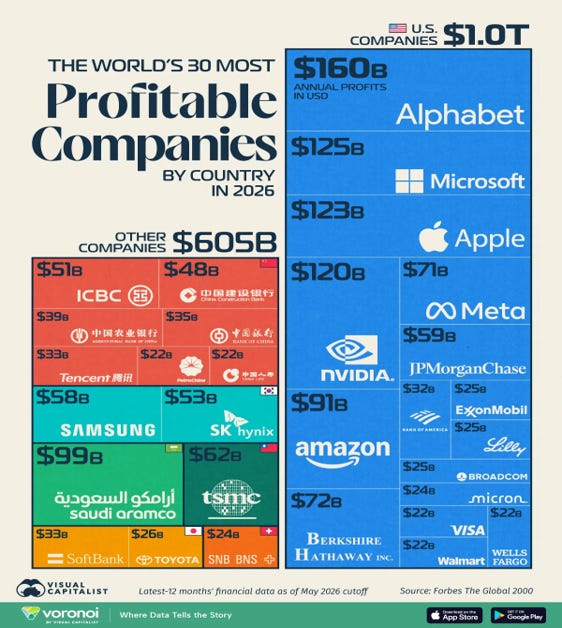
“The World’s Most Profitable Companies, by Country - Over half of the 30 most profitable companies worldwide are based in the United States, with $1 trillion in annual profits. Alphabet is the world’s most profitable company as of 2026, with $160 billion in annual profit. Saudi Aramco’s $99 billion of profits is more than any other non-American firm worldwide. This visualization uses the latest Forbes Global 2000 list to rank the world’s 30 most profitable companies as of 2026 based on their most recent 12-month financial results. Beyond the United States, top firms are overwhelmingly located in Asia, although the Swiss National Bank ($24 billion), Switzerland’s central bank, also makes an appearance.”, Visual Capitalist & Forbes, July 6, 2026
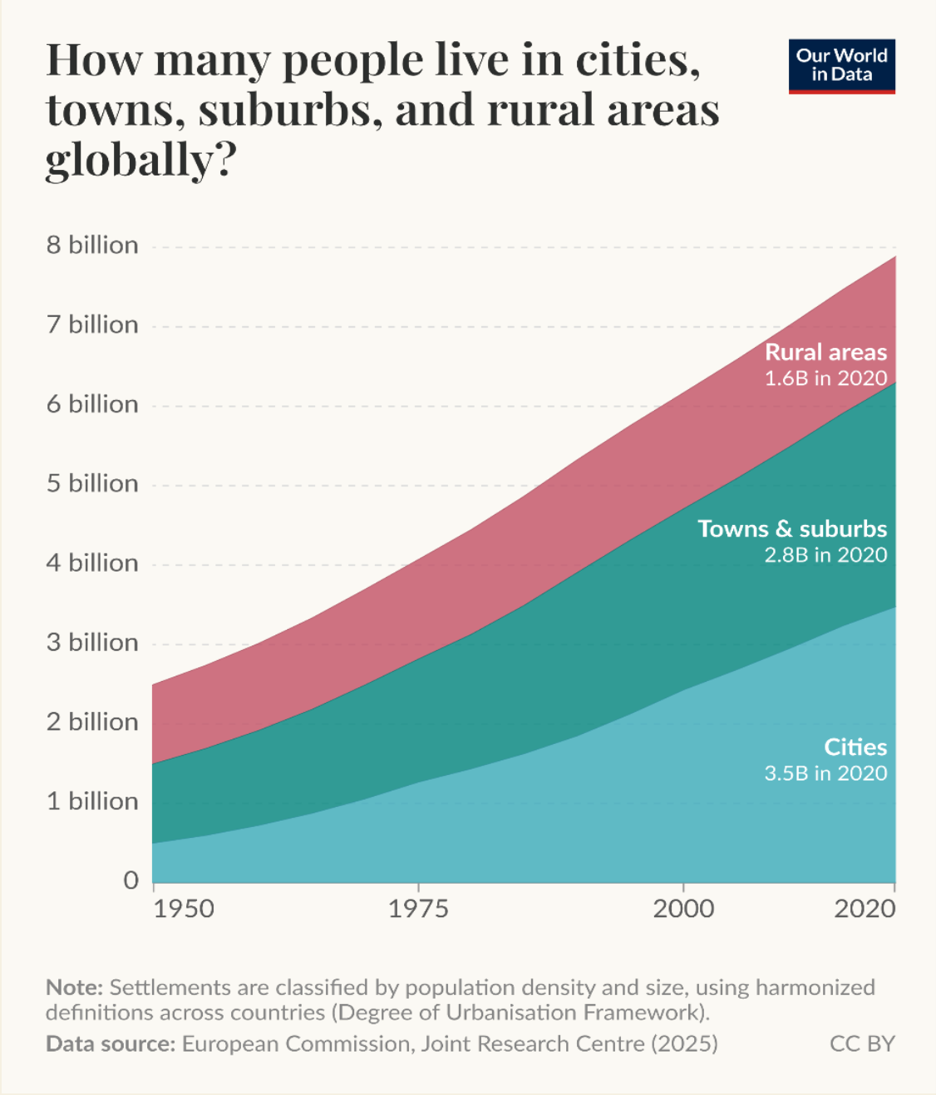
“Urbanization - The world today is predominantly urban. Around 80% of people live in cities, towns, and suburbs rather than rural areas. Urbanization is the migration from rural areas into towns and cities. Over the past century, billions of people have made this move. The world’s population is spread across a range of settlements, from isolated houses and farms to megacities and everything in between. Tracking these patterns is important because where people live shapes many aspects of their lives: how they work and move around, who they interact with, and the opportunities and risks they face. It also shapes what governments need to provide — from housing and transport to healthcare and schools. In 2020, around 3.5 billion people lived in cities, another 2.8 billion in towns and suburbs, and around 1.6 billion in rural areas. This means that cities are home to 44% of the global population, with 36% in towns and suburbs, and 20% in rural areas. From a historical perspective, this is a dramatic shift. Even as recently as 1950, only around 20% of the world’s population lived in cities by this definition.” Our World In Data, May 2026
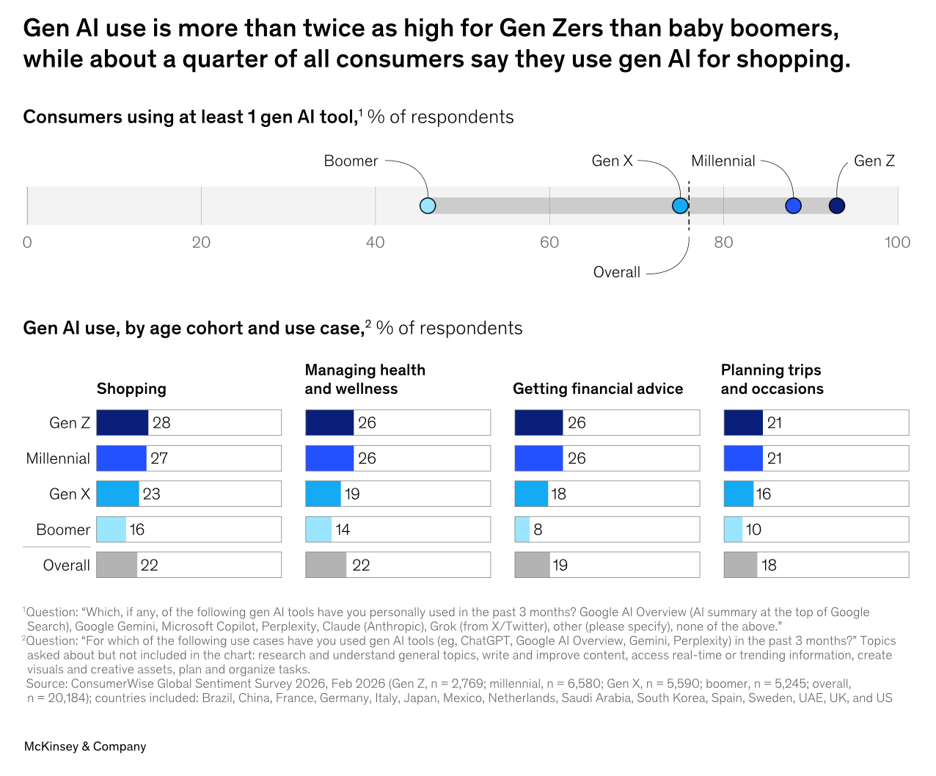
“State of the Consumer 2026: When tech acceleration and cost pressures collide - The consumer is changing fast. Four trends—the tech-driven path to purchase, the health revolution, the experience economy, and the resourceful consumer—will redefine the sector. Will brands keep up? Already, we are seeing that consumers’ path to purchase is increasingly complicated, brand influence is more diffuse, and the priority consumers place on value now cuts across income segments and categories. For years, digital tools have been changing the consumer purchase journey. According to our consumer survey, social media is now increasingly relevant across all stages of that journey and has become the most important channel for Gen Z. More recently, rapidly evolving AI models have begun to shape how people shop.”, McKinsey & Co., June 22, 2026
Global Supply Chain, Energy, Commodities, Inflation, Taxes, Tariffs & Trade Issues
The U.S. Tariff Wall Gets Rebuilt, Not Removed
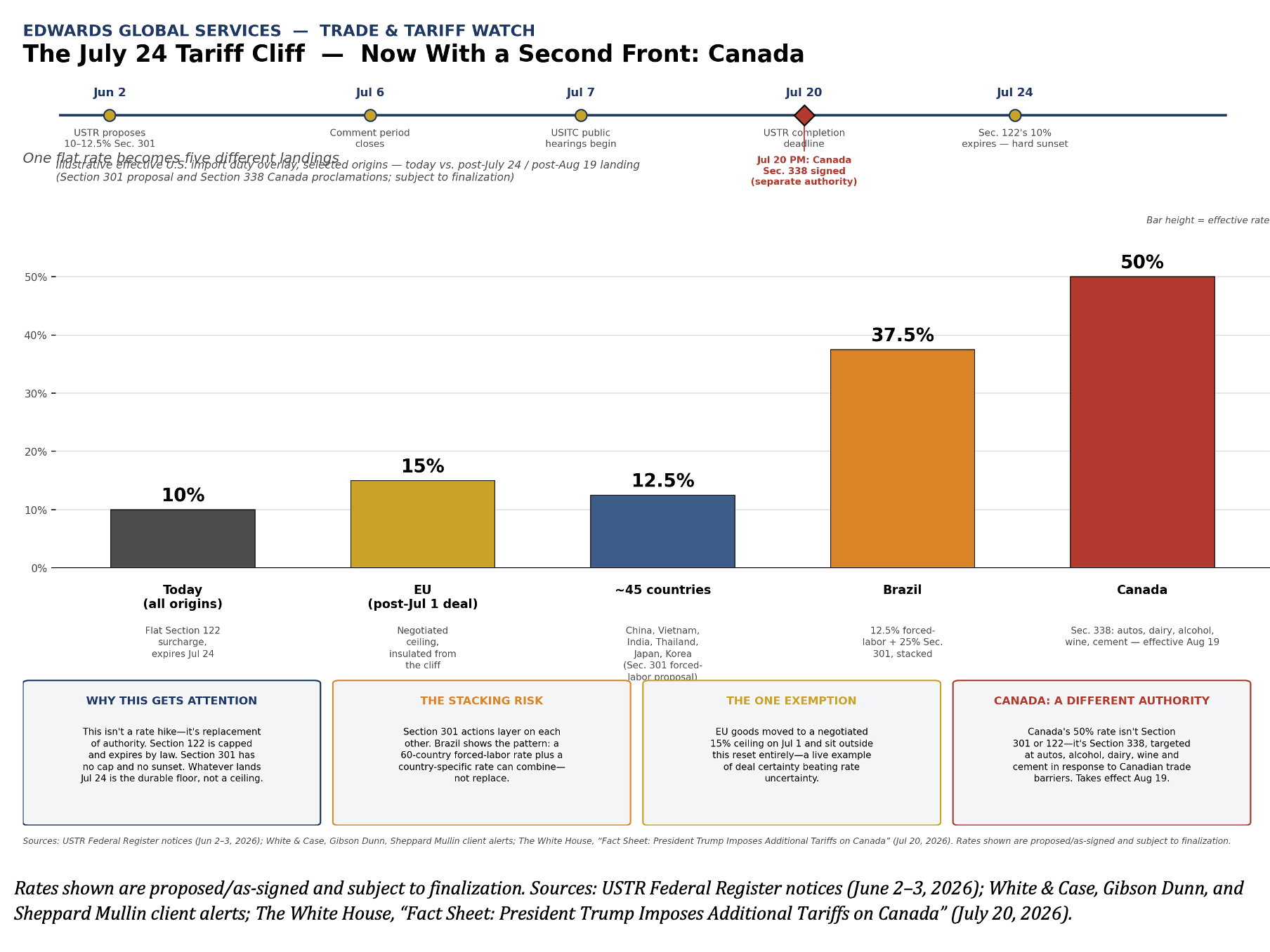
In three days, the tariff regime that has governed nearly every U.S. import since February 2026 quietly expires and a new one takes its place. Section 122 of the Trade Act, the emergency 10% global import surcharge President Trump imposed after the Supreme Court struck down his IEEPA-based tariffs in February, sunsets by statute on July 24. Unlike the authority it replaced, Section 122 was always temporary: capped in rate, capped in duration, with no mechanism for extension. Its successor is not.
The Office of the U.S. Trade Representative has proposed Section 301 tariffs of 10% to 12.5% on goods from roughly 60 countries, following a months-long investigation into forced-labor enforcement practices. Public comments closed July 6; hearings concluded shortly after. A final rule is expected within days of the July 24 deadline. The landing will not be uniform.
The European Union negotiated a flat 15% ceiling on July 1 and sits outside the reset entirely. Brazil sits at the opposite extreme and its number is no longer hypothetical. On July 16, USTR confirmed a separate 25% Section 301 tariff on Brazil, unrelated to the forced-labor case, covering most Brazilian goods but exempting coffee, beef, avocados, Brazil nuts, petroleum, and aircraft parts. That tariff takes effect July 22, two days ahead of the broader reset. Layer the confirmed 25% rate on top of a forced-labor tariff if Brazil is also captured there, and combined exposure reaches 37.5%. The distinction worth flagging: the EU’s rate is negotiated and fixed; Brazil’s 25% is confirmed and already moving; the forced-labor rate underneath it is still proposed.
The distinction that matters most for planning purposes: Section 122 had a ceiling. Section 301 does not. Whatever rate is finalized this week is not expected to be temporary. A caveat worth mentioning: the 60-country forced-labor action is still proposed, not finalized. But Brazil’s country-specific 25% tariff is no longer in that category. It’s confirmed and takes effect two days from now.
Hot flash!!!!!! Late on July 20, hours after this section of the newsletter was finalized, President Trump signed three Section 338 proclamations imposing 50% tariffs on select Canadian goods - autos, alcohol, dairy, wine, cement, and more- citing Canadian trade barriers against U.S. exporters. Unlike the Section 122/301 reset above, Section 338 is a distinct authority with no forced-labor nexus and applies regardless of USMCA origin. The tariffs take effect 30 days after signing, around August 19, unless Canada removes the cited barriers first.
Sources
· USTR, Federal Register notices on the Section 301 forced-labor investigation determinations and proposed action (June 2–3, 2026)
· USTR, “Fact Sheet: President Trump Directs USTR Section 301 Action in Response to Brazil’s Unreasonable Acts, Policies, and Practices” (July 16, 2026) — ustr.gov
· CNN Business, “US announces new 25% tariffs on Brazil for ‘unfair’ trade practices” (July 16, 2026) — cnn.com
· The Washington Post, “Trump announces new 25 percent tariff on goods from Brazil” (July 16, 2026) — washingtonpost.com
· The Washington Times, “Trump slaps 25% tariffs on Brazilian products, citing trade practices” (July 16, 2026) — washingtontimes.com
· Yahoo Finance, “Trump administration announces 25% tariffs on Brazil ahead of a global rollout expected within weeks” (July 16, 2026) — finance.yahoo.com
· White & Case, “USTR proposes 10-12.5% tariffs in Section 301 investigations of the regulation of imports produced with forced labor” — whitecase.com
· Gibson Dunn, “USTR Proposes New Section 301 Forced Labor Tariffs Covering Most Major U.S. Trading Partners” — gibsondunn.com
· Sheppard Mullin, “Section 301’ing the World (or 99.4% of It)” — sheppard.com
· Dorsey & Whitney, “Proposed New Section 301 Tariffs and Other Trade-Related Developments” — dorsey.com
· Clark Hill, “USTR Section 301 Tariffs Target Forced Labor Imports Updates” — clarkhill.com
· Dimerco, “US Tariff Update 2026” — dimerco.com
· Movargo, “Section 301 Tariff 2026: What Happens After July 24?” — movargo.com
Comments
Nothing yet. Say the first thing.
Sign in to join the conversation.