
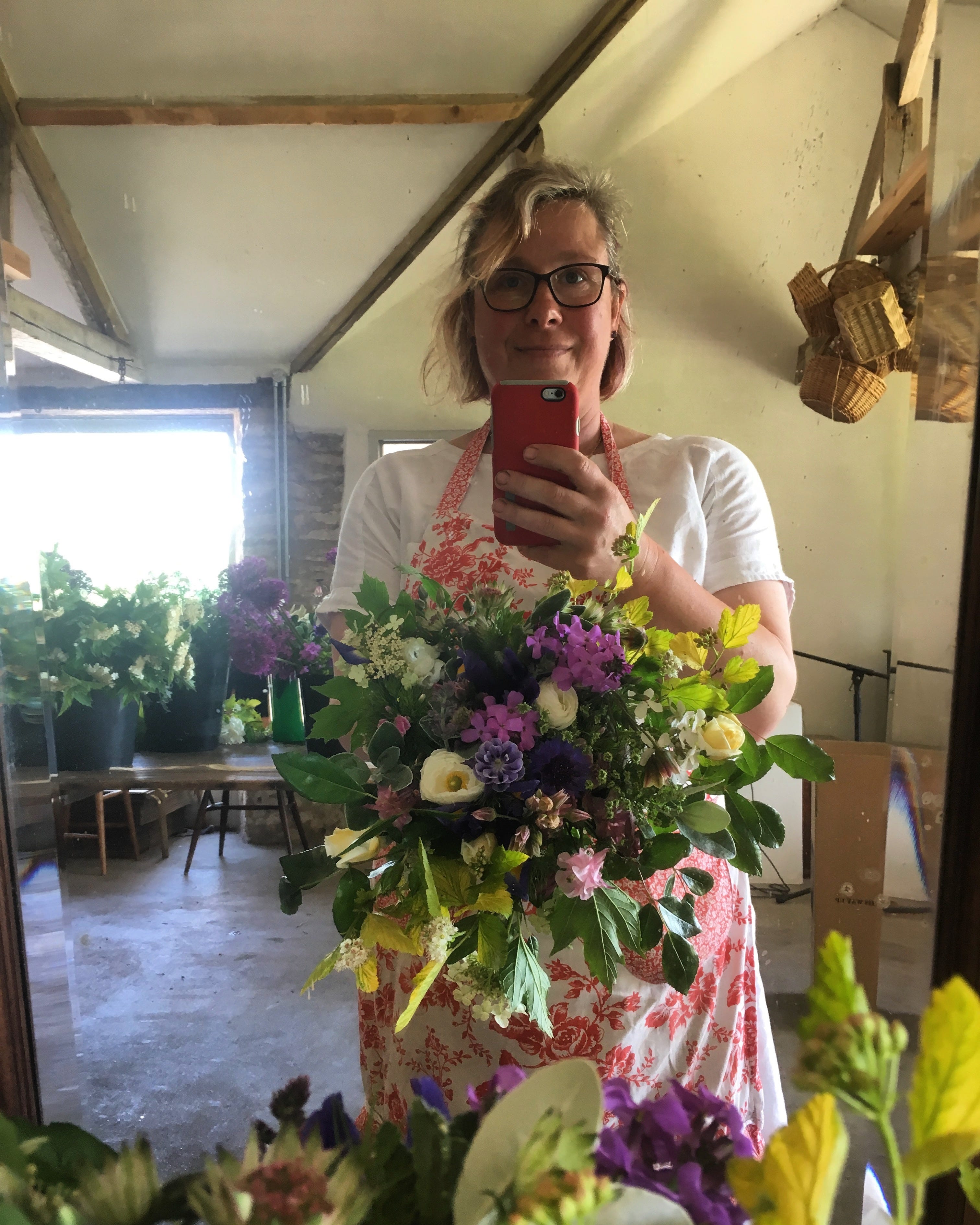
I started the business of selling flowers at Common Farm in sunny Somerset in April 2010. I had a husband, a three year old, and a six month old baby. We’d bought the biggest house and most amount of land we could scrabble together. I belatedly realised that you can buy as much house as you like, but if you can’t afford to live in it that investment ain’t gonna last long. I needed to turn the property into a business if we were going to stay here. The land had an agricultural tie, but there wasn’t enough of it to be considered a smallholding according to the government and so there was no financial support for farming it.
We had tried keeping small amounts of livestock - but you have to really love the livestock and then not mind sending it to slaughter - tough business and not one I enjoyed. We’d grown veg in quantity - but it takes a reeeeally long time between sowing a seed and harvesting a cabbage and none of my family seemed to want to eat that home-grown veg much. I fumbled on with the veg, but sprinkled the veg patch with flowers which much improved the view, and which I could cut and arrange in vases around the house. A stand of sweet peas, a march of dahlias, sunflowers, calendula, a little hedge of short-lived hyssop.
In April 2010 my brother died of a brain tumour that had been trying to finish him off for years. He was five weeks short of his fortieth birthday. I remember just sitting for a bit, in our cold, north facing sitting room, and sort of breathing with it. My daughter was six months old. My boy was three. We had been planning for friends to come because the next day was my birthday. We didn’t have a date for the funeral yet. Mum was staying with my sister in law and my brother’s three children. It wasn’t a time to get in the car and rush north and get in the way. My brother’s family live in Glasgow - we live in Somerset. When we told my little boy that his uncle had died but that two friends would still come for my birthday, he looked at me and smiled and said, ‘Then Uncle Ian (my boy’s godfather, and my old friend from college days,) will have to be your brother now.’ The image of that little open face and his direct gaze and his pronouncement that life will go on is one I still remember often, especially when the chips are down one way or another.
For my brother’s funeral we all took flowers from our gardens. Setting off with Fabrizio, two small children, and buckets of flowers in the boot began a pattern that would continue for years. We made bunches of flowers in the garden of my brother’s house and laid them in heaps of haphazard gorgeousness on top of his willow coffin. I learned the value of spending time with the flowers the day before the funeral, and how much having something to do with one’s hands, and things that couldn’t help but be beautiful around one, helped make a situation more bearable.
Some weeks later, I remember clearly joining the group of friends who met regularly for tea so that the children could play and the relentless repetition of feeding kids at 5pm could be given variety. I sat next to Michele - still my sounding board and often accountability coach - and said, ‘I’m going to grow flowers for sale.’ As I said it I reached for a custard cream. And she said, ‘What?’
I told my friend, my little boy’s Uncle Ian, that I was going to start a business growing cut flowers for sale. ‘Ah, a lifestyle business,’ was his response.
The Lifestyle Business Retreat runs in October. Book your place here.
I had absolutely no idea how to run a business. I had never thought about cost benefit analysis, or how much of a price should be profit. I didn’t have a clear idea what our costs living at Common Farm were. Book keeping was a closed subject to me. All I knew was that I needed a new direction, I had energy, it appeared that I was good at growing flowers for cutting - or at least I liked it much more than growing veg and accordingly, as with anything cared for with love and enthusiasm, the flowers did better.
And so began a chaotic first few years. Bouncing in and out of overdraft, pricing according to what I thought people would pay rather than what would be necessary if we were to be able to pay the bills. We took on help we couldn’t afford because I assumed that help would enable us to do more and therefore we’d make more. Of course help is very nice but the most costly addition to a business’ expenses one can make - it is necessary to scale the business to cover the cost and the help - I LOVED the help - and they noticed something about me I didn’t know. ‘You always disappear,’ they said. ‘We’ll all be doing something and you’ll disappear.’ They called it flitting. It was just before Covid that I finally bit the bullet and let the help go. We never really made enough to pay staff. And I always preferred and still prefer to largely work on my own. And then through the Covid years I worked out how we could make enough without.
But that was ten years after we started the business.
So how did we keep going through those chaotic first years? The answers are various:
Comments
Nothing yet. Say the first thing.
Sign in to join the conversation.