
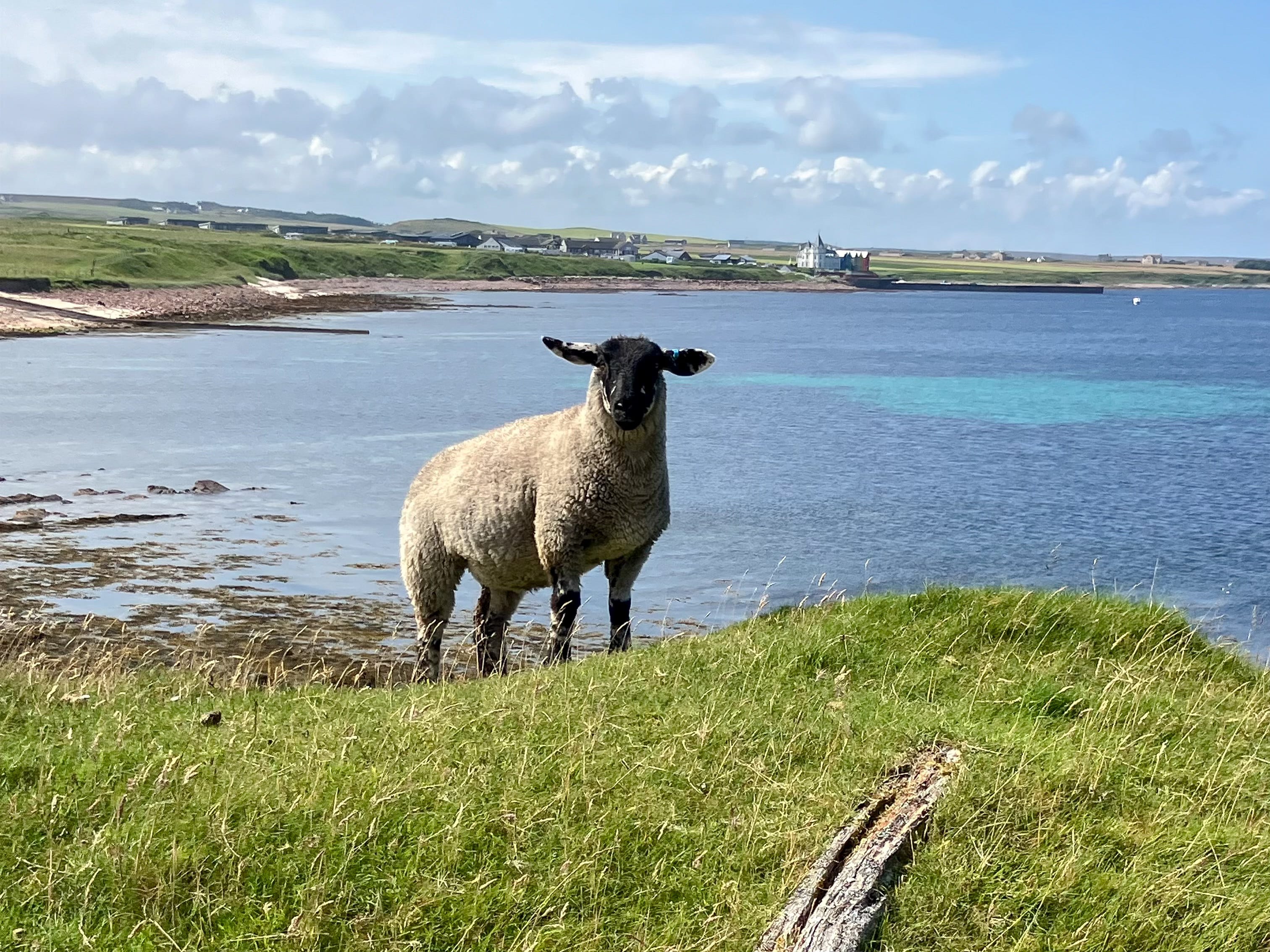
Janet: Britain’s most northerly sheep
I pushed through the long grass that lined the cliff edge, the dizzying drop to my right cutting across in front of me to redirect me inland. Far below, gulls wheeled about crumbling black sea stacks, their wailing cries dulled by a hazy, late morning sun. Unfortunately, the heat only served to stoke the acrid scent of ammonia that emanated from the thousands of nests just out of sight below me; I’d had a headache for three days now. Northwards, the coastline curved steeply downwards before jumping up again to meet the final stretch of zig-zagged clifftop that tipped Scotland’s rugged east coast. Not far to go now. Squinting against the glare of the sea I could just about make out a cluster of white dots up ahead, speckling the narrow band between fence-line and void. More sheep.
It’s something they don’t tell you in the guidebooks or the Youtube vlogs. To walk the length of Britain is to develop an intimate relationship with the island’s most dull yet enigmatic denizen. It starts subtly: a casual stand-off, the dipping of tails as they bustle ahead of you along the coastal paths of Cornwall—the gentle flirting of a couple yet to recognise their interest. From there the bobbing tails appear more frequently: a coy suitor playing hard to get among the bracken and gorse that lines the trails to Devon.
It was in Wales that our courtship began proper. People joke about Wales and its sheep, and while our relationship fell short of consummating the lewdest of such implications, I can confirm that the tales of their number are but understatements. Little more than a kilometre beyond the Welsh border—alongside the first sputtering rain in three full weeks on trail—I had already passed through five fields of the self-absorbed ruminants, little lambs prancing alongside me as I passed. In Wales it is incessant: a fleeced legion that wander the land.
Across the hills and dales that followed, our kinship blossomed, the lambs I walked beside growing larger and more steady with every passing day. We would flirt back and forth, them turning to look back at me for a moment before resuming their ungainly trot along the path before me, goading and fearful at once as they encouraged me along. We’d play endless games of circling and trailing, working to get around one another as we’d try to guess each others’ moves and adjust our own so as not to impose—two new lovers testing out the landscape of our union. A few weeks later, after a euphoric crossing of the Crib Goch ridge, I came across the great longhorn majesties that grazed poised and sure in the mountain meadow above Pen-y-Pass. They were unlike any I’d met so far: kings among sheep-kind, self-assured and composed as their lesser brethren were skittish and unruly. I watched them from a distance as I ate my morning porridge, woolly spirits of the mountains imbuing me with a strength and stamina that would propel me through the peaks of Eryri yet to come.
Back across the border in England, many more, the herds of the Pennines, wandering the bog-cotton frosted moors that surrounded the age-worn flagstones of my path. By the Yorkshire Dales, though, our honeymoon was over. I’d just about had enough of the lot of them. Slowly, field by field, day by day, our resentment had grown—lovable quirks turned to vexation, until eventually the very sight of yet another bobbing tail invoked little short of rage. They’d begun to play a game with me, watching me from a distance, carefully calculating, waiting until the moment I got close enough that they knew it would tug my nerves. Then they’d startle, bleating in alarm and scattering violently as if they’d never seen me coming at all. How can you startle when you’ve been watching me for the last five minutes? I hadn’t changed direction, I hadn’t changed speed: they knew exactly what was going to happen. It was clearly just to spite me. And it infuriated me.
We kept our distance after that, dear friends fallen out, eyeing each other with grudging affection across a gulf we were too proud to breach. Through the Lake District and into Scotland, until upon the high peaks of Lochaber we made our accord. There, at the head of Glen Nevis I battled the wind. High in the cloud I was beaten and blown over, crawling to a col to agonise on decisions of prudence and the dwindling supplies I had remaining. And just in that moment as I contemplated the relative merits of camping out the storm and the long-overdue pizza that waited in Fort William, there appeared on the ridge-line the dappled wedge of a sturdy woollen head. Solemn grey eyes peered at me from the cloud above, anything but sheepish, totally unfazed by the driving rain and wind—a gaze imbued with a certainty of place and belonging that only a sheep on a mountain in a storm can have. And so I headed on, my passage into the gales over Aonach Beag bolstered by the ovine gods of the mountain once again. And their wisdom prevailed: but an hour later I stood atop Càrn Mòr Dearg as the clouds drew back and a brilliant sun lit the arcing knife-edge path to Ben Nevis while the waters of Steall Falls glittered far below.
We were solid now. No more flirting or obsessing or testing one another out. No lambs ran beside me, not anymore. By this point in late June our relationship had long shed the youthful frivolity of its early days, replaced instead by the maturity and resilience that shone in the eyes of the gigantic ram on the clifftops above Dunbeath. We were brothers, him and I—partners of journey and wind and trail.
My legs sluiced through the tall grass, blues and yellows of wild flowers bending here and there as they separated with my passing. All habitation now far behind, I walked alone on that final stretch of headland toward the end of land. That is, unless you count the six broad whiteish figures meandering about the cliff edge to my right: the island’s most northerly sheep—I wondered if they knew? In either case, they ignored me as I passed, content in their lunching, until, just as I crested the hill beyond, the nearest of them—a ewe in her elder years—raised her head from her meal. One final pair of those deep brown eyes, as clueless and knowing as the day we first met more than a thousand miles to the south. And in that moment were all the sheep-folk across the length of a country—mountain and lowland, curly horned and straight, from little lamb to giant ram, white, black and brown; those that grazed beside me as I pitched my tent in fields in the sun, those bold individuals astride the precipices of Rhinog, Idris and Cairngorm, those wildest of all in the rough bounds of Knoydart. They’d been there all along, always at my side; it was the sheep more than any, who really knew my story. And with one final nod to the soulfully vacant brown eyes that held mine, I turned one last time to the north and a life that sheep would no longer share.
No posts
Comments
Nothing yet. Say the first thing.
Sign in to join the conversation.