
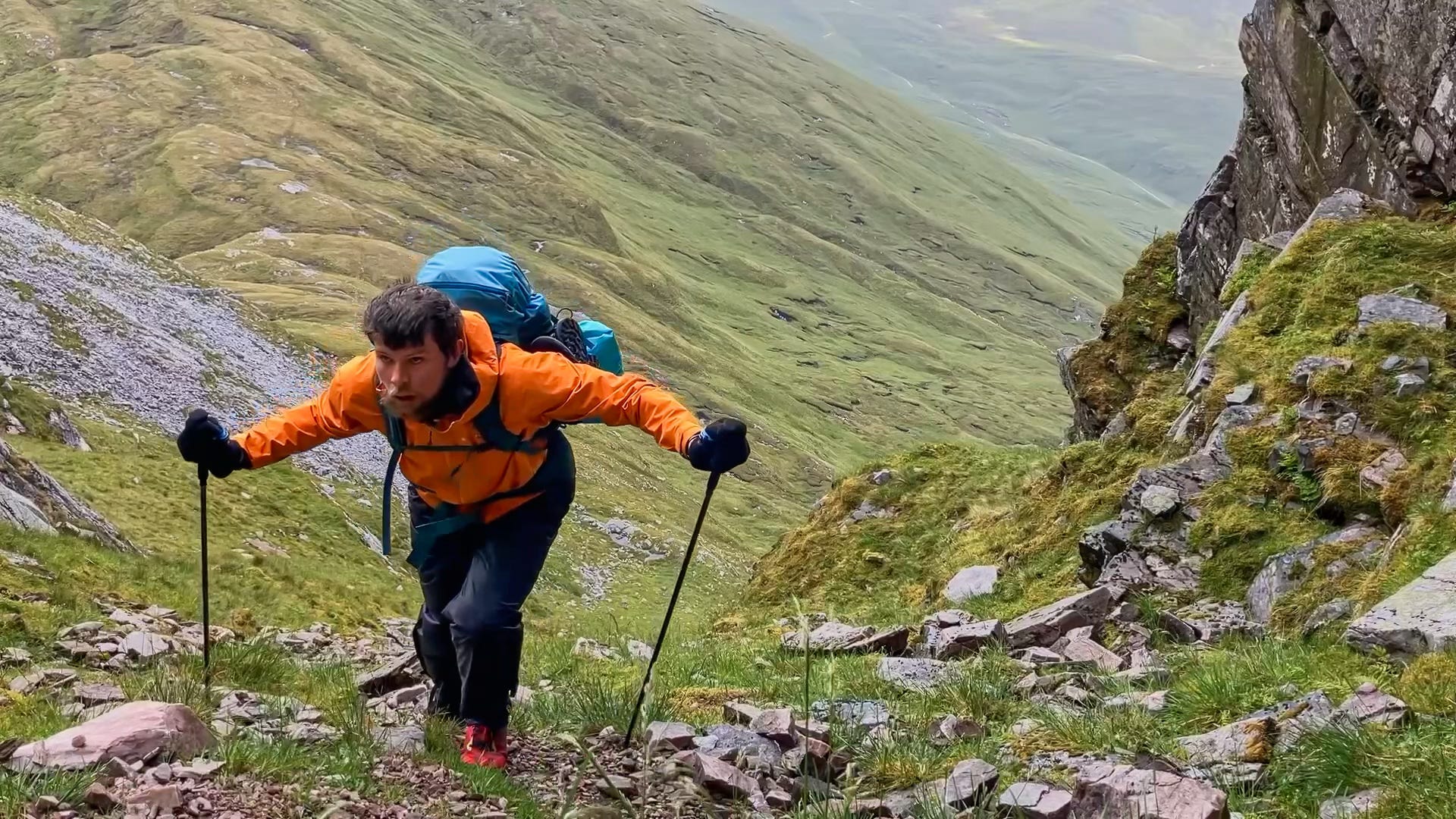
Loose rock crunched beneath my shoes as I wound the snaking path off the edge Scafell Pike into the saddle it shared with Sca Fell. Mickledore. A place of choices.
To my right, Lord’s Rake, with its tedious zig-zagging chute of scree and broken rock that filled the steep gully to the summit; to my left the long descent to Foxes Tarn before an even longer slog back up the east side of the mountain. Now almost eight hours in, both propositions were as uninspiring as they were exhausting. Directly in front of me was the sheer face of Sca Fell buttress. There lay my third option. Broad Stand. A short climb and then an easy scramble up the most direct route to Sca Fell’s cairn. I could see the square hanging slab of rock that sloped away to the precipice off to the left—the single move for which the route was so infamous. Above that it was easy—a winding scramble up through the broken rocky jumble that cut through the buttress above.
But that one move?
I knew it was easy enough in theory. I’d climbed harder rock ropeless many times in the past. But I’d never actually been up it before. And with trail shoes and a fourteen kilo pack? I wasn’t sure. It was dry, though. And I was feeling strong. I’d covered almost thirty kilometres since the dawn light on the summit of Helvellyn—and it was still only 10:30. I was up on schedule. It would be a shame to throw that away: I still had a long way to go.
Fuck it, I thought. I can at least go and look.
As I reached the narrow slit that led into the cliff face and to the start of the climb—the keenly named Fat Man’s Agony—I took a furtive look around. Despite the crowd on Scafell Pike, there was no-one in sight. Why it mattered I wasn’t sure, but it made me feel more comfortable—it always did when soloing. Less people judging your choices I guess.
I slipped off my rucksack and shoved it into the slot in front of me, hopping up to bridge between the two rock faces where they were too narrow to continue at ground level. After a few moments of pushing and pulling the uncooperative rucksack—moments that felt strangely reminiscent of the memetic golden retriever that lies down in rebellion of lead tugs towards home—I reached the back wall. I heaved the rucksack back onto my shoulders and reached above to hoist myself onto the slanting ledge that lay below Broad Stand itself. There I paused, considering.
To my right rose a vertical wall of grey rock, stretching high above towards the main buttress. To my left the ledge I was on inclined slightly, before ending with the angled slab of rock I’d seen from below, sloping away into the drop. Below, the rock-strewn slope of Mickledore swept downwards towards the deep green of the valley a thousand metres beneath. I studied the slab. If I could step onto it, I’d be able to walk up and around to the ledge above me and easy ground. But it was polished and smooth, sloping away to nothing, with no hand holds I could see.
I tentatively stepped a foot across, testing the friction between shoe and rock. No. That wasn’t going to work. Not without climbing shoes. I reached above. Nothing. I couldn’t reach the next ledge. Suddenly I felt very precarious, perched on a slanting shelf, my rucksack pulling heavy on my shoulders over the drop below. I could always go back, but the down-climb would be an effort, and I really didn’t fancy a second squeeze with the Fat Man.
Eyes wandering about the rock in front of me, my attention fixed on an edge of rock by my chest, angled awkwardly but solid. I contemplated silently, calculating. A gusting wind tugged at my pack, flapping my t-shirt where it hung loose below my waist-belt. Clouds slid by overhead, their shadows racing across the saddle and down into the vast space that carved out the valleys and peaks beyond. Sweat from the climb up Scafell Pike chilled. I could use the edge to pull-push against a slanting foothold on my right, hoisting me high enough to reach the sloping ledge above. From there it should be easy.
A moment of decision. To commit or not?
I stepped up, pressing down on my left hand to reach up and over the ledge with my right. Instantly I knew I’d overcommitted. I couldn’t return. The extra weight of the pack had my left arm frozen, unable to return, body tensioned between wrist and toes in such a way that the only route down was to pop off the wall, risking toppling over the ledge below into the mess of broken rock beneath. The fingers of my right hand scrabbled wildly across the smooth rock and loose tussocky grass of the sloping ledge above as they searched for a hold, anything. Disbelief. There’s nothing here. My left arm began to tire, the pack pulling me out and downwards. My right toes pushed harder against the smooth rock. Anxiety began to rise in my chest as my cheek pressed tighter against the stone.
An edge. The surge of relief sank almost instantaneously as my right hand explored the thin ridge of rock at the base of an earthy tussock. It was little more than half a fingertip. I crimped down hard on it and paused. It would mean committing everything to the thin hold, smearing my feet into the face and swinging out over the drop to reach up for something more substantial that I hoped would be above. But I didn’t have much longer. My left leg had begun to tremble. Go. I pulled hard and prayed, releasing my lower hand and waiting for the pop of my right fingers.
Carefully positioning my left foot, I swung out over space, the momentum of the pack tugging at me as it shifted on my shoulders. Mind as blank as my heart rate was erratic, I reached over to the back of the ledge above, finding a solid horn of rock just where it cornered down towards the slab to my right. Seizing it, I replanted my feet and hooked a foot over the ledge I held, stepping myself up without thought: familiar movements. With a quick glance toward the drop below, I continued up the ramp of tussocky rock to join the gully above, focus shifting just as quickly to the pleasantly gentle scrambling that continued up to the summit.
Such moments of commitment are something my mind holds a deep affinity for. Whether that single movement in a climb, or the decision to pass up the certainty of a perfect campspot in favour of the unknown: just one more ridge of mountains before dark. I’m not sure why, but always these moments seem powerful.
Maybe it’s just that they make me feel alive. So much of life is planning and assessing and replanning. So rarely do we ever actually go all in. There is an exhilaration to making a decision that can’t be changed, at least not without great effort or risk—to take a path from a fork without looking back, committing to the unknown. There’s something exhilarating about the way it always works out. Like the early stages of a painting where all seems to fall short, yet in trust and persistence it somehow always comes around—automatically, beyond conscious understanding. Fate? Flow? The forced tapping of capacity beneath conscious control? Perhaps it’s simply a taste of freedom to my subconscious: uncommon moments of intoxicating spontaneity to a mind more familiar with incessant overplanning and careful contemplation.
But there is something insidious there too. Once a decision is made, I find it very difficult to go back—some flaw in my character that refuses to loose ground already gained. I’d done the same just weeks earlier in the Rhinogs of Eryri: a long moment of decision before dropping the rucksack down a 30 foot cliff that committed me to the down climb. It had turned out fine. Just as it had today. Just as it always has. In fact, my record is clean, obviously. But what if it hadn’t? There’s more than one walker been found dead beneath the buttresses of Sca Fell. Of course, I’d do the same again just a few hours later, flirting not with risk this time, but endurance, heading into a long night of storm as I made the decision to push on to Carlisle, extending my long day of the mountains into a hundred kilometre sodden epic that would leave me broken and remade both at once. An idea, once conceived, that only collapse and worse would ever allow my stubborn appetite for possibility to abandon.
These are small undertakings, just flickers on the surface, tentative forays into the eaves of a vast forest of personal limits and the dance they invite. But they speak to a larger shadow. A shadow of ego and identity and meaning. A shadow that scares and excites me in equal measure. The shadow of potential and the cost that it courts.
A thick mist engulfed me as I climbed the remaining ledges to the plateau of Sca Fell, cool vapour kissing the bare skin of my arms to goose-flesh. I wasn’t shaken. I was onto the next thing—considerations of the upcoming descent down the narrow scree gully to Lord’s Rake. But a sudden whisper of the moment before had me cringing a little, looking around sheepishly as if the mist itself was judging me. And as the summit cairn rose black from the mist ahead, a long-forgotten quote bubbled to the surface of my mind:
“The game in climbing is cut that line as fine as you can, but you don’t want to take stupid risks. If you die taking a stupid risk, not only are you dead but you’ve embarrassed yourself, disgraced yourself. You’re not supposed to take risk lightly. You’re supposed to show that you’re so good and so controlled, you can take it right to that line and go no further.” (Jon Krakauer)
No posts
Comments
Nothing yet. Say the first thing.
Sign in to join the conversation.