
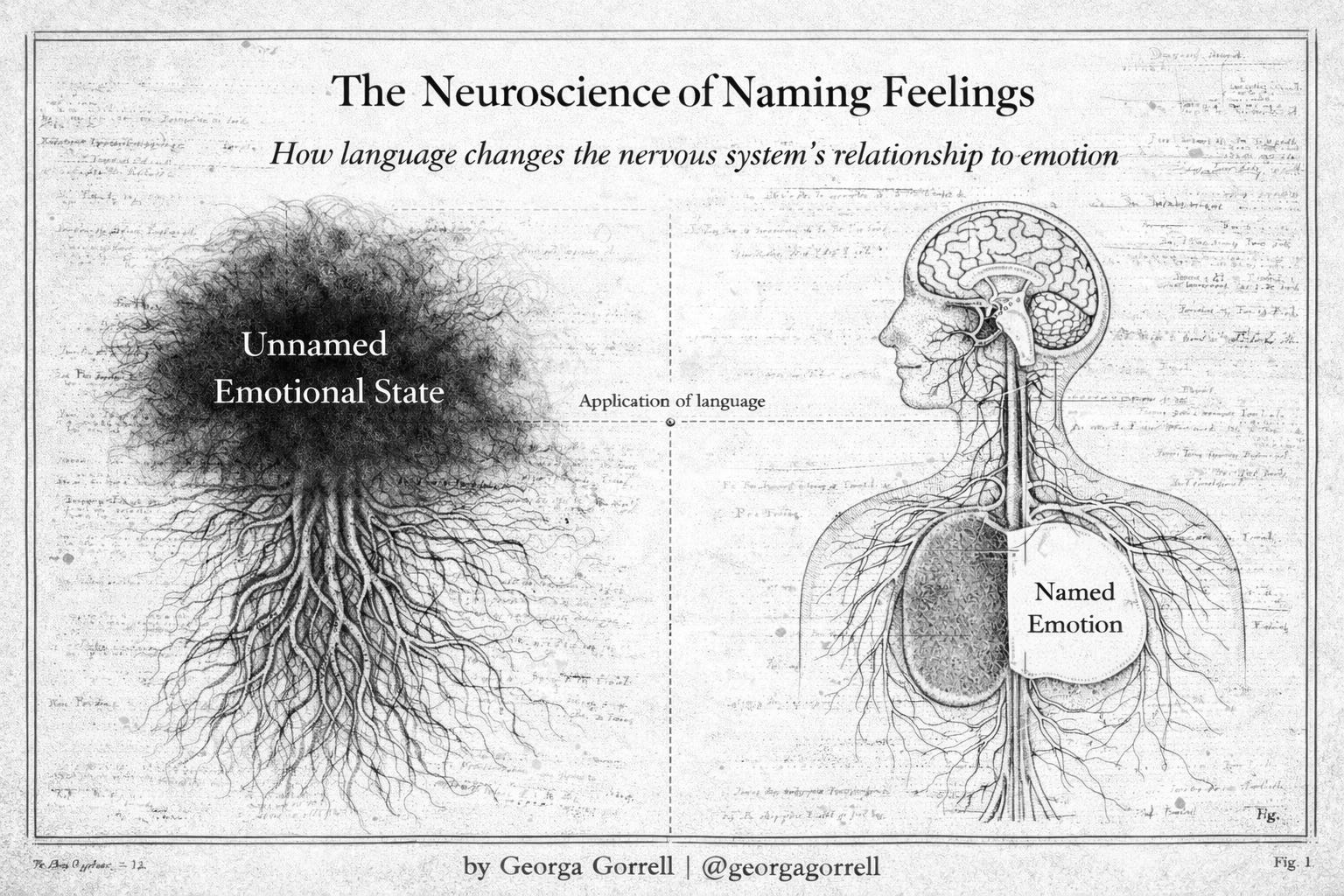
Emotions are not always acknowledged or experienced as passing inner events. They come with force and immediacy, filling awareness so completely that they feel indistinguishable from who we are. Anxiety can feel like a way of being, rather than a temporary state. Shame can feel like a conclusion about the self, an identity, rather than an emotion moving through the body. In these moments, experience and identity blur together.
This happens because the nervous system does not initially treat emotions as objects of awareness. Before language is applied, an emotion is lived from the inside. It shapes attention, breathing, posture, and behaviour without being recognised as a process that has begun and will end. The feeling becomes the centre around which everything else organises. It takes over.
Identity temporarily collapses into the emotional state.
Naming does not remove emotion. It changes how the nervous system holds it.
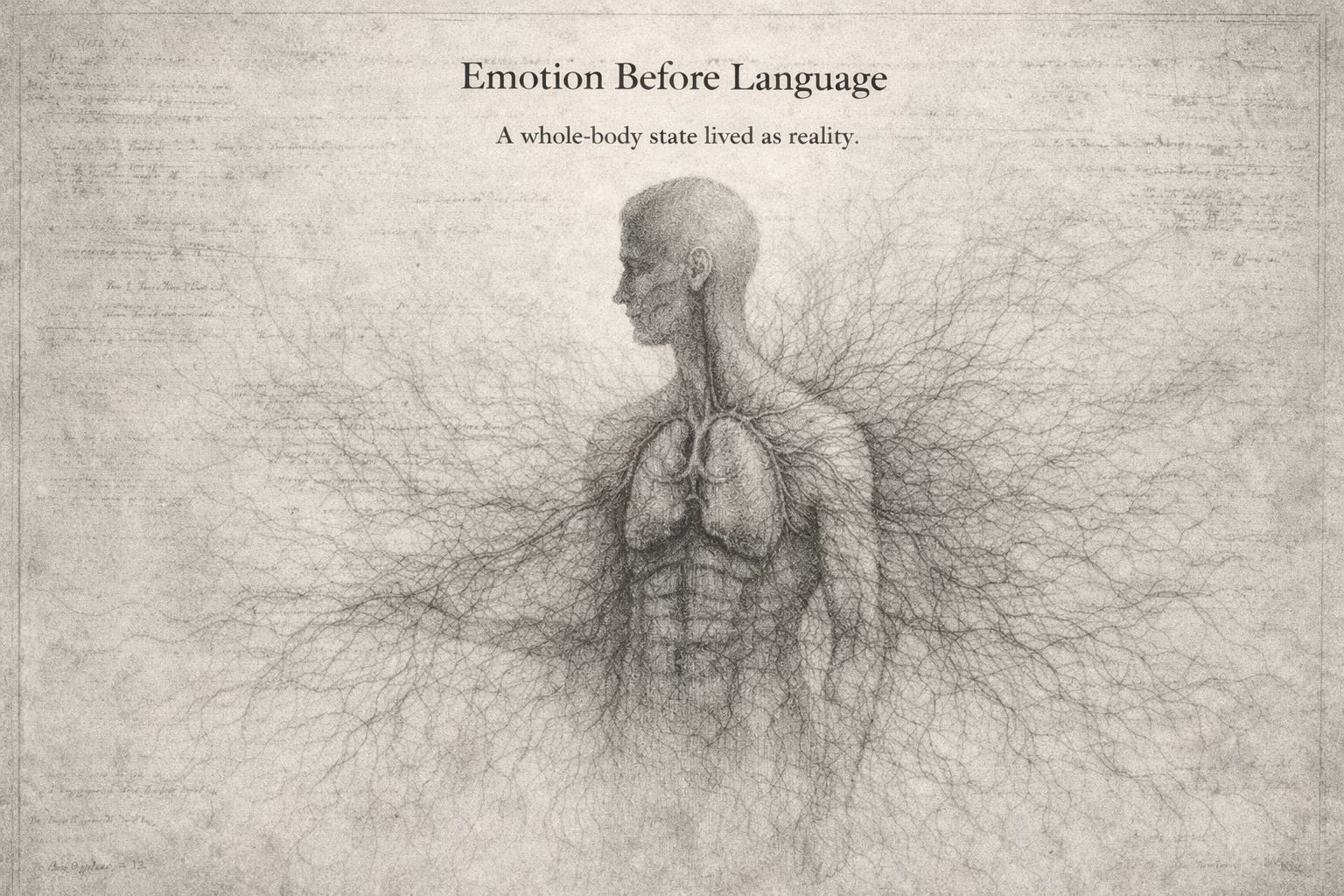
Before a feeling is named, it exists as a whole-body state. Breathing becomes shallow or held, muscles may tighten, and attention narrows around whatever seems relevant to the emotion. The nervous system treats this state as a present reality rather than an internal signal.
This is why emotions feel unquestionable while they are happening. There is no mental position from which to observe them. The emotion is not something occurring within experience; it is the experience.
From a biological perspective, this kind of emotional takeover is useful. When an emotion fills awareness, the nervous system can respond quickly because it is not stopping to reflect or evaluate. This supports fast action. The problem begins when the same emotional states return again and again without being recognised as temporary internal events. Over time, the nervous system starts to treat them as familiar conditions rather than passing responses. What was designed to help the person react in the moment can begin to feel like who they are.
Language creates a separation that did not previously exist.
An unnamed emotion is lived as identity rather than recognised as experience.
Neuroscience research shows that naming a feeling alters how the brain processes it. Studies led by Matthew Lieberman have found that when people label an emotion, activity in the amygdala decreases while activity in parts of the prefrontal cortex increases. This reflects a shift in how the nervous system relates to the emotional signal.
The emotion does not disappear. What changes is its position. The feeling is no longer running the system on its own. Attention has the ability to widen and the state becomes something that can be noticed rather than something that consumes awareness.
Research by Lisa Feldman Barrett on emotional granularity helps explain why this happens. When emotional language is vague, the nervous system stays in a broad, unspecific state of alert. The signal remains unclear, whereas when a feeling is named with accuracy, the brain receives a clearer map of what is happening. This reduces uncertainty and lowers the amount of energy the system needs to stay activated.
Accuracy acts as a signal of understanding to the nervous system.
The person now has a relationship with the emotion rather than being submerged in it.
Emotional distress often continues because feelings are described inaccurately. Broad labels are used in place of precise ones. Anxiety becomes a default term even when the underlying state may be grief or fear. Irritability stands in for shame, numbness can be mistaken for calm. Persistent mental activity is treated as a thinking problem rather than a sign of physiological activation.
When the label does not match what the nervous system is responding to, the body stays unsettled. The emotional signal continues because it has not been properly recognised. The person may understand their experience intellectually while still feeling tense or overwhelmed.
Confusion can stabilise emotional activation.
Relief tends to appear when the language finally matches the experience closely enough for the system to register it.
Many emotions persist because the words used to describe them are too broad to be regulating.
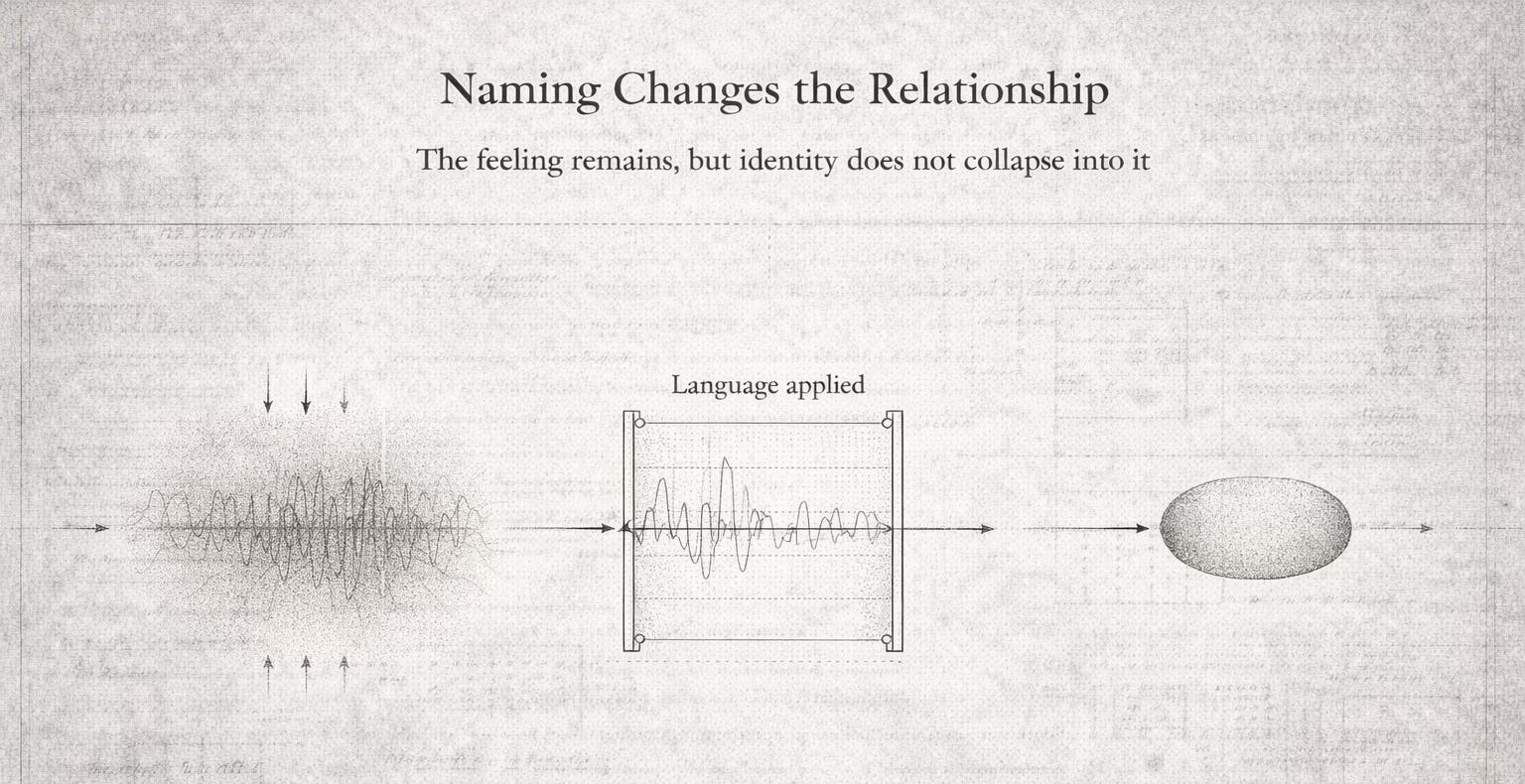
Naming a feeling and explaining it are different processes. Naming is brief and direct. It identifies what is present without expanding on it. Explaining builds a narrative around the feeling, linking it to causes, history, or meaning.
Narrative has an important place in understanding a life. At the level of nervous system regulation, however, explanation often keeps the emotional state active. The system experiences the story as a continuation of the signal.
Naming creates space. Explanation can keep the loop running.
Language can either create perspective or deepen immersion.
This distinction matters because many people believe they are processing emotion when, in fact, they are repeatedly reactivating it through explanation.
Emotions that are not clearly recognised tend to remain expressed through the body. Research in trauma and somatic psychology shows that experiences which are not integrated through awareness and language persist as tension, altered breathing, or shutdown.
When a feeling is named accurately, it moves into conscious awareness in a different way. The nervous system registers that the signal has been received. Physiological activation begins to change, breathing becomes more even, muscular tension softens, and sensation shifts.
This happens through recognition rather than analysis.
Once the emotion is recognised, the body no longer needs to maintain the same level of physiological activation.
The ability to name feelings clearly develops through our early relationships. In childhood, emotions are broad and undifferentiated. Caregivers provide language that helps the child recognise what is happening inside them. Through repeated experiences of being mirrored and understood, feelings become manageable and time-limited.
When this process is inconsistent or absent, emotions remain less defined. In adulthood, feelings may arrive with intensity but very little clarity. They feel overwhelming because they have never been clearly distinguished from one another.
Learning to name emotions later in life introduces an internal observing position that was not fully established earlier. The feeling is still present, but it no longer overtakes identity.
This reflects psychological development rather than emotional suppression.
Naming works within a window of nervous system tolerance.
When emotional arousal is very high, language may not be accessible. In moments of panic or shutdown, the nervous system is focused on survival. Regulation needs to occur before naming becomes possible.
Safety comes first.
Its role is specific. It prevents emotions from occupying the entire sense of self.
With repeated accurate naming, the nervous system learns that emotions have shape and duration. They rise, peak, and subside. They no longer signal danger simply by existing.
This changes how a person responds to their inner life. Reactivity decreases and presence increases. Emotions are experienced without immediately becoming directives for action or conclusions about identity.
Precise naming requires attention and language that fits experience closely enough for the nervous system to recognise it. Yet this small act establishes a boundary that changes the entire relationship to emotion.
On one side is what is being felt.
On the other is the self that can notice it.
That separation allows emotion to complete its course rather than define identity.
When emotion is recognised as experience, it loses its power to define the self.
Language, used carefully, restores perspective. Perspective creates space. Within that space, emotion can resolve rather than remain stuck.
This is how clarity enters the nervous system.
Comments
Nothing yet. Say the first thing.
Sign in to join the conversation.