
Geopolitics is now playing an ever more important role in global supply chains, though its impact goes well beyond that of trade and manufacturing. International sports are likewise becoming more vulnerable to political tensions, sanctions, security risks and disruptions to cross-border travel.
Formula 1 (F1) is a good example. The global schedule of the sport usually extends from March to November, taking the teams to various continents and calling for a large-scale logistical arrangement. The race programmes are worked out well in advance, and the cars, equipment, spare parts and other cargo have to be transported between the venues in accordance with carefully coordinated timetables.
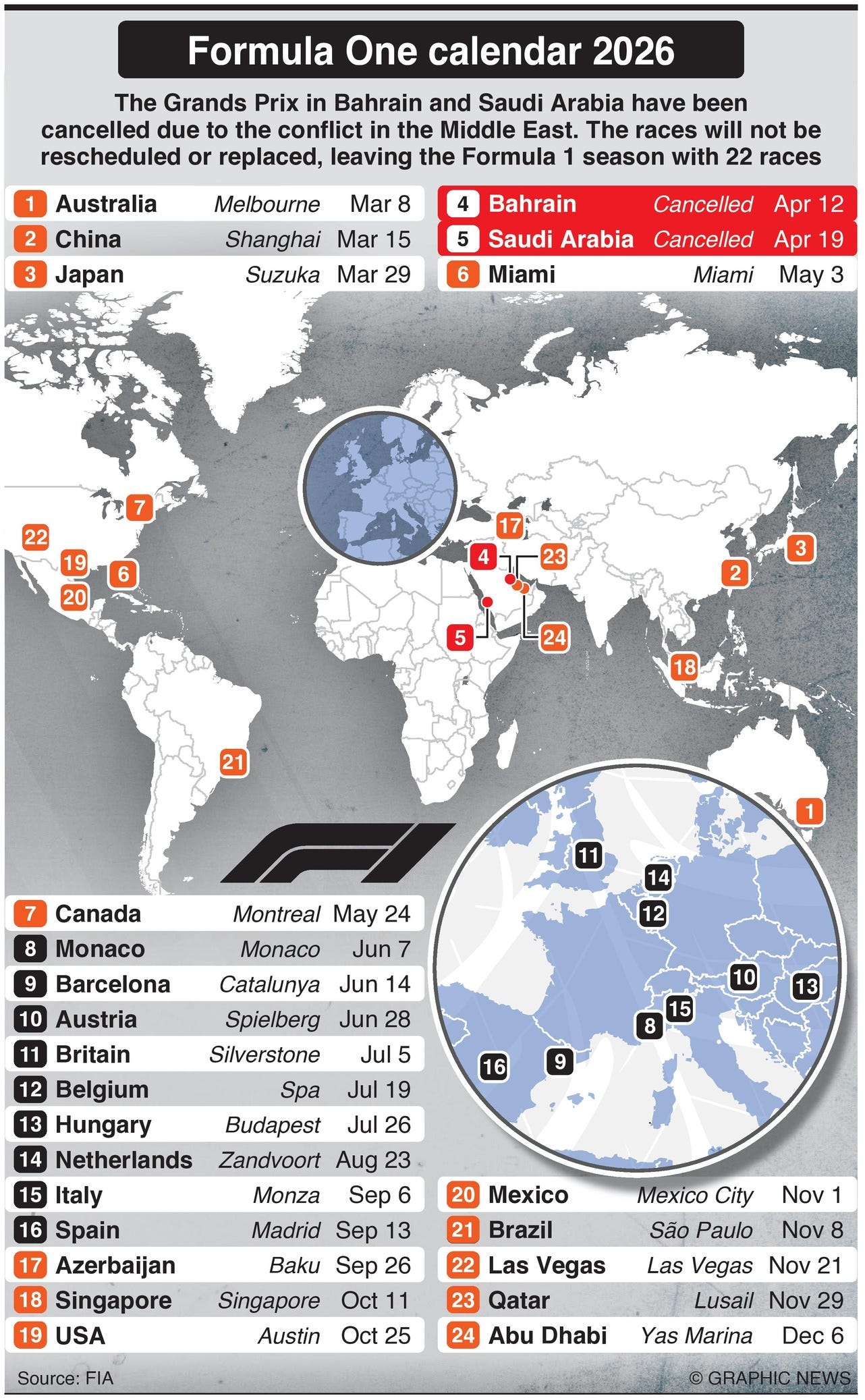
This system was put under pressure this year in 2026 when the growing tensions in the Middle East led to the cancellation of the Bahrain and Saudi Arabian Grands Prix which were originally set for April. F1 announced in March that both races would not go ahead due to the circumstances in the region.
The situation shows a wider truth in that although F1 is a global entertainment business it is also a highly complex international logistics operation and this makes it susceptible to geopolitical shocks.
The Middle East Becomes a Strategic Risk
F1’s commercial expansion has made the Middle East an increasingly important area.
Bahrain and Saudi Arabia have put a great deal of money into arranging F1 races, and Qatar and Abu Dhabi have also become firmly established on the timetable. The region provides Formula 1 with access to wealthy consumer markets as well as offering international sponsors and various governments who wish to diversify their economies and enhance their global standing.
The very geography which has made the area commercially attractive has at the same time introduced new risks. The cancellations in 2026 show how rapidly a regional security crisis can throw into disruption a sporting schedule which had been planned months or even years in advance. Estimates suggest that the loss of the races in Bahrain and Saudi Arabia could result in a cost of about US$190 to 200 million, though the exact financial impact is still uncertain.
The effects go beyond increased ticket sales and broadcasting income; all teams, drivers, sponsors, hospitality operators, hotels, airlines and local businesses rely on the races taking place on time.
F1’s Logistics Network is More Fragile Than it Looks
There is always a complicated freight operation associated with each Grand Prix.
Comments
Nothing yet. Say the first thing.
Sign in to join the conversation.