
Welcome back! Today’s bad advice is unsolicited, partly because you’re not sending me enough questions, but mostly because I just read a two-volume biography of Elvis.1
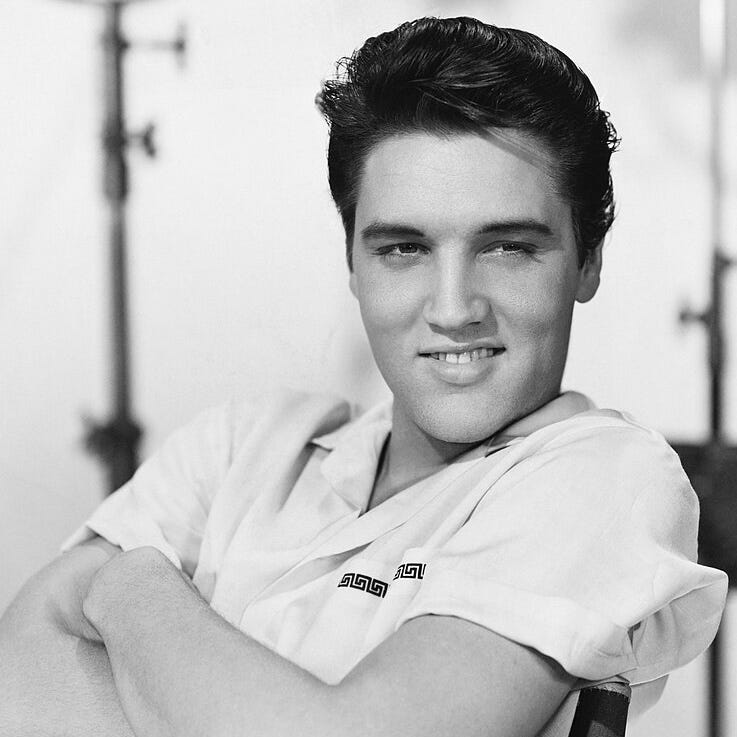
Could it have been a one-volume biography? Possibly. I learned more than I needed to about the filming of Loving You, and while it’s interesting to know that Elvis’s idea of a good time was to rent out an entire amusement park, ride bumper cars with his friends until dawn, and then buy everybody a Cadillac, after the tenth or eleventh trip to the amusement park and the Cadillac dealership, the cycle got a little repetitive.
As I imagine it did for Elvis and his friends, too. While several members of his Memphis Mafia entourage eventually wrote tell-all memoirs about their lives as courtiers to The King of Rock and Roll, I was surprised to learn that none of them were titled What the Hell Do I Do With All These Cadillacs?
Also: does volume two get pretty depressing? It sure does! But that’s what makes it so invaluable. The amount of bad advice you can extrapolate from Elvis’s singular, awe-inspiring, and ultimately tragic life is staggering.
So I thought it’d be helpful—especially for those of you lacking the requisite unemployment to consume a 1,117-page biography of a long-dead entertainer—to distill his most impressive errors of judgment into the following list.
One disclaimer: I don’t mean to either condemn Elvis or hold him up to ridicule. The reason I read the bio in the first place was because I watched EPiC, a live concert film mostly compiled from Elvis’s 1970-72 Las Vegas residencies, and was mesmerized by The King’s onstage charisma:
His animal magnetism is even more apparent in this segment from The Milton Berle Show in 1956:
Just try to watch that clip without wishing you could go back in time and sleep with him, even if you’re not into guys.
Elvis was history’s first, and probably greatest, rock star. He was also a dirt-poor kid with a high school education who was just nineteen when he hopped on a rocketship to unfathomable fame and fortune, with no road map or prior cautionary tales to consult as he charted a course through an absolutely bananas life.
So while his story is ultimately tragic, it’s also understandable that he had a tough time course-correcting once he got the following misguided opinions into his head.
This was Elvis’s fatal flaw: he didn’t get enough sleep. I think if he could’ve managed a consistent eight hours a night, he might still be with us.
But it was a real challenge! If it’s 1955, and you’re spending every single night playing a primitive form of hyper-sexualized folk music for a mob of teenage girls who you’ve whipped into such a hormonal frenzy that they’re literally trying to tear your clothes off your body…and then you have to run from the mob and pile into a sedan with a standing bass strapped to the roof, drive two hundred miles with your band through the night to the next town…where by the time you pull in, the sun’s rising, and in five hours, you’re due at a radio station interview to promote that night’s show…it’s going to be a struggle to fit in two solid REM cycles, let alone three.
But if Elvis had been well-rested, he probably wouldn’t have taken such a shine to the amphetamines.
And without the amphetamines, he wouldn’t have needed the tranquilizers and the narcotics to come down. And those are what killed him.
This was the biggest surprise of the book: the evil influence that turned Elvis on to drugs was…the U.S. Army.
In 1958, at the height of his initial popularity, he was drafted and served two years in a tank battalion in Germany. When he first enlisted, Elvis was literally a milk drinker. But to keep their soldiers awake during overnight tank maneuvers, the Army used to hand out amphetamines. (Maybe they still do? I dunno.)
Probably because he never got enough sleep, Elvis reeaaaally liked taking speed. But—apparently because he’d initially gotten the pills from Uncle Sam—he didn’t believe they were drugs. He seems to have thought of them as just a clever life hack, or some kind of magic beans.
It probably won’t surprise you to learn that when you’re as famous as Elvis was, even apparently ethical doctors will prescribe all the drugs you want, with no questions asked.
Which is how he wound up with fourteen different drugs in his system when he expired in August 1977.
Right up until the end, Elvis insisted to everyone around him that he abhorred drugs, would never take them, and was only ingesting medicine prescribed by his doctors.
While you’d think his demise would’ve discredited such a belief, it was later adopted by the Sackler family in their marketing of Oxycontin.
Which is how we wound up with the opioid crisis.
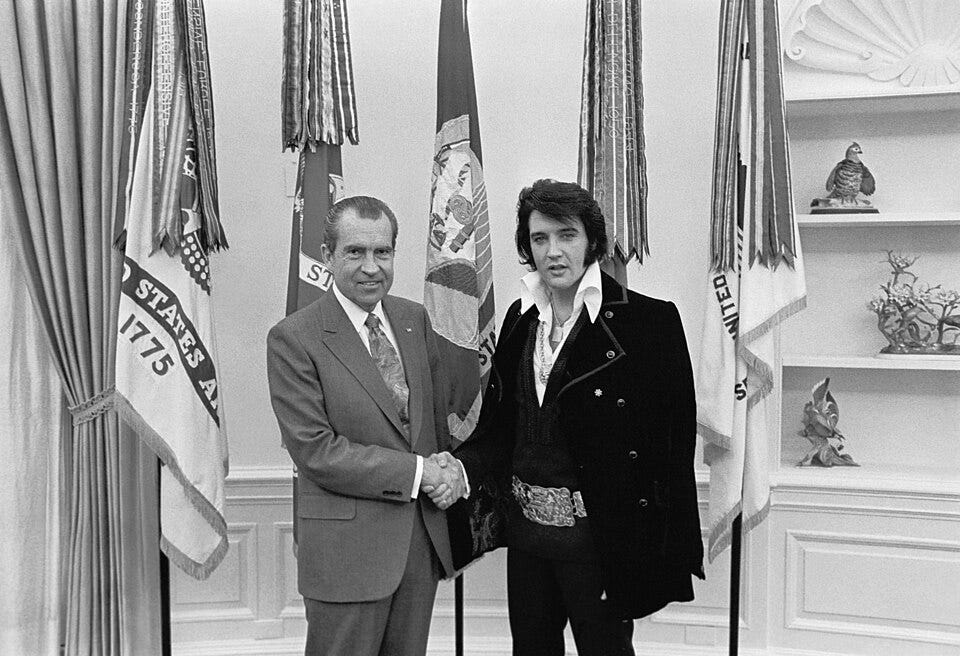
Here’s how committed an anti-drug warrior Elvis was: in January 1971, during what seems to have been an undiagnosed manic episode (or, not to get repetitive, maybe it was the drugs?), he flew to Washington, D.C. on a whim, took a limo to the White House, and dropped a handwritten letter at the front gate at 6:30 a.m. requesting a meeting with President Richard Nixon so he could volunteer to be a secret federal agent investigating (to quote his letter) “The Drug Culture” and “the Hippie Elements.”
As a gift for the president, Elvis brought a chrome-plated Colt .45, probably purchased during a $20,000 gun-buying spree in Beverly Hills a few weeks earlier (again: undiagnosed manic episode, or just a good time? Hard to tell!).
Elvis was neither the first nor the last mentally unstable person to arrive unannounced at the White House gate, high as a kite, brandishing a gun, and demand to see the president. To my knowledge, though, he’s the only one the Secret Service has ever let in.
To be fair to Colonel Tom Parker, who was not a colonel and whose real name was not Tom Parker—it was Dries van Kuijk, but he shed that along with the rest of his past when he immigrated to the U.S. illegally from Holland around 1929—his original arrangement with Elvis only gave him twenty-five percent of The King’s income.
The Colonel didn’t scale it up to fifty percent until the 1970’s, when his gambling problem got so severe that he could no longer get by on twenty-five.
Parker could’ve mitigated both his and Elvis’s growing financial problems by booking an international tour to cash in on The King’s global superstardom…except the Colonel couldn’t leave the U.S. for fear that his immigration status would be discovered, and he wouldn’t be able to get back in. So other than five dates in Canada in 1957, Elvis never played outside the country. (To give you an idea of how much non-U.S. concert money he left on the table, Elvis’s 1973 Aloha From Hawaii satellite broadcast was watched by an estimated one-and-a-half billion people worldwide.)
It’s not entirely clear from the bio why Elvis never got wise to how badly his manager was screwing him. (Okay, fine. It was the drugs.)
This part’s very sad, but you can see how it happened. Elvis wanted his friends around, so he’d always have somebody to hang out with. But his friends weren’t rock stars, so they needed actual jobs to support themselves. Which meant they couldn’t hang out with Elvis 24/7.
Unless he gave them jobs! Then their jobs would be to hang out with Elvis!
This worked great for everybody, until it didn’t.
As a sensitive soul and a God-fearing Christian boy, from the time Elvis became a star, he never stopped wondering why he’d been chosen for such a life, or what God’s plan was for him. But nobody in his entourage was up to the task of helping him wrestle with questions of such cosmic significance until 1964, when Larry Geller2 started doing his hair.
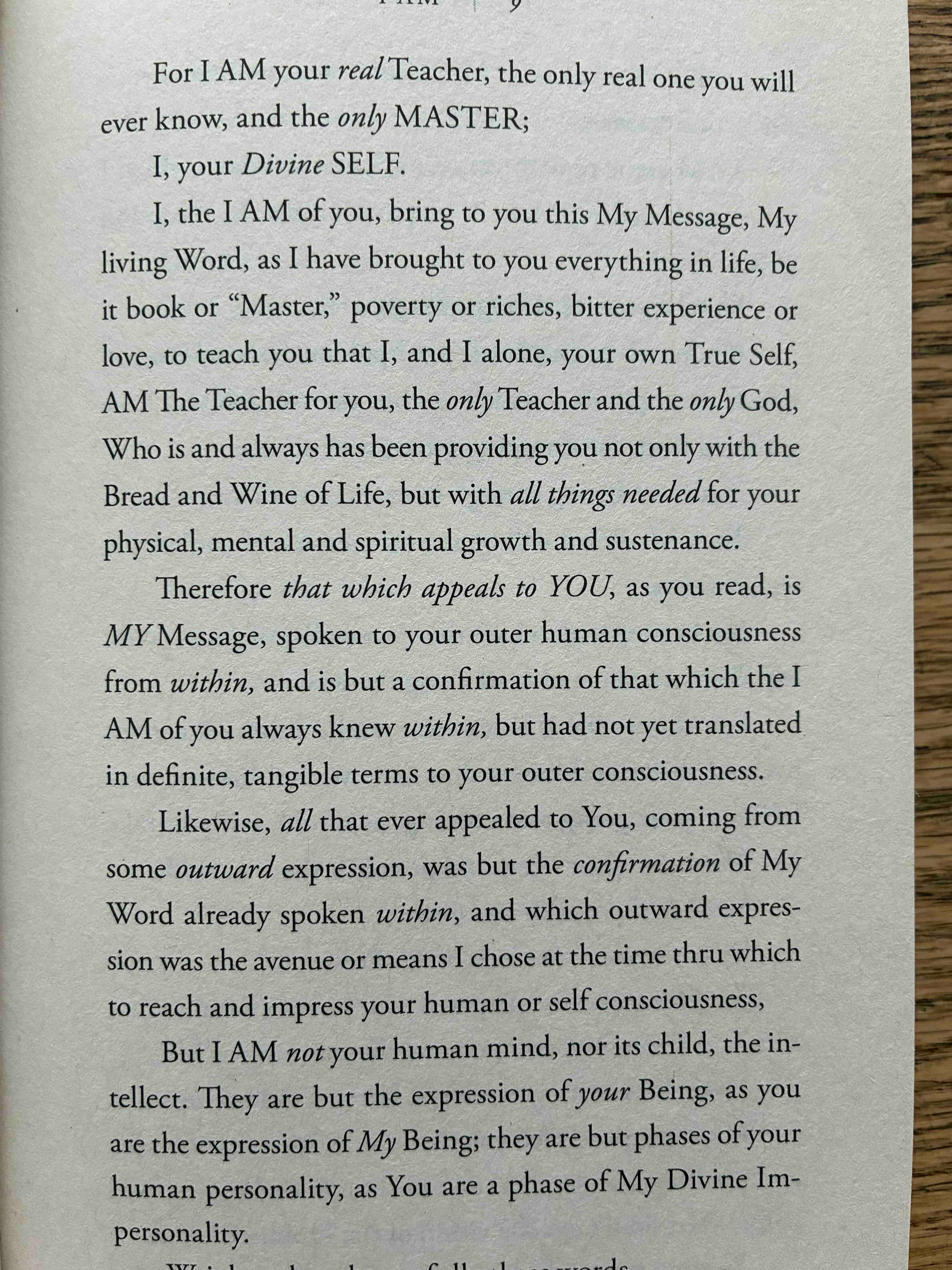
The archetype of a flaky California spiritualist, Larry Geller’s Wikipedia page identifies him as Elvis’s “spiritual advisor and personal hairstylist.” Under Larry’s tutelage, Elvis developed an avid interest in metaphysics, astrology, numerology, meditation, Hindu mysticism, and God only knows what else. The most notable of the library’s worth of books Larry dumped in Elvis’s lap was a 1917 tract of mystic self-realization called The Impersonal Life, which The King was so enamored of that he must’ve single-handedly kept it in by print by giving innumerable underlined copies to his girlfriends, co-stars, and hangers-on.
Elvis was so fanatical about The Impersonal Life that I assumed it must be worth reading. So I tracked down an out-of-print copy online and gave it a shot.
I don’t recommend the experience.
The funniest thing about Larry Geller was how much everybody else in Elvis’s life hated his guts: the Colonel, Priscilla, Elvis’s dad Vernon, and especially the Memphis Mafia guys, who were bitterly resentful that Elvis preferred spending hours locked in his bathroom talking about the nature of reality with his hair stylist instead of having water gun fights with them outside.
But Elvis was so smitten with Larry that it took two years before the Colonel was able to enforce an edict that all of Elvis’s haircuts had to be chaperoned and limited to thirty minutes.
And last, but not least:
Elvis seems to have clung to this belief as tightly as the ones about the drugs.
And to be fair, I think it’s actually true…as long as you’re ALSO a teenager. His relationship with Dixie Locke, which started pre-fame in 1954 when he was nineteen and she was fifteen, was adorably wholesome. (He took her to her junior prom! After he was already famous! The photo is so cute!)
His relationship with his wife Priscilla, which started when he was twenty-three and she was fourteen, was…significantly less wholesome.
And by the time Elvis started dating nineteen-year-old Ginger Alden less than a year before his death at forty-two, the whole situation just seemed embarrassing for everybody.
But looking at it from Elvis’s point of view, I think the biggest advantage to teenage girlfriends might be that they’re young and impressionable enough to actually read The Impersonal Life when you force it on them.
Thanks for reading! And for the love of God, please submit more questions so I don’t have to read another book.
The biographies were Peter Guralnick’s Last Train to Memphis and Careless Love, which are fantastic and absolutely worth reading in full if you’re into that kind of thing.
Crazy fact about Larry Geller: his business partner in his L.A. hair salon was Jay Sebring, who later dated Sharon Tate and was murdered with her by the Manson Family in 1969.
No posts
Comments
Nothing yet. Say the first thing.
Sign in to join the conversation.