
Blockchain has become synonymous with trillion-dollar markets and transformative promises. Yet much of the economic activity recorded on blockchains does not actually depend on them. The clearest illustration is the split in what has worked: stablecoins have grown into a $300B+ product, while many of the flagship enterprise projects built to reshape trade, shipping, insurance, and settlement have quietly shut down.
This issue makes one argument: the first wave of blockchain adoption is an infrastructure story, not a full-economy transformation. It added programmable, always-on rails to activity that was already standardised and digital, and stalled wherever the hard problems sat off the ledger. The sections below give a framework for reading the market, explain why payments won and multi-party coordination did not, connect regulation to the same question, and close with what it means for an allocator or operator.
“Blockchain” is one label for four very different things. Reading the market well means separating them, from the raw network down to real economic reliance.
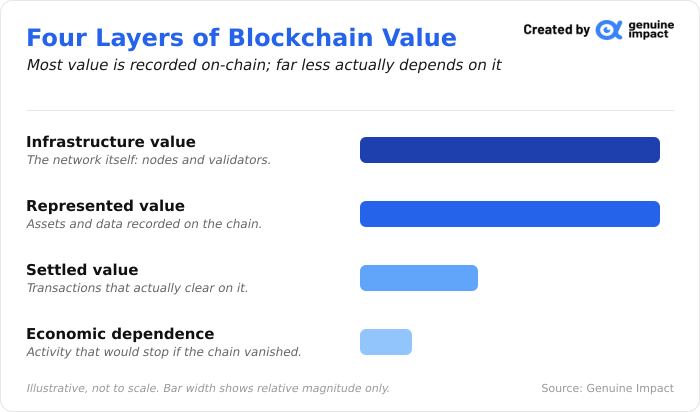
The gap between the top rung and the bottom is the whole point. Vast value is recorded on-chain; far less actually clears there, and less still would genuinely break if a given chain vanished. Most coverage lives at the top two layers, the market caps and the totals, where the numbers are largest and least meaningful. A process that can be recorded on a chain is not the same as a process that depends on it. Much on-chain activity is internal reshuffling, trading, transfers between custodians, and protocol operations, rather than durable external relationships. Recordable is not transformative. Recording information is much easier than changing the institutions that create and govern it.
Those four layers explain why one application became real infrastructure while others stalled. Start with the winner.
The clearest large-scale blockchain use case is the simplest: moving a dollar. Stablecoins are the clearest payments application with product-market fit. More than $300 billion is outstanding, mostly dollar-pegged USDT and USDC, and by late 2025 their issuers held well over $150 billion in US Treasury bills, making stablecoin issuers collectively among the larger holders of short-dated US Treasuries. Payment firms are wiring in directly; Visa’s stablecoin settlement reached a roughly $7 billion annualised run-rate by 2026.
Why this and not the harder cases? A stablecoin is digital-native, has a clear owner, and carries uniform terms, so a transfer between two wallets is a small, deterministic contract. The same holds for the other things that work: transfers of native tokens, on-chain lending and trading, and the private post-trade ledgers banks run between institutions that already agree on the rules. Blockchain did not fundamentally change these activities. It added a fast, programmable rail to value that was already digital and liquid. That is coordination, not reinvention.
The reverse case is where the ambitious money went, and where it died. The projects intended to reinvent global trade, shipping, insurance, and securities settlement are now a graveyard of shutdowns.
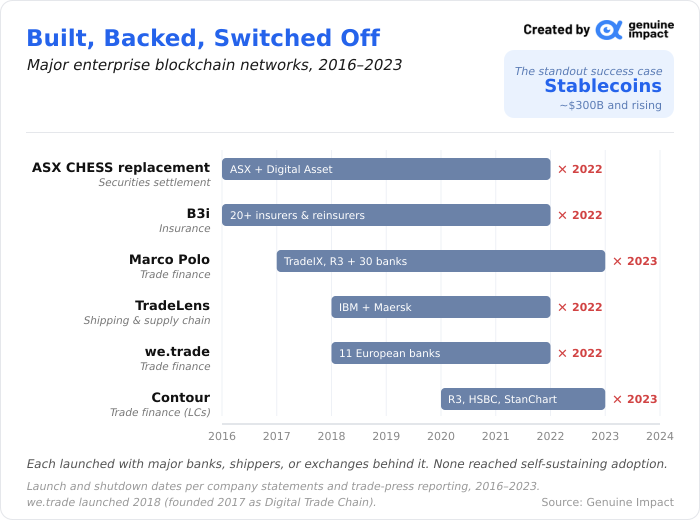
The backers were serious in every case. we.trade, a European bank consortium, and B3i, an insurance consortium, both closed in 2022. The Australian Securities Exchange scrapped its blockchain replacement for the CHESS clearing and settlement system the same year, after seven years of delays. Marco Polo and Contour, two trade-finance networks backed by the likes of BNY Mellon, HSBC, and Standard Chartered, collapsed in 2023.
TradeLens is the clearest example. Launched by IBM and Maersk in 2018, it signed more than 300 members across carriers, ports, and customs authorities, and was shut down in 2022 for never reaching commercial viability. The ledger was never the hard part. TradeLens could not persuade rival shippers to route their data through a platform half-owned by Maersk, and a tokenised bill of lading meant little while paper documents and national laws still governed the goods. Its value depended on competitors cooperating, regulators recognising the record, and confidential data being shared, none of which a blockchain supplies.
The same trap caught all six. Each borrowed the network-effect logic of crypto: it delivered value only if everyone joined, and in industries built on competition, everyone rarely does. Banks would not hand client relationships to a shared utility, rivals would not route data through a competitor’s platform, and no consortium could make a digital record binding where paper and national law still ruled. The underlying technology generally functioned. The commercial model did not.
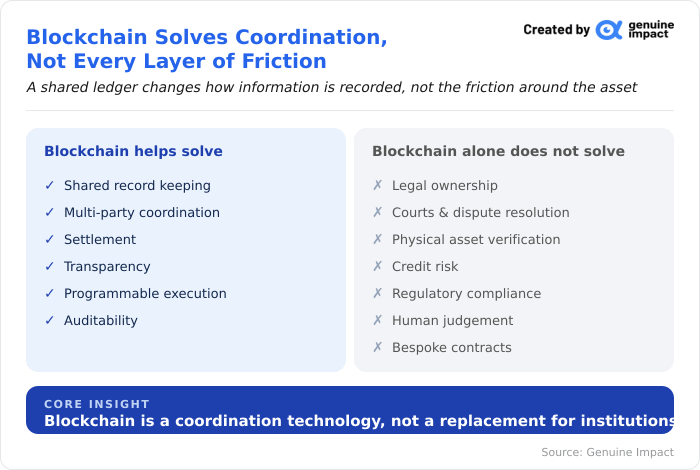
A shared ledger records the state of a process. It does not harmonise the rules, or the people, that govern it.
If cooperation is the bottleneck, regulation is what could eventually force it, and so far it has moved fastest exactly where the market already works. The US GENIUS Act, enacted in July 2025, created the first federal framework for payment stablecoins and bars permitted issuers from paying yield directly to holders, keeping them payment instruments rather than securities; the regime takes effect on 18 January 2027, or 120 days after final implementing rules if that comes sooner. The EU’s MiCA has pushed the market toward compliant issuers, and Hong Kong passed a Stablecoin Ordinance in 2025. In each case the law is hardening the rail that already carries volume.
The harder question is legal recognition for everything else. For a chain to be a source of truth rather than a convenient copy, courts and regulators must treat the on-chain record as the binding register. That is what governs finality, who holds which claims, and how disputes resolve. For payments, that recognition is arriving. For complex assets and multi-party processes, the law, the standards, and the willingness of rivals to share one remain the bottleneck.
The implications are straightforward. Blockchain as a payment and settlement rail is validated: stablecoins and the programmable movement of cash-like value already operate at scale, with the real risks sitting in smart-contract and custody layers and in issuer concentration. Blockchain for complex, multi-party coordination is unproven, and the track record is poor. A headline pilot is not a working network.
When evaluating any blockchain project, four questions cut through the noise:
☐ Does anyone actually depend on it?
☐ Would the workflow stop if it disappeared?
☐ Can participants revert to existing systems?
☐ Does it solve coordination, or only record information?
If the honest answers are "no one," "no," "easily," and "only record," it is optional plumbing. For a few institutions the honest reason to stay connected is optionality, a cheap hedge to plug into new rails if they mature, worth its cost only where the core business genuinely touches assets that need shared infrastructure. The metric that matters is critical dependence, not assets logged or transactions counted.
Stablecoin settlement in production. Whether banks and payment firms move stablecoin rails into core flows. This is the evidence that blockchain is becoming financial infrastructure rather than a speculative asset class.
Legal recognition of on-chain records. Whether any jurisdiction or court treats a blockchain as the authoritative register. This is the point at which chains move from recording activity to being the record.
Survival of the new enterprise networks. Whether the current wave of bank and market-infrastructure consortia, in repo, collateral, and post-trade, outlasts the last one. Survival without a single dominant sponsor is the tell.
The first wave of blockchain adoption is an infrastructure wave. It has shown, at scale and with serious institutions involved, that a shared ledger can settle standardised, digital-native value reliably. That is why payments and stablecoins dominate the credible case studies while the ambitious enterprise networks are mostly post-mortems.
The bull case is that the failures were early, and the next generation will work once standards and law catch up. Perhaps. But payments worked because a dollar was already fungible, settled, and uniform; a shipment, a building, or a contested claim is none of those, and no ledger changes that.
Blockchain has proven it can coordinate digital value. It has not proven it can replace the institutions that govern legal and economic relationships. Until it does, the honest description is narrow and precise: a durable shared ledger for specific financial flows, not a universal solvent for economic friction.
Sources verified mid-2026. Stablecoin supply and reserve data from DefiLlama, CoinGecko, and issuer disclosures; enterprise blockchain shutdowns (TradeLens, we.trade, ASX CHESS, Marco Polo, Contour, B3i) from company statements and contemporaneous reporting (2022–2023); regulatory details from the GENIUS Act, OCC, FDIC, and Treasury rulemakings, EU MiCA, and the Hong Kong Stablecoin Ordinance. On-chain values change daily and should be verified before publication.
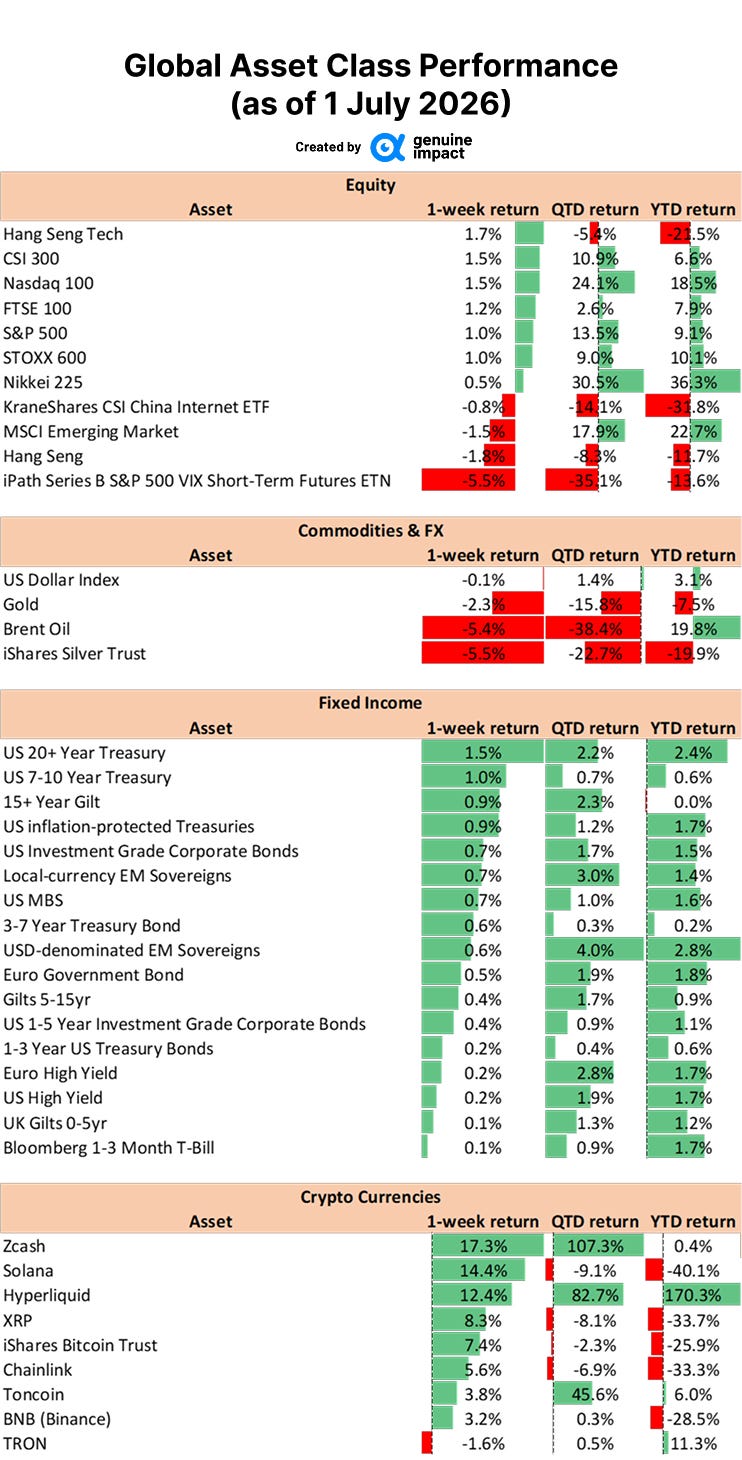
Global markets turned risk-on into quarter-end, recovering much of the ground lost in June’s sell-off. Gains were broad but shallow across equities, with US tech leading and China mixed. The Nasdaq 100 rose 1.5% and the S&P 500 1.0%, Europe’s STOXX 600 and the FTSE 100 added 1.0% and 1.2%, and Hang Seng Tech gained 1.7% even as the broader Hang Seng fell 1.8% and emerging markets slipped 1.5%. The VIX short-term futures position fell 5.5% as volatility drained out of the tape.
The sharpest moves were in crypto, which rebounded hardest of any asset class. Zcash rose 17.3%, Solana 14.4%, and Hyperliquid 12.4%, with the iShares Bitcoin Trust up 7.4% and XRP 8.3%. TRON was the only name to finish lower, down 1.6%.
Precious metals and oil were the week’s only meaningful decliners. Gold fell 2.3%, silver 5.5%, and Brent crude 5.4%, while the US dollar was flat at down 0.1%. Fixed income firmed across the board, with long US Treasuries up 1.5%, so almost everything outside commodities rallied together.
‼️ After the broad sell-off we flagged in June, risk assets rebounded into quarter-end. The question this week is where the portfolio led the recovery and where it lagged.
While the market clawed back its losses, our top position gained 18.6% in a single week, with two more holdings up 10.3% and 8.9%. Want to see which stocks, at what weights, and what we are watching next? Subscribe to unlock the full holdings and performance below ⬇️
Comments
Nothing yet. Say the first thing.
Sign in to join the conversation.