
The Association of Lactation Consultants in Ireland (ALCI) will host its annual conference this coming October in Galway. Promotional posts on social media feature a lactation consultant, Jacob Engelsman, who promotes some practices that many people find highly objectionable.
The Association of Lactation Consultants in Ireland (ALCI) is a professional association which represents and promotes International Board Certified Lactation Consultants (IBCLCs) in Ireland. Lactation consultants provide advice and practical support for breastfeeding and lactation problems.
The ALCI’s main purpose is to provide education, professional development, and support for lactation consultants and other healthcare workers involved in breastfeeding and lactation. It also acts as an advisory voice on breastfeeding and lactation issues, and promotes awareness of breastfeeding and breast milk (they call it human milk) as essential components for health, well-being, and disease prevention.
The association is funded primarily through HSE grants, membership fees, and income from educational events and conferences. The HSE provides ALCI and other breastfeeding support organisations with annual grant funding - an important investment of taxpayers’ money, given that Ireland has one of the lowest breastfeeding rates in Europe.
The ALCI’s annual conference hosts speakers on a variety of topics related to breastfeeding and lactation. Last year’s topics included HSE Infant Feeding Standards; donor breast milk; the role of voluntary breastfeeding organisations; the WHO Code on marketing breastmilk substitutes; induced lactation following surrogacy (the speaker was a woman who talked about her own personal experience of inducing lactation for a baby born via surrogacy); and medication use during breastfeeding.
This year’s program lists a lactation consultant called Jacob Engelsman speaking on “communicating inclusively: creating gender-affirming clinical spaces for families” and “lactation support for gender-diverse families”.
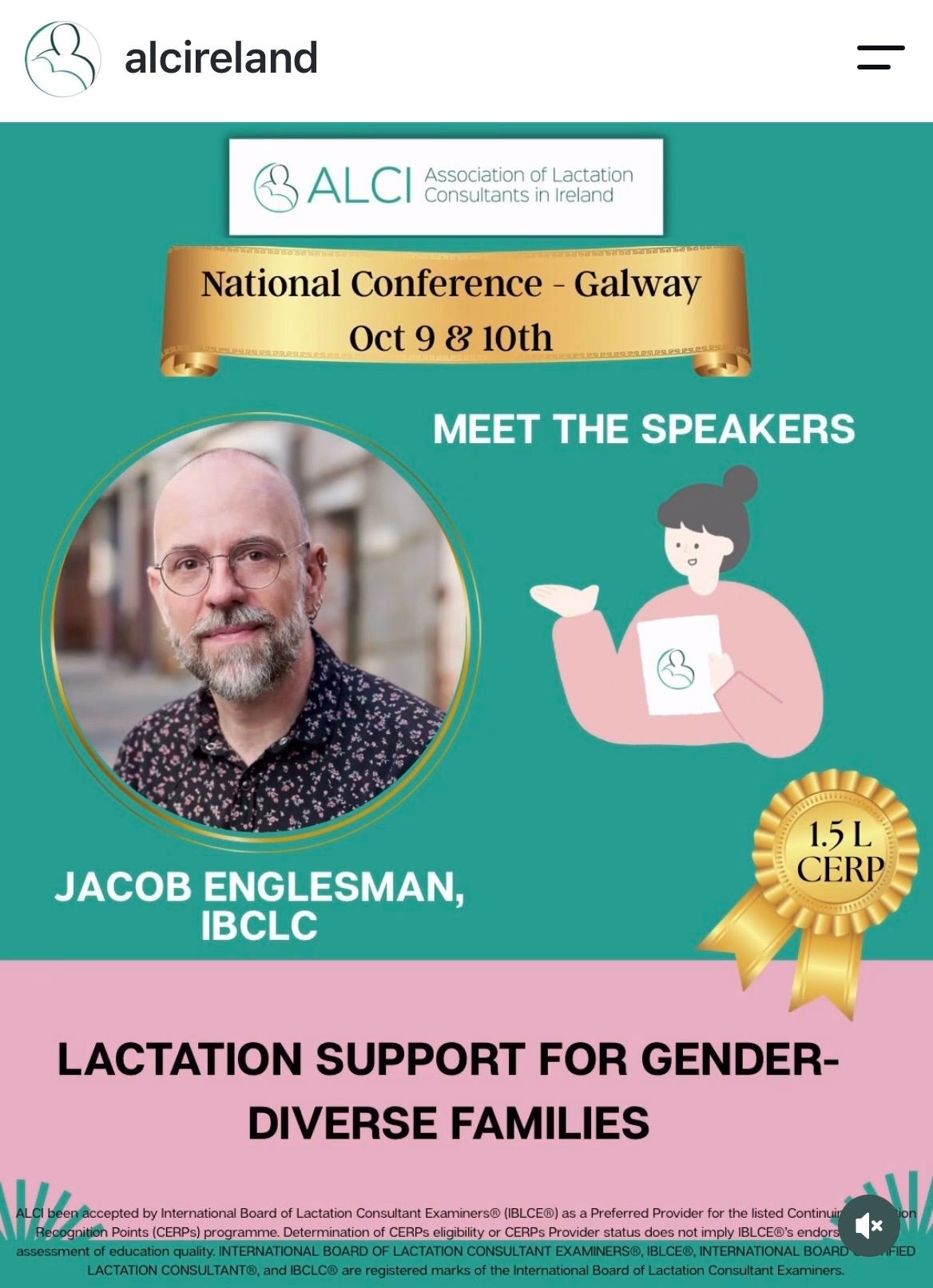
Few people are in doubt that pregnancy, childbirth, and breastfeeding are experienced by women and women only, so naturally there has been some commentary and pushback online. ALCI appear to have disabled commenting on their social media posts after removing negative comments.
Jacob Engelsman is a Certified Lactation Consultant based in the US. He describes himself as an infant care specialist, speaker, and writer. He is the author of a recently published book, Lactation for the Rest of Us: A Guide for Queer and Trans Parents and Helpers, and specialises in inducing lactation in non-gestational parents (parents who haven’t given birth). “Lactation is for anyone” Jacob tells us in this podcast interview.
Engelsman’s interest and expertise is not limited to lactation for the purpose of feeding an infant. One of his previous presentations was “Inducing Lactation for Kinksters” and for several years, according to his CV, he has been giving various talks including on lactation at Frolicon, an adult lifestyle and fetish convention held annually in Atlanta, Georgia with substantial programming around kink, BDSM, sexuality, polyamory, LGBTQ+ relationships and alternative sexual/family cultures.
He is not a nurse, midwife, doctor, or healthcare professional (nor does he claim to be). He is not a parent or someone with personal experience of breastfeeding. He got his certification five years ago and prior to that worked in the food service industry.
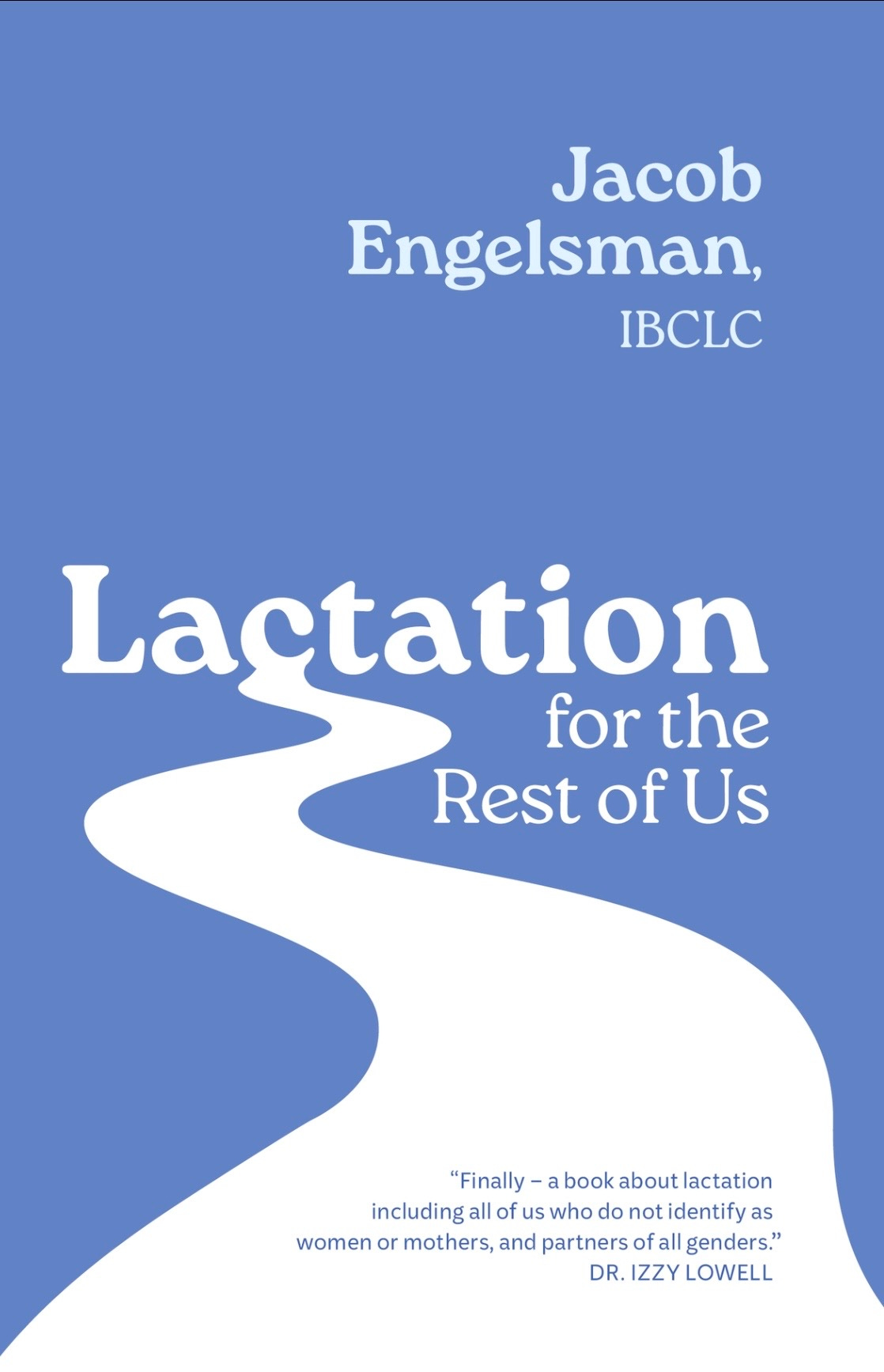
Engelsman’s book is a quick and at times confusing read. As someone with a background in healthcare and several years of breastfeeding experience, I can say that there are many books available on breastfeeding that are clearer, more comprehensive, and more practical.
The most obvious problem in terms of this book as a resource for breastfeeding women (even if they identify as trans or nonbinary) is that Engelsman’s desire to include everyone in the category of people who breastfeed renders some of his advice incomprehensible or nonsensical. At times it’s hard to know whether he’s talking about actual women or men who identify as women, about mothers or about others inducing lactation. For example, at one point he talks about the drug domperidone and the potential risks of taking it to induce lactation but he mentions that it comes with a risk of “an increase in dysphoria and other perinatal mood and anxiety disorders…even postpartum psychosis” (p.82). A postpartum woman wouldn’t need to take this drug to induce lactation, and a man (or woman) who has not been pregnant and given birth is not going to experience perinatal anything or postpartum psychosis. Perinatal means the period around birth and postpartum means the time that starts immediately after childbirth. The words refer to the woman who is pregnant, birthing, or has recently given birth.
Some women who identify as “queer” will buy this book in the hope it will offer them particularly relevant information or guidance. In the main, though, this book is not really written for women; the clue is in the title: “Lactation for the Rest of Us”.
Of course, there may be trans- or nonbinary-identified women who value having a lactation consultant who is male and who sees the world through a “queer” lens as they do (Engelsman identifies as a “cis queer” man and is married to a trans-identified woman). It may also be the case that Engelsman has some experience helping women who have had elective mastectomies to either breastfeed to some extent, or get to grips with the alternative.
Regardless of how they identify or what they believe, all women having babies should be able to access breastfeeding support when they need it from someone with expertise and experience, and who understands the importance of the mother-baby dyad.

The ALCI, in turn, has a duty to ensure its members are equipped to deal with all kinds of women in all kinds of situations, and so it is reasonable that their conference and other professional development resources would touch on the issue of women who identify as trans or nonbinary and who may have had surgeries that impact their ability to breastfeed. There is a growing cohort of detransitioners too who may need support, although the sad fact of the matter is that the vast majority of women who have undergone “top surgery” in an attempt to appear masculine do not retain the ability to produce or extract milk to feed their babies.
Men cannot breastfeed babies. It is not normal or healthy for a male to lactate; in fact, it usually signifies a serious medical issue like a pituitary gland tumour, thyroid problems, or liver or kidney disease.
Why would a man want to lactate? In Engelsman’s own words:
“There are several reasons a person may choose to lactate regardless of whether they can gestate a child…a non-gestational parent might choose to induce lactation as a way to feel emotionally closer to the baby, assert their own feelings of parenthood, gender euphoria, or just for the unique experience of it.” (p.49)
Writing specifically about “cis” men - that is, men who identify as men - he says:
“As to the question of why they would want to, it seems reasonable to believe that cis men want to lactate for the same reasons as anyone else. Which is to say, usually to feed and bond with their baby and to a lesser extent for curiosity, fun, or sexual gratification.” (p.152)
Notably, none of those reasons for inducing lactation centre a baby. This is a book and approach that prioritises adults’ desires (mostly male desires) over babies’ health and well-being.
Every mother I know who has breastfed has done so because it is good for their baby. Establishing breastfeeding with a newborn can be difficult and is always exhausting, but many women battle through because they know it’s best for their baby. Apart from rare exceptions, mothers put their babies’ needs first. They do not breastfeed to assert feelings of parenthood or to experience gender euphoria, or just for fun or sexual gratification.
When women are pregnant or breastfeeding they’re told to avoid or severely limit all kinds of things because they can be harmful to the baby - coffee, alcohol, some foods and various medications, definitely all recreational drugs. Engelsman, however, takes a relaxed approach. There seems to be no concern about feeding a baby whatever secretions the requisite drugs and pumping manage to induce in a male, despite it being untested in terms of nutrition and safety. Additionally, and contrary to most public health advice, when it comes to drugs and alcohol Engelsman says:
“Let someone else take care of your baby when you’re high or drunk. Beyond that, drug or alcohol use is rarely a deal-breaker for giving a baby your milk… The main problem with feeding your baby while you’ve been drinking is that you’re impaired regarding motor skills and decision making. Put simply, you’re more likely to drop the baby if you’re drunk.” (p.109)
Despite all this, there is little to indicate that many men can successfully induce lactation. The work required for the tiniest amount of liquid to be produced is significant - a few months of taking the contraceptive pill followed by several weeks of pumping or manually expressing up to eight times per day while taking more drugs and/or herbal supplements. Still, according to Engelsman some people ask “Is it okay for this to feel sexy?” (p.67). (I’ve yet to meet a woman who doesn’t find pumping to be a laborious and often uncomfortable process but again, this isn’t a book for or about women).
Engelsman shares two case studies in his book, both trans-identified men who try to induce lactation. One had very little success producing anything more than drops of liquid despite his best efforts.
The other apparently produced significant amounts of liquid but his wife (the baby’s mother), who was initially on board with the idea of “co-nursing”, found she couldn’t bear it when the baby came along. She herself was nursing successfully. They tried to blame it on her being depressed and hormonal but she didn’t meet the criteria for depression, and of course she was hormonal; she had just given birth! It reads like a profoundly distressing experience for the baby’s mother. Eventually the baby refused to latch with him, even when he attempted it “in a dark room when she was sleeping” (p.90).
Article 3 of the UN Convention on the Rights of the Child says that a child’s best interests must be the primary consideration in decisions affecting them. That being the case, where induced lactation by a non-gestational person is being considered, a baby’s health and welfare, evidence of safety, and available alternatives should be considered first and foremost, independently of the adult’s wishes or identity.
Adult desires do not justify exposing a baby to a novel and poorly researched feeding practice. Barring an apocalyptic event, it’s hard to imagine any circumstance where established alternatives such as the lactating biological mother or infant formula would be unavailable. A baby should never be used as a prop to validate a man who is pretending to be a woman; the baby cannot consent, cannot speak for itself and must not become secondary to an adult’s desire for validation or performance of an identity.
There is no discussion about the ethics of male lactation in Engelsman’s book. One can only hope that attendees at the conference will feel free to question the wisdom and safety of pretending that male lactation is in any way normal or healthy.
ALCI have invited Jacob Engelsman to present at their conference. While their disclaimer states that they don’t necessarily endorse the views of conference speakers, that does not remove their responsibility for who they choose to invite and give a platform to. If a prospective speaker has publicly expressed views or promoted practices that many people could reasonably find highly contentious, consideration of this should form part of ALCI’s due diligence and decision-making. It is, after all, membership fees and taxpayers’ money that is funding the conference.
Surely ALCI can provide inclusive and compassionate lactation support to women, regardless of how they identify, without surrendering sex-based boundaries or accepting the proposition that male lactation is equivalent to the normal female process of breastfeeding? Women are entitled to boundaries, and babies are entitled to have their welfare prioritised. Is it too much to ask that women and babies remain at the centre of a profession established to support them?
Ireland’s breastfeeding rates are persistently low compared with many European countries. Shouldn’t public funding be concentrated first on improving practical breastfeeding support for women and tackling social and healthcare barriers that cause women to stop breastfeeding when they would prefer to continue? Any amount of money spent on supporting male lactation is money foolishly spent.
If ALCI intends to include induction of male lactation within its remit going forward, what evidence-based safeguards will be put in place to ensure that a lactation consultant will always put the infant’s best interests first? How will a consultant establish that the infant’s welfare and nutritional needs take priority over the adult’s desire to lactate?
ALCI and Jacob Engelsman were contacted and given an opportunity to respond to the criticisms raised in this article. Neither had responded by the time of publication.
Concerned about ALCI’s approach? You can support this independent petition calling on ALCI not to endorse male lactation.
Catherine Monaghan is an Irish women’s rights activist and founding member of Wicklow Women 4 Women.
Genspect publishes a variety of authors with different perspectives. Any opinions expressed in this article are the author’s and do not necessarily reflect Genspect’s official position. For more on Genspect, visit our FAQs.
Comments
Nothing yet. Say the first thing.
Sign in to join the conversation.