

With the publication of Irreversible, Patrick D Hahn, a lecturer, researcher and author interested in overmedicalization and harm, wades into deep waters wearing a life vest. He presents a critique of the medicalized treatment for gender dysphoria that is expansive without being overwhelming. He doesn’t do a deep dive into the subject matter of any chapter, but he does give an insightful overview of the history and medicalization of the trans movement in sufficient detail for the rest of us to get our feet wet without drowning in jargon or complicated scientific language. The subtitle alone (The Rise Of Sex Change From Fringe Subculture To Multibillion-Dollar Industry) tells the potential reader what he or she needs to know: This book falls squarely in the gender-critical camp and the author is not afraid to speak his mind.
Hahn fearlessly describes trans as a “delusion,” a “social contagion,” and an “epidemic.” He calls out the movement as “an ideology which not only lacks any kind of credible evidence base, it also lacks a semblance of internal coherency, substituting instead a fog of semantic obfuscation.” Hahn states that transgenderism is “a social role, defined by the consumption of medical interventions for problems which manifestly are not medical in nature.” He invites us to “follow the money” and see what he names “Transgender Inc.” for what it is: a powerful, multibillion-dollar industry that presents an appearance of scientific authenticity as it inflicts harm on healthy, normal bodies.
Hahn’s book takes us on a journey through a brief history of trans, which includes figures like Magnus Hirschfeld, the German doctor who in 1910 introduced the term “transvestite.” Hahn also describes several individuals who were guinea pigs for the earliest sex reassignment surgeries in the 1920s and 1930s, including Rudolph “Dora” Richter and Einar Wegener, alias Lili Elbe, as well as George “Christine” Jorgensen, who received widespread media attention after his hormonal and surgical transition in the early 1950s.

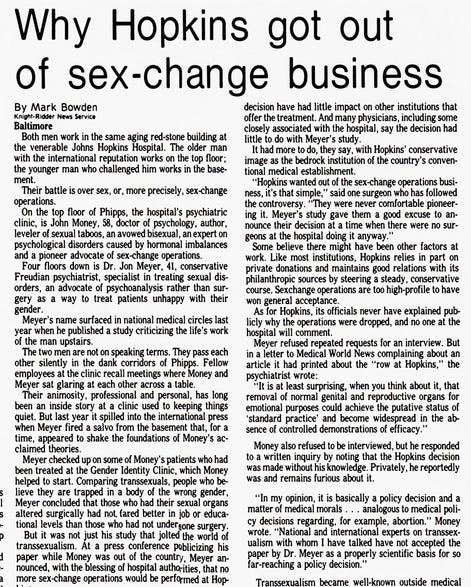
Hahn also focuses on the infamous Dr. John Money and the Gender Identity Clinic at Johns Hopkins Hospital from its opening in 1966 to its closing in 1979. The book describes the unethical experiment that Money carried out on David Reimer, who was raised as a girl based on the good doctor’s advice after the boy’s penis was accidentally burned off during a botched circumcision. The experiment was an abject failure, and David, who was obviously traumatized at the hands of Money, eventually took his own life. Hahn makes it clear that Money was a lying, unscrupulous child abuser who had absolutely no scientific justification for his “theories” about gender.
Hahn’s description of the closing of the Gender Identity Clinic at Johns Hopkins is important. The reader is left with the same knowledge that the doctors who headed the clinic came to realize by the late 1970s: sex reassignment doesn’t work. There is no convincing evidence that patients who changed sex were better off than those who did not have surgery. As a result, the Hopkins medical board voted to ban sex reassignment surgery at the hospital. Hahn is quick to note that this should have put an end to this nonsense. It did not.
Hahn connects the poor outcomes reported by the studies of adult transsexuals to the expansion of “Transgender Inc.” to include children. Throughout the book, he is adamant about how society has allowed the development of “factories for mass-producing cases of disordered gender identity,” particularly in children. Hahn has the guts to suggest that the gender industry is “grooming” kids to transition. You can almost feel him spitting with rage as he describes the ways in which medicalization, rather than psychotherapy, has become the only way to treat “a delusional gender identity … based on proclamations made decades ago by ‘experts’ guided by little more than their own confirmation bias and their own contact with the most hardcore, refractory cases.” He states:
Given the stupendous physical, psychological, social, and financial toll exacted by the transgender obsession, if this were anything other than a manufactured epidemic, you would think our public health authorities would be moving Heaven and Earth to find out what is causing it. They’re not doing that, because they know perfectly well what’s causing it. They’re causing it.
Perhaps the nerdiest chapter of Hahn’s book deals with Disorders of Sex Development, formerly known as intersex conditions. Hahn invites the reader to skip this chapter if the technical aspects seem overwhelming, but if you have an interest in understanding these biological phenomena, treat yourself and dive in. This chapter offers a superb description of the most common of these disorders, which are actually quite rare. Some of these conditions can result in ambiguous genitalia that do not clearly look like one sex or the other, or external sex organs that have the appearance of one sex on the outside accompanied by the internal gonads of the opposite sex, or in some extremely rare cases, the presence of both ovarian and testicular tissue in the same individual. Because these conditions seem to be a sort of bridge between male and female, the trans community has incorrectly held them out as evidence that sex is not binary and exists on a continuum or spectrum. Hahn wraps up this chapter by stating:
The main relevance of so-called “intersexes” to this debate seems to be that they are used as props by those who seek to gaslight us and convince us that we are so stupid we have no idea what a man is or what a woman is, and so we have no choice but to stand by and watch passively as thousands of children with completely normal male or female bodies are being poisoned, maimed, sterilized, and robbed of their futures by the sex change industry.
Hahn pays particular attention to the infamous, but thankfully now defunct, Tavistock gender clinic in London. Its clinicians were overloaded with cases of children presenting with gender dysphoria who were not afforded the opportunity to explore the reasons for their incongruent gender identity. Instead, overworked Tavistock clinicians were expected to rubber-stamp prescriptions for puberty blockers, which helped the clinic’s Gender Identity Development Service grow its revenue multifold. According to Hahn, the clinic’s deliberate gender-affirming activity helped to create a demand for the services it provided. Tavistock knew that hormonal interventions were not improving the psychological wellbeing of its patients, but continued to groom its patients into further transition anyway.
Hahn highlights the case of Keira Bell, a young woman who was permanently harmed by Tavistock, and is now an outspoken detransitioner. For Keira, who believes she was coerced into consenting to the clinic’s recommended treatments, the consequences, including facial hair, vaginal atrophy and a double mastectomy, were devastating. From her perspective, she was one of Tavistock’s unfortunate experiments. Tavistock is just one example in Hahn’s book of how the financially lucrative nature of gender-affirming care has driven the gender industry to drug, mutilate, and sterilize children and adults, often in the name of supposedly preventing self-harm.
An unfortunate aspect of the battle against gender-affirming care that Hahn does not address directly is the political divide. However, he does address this divide indirectly by making statements and quoting sources that parrot the standard political leanings of the players. For example, he quotes Republican lawmakers’ description of gender-affirming care as “morally and ethically repugnant,” and states that the ACLU has spoken out against Republicans as having the intention to discriminate against the marginalized trans community by banning “life-saving” health care. In addition, Hahn quotes Joe Biden in a way that depicts the former Democratic president as being tone deaf to the serious issues of the day, that included a school shooting carried out by a trans-identified former student. While Biden’s quoted statement was truly callous, pointing it out does nothing to rise above a debate that Hahn believes should transcend politics. On the contrary, Hahn’s book fans the flames that perpetuate the left/right antagonism that surrounds this issue. Gender-critical left-leaning readers may feel that Hahn’s book is weighted against them.
Hahn doesn’t delve into the socially problematic aspect of the trans movement that has allowed men access to women’s spaces and sports because he believes that when Transgender Inc. loses steam, these cultural issues will dry up on their own. However, he does emphasize the enormous costs, both financial and medical, of gender-affirming care. For example, Hahn describes the permanent and toxic effects of wrong-sex hormonal treatments. He also gives limited but graphic descriptions of male-to-female and female-to-male sex reassignment surgeries along with their common risks and complications, which can be severe. He lists the literal cost of various “gender-affirming” surgical procedures and points to research that estimated the size of the U.S. market for sex reassignment surgery in 2022 as exceeding 2 billion dollars. As the number of individuals who claim to have gender variance increases, this extremely lucrative market is only expected to grow.
By writing this book, Hahn is preaching to the gender-critical choir, but the music is moving. His book will get no traction in the trans community. It uses loaded language like “transgenderism” and attempts to answer questions that many people feel they can’t even ask without fear of reprisal:
What causes transgenderism?
Does sex reassignment surgery help?
Does psychotherapy help?
Although Hahn’s book resonates well with its audience, it is far from perfect. Its most glaring imperfection is his selection of the format for the book itself: an eight and a half by eleven paperback. This style gives it the quirky look and feel of a workbook, noticeably impacting the layout of the text on the page and the reader’s field of vision. More importantly, the book lacks consistent organization, with some chapters following a coherent structure and others feeling like a hodgepodge of ideas, ultimately detracting from his central thesis. In addition, Hahn’s unfortunate choice of Roman numerals for the endnotes is cumbersome, making it challenging to locate any particular note in the back of the book. These issues are the sort of thing that happens when you self-publish. All of these flaws and other minor defects would have been addressed by a professional editor. Although the book has its imperfections, don’t let the unusual format and structure, occasional editorial oversights, and peculiar citation numbering style distract you. Irreversible is a book worth reading.
Setting criticisms aside, Hahn’s book has value. It broadens our perception of the history of trans and provides meaningful insight into the serious problems inherent in popularizing the medicalization of what used to be a deviant psychiatric disorder, but is now merely a healthy divergence in lived experience. The author is fully aware that he is opening himself up to condemnation by the trans community and its supporters. He is no stranger to controversy, having published several other books that criticize the medical industrial complex which puts profits over patients. By publishing Irreversible, Hahn presents “a work of advocacy” that provides a stark portrait of the irreversible and irremediable harms being perpetrated on “some of the most confused and vulnerable members of our society — including children.”
Irreversible covers much more. For example, the book includes an interview with James Esses, a therapist in the U.K. who was expelled from his master’s program, reinstated, and then chose to leave because he refused to conform to the expectation that anything other than unconditionally affirming a client’s trans identity is conversion therapy.. The book also relates the tragic first-hand account of Jeffrey Younger, a father who lost a custody battle over his twin sons, one of whom was apparently coerced into transition by his mother.
These stories and accounts illustrate the coercive influence of health care professionals, educators, members of the judiciary, and average people who engage in discourse, both online and in person, that spreads the gospel of trans and indoctrinates people into a belief system based on a lie.. Hahn wants to counter the message of trans advocates with his own: we have “create[d] an entire branch of medicine and an entire industry devoted to poisoning and mutilating and sterilizing healthy bodies … including children.” Hahn’s book hammers home this point: the harmful effects of these interventions are Irreversible.
Genspect publishes a variety of authors with different perspectives. Any opinions expressed in this article are the author’s and do not necessarily reflect Genspect’s official position. For more on Genspect, visit our FAQs.
Comments
Nothing yet. Say the first thing.
Sign in to join the conversation.