
Hi everyone -
Continuing this week with the newsletter format of Learn, Experiment, Optimize, I’m bringing you some new research connections that I found interesting - and hopefully you will too!
Gratefully yours,
~Debbie
Low vitamin B6, quinolinic acid, and Parkinson’s (Learn):
Vitamin B6 is an essential cofactor in over 100 different reactions in the body. It’s a water-soluble vitamin that we don’t store long-term, so we need to get it regularly in our diet.
Genetic variants can influence how likely you are to need a little more B6 and which form of B6 is likely to work best for you. Here’s the full Genetic Lifehacks article on B6 if you want to check your genes.
While updating the B6 article this week, I came across a 2025 study on Parkinson’s that ties to B6 in a really interesting way.
The study showed that B6 levels are usually lower in people with Parkinson’s (as many studies have shown for decades), and that lower B6 levels cause the amino acid tryptophan to be metabolized into quinolinic acid, which is neurotoxic, in the brain.
Tryptophan can either be used to synthesize serotonin and melatonin, or it can be converted to kynurenine. When inflammation is present, such as in aging or in people exposed to toxins, more tryptophan gets shuttled to the kynurenine pathway. Kynurenine then can either become a neuroprotective kynurenic acid or go down a second path that leads to the formation of niacin - with quinolinic acid as an intermediary there.
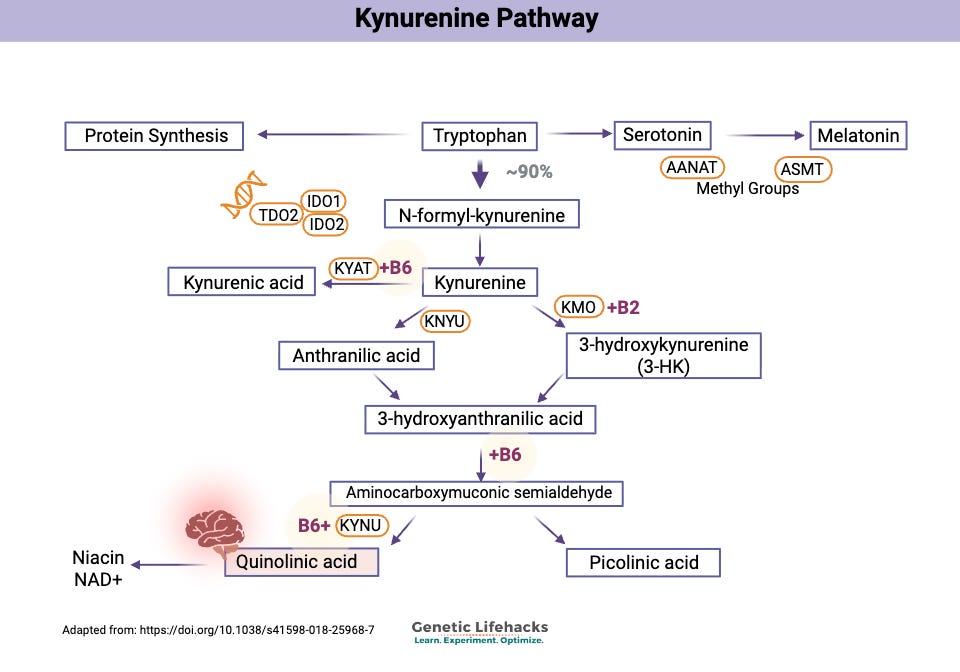
When B6 is limited, less kynurenine goes toward kynurenic acid, with more creating 3-HK and ending up as quinolinic acid, which is excitotoxic. It can bind to NMDA receptors and cause overactivation.
In the study, higher quinolinic acid levels in Parkinson’s patients were directly shown to be associated with worse motor-related symptoms.
The authors of the study don’t say that taking vitamin B6 will prevent all Parkinson’s cases, and I don’t want you to think that is the takeaway here. Rather, they show that lower B6 levels are likely involved in part of what is going on with Parkinson’s. There are multiple pathways involved.
Here’s what I found interesting - the connection with the gut microbiome and an environmental risk factor for Parkinson’s.
A 2024 study shows that long-term exposure to organophosphate pesticides changes the gut microbiome in a way that reduces vitamin B6 production.
Backing up a bit - we get vitamin B6 from foods like liver, tuna, chickpeas, salmon, chicken, bananas, and potatoes. But the bacteria in our gut also crank out quite a bit of B6. We can’t survive on the amount from the gut microbiome alone, but some bacteria are giving off B6, which is then absorbed in our gut or used by other gut microbes.
The 2024 study involved people exposed to higher ambient levels of organophosphate pesticides, which are used on crops and on golf courses. (Another recent study had shown that living within a mile of a golf course was associated with “126% increased odds” of Parkinson’s compared to living more than 6 miles from a golf course. The connection to golf is pesticide runoff into the water sources.)
So… we have organophosphate pesticides changing the gut microbiome to reduce B6 production, pesticides linked to increased Parkinson’s (possibly through multiple routes including BChE), and reduced vitamin B6 mechanistically and directly linked to increased quinolinic acid, which causes neuronal damage.
What can you do? (Experiment)
For active Genetic Lifehacks members - check your genes related to vitamin B6 and see how your diet stacks up with the amount of B6 needed. One SNP in the PNPO gene (rs17679445) is found in about 6% of the population, and it reduces the conversion to the active form of B6 (P5P) by 40%. For someone with variants that reduce B6 levels or reduce conversion of B6 to P5P, consider increasing your dietary intake or supplementing with low-dose P5P.
The thing with B6 is that you don’t want to go overboard with high-dose supplements for a long time. There are case studies and anecdotal reports of people ending up with peripheral neuropathy with long-term high-dose B6 supplementation. The upper limit (UL) is set at 100mg/day for adults, which is significantly higher than the RDA of 1.5-1.7mg/day.[ref] So dialing in B6 may mean taking into account whether you have something causing chronic inflammation (and thus using up more B6), looking at your current dietary intake, considering any genetic variants, and then adding either food sources or a low-dose supplement.
The thing to remember with supplements, whether vitamins or flavonoids, is that it doesn’t have to be something you take forever - come back in a few months and reconsider your current status with diet, inflammation, and any positive changes that have occurred. Back off the supplement if it is no longer needed.
As always, let me caution that you should talk with your doctor if you have any questions, are on prescription medications, or have major medical issues before starting any supplement, including something as seemingly benign as a water-soluble vitamin. Definitely talk with your doctor if you’re on Parkinson’s medications because B6 also plays a role in the conversion of dopamine.
Preventing neurodegenerative disease and cognitive dysfunction (Optimize):
The Parkinson’s study was just one example of the many ways that B6 is important in the brain. There are links between optimal vitamin B6 and depression, homocysteine levels, Alzheimer’s, and overall cognitive function.
Read through the full B6 article if you’re interested in the other ways that B6 optimization can help with brain function. And if you’ve got B6 covered, cross it off your list and move on to the Parkinson’s article, brain fog article, depression and inflammation, blood-brain barrier function, etc.
Latest on Longevity Lifehacks:
Comments
Nothing yet. Say the first thing.
Sign in to join the conversation.