
Today it's getting technical again, and really nastily complicated. I want to emphasize once more that I understand only a fraction of what Maria (Maria Gutschi) has in mind when it comes to ionizable lipids and nanoprecipitation.
The occasion is the following statements from Dr. Bine’s Substack1:
“In short: Pfizer claims that a certain substance is normally broken down and eliminated by the body. In reality, however, the emulsifier likely remains in the body and damages cells.”
This statement strikes me as problematic in several respects. An emulsifier (in the chemical, physical, or classical sense) stabilizes a dispersion of two immiscible phases, typically by adsorbing at interfaces and reducing interfacial tension. 2,3
Probably the main thinking error that was made lies in the fact: A substance can be amphiphilic without being an emulsifier in the classical sense.4 Moreover, a true emulsifier is not automatically a membrane-disrupting or membrane-destabilizing detergent.5,6
Let’s look at what the data provides and what not.7
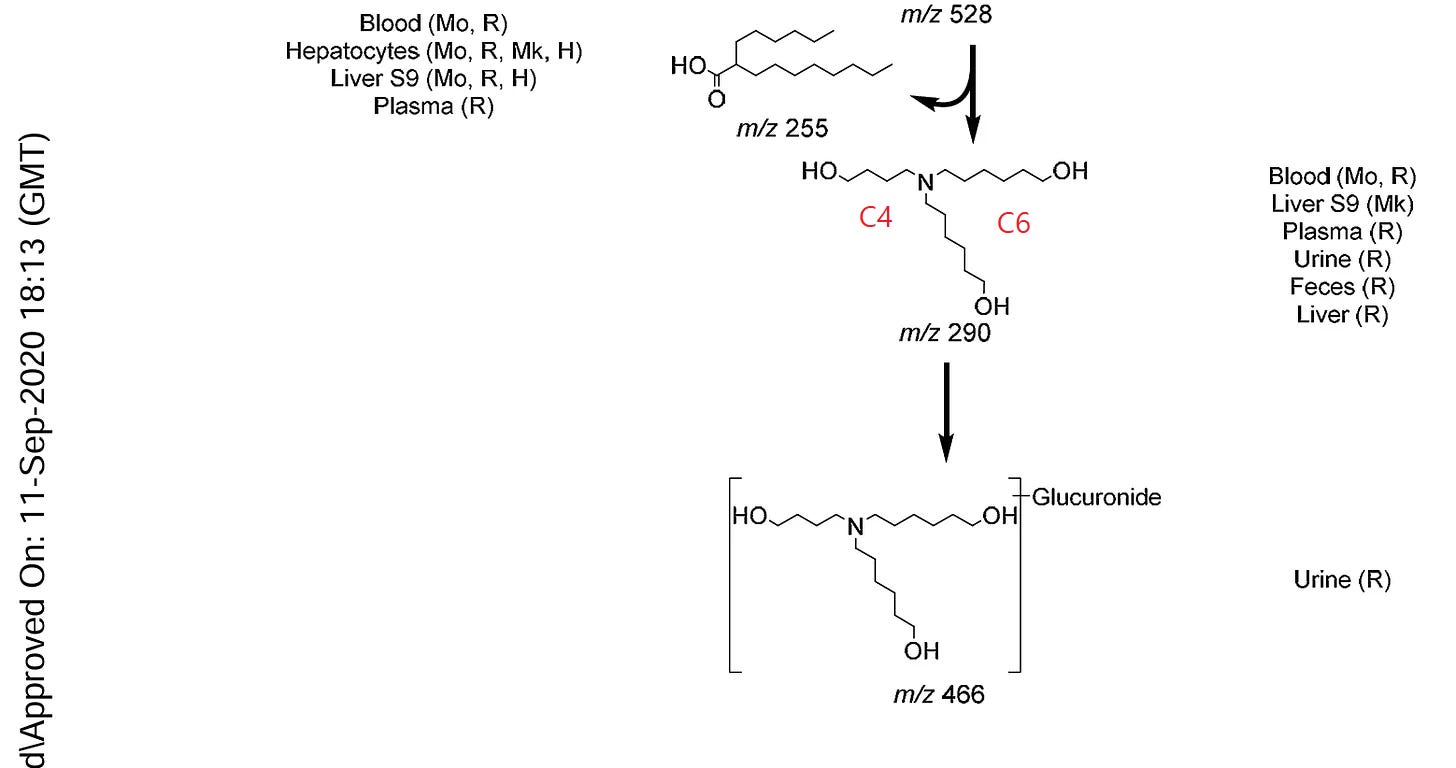
Of particular interest in this context are the products with m/z 528 and m/z 290. However, since I have so far focused exclusively on m/z 290, and I am certainly not the strongest when it comes to rigorous chemical formulas and stoichiometric equations, I can only discuss the aspects where I am reasonably confident that I have not made a conceptual error.
Emulsifiers typically have alkyl chain lengths in the range of C8–C12:
C₈ (caprylic acid): ≈ 1.0–1.2 nm
C₁₀ (capric acid): ≈ 1.2–1.4 nm
C₁₂ (lauric acid): ≈ 1.5–1.7 nm
These chain lengths are what determine the amphiphilic properties of emulsifiers.8,9, 10
As can be seen, our m/z 290 degradation product is structurally quite different. Following ester cleavage, it is a trialkanolamine consisting of a central amine moiety and three hydroxyalkyl side chains (one C4 chain and two C6 chains, each terminating in a hydroxyl group). This is also reflected in the compound's name, as Segalla correctly points out.11
C6 alkyl chains are typically too short to confer effective emulsifying properties. Furthermore, within the acidic environment of endosomes and lysosomes, the tertiary amine head group becomes protonated, resulting in a highly polar and positively charged amphiphilic structure. This protonation state is not consistent with the behavior expected from a classical formulation emulsifier, which requires a balanced hydrophilic–hydrophobic architecture optimized for stabilization of interfaces between immiscible phases. Within the acidic environment of endosomes and lysosomes, protonated ionizable lipid species instead primarily participate in electrostatic interactions, membrane association, lipid reorganization, and processes relevant to endosomal escape rather than acting as classical emulsifiers.
Let’s look at the paper by Segalla:
“In conclusion, on the basis of the evidentiary and mechanistic elements set out above, a precautionary revocation of the Conditional Marketing Authorization (CMA) for Comirnaty is proposed as a proportionate measure to restore regulatory integrity and to stop immediately anyavoidable public-health exposure while the outstanding toxicological criticalitiesare addressed under full analytical traceability.
The grounds supporting this request can be summarized as follows:
Vitiation of regulatory consent: The EMA, as reflected in the Assessment Report of 19 February 2021, appears to have been influenced by the inclusion and subsequent endorsement of non-traceable (and potentially non-existent) chemical isomers, thereby compromising the evaluative process and plausibly underestimating risk.
Public-health risk: The intracellular persistence and bioenergetic impact of the catabolites (2-hexyldecanoic acidand the trialkanolamine [(4-hydroxybutyl)azanediyl]dihexanol) entail undeclared risks of systemic toxicity and genomic instability for exposed individuals.
Safety protocols and the Precautionary Principle: The deployment of lipid nanomaterials whose toxicological profiles are inadequately characterized is inconsistent with the Precautionary Principle and with European regulatory expectations for nanomaterial-containing medicinal products, thereby impairingrecipient safety.4.Ethical profile: The documented criticalities raise a manifest concern with respect to foundational standards for human experimentation, including those captured by Article 10 of the Nuremberg Code: “During the course of the experiment the scientist in charge must be prepared to terminate the experiment at any stage, if he has probable cause to believe, in the exercise of the good faith, superior skill and careful judgment required of him,that a continuation of the experiment is likely to result in injury, disability, or death to the experimental subject.”
In a brief summary Segalla's central concern is that the metabolites 2-hexyldecanoic acid and [(4-hydroxybutyl)azanediyl]dihexanol may persist in cells and cause toxic effects, including disruption of cellular metabolism and possible genomic instability, and that these risks have not been sufficiently assessed by regulators. But there is no word that would support any assumption of emulsifying properties.
And the second sentence made me wonder is this one:
“
Inhibition of mitochondrial β-oxidation, mediated by 2-hexyldecanoic acid (H410; Aquatic Chronic 1).
Disruption of lysosomal homeostasis and lysosomotropic sequestration, caused by the cationic trialkanolamine [(4-hydroxybutyl)azanediyl]dihexanol.
Destabilization of the nuclear envelope (“lipid stripping”) through detergent-like membrane disruption. ”
Dr. Stebel conflates dysfunction/organizational disruption (perturbation) with structural disruption (dissolution/structural loss, severe alterations in permeability). One could, of course, argue in terms of NLRP3 activation. However, such disruption within the endosome/lysosome is only present if endosomal escape occurs. This therefore represents a different mechanism than dissolution caused by emulsifiers. Such effects would be more plausibly explained by the proton sponge effect and a resulting “burst”.
The review by Szegin et al.12 summarizes that biological membranes are dynamic organizational units and that changes in lipid composition, domain formation, or lateral organization can influence membrane function without physically destroying the membrane. A change in membrane organization (“perturbation”) is therefore not equivalent to a loss of structural integrity.
Furthermore, Stewart et al.13 clearly distinguish between membrane perturbation and membrane disruption. Membrane perturbation refers to processes such as the incorporation of amphiphilic molecules, changes in membrane curvature, alterations in lipid packing, or modifications of membrane dynamics. Membrane disruption, in contrast, implies a loss of structural integrity through mechanisms such as defect formation, pore formation, permeabilization, or loss of barrier function.
What did we wrote for the mechanisms of the metabolites and the issue how the metabolites will most likely be handled in transfected cells?14:
“Once the genetic material (RNA/modRNA/DNA) escapes the endosome, it can be packaged into naturally secreted membrane-bound vesicles along with ionizable lipids and intact mRNA. Maugeri [72] showed that, in a murine model, LNPs in recycling endosomes are either expelled intact or partially degraded, thereby affecting transfection efficiency. This process involves the trafficking of a fraction of LNP-delivered mRNA together with LNP-derived lipids into intraluminal vesicles of multivesicular endosomes (MVBs, which are subsequently released via extracellular vesicles, thereby enabling intercellular transfer. In such models, these exosomes circulate systemically and have been shown to mediate functional RNA transfer to distant cells and enable protein translation [72] . The evidence for modRNA-LNPs transfer in humans remains preliminary and needs further investigation [84,85].
Exocytosis serves as both a clearance route and a secondary distribution mechanism, extending modRNA or lipid fragments to the surrounding microenvironment in a paracrine manner [86], where functional translation is possible. Importantly, recycling of endosomes, as well as eLNPs or those with blebs, may cause cellular stress, oxidative damage, and chronic inflammation [87]. These factors are not considered in biodistribution studies and may contribute to cumulative toxicity, especially with repeated doses [88].”
To be honest, I was not able to fully follow the reasoning behind how Dr. Stebel arrives at the aldehyde issue. The argumentation appeared too chaotic to me to identify a clear line of reasoning. However, we already addressed this issue (and keep in mind that the paper has not been modified with additional literature since its submission and acceptance after submitting the major revision in late January 2026):
“Tertiary amine-based ionizable lipids can generate N-oxides and reactive aldehydes during manufacturing and storage, which may covalently modify modRNA, rendering it untranslatable. Packer et al first identified such adducts in 2021 [94]. They can be mitigated by buffering or novel lipid designs [95]. These adducts may generate aberrant molecules that activate interferon-driven innate immune pathways [96,97] or potentially modify cellular proteins through electrophilic mechanisms. Ionizable lipids commonly incorporate unsaturated acyl chains susceptible to peroxidation, producing electrophilic aldehydes such as 4-hydroxynonenal (4-HNE), a well-established oxidative-stress product known to disrupt protein folding and lysosomal function [78,98]. However, direct evidence that modRNA-LNP administration generates 4-HNE at biologically significant levels in humans is lacking, and any clinical impact remains speculative.”
In our paper, we had therefore already discussed that ionizable lipids, due to their chemistry and membrane interactions, could in principle promote oxidative stress pathways, lipid peroxidation, and the formation of reactive aldehydes such as 4-HNE. Since we are working hypothetically, this represents a mechanistic prediction rather than an observation.
Independent datasets are now emerging that fall precisely within this predicted space: mitochondrial vulnerability, oxidative stress signatures, and patterns consistent with lipid peroxidation.15,16,17,18 Unfortunately, we had not yet come across Jo et al. at that time.
Does this prove our hypothesis? No. Is it becoming increasingly difficult to dismiss these parallels as mere coincidence? Definitely.
What is fascinating about this is not 4-HNE itself. What is fascinating is when physicochemical premises, initially formulated as a hypothesis, later reappear in independent in vivo datasets.
To be honest, I am still not sure whether I should feel proud of this or find it rather unsettling.
Tan C, McClements DJ. Application of Advanced Emulsion Technology in the Food Industry: A Review and Critical Evaluation. Foods. 2021 Apr 9;10(4):812. doi: 10.3390/foods10040812. PMID: 33918596; PMCID: PMC8068840.
Xiao T, Ma X, Hu H, Xiang F, Zhang X, Zheng Y, Dong H, Adhikari B, Wang Q, Shi A. Advances in emulsion stability: A review on mechanisms, role of emulsifiers, and applications in food. Food Chem X. 2025 Jul 17;29:102792. doi: 10.1016/j.fochx.2025.102792. PMID: 40747487; PMCID: PMC12311586.
Uzoigwe C, Burgess JG, Ennis CJ, Rahman PK. Bioemulsifiers are not biosurfactants and require different screening approaches. Front Microbiol. 2015 Apr 7;6:245. doi: 10.3389/fmicb.2015.00245. PMID: 25904897; PMCID: PMC4387539.
Pereyra AS, Harris KL, Soepriatna AH, Waterbury QA, Bharathi SS, Zhang Y, Fisher-Wellman KH, Goergen CJ, Goetzman ES, Ellis JM. Octanoate is differentially metabolized in liver and muscle and fails to rescue cardiomyopathy in CPT2 deficiency. J Lipid Res. 2021;62:100069. doi: 10.1016/j.jlr.2021.100069. Epub 2021 Mar 20. PMID: 33757734; PMCID: PMC8082564.
Zhang S, Xiao H, Li N. Degradation of Polysorbate 20 by Sialate O-Acetylesterase in Monoclonal Antibody Formulations. J Pharm Sci. 2021;110(12):3866-3873. doi:10.1016/j.xphs.2021.09.001
https://phmpt.org/wp-content/uploads/2023/02/125742_S1_M4_4.2.2.4-043725.pdf
Heil CS, Wehrheim SS, Paithankar KS, Grininger M. Fatty Acid Biosynthesis: Chain-Length Regulation and Control. Chembiochem. 2019;20(18):2298-2321. doi:10.1002/cbic.201800809
https://www.biolinscientific.com/blog/emulsifiers-are-surfactants-that-stabilize-oil-water-interfaces
Zhang Y, Yan E, Chen Q, Zhao L, Wang Y, Deng J, et al. Influence of alkyl chain length on the performance of inverse emulsion polyacrylamide fracturing fluid thickeners. Ind Eng Chem Res. 2024;63(13):5513-5526. doi:10.1021/acs.iecr.3c04228.
Segalla G. ALC-0315 Toxic Metabolites: Pharmacokinetic and Regulatory Criticalities in a COVID-19 “mRNA Vaccine”. Int J Vaccine Theory Pract Res. 2026;4(2):1673–1699. doi:10.56098/q9fgvp96.
Sezgin E, Levental I, Mayor S, Eggeling C. The mystery of membrane organization: composition, regulation and roles of lipid rafts. Nat Rev Mol Cell Biol. 2017;18(6):361-374. doi:10.1038/nrm.2017.16
Stewart MP, Langer R, Jensen KF. Intracellular Delivery by Membrane Disruption: Mechanisms, Strategies, and Concepts. Chem Rev. 2018;118(16):7409–7531. doi:10.1021/acs.chemrev.7b00678.
Seger F, Gutschi LM, Seneff S. Lipid nanoparticles as active biointerfaces: from membrane interaction to systemic dysregulation. Preprints. 2025;2025110517. doi:10.20944/preprints202511.0517.v6.
Jo H, Yoon S, Cho S, Lee E, Kim N, Choi EB, et al. Enhanced subchronic cardiac stress of high doses of a novel SARS-CoV-2 mRNA vaccine candidate in streptozotocin-induced diabetic mice. Food Chem Toxicol. 2025;196:115187. doi:10.1016/j.fct.2025.115187.
Mori G, Yamamoto M, Ishikawa K, Tamashiro H, Suzuki H, Mizuno S, et al. Mitochondrial vulnerability underlies myocarditis from COVID-19 mRNA vaccine. Nat Commun. 2026. doi:10.1038/s41467-026-71295-1.
Kim S, Park C, Lee Y, Lee K, Lee H, Lee K. Inflammatory and immune-mediated toxicity of lipid nanoparticles. Biomed Pharmacother. 2026;119385. doi:10.1016/j.biopha.2026.119385.
Choi, K., Choi, S., Joe, D., Seo, Y.-s., Ham, J., Chung, H., et al. (2026) ‘Myocarditis After mRNA Vaccination: A Metabolic–Innate Immune Cascade Centered on Lipid Nanoparticles’, Mediators of Inflammation, 2026, doi:10.1155/mi/8991922.
Keine Posts
Comments
Nothing yet. Say the first thing.
Sign in to join the conversation.