
Is not peace, in the last analysis, basically a matter of human rights--the right to live out our lives without fear of devastation--the right to breathe air as nature provided it--the right of future generations to a healthy existence?
John F Kennedy
Which foreign-policy commencement address stands as the most consequential? Many would choose John F. Kennedy’s “A Strategy of Peace,” delivered to the graduating class of American University on June 10, 1963.
That spring morning, President John F. Kennedy came to American University in Washington, D.C., to deliver a commencement address intended to alter the course of history. Speaking from a podium bearing the presidential seal, he called for an end to the nuclear arms race with the Soviet Union and for the start of a new era of peace among nations.
It failed miserably.
Although the speech was downplayed or dismissed on Capitol Hill and by the American press, and soon largely forgotten at home, it drew praise abroad from leading foreign policy figures and major news outlets.
The Coumbus Dispatch called it “an appeasement cue.” Congressional response was mixed; Barry Goldwater criticized JFK for adopting a “soft stance” on the Soviet Union. UK’s Manchester Guardian called it “one of the great state papers of American history,” while Premier Khrushchev later described it as “the best speech by any President since Roosevelt.”
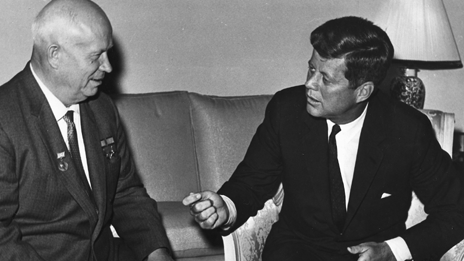
As JFK hoped, it resonated with Soviet Chairman Nikita Khrushchev. It asked Americans to rethink U.S. relations with the Soviet Union and to support finding ways for the two countries to co-exist peacefully.
Special Counsel to the President and author of the address, Theodore Sorensen later wrote, “The signal the Soviet Chairman had awaited was loud and clear and it was received by the Russian people as well as their leaders. The full text was published in the Soviet press. Still more striking was the fact that it was read as well as heard throughout the USSR.”
An American University initiative, Remembering JFK at AU, states:
“With the specter of the Cuban Missile Crisis still hanging heavy over the nation, Kennedy’s speech brought hope that a real and lasting peace could be achieved. During the nearly 27-minute address, Kennedy called for the development of a test ban treaty, pledging that the United States would suspend nuclear tests in the atmosphere so long as other nations did the same. Kennedy also encouraged a respect and understanding of the Soviet Union, unfathomable just months before the speech. It was a watershed moment in the history of U.S.-Soviet relations.
Kennedy’s speech, written by long-time advisor Ted Sorensen, was unprecedented in its dovish pursuit of peace. Few presidents before him ever spoke so artfully and passionately about the need to work toward unequivocal amity.”
History has proven when JFK stepped away from the podium, he was effectively a dead man walking. The peace agenda he pursued - not merely peace in our time but peace for all time - was never going to fly with the military-intelligence establishment. Less than six months later Kennedy was dead, and so was his vision.
That year, during his last trip to Germany, JFK addressed the Bonn press, stating the European alliance was founded to deter a new war. “When Pandora opened her box and the troubles flew out,” he told a German press conference, “all that was left in was Hope. In this case, if we have nuclear diffusion throughout the world, we may even lose hope.”
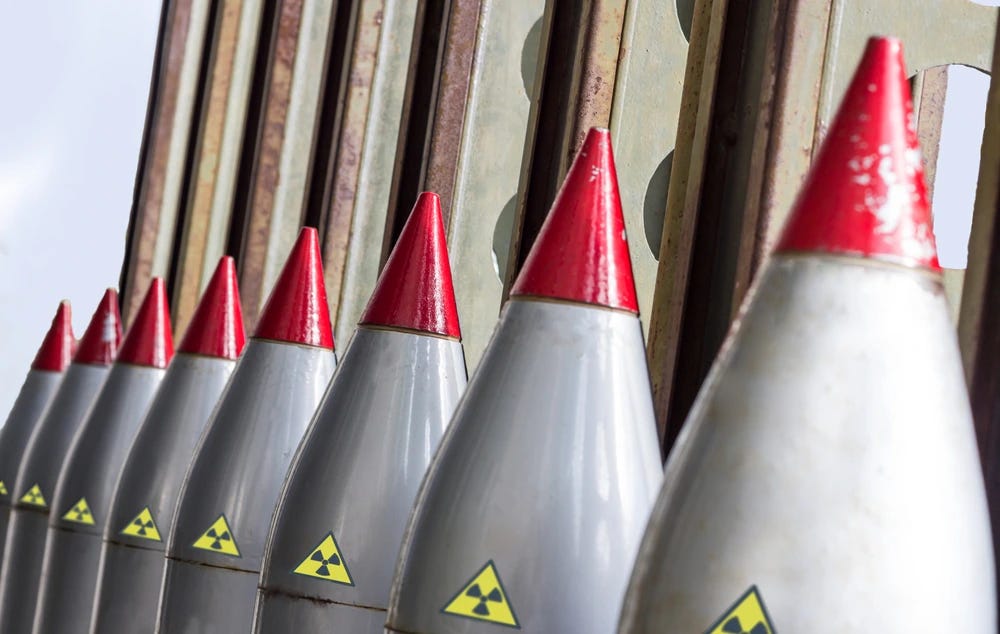
In a grim coincidence, ICAN reported this week that the nine nuclear-armed states spent nearly $119 billion—$3,768 per second—on their nuclear arsenals. Its report, Premeditated: Nuclear Weapons Spending in 2025, found that combined spending by China, France, India, Israel, North Korea, Pakistan, Russia, the United Kingdom, and the United States rose 19% from the previous year. As the world again approaches the brink—amid geopolitical tensions even more complex than those of the Cold War—all nuclear-armed states now have weapons systems expected to remain in operation until at least 2050.
That is, if humanity lasts that long.
No posts
Comments
Nothing yet. Say the first thing.
Sign in to join the conversation.