
The industry hiring machine still selects for the wrong signal. Here's the loop I'll use instead: terminal, AI allowed, one hard problem, one hour.
I have spent too many years watching the engineering hiring process pretend to measure builders while measuring something else entirely. Keyword screens. Trivia panels. Process theater that rewards who rehearsed the ritual, not who can stay with a hard problem when the answer isn't in a textbook. Business leaders keep saying progress is going exponential. Hiring still selects for the old game.
Here's the takeaway, and I'm done burying it: the industry hiring machine is broken; the fix is philosophies (resilience, deep thought, attention to detail) plus a plain AI-native loop, not a better ATS. If you keep optimizing for keywords and leetcode theater, you hire people who pass filters and stall when the work is building with AI under pressure. Candidates who wait for the old process to "get fair" miss the window to prove they can ship under the new rules.
Start with what the funnel actually does.
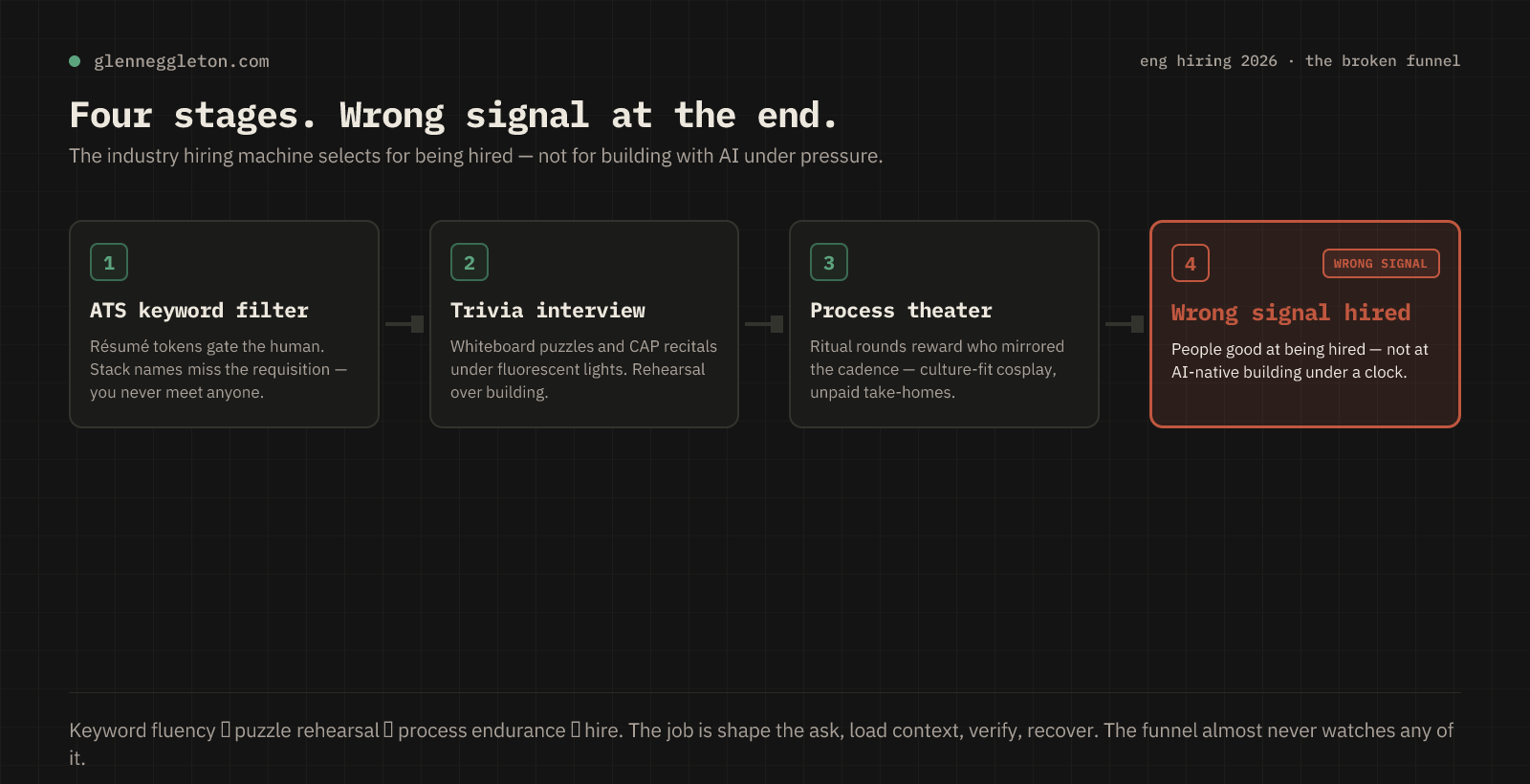
An ATS parses a “résumé” for tokens. If your stack names don't match the requisition, you never meet a human. Then comes the interview theater: invert a binary tree on a whiteboard, recite CAP theorem under fluorescent lights, narrate a system design for a product nobody in the room will build. Somewhere in there is a "culture fit" round that often means "did you mirror our cadence." Somewhere else is a take-home that becomes unpaid labor with no feedback.
None of that is evil by intent. It is cargo-cult signal design. It selects for people who are good at being hired under those rules: keyword fluency, puzzle rehearsal (ahem leetcode), process endurance. The job, in 2026, is closer to: sit down with an agent, a repo, and a messy problem, and make something real under a clock. Shape the ask. Load the right context. Verify what actually changed. Recover when the first pass is confidently wrong. That is the work. The funnel almost never watches any of it.
The funnel and the work stopped matching. That gap is what wore me out. Not the existence of interviews. Not the desire for a bar. I'm not going to litigate every vendor or redesign leetcode curricula. I'm saying the signal is wrong, and I'm done pretending a sharper filter on the same inputs fixes it.
When I picture someone I want to hire, I don't start with a language list. I start with how they hold themselves when the problem is hard and the answer isn't Googleable.
Resilience. They stay with it. They don't flinch into the first plausible patch and call it done. They come back after the agent hallucinated a fix and the tests still failed.
Deep thought. They shape the problem before they code. They ask whether the task is even the right one. They can sit in ambiguity without filling it with noise.
Problem solving. Not the puzzle-contest version. The builder version. Break a vague ask into a scoped brief. Try something. Read the failure. Try again. Use the tools in the room, including AI, without pretending the tool is the craft.
Attention to detail. Diffs that don't leave landmines. Naming that matches intent. A habit of verifying what actually changed, not what the summary claimed.
Those are philosophies, not checklist skills. You can teach a framework in a week. You cannot easily teach someone to care about the hard thing when nobody is watching. The builders I trust share that posture: they keep their hands on the work until it's real, and they treat AI as a tool inside that posture, not as a substitute for it.
Trivia interviews don't surface that. A polished résumé doesn't either. A one-hour loop with a hard problem and AI allowed often does, because you watch them think and recover under pressure. You see whether they shape before they type. You see whether they verify. That's the signal I want.
I don't need a new platform. I need a format that looks like the job.
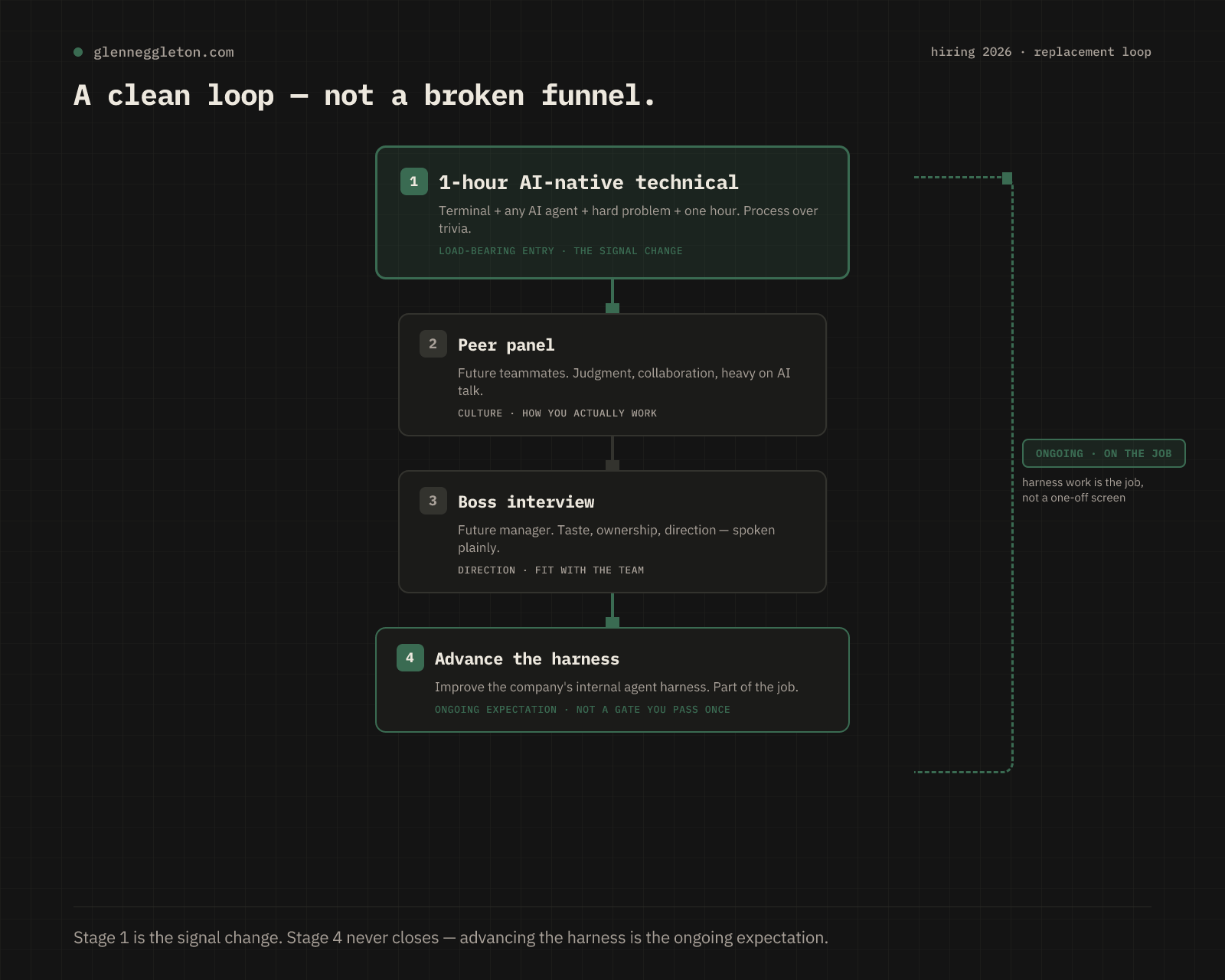
Step one: terminal, any AI agent, a hard problem, one hour. Candidate picks the agent they're fluent with (Claude Code, Cursor, whatever they actually use). We give a real-shaped problem, not a trivia dump. They work in the open. We watch how they shape the ask, what they load into context, when they verify, when they get stuck and recover. The output matters. The process matters more. This is an AI interview for engineering work as it is done now, not as it was done in 2015, and it is deliberately boring infrastructure-wise. No proprietary assessment suite. Just the tools of the job and a clock.
Step two: culture interviews with future peers. The people who will work next to you ask about judgment, collaboration, and how you use AI day to day. Heavy on AI talk on purpose. How do you brief an agent? When do you throw a draft out? What do you refuse to automate? Peers smell theater faster than a hiring manager with a scorecard.
Step three: interview with the future boss. Direction, taste, ownership. Same expectation spoken plainly: you will help advance the company's internal agent harness, the loop around the model that gives it tools, checks its work, and keeps the craft from drifting. That isn't a side quest. It's part of the job. If you want the long version of why that harness is worth paying attention to, I benchmarked my own against a bare setup and wrote up what the tokens actually buy.
That's the whole loop. No ATS cosplay. No whiteboard nostalgia. A technical hour that looks like the work, then humans talking about how you'll build together.
I get this objection frequently when I describe the format, so I'll answer it here, not as a footnote.
The format is the same at every level: terminal, AI allowed, hard problem, one hour. The problem difficulty and the bar scale with level. Juniors are not measured against seniors. A junior loop asks whether you can stay with a scoped problem, use an agent without surrendering judgment, and show the philosophies above at the stage you're at. A senior loop asks for more scope, more taste, more ownership of the harness. Same format, different scope and bar.
What the loop surfaces is how someone thinks and recovers with tools in the room, not a trivia dump they crammed the night before. If you're earlier in your career and worried the AI-native bar leaves you behind, it doesn't have to. The scaffolding seniors already use can be shared, not gatekept; I've written about opening that toolbox. The expectation isn't "already know everything." It's "show me how you build when the tools are in the room."
Keeping up is available if you practice it. You don't need permission from a broken funnel to run the real loop. Open a terminal. Pick a hard problem. Use the agent. Verify the result. Help yourself, then help the next person through the same door.
If you're hiring, stop polishing the theater and change the signal. If you're a candidate, stop waiting for the old process to get fair. Prove you can ship under the rules that match the work.
Chin up. Hands on a keyboard. Everyone is a builder now.
If this is the kind of thing you think about (how we build, and who we let build with us), subscribe below. I write up what these systems teach me, usually by getting them wrong first.
— Glenn Eggleton builds agentic engineering systems and writes about what survives contact with production.
No posts
Comments
Nothing yet. Say the first thing.
Sign in to join the conversation.