
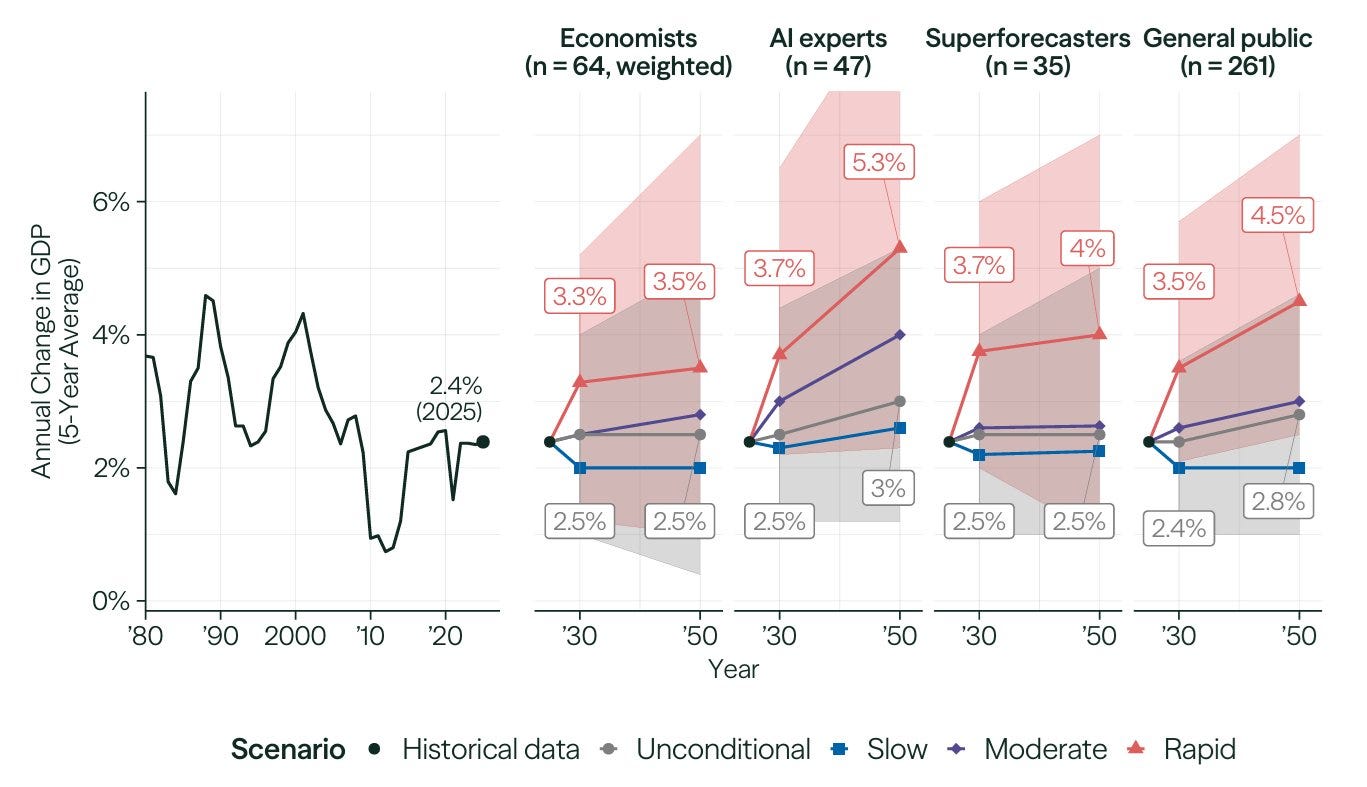
Mid-century Ultramodern A team including forecasting guru Phil Tetlock just published their results of an interesting survey about AI impact up to 2050. The researchers surveyed four different groups of people — economists, AI experts, superforecasters, and the general public — asking them for their predictions about (among other things) GDP growth and labor force participation.
A key graph of the paper’s results is above, and its abstract gives more findings from the research:
The median respondent in each group expects substantial advances in AI capabilities by 2030, small declines in labor force participation consistent with demographic shifts, and an annual GDP growth rate of 2.5%
One result that stood out to me is that even if “AI systems surpass human performance on many cognitive and physical tasks, experts forecast substantial, though not historically unprecedented, economic shifts: annualized GDP growth rising to around 4% and the labor force participation rate falling from its current level of 62% to 55% by 2050, with roughly half of that decline—equivalent to around 10 million lost jobs—attributable to AI.”
The text I bolded above emphasizes a key point. Powerful technologies have reshaped the economies and societies in the past. Well-informed people currently believe that AI will do the same, and to about the same extent. The AI experts as a group predicted the biggest economic changes by 2050, but even they aren’t forecasting a hypercharged economy growing at double-digit rates.
The New York Times writeup of this work features two of my Workhelix co-founders. A quote from Daniel Rock opens the piece, and Erik Brynjolfsson is featured later on. This is entirely appropriate since they are two of the economists who have been looking longest and hardest at AI’s economic impacts.
The Power of Weak links A new paper by Chad Jones and Christopher Tonetti provides a compelling view of what will constrain the economic lift from AI, even if the technology turns out to be hyper-powerful and pluripotent. When this is the case, the authors explain,
Automation leads economic growth to accelerate, but the acceleration is remarkably slow because of the prominence of “weak links,” i.e., an elasticity of substitution among tasks substantially less than one. Even when most tasks are automated by rapidly-improving capital, output is constrained by the tasks performed by slowly-improving labor.
“Elasticity of substitution substantially less than one” here simply means you can’t rely entirely on AI; there are still tasks you have to do manually. Those who believe in imminent ASI say that there won’t be many such tasks in the economy of the future, but the forecasters cited above disagree with this assessment.
The trippiest parts of this paper are its long-run scenarios for economic growth. Jones and Tonetti calibrate a model of the economy based on historical patterns of task automation, then run it into the far future under three different scenarios of AI power:
All tasks are automated by AI in “finite time”
All tasks are automated by AI, but it takes an infinite amount of time
All tasks are not automated by AI
here’s what economic growth looks like under the three scenarios:

There is a very fast takeoff in scenario 1, but look when it occurs: not until the middle of the next century. As the authors write, “ the paths are indistinguishable for the next 75 years.” Like I said, trippy stuff.
These ideas of task automation and substitution are fundamental to understanding how the economy is going to evolve. Sneak peak: my colleagues and I are going to have a book more to say about them in the future.
Do This; Don’t Do That. A team at Stanford including Erik just published their look at 51 case studies of successful AI deployments. It’s a goldmine of good ideas and emerging best practices, so check it out. Here are two snippets to whet your appetite:
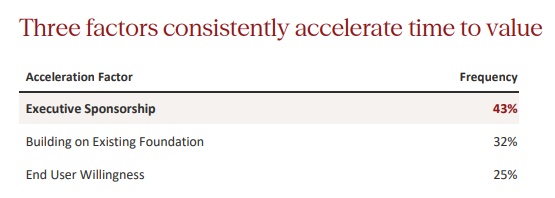
and
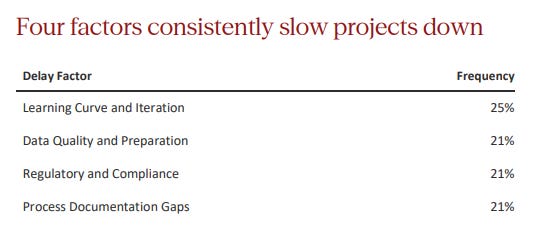
The Widening Continental Divide A new report from the St. Louis Fed shows that the gap in AI use between American and European companies is large and appears to be growing. This is not good news for European competitiveness, which has been a hot topic since Mario Draghi released his bombshell report in 2024.
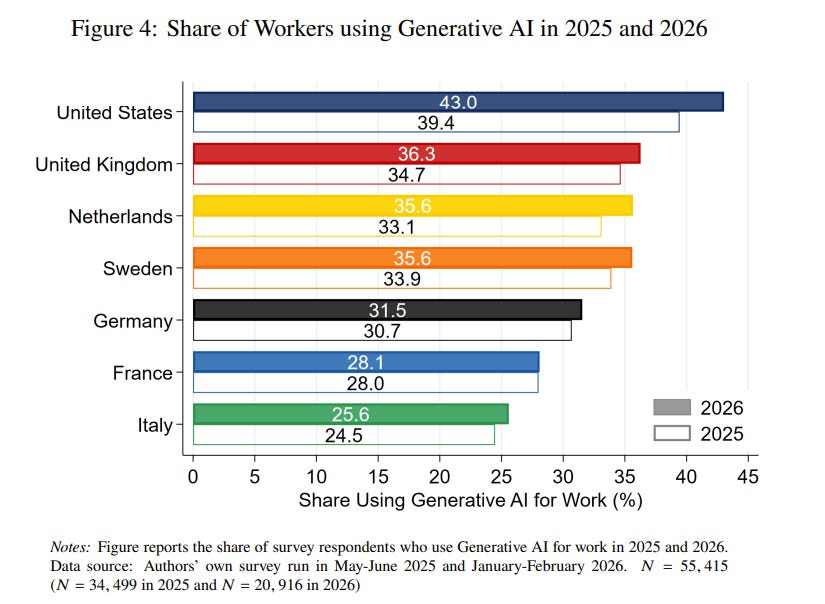
I’ve written here about the challenges Europe will face as it tries to catch up, and the more I look at the evidence, the more pessimistic I get.1 I’m giving a couple of talks on the subject next week at the Harvard Kennedy School. I will report back on them.
Please Don’t Normalize AI. AI whisperer Ethan Mollick has a great column in The Economist telling companies to keep AI weird.
Treating this technology as another software deployment is like receiving a mysterious alien artefact and immediately using it as a paperweight.
…When leaders see studies showing productivity gains of 30% from AI, their instinct is to cut 30% of the workforce. That arithmetic is simple. What is hard, and requires genuine imagination, is asking a different question: what does it mean to rebuild an organisation around the fact that a single programmer can now write a hundred times more code? What new products become possible? What new markets open up? No vendor can answer those questions for you. No consultant has a playbook (much as they might claim they do). The hard strategic work of reimagining what your organisation could become is precisely the work that de-weirding AI allows companies to avoid.
I vehemently agree and want to add one point: at many if not most of the companies I work with, the hard strategic work of reimagining (if it’s being done at all) is being done by executives and expensive consultants in an (often metaphorical) room with an (often metaphorical) whiteboard, doing a 2020s version of 1990s business process re-engineering.
That’s not weird. What is weird is the set of wild ideas and experiments being carried out by geeks all throughout the organization, at every level. These folk are stunned by the power of current models, and they’re eager to figure out how to use them to do things in profoundly new ways. Companies that can tap into that energy and channel it into the right2 directions will have a huge advantage.
This weekly roundup is brought to you by Workhelix, the startup I cofounded (along with Daniel Rock and Erik Brynjolfsson, who are featured this week!) to help organizations know and grow the ROI of their AI. If that topic is top of mind for you, please get in touch.
As a card-carrying member of team Liberal Democratic West it gives me no pleasure to say this, but facts are stubborn things.
Yes, “right” here includes “safe,” but I don’t think the most safety-obsessed companies are going to be the AI leaders of the future.
No posts
Comments
Nothing yet. Say the first thing.
Sign in to join the conversation.