
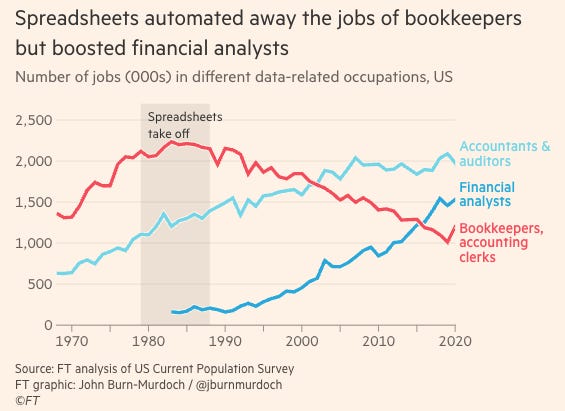
At Stripe’s recent annual conference, co-founder Patrick Collison described the extent of AI enablement of the work being done as part of the Tempo project - an effort to build a blockchain-enabled, stablecoin-based payments system. Collison said that the 12-person team has put an LLM inside a harness, and then put that inside a Slack channel. Anyone working on the project can just send a message to that channel describing work that needs to be done, and then the AI will… do it.
As Collison said in an on-stage conversation with Sam Altman:
So it’s a relatively new and small team, a couple dozen people. The Tempo team set up a harness and an [AI] tool in their Slack installation, for orchestrating pretty much everything at the company. Everything.
You can just ask any task: “go and read these Google Docs, turn those into a bunch of linear tasks, then go write a pull request to implement them, then go deploy them and use our log analysis tools to test the deployment actually worked” and the agent will happily go and employ tool use across all of this.
It’s extremely trippy watching a whole organization — I mean, a small organization, but an organization — of people do everything in a Single slack channel
I don’t think that would scale at Stripe, but it was the first time I had the experience you were describing, which is, it’s clearly incredible. I don’t quite see how to transpose it for us, but this is really something. It’s really something to watch.
Altman replied:
I find that a lot of people… have not yet been able to wrap their heads around the fact that you can just kind of ask us [i.e. OpenAI] anything, and it’ll probably happen. I myself still find myself, like, not trusting quite enough that it’s going to be possible. I don’t know exactly how it’s going to transpose to bigger companies. It does feel like we’re missing kind of like one more abstraction; how humans and AIs are gonna interface at massive scale. The advantage that these smaller companies have is, it’s just the AIs. They don’t have to figure out the interface with all the people. But we’ll figure it out.
Lots of people and organizations are trying to figure that out (including Workhelix!) A new HBR article by a team from Bain and OpenAI tells what they’ve learned about scaling up AI or, as they put it, moving “from AI Experimentation to AI Transformation.” Their four core recommendations are:
Narrow possibilities strategically
Reimagine workflows across the organization
Engage those closest to today’s process
Measure what matters
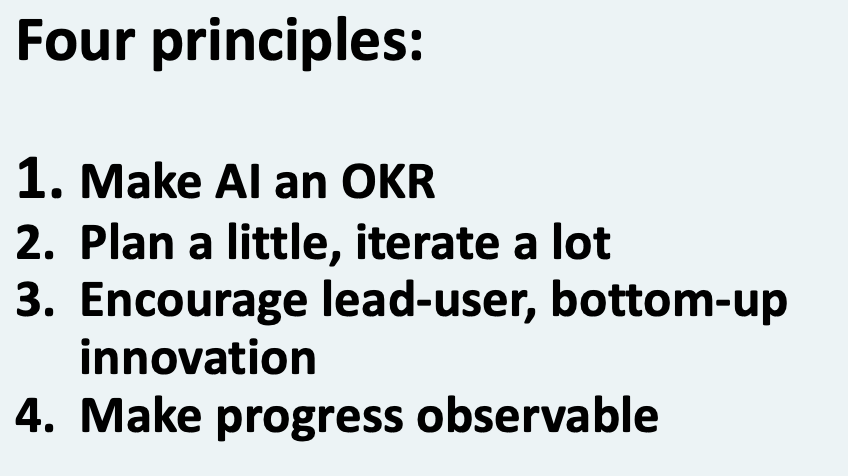
These map closely to what I tell the leadership teams I work with at Workhelix and teach at Sloan. My canonical presentation for these sessions, which is titled “Who’s Going to Succeed with AI?” includes the slide below. It too contains four items!
The biggest difference I see between the approach advocated in the HBR article and the one I advocate has to do with workflow reimagining, an AI-era rebirth of the business process re-engineering trend of the 1990s and 2000s.1 The Bain + OpenAI team advocates a largely top-down approach to this re-imagination. It also advocates understanding current workflows in detail before beginning the re-imagination process:
begin by understanding current workflows across the company for your chosen strategic priority and determining how time is spent in that area, and by whom. This will help you begin to select the most fruitful opportunities from those you’ve identified, and ensure that the value is realized across the business. Ask: Which areas offer the highest value in terms of time, effort, and usage? Which processes are most ready in terms of repeatability, quality of supporting data, and technology? And where is there currently high variation across business units? Then reimagine these workflows with AI at the center.
Redesigning processes requires close collaboration with leaders across seniority levels who are close to the work process but who are also committed to the AI transformation and able to envision a new way of doing the work. Individual contributors who are outstanding in their domain are also critical to deeply understanding the current process, especially those who can take a step back to reenvision how the work could get done more efficiently with AI. By involving front-line employees, leaders access insights from those closest to problem areas in the current approach who may have discovered individual productivity gains that can translate to broad workflow innovations.
That last sentence reveals a top-down bias: frontline employees might know how to improve the productivity of their individual work, but “leaders” are necessary to reimagine the entire workflow .
I encourage leadership teams to try something quite different: to say to the people in their organization, “Here are the workflows and associated performance measures that we really want to improve. Have at it with AI.” That’s what I mean by “Encourage lead-user, bottom-up innovation.”
Why do I think that works better? Imagine you’re an insurance company that wants to use AI to improve claims processing - to reduce both time and cost without increasing errors and mistakes (or perhaps even decreasing them!). Don’t you think the people who currently do that work have a lot of ideas for to accomplish those goals? Don’t you think they know where the waste, delays, and missteps are?
As the conversation between Collison and Altman above highlights, those people can now just use AI not just to describe a new workflow, but to actually code it up and test it. So why not create a sandbox that lets them try stuff? Put a bunch of historical claims data in it, tell people what performance standards they have to meet or exceed (what % incorrectly rejected and incorrectly accepted claims, for example), give them guardrails (tell them, for example what kinds of mistakes and actions are completely unacceptable), then let them try stuff. Here are some things that I predict will happen:
Teams will spontaneously form to tackle this problem. These teams will eventually draw in expertise from risk, compliance, legal, and other guardrail parts of the organization.
Many of the new workflows created by AI teams will beat the benchmarks.
Some will beat them by a lot.
The AI teams will finish their work much more quickly, and at a much lower cost than teams following the
outdatedlegacy approach of mapping the as-is workflow, mapping out the to-be, circulating the to-be widely for comment and feedback, and so on.There will be many objections to what the AI teams come up with. The status quo bias is very strong in most organizations.
The AI teams will easily be able to handle these objections with further clever combinations of AI and people.
The approach recommended in HBR by the Bain/OpenAI team isn’t a variation of the classic business process re-engineering approach. It is the classic BPR approach — the one first proposed in the mid-1990s and refined in the 2000s. Trust me, I was there.
To continue to follow that approach in the era of modern AI is to miss a gigantic opportunity. Redesigning how work gets done no longer has to be top-down, centralized, elite-led, tightly-controlled, slow, and expensive. It can now be the opposite of all those things.
Yes, you’ve got to be thoughtful about how you go about enabling user-led, AI-enabled work redesign, and yes, guardrails and governance are really important. But it’s also really important not to keep doing things the same way after a much better way becomes available.
It is now easy, cheap, and fast to redesign big chunks of work — redesign them not just on paper, but in practice. It no longer requires technical chops to make a good first draft / working prototype of this redesign. And that redesign can include all parties that need to have a say in the work. The audit, risk, and compliance functions, for example, can be ably represented by audit, risk, and compliance agents.
Should such agents be augmented / double-checked by humans? That sounds right to me, at least in the short term, but what do I know? What do I know about claims processing and/or the capabilities of frontier AI models? Maybe audit, risk, and compliance agents will do just fine on their own. Maybe not. Iteration, experimentation, and measurement are the best ways to answer these questions. Top-down business process re-engineering workflow re-imagining is a distant second.
I’m glossing over a bunch of important details here, but none of these details obscure the central fact. Your people are now tremendously empowered by AI. They can use it to improve major parts of your organization’s work, and with judicious review, oversight, and governance, those improvements will scale. Why would you not want this?
Fellow Substacker Jasmine Sun wrote an NYT opinion piece devoted to explaining why, as her initial sentence puts it “Most people I know in the A.I. industry think the median person is screwed, and they have no idea what to do about it.”
Sun’s piece nicely lays out the gloomy argument: A.I. is now quite good at many things like software engineering that, until quite recently, were the exclusive domain of humans. And the models are rapidly getting better and more capable. So it’s hard to see how the diffusion of ever-improving AI throughout the economy won’t lead to a “permanent underclass” of people who don’t have much to offer an employer:
Whether you talk with engineers, venture capitalists, founders or managers, or with doomers, accelerationists, lefties or libertarians, the so-called San Francisco consensus on the impact of A.I. for workers is bleak. Many are convinced that advanced A.I. will soon surpass human capabilities. This would produce tremendous growth and scientific achievement, but it would also displace millions of jobs as fewer humans are needed to make the economy run. The technology will depress economic mobility and exacerbate inequality, while ferrying power and wealth to the A.I. companies and the existing owners of capital.
Sun acknowledges that “Most economists and A.I. experts do not expect this scenario” but spends little time explaining why not. I’ve spent a fair amount of time explaining why not, and why the San Francisco Consensus sounds like the old lump of labor fallacy with a few extra steps ( see, for example, these two posts here, the report I wrote when I was a Technology and Society Fellow at Google, and previous posts in this ongoing “This Week in “Putting AI to Work” series).
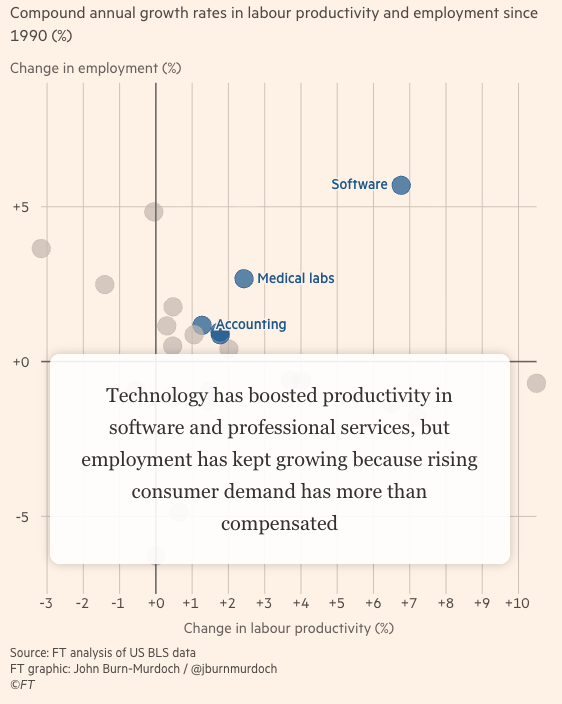
An opinion piece in the FT by columnist John Burn-Murdoch on AI’s labor force effects counters the gloomy argument with evidence both recent and historical about technology’s impact on jobs. As he puts it:
An often overlooked question is whether there is such pent-up demand for a product or service that, when it becomes cheaper and more abundant, consumption rises at an even faster pace. Large increases in software productivity since the 1990s were accompanied by rising, not falling, employment in web development: the explosion in demand for software far outstripped the reduction in the amount of labour required for a given amount of code production.
It has been a comparable but less dramatic story for most professional services. Software has made accountants, architects and advertising creatives more productive, but larger rises in appetite for their services mean employment has also risen.
Burn-Murdoch also highlights a clear pattern from history: while tech progress does eliminate some job categories, it simultaneously creates others:
His summary is:
“Can AI do this task?” is a useful starting point for thinking about how it might impact employment, but it is an ambiguous signal that forms only one part of a large and complex picture. Considering the other factors that can shape job growth, directly or indirectly, helps to explain why thus far those occupations that are most exposed to AI are as likely to have grown as to have shrunk.
Will that happy pattern of technology-fueled net job growth, continue? I am more optimistic than the Silicon Valley consensus on this point.
This weekly roundup is brought to you by Workhelix, the startup I cofounded to help organizations know and grow the ROI of their AI. If that topic is top of mind for you, please get in touch.
Some readers will remember that era of Re-engineering the Corporation and SAP R/3 implementations. They may not remember it fondly.
No posts
Comments
Nothing yet. Say the first thing.
Sign in to join the conversation.