
I’ve been getting messages about this for a long time now, and I want to start by being honest with you: I’ve been putting off writing this post because I didn’t know how to write it without it feeling like either a trauma dump or a productivity listicle, and it’s neither of those things — it’s something more personal and more practical and more angry than either of those formats allows, so here’s my attempt at something in between.
I have a weak/ restrictive/ problematic passport.
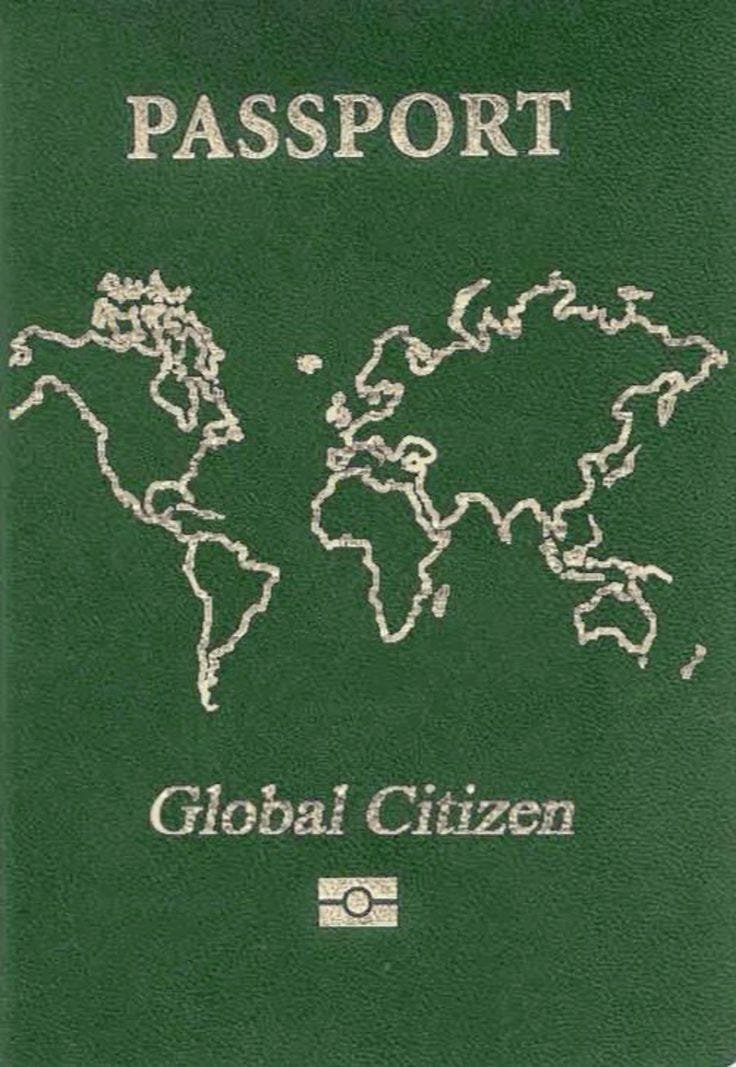
In 2026, that means I have watched the Henley Passport Index document what I already knew from experience: the gap between the strongest and weakest passports in the world is now 168 destinations — the widest divide in the 19-year history of the index, which is a polite way of saying the bureaucratic wall between people who got lucky with their birthplace and people who didn’t has never been taller. Singapore’s passport holder can go to 192 countries without a visa. I can go to somewhere between 78 and 92, depending on which index you check and which week it is and which political event happened recently that has nothing to do with me personally but will absolutely affect whether an embassy even considers my application.
And that’s not even the worst of it, right? Because the mobility score doesn’t capture what it actually feels like to navigate a global life with a document that carries geopolitical baggage you didn’t choose. It doesn’t capture the €200 visa fee you pay to get rejected with no explanation. It doesn’t capture 2 years (!) I spent trying to get a US student visa across 5 (!) countries before one embassy said yes. It doesn’t capture getting pulled aside at customs in a country you’ve visited four times before, explaining yourself to an officer who is doing their job and also clearly suspicious, while the person ahead of you with a blue passport walked straight through. It doesn’t capture finding a work exchange placement you love and then discovering the host has a strict EU/Schengen passport requirement, not because they’re cruel but because they can’t navigate your visa situation.
I want to say clearly, before I say anything practical: this is not fair. The global mobility system is structurally unjust in a way that is boring to say and important to keep saying, because the injustice is baked into something so ordinary that most people who benefit from it have never had to think about it for a single minute of their lives. Your passport is not a merit badge. It is a lottery ticket you were handed at birth, and the people holding the winning tickets have largely decided the rules of the game.
Okay. I said it. Uffff.
Now let me tell you what I’ve actually done with mine, because despite all of the above: I have lived and worked officially in 7 countries, studied languages abroad, done work exchanges, traveled as a tourist across several continents, gotten my bachelor’s degree from an American university, completed 5 international exchanges, spent meaningful time (not just passing through but worked/ studied) in 17 countries total, and am now about to start an international master’s degree — and for the past half a year I’ve helped about 20+ of you to find your global opportunities as a self-appointed global opportunities strategist.
This post is everything I know about how to do this with a complicated document you’ve got, as sustainably and as financially painlessly as possible.
The first and most underused strategy for any restricted-passport holder is to stop thinking about “travel” in the way travel influencers present it — which is to say, as a collection of cool places — and start thinking about it geographically and structurally, meaning: which regions have the lowest friction for my document, and which of those regions also have the infrastructure I need to build something?
For me, that’s a lot of Southeast Asia (Vietnam, Thailand, Cambodia, Indonesia — visa on arrival or visa-free), a lot of Latin America (Brazil, Colombia, Argentina, Chile — visa-free for tourism), Georgia (visa-free for a year, and as of 2026 they now have a formal C5 digital nomad visa structure), Central Asia, Turkey, the UAE, and parts of Africa. The Schengen zone is complicated right now — it’s possible to get a visa but it’s slower, more scrutinized, and some individual countries have layered additional restrictions on top of the general EU rules. This doesn’t mean Europe is impossible; it means you need to budget more time, more documentation, and more backup plans.
For Indian passport holders (80th in the world, 55 visa-free destinations as of 2026), the accessible zone expands through Southeast Asia quite easily — most of the region is accessible via e-visa or visa on arrival — and includes a lot of the Middle East, parts of Africa, and Latin America, with the Schengen zone requiring a visa but not being categorically hostile.
For Pakistani passport holders (97th, 32 accessible destinations), it’s harder and I’m not going to pretend otherwise, but Cambodia, Nepal, the Maldives, Indonesia via visa on arrival, and several African countries are accessible — and more importantly, the programs I’m about to describe don’t care about your tourism mobility score because they provide their own legal status.
For Afghan, Syrian, Iraqi, and Somali passport holders — I’m not going to give you a list of visa-free countries because that list is genuinely short and the more useful thing I can tell you is to focus almost entirely on the program-based pathways below, where the program’s legal sponsorship replaces the need for independent visa access.
The point I’m making is: your passport’s geography is real, you need to know it accurately, and then you need to build your strategy around it rather than spending your energy being angry at it, which I say as someone who has spent considerable energy being angry at it and can confirm it doesn’t help.
Here is the single most important reframe I can offer you about building a global life with a restricted passport: your passport governs your tourist mobility, but programs govern everything else.
What I mean is this: when you apply for a visa to visit a country as a tourist, you are asking a government to trust you with no particular reason to do so. You are a stranger asking to borrow their territory, and if your country has complicated geopolitics, that request gets complicated.
But when you get accepted to a university program, a scholarship, a work exchange, a volunteer placement, or a structured work opportunity — someone has already vouched for you, there is paperwork with your name on it, there is a reason for your presence that the immigration system can process, and suddenly the calculation is completely different. You’re not a stranger anymore; you’re a student, a researcher, a cultural assistant, a volunteer, a language teacher. You have a category. And categories move through borders in ways that individual strangers don’t.
This is why I spent years building my global life almost entirely through programs rather than trying to acquire tourist visas independently and hope for the best, and why I am now working with clients to do the same.
The Erasmus Mundus Joint Master’s Degree is the most powerful program on this list for restricted-passport holders, and it is genuinely open to all nationalities — not nominally open, actually open, with funding specifically allocated for students from outside the EU — and the reason it matters for this conversation is that it doesn’t just give you an education, it gives you legal residence across multiple European countries for two full years, with tuition covered, a monthly stipend of around €1,000–€1,200, and travel allowances built in.
The 12-month rule is the thing to know: if you haven’t lived in Europe for more than 12 months in the past 5 years, you qualify as a partner country applicant, which is the category with more funding allocated. The applications generally open in October for the following academic year and close around January or February. The catalogue of programs covers almost every field — social sciences, humanities, engineering, environmental studies, global studies, education — and you study across 2–3 different European universities during the degree, which means you are legally moving between countries rather than fighting for individual tourist visas.
I applied to Erasmus Mundus programs. I know this process from the inside. It is competitive, it is real work, and it is absolutely worth it for restricted-passport holders because you’re not just getting a scholarship, you’re getting two years of European legal presence plus a master’s degree plus a network, which is a very different asset than what you started with.
Other scholarships worth knowing: the DAAD (German government, open to all nationalities, covers study costs and living expenses for Germany), the Stipendium Hungaricum (Hungary, fully funded, genuinely open to a very wide range of nationalities including many that struggle with European visas), the Türkiye Bursları scholarship (Turkey, fully funded, open to almost all nationalities including many that have limited European access, and Turkey itself is very accessible from a visa standpoint for most passport holders), and the Korean Government Scholarship (GKS), which covers everything and places you in Seoul for a degree program with 1–2 year language training included.
The logic for all of these: the scholarship provides the visa. You don’t fight the system alone; you arrive with institutional backing.
Worldpackers, Workaway, HelpX, WWOOF — I’ve written about these before, but the specific thing that matters for restricted-passport holders is different from what matters for everyone else.
For you, the visa question comes before everything else: can I actually enter this country? Once you’ve confirmed you can legally be somewhere (because it’s visa-free, or because you’ve gotten the necessary visa), a work exchange means you are not burning through savings while you’re there, which extends how long you can actually stay and experiment without the financial pressure that makes every complicated week feel catastrophic.
Southeast Asia is where this pathway is most accessible for restricted passports: Thailand, Vietnam, Cambodia, Indonesia, the Philippines — all very work-exchange-active, all accessible for most restricted passports via visa on arrival or e-visa, all significantly cheaper cost-of-living than Europe, and all with hosts who are genuinely not sorting applicants by nationality. Your skills, your profile, your communication — that’s what gets you accepted, not your document.
The honest caveat about work exchanges for restricted passport holders: some hosts in Europe or North America will have legal constraints around who they can host (certain visas require work authorization that a work exchange doesn’t provide), and some will specify passport requirements directly. This is annoying but real. The workaround is to filter for countries where your visa situation is already clear before you start falling in love with a specific placement. Apply where you can actually go, get your references, build your Worldpackers profile, and then as your access expands (through scholarships, residencies, or other programs), your options expand with it.
This is one of the most underused pathways I know of, and I want to be specific about why it matters for restricted-passport holders in a way that it doesn’t for anyone else.
Enrolling in a language school doesn’t just teach you a language: in many countries, it is the mechanism that provides you with a student visa, legal residence, and crucially, the right to work part-time. That combination, legal presence plus income potential plus a language skill you actually wanted anyway, is one of the most efficient things a restricted-passport holder can do with several months of their life and a few thousand dollars.
Here’s how it works in practice across the four countries worth knowing about:
South Korea (D-4 visa): Enroll in a Korean language program at any accredited university language institute — Yonsei, Korea University, SNU, Ewha, or dozens of others — and the school sponsors your D-4 general trainee visa. After the first six months of enrollment, with attendance above 90%, you can apply for part-time work permission of up to 20 hours per week. The language programs run in 10-week terms four times a year, cost roughly $1,500–$2,500 per term depending on the school, and Seoul’s cost of living — while not cheap — is manageable if you’re earning even part-time income once the six months are up. The D-4 visa is also a genuine stepping stone to the EPIK teaching program, since having a foundation in Korean and existing in-country status makes the application significantly smoother.
Japan (College Student visa): Japanese language schools sponsor student visas for programs of six months or longer, and the school handles most of the immigration paperwork on your behalf — the process is bureaucratic but the school is genuinely doing the heavy lifting. Once in Japan on a student visa, you can work up to 28 hours per week (with immigration permission, which the school will also help you apply for). Programs are available four times a year (January, April, July, October intakes), cost roughly ¥300,000–¥500,000 per six months depending on the school, and most accredited language schools will work with applicants from most nationalities. The honest caveat: Japan’s visa process is genuinely slow and some nationalities face additional scrutiny, so budget three to five months between decision and arrival.
Germany (language course visa): Germany issues a specific visa category for language course enrollment — not a tourist visa, not a full student visa, but a residence permit that covers the duration of your course up to 12 months, and allows you to work up to 20 hours per week in any job (not freelance or self-employment, but employed work). You need an acceptance letter from a German language school, proof of funds (a blocked account of roughly €992 per month is the standard), and health insurance. The Goethe-Institut is the obvious starting point but direct enrollment at independent language schools in Leipzig, Berlin, or Munich is often significantly cheaper and qualifies equally. Germany is in the Schengen zone, which means the visa also lets you travel across 29 European countries during your stay — which for a restricted-passport holder is a genuinely significant secondary benefit.
France (student visa, VLS-TS): Enroll in any accredited French language school for more than three months and you can apply for a long-stay student visa (VLS-TS) that gives you legal residence for the duration of your studies, the right to work up to 964 hours per year (roughly 20 hours per week), and freedom of movement across the entire Schengen Area. France’s visa process runs through Campus France, which has offices in most countries. The Alliance Française network — present in 130+ countries — is the most accessible and internationally recognized entry point, and some branches offer partial scholarships specifically for people with refugee or temporary protection status that cover full tuition and exam fees.
The logic across all four of these is the same: the school is your institutional sponsor, and the institutional sponsorship is what converts your complicated passport from a liability into a manageable administrative situation.
The cost is real and I’m not going to pretend otherwise — language school tuition plus living expenses for six to twelve months is a meaningful financial commitment, and it is worth running the numbers honestly before you commit. But the comparison isn’t “language school cost vs. zero” — it’s “language school cost vs. the cost of a scholarship application cycle you might lose, or months of trying to piece together tourist visas that keep expiring, or years of staying put while you wait for a better option.” When you frame it that way, several months of legal presence in a country you actually want to be in, with part-time work rights and a language skill at the end, looks quite different.
Teaching English abroad is, alongside the scholarship pathway, the most reliable program-based route to legal presence in countries that otherwise require complicated visas — because in most cases the program or the employer handles the work visa on your behalf, and you arrive not as a tourist asking permission but as an employee with paperwork.
The best programs for restricted passport holders: EPIK in South Korea (public school program, handles your visa, flight reimbursement, furnished housing, salary of roughly ₩2–2.7 million per month), JET in Japan (highly competitive but similarly structured), and direct applications to private language schools in Southeast Asia (Vietnam, Thailand, Cambodia) which are often less formal and more flexible and where visa requirements are generally less complicated.
The TEFL/TESOL certificate is the thing to get before you go anywhere: roughly $200–400 for a 120-hour course online, and it converts your native or fluent English into a portable professional credential that is genuinely in demand across almost every country that is accessible to your passport. If you are a non native speaker but have strong English — which many of you do — this is one of the most useful $300 you can spend.
I need to talk about Georgia specifically because I think it is genuinely underused as a launchpad and I want to explain the logic.
Georgia’s visa-free year (90+ nationalities) means you can legally be there for a year without applying for anything, which is a longer and more reliable legal presence than most places offer without a visa. In 2026 they introduced a formal C5 digital nomad visa structure, so if you have remote income, there’s now a formal pathway. Rent is $400–600/month for an apartment, total monthly budget can be $800–1,200, and Tbilisi has become a genuine hub for people who needed to leave one geography and build something somewhere with more flexibility.
The strategic use of Georgia is this: you go there with legal status secured, you use the year to work on remote income or a scholarship application or an English teaching certification or a portfolio of work that makes you a stronger candidate for the next program you’re applying to — and then the next move comes from a place of having something to show rather than starting from nothing.
If you are an academic weapon, the research-based pathway is worth knowing about because fully funded PhD programs exist across Europe, North America, and East Asia that provide not just tuition and stipend but full residency authorization and sometimes even a travel budget — meaning the institution is solving your legal presence problem entirely in exchange for your research work.
Fully funded PhD positions are posted as jobs (especially in Europe and Scandinavia), you apply like you’d apply for a position, and if you’re accepted the university sponsors your visa. The research areas with the most international openness right now: computer science and AI, environmental science, education, linguistics, and social sciences. You can find postings at research.fi (Finland), university career portals across Germany, Denmark, the Netherlands, and through the UN Volunteers program for people interested in international development research.
This is a longer play but it is also the most thorough solution to the restricted-passport problem I know of, because you end up with several years of legal presence in a new geography, a credential that is globally legible, and a network that crosses borders in ways your passport didn’t.
The financial reality of building a global life with a restricted passport is that you will spend money on visa applications that get rejected, and there is no way to fully avoid this, but there are ways to reduce how often it happens and how much it costs when it does.
Practical rules I’ve learned:
Apply for visas from countries where you have existing legal status, not from your home country, whenever possible — an active tourist visa somewhere, or a work status somewhere, tends to be received more favorably than an application filed from a country that has complicated relations with the country you’re applying to.
Never apply for a visa to a place as your first and only option — always have a plan B geography that is accessible without a visa, so that if the application fails, you’re not stranded.
Budget for visa costs explicitly — I mean a literal line item in your annual budget that says “visa applications” and contains a realistic number, because the alternative is being surprised by a $150 application fee right when you can least afford it. Treating visa costs as unpredictable emergency expenses rather than expected operational costs of a global life creates a lot of unnecessary stress.
Build a strong application profile before you need it — this means bank statements that show financial stability (even if your actual balance isn’t huge, consistency matters), a clear travel history with no overstays, strong ties to wherever you’re applying from (a lease, a work contract, something that shows you have reasons to return), and reference letters if you’re applying through programs. The profile you build over time makes each subsequent application easier, which is not comforting when you’re on application two, but it’s true by application ten.
Use the tools that exist — visaguide.world and visalogy.com both give you current, passport-specific visa information by destination. Not travel-blog general information — actual passport-specific requirements, updated regularly. Why didn’t I know about these websites earlier…
There is a specific kind of exhaustion that comes from building a global life with a restricted passport that people who haven’t done it don’t fully understand, and I want to name it without being dramatic about it.
It is the exhaustion of having to justify your existence in every country you enter. It is the cognitive load of always maintaining a plan B and a plan C. It is watching people with different documents move through the world with a frictionlessness that is genuinely invisible to them. It is the specific grief of being rejected not because of anything you did but because of where you were born, and then having to pick yourself up and apply somewhere else.
And I also want to say: you can feel all of that and still build something real, because I have, and I’ve watched people I’ve worked with do it too — not because the system is fair (it isn’t) and not because you have to earn access to the world through suffering (you don’t), but because the pathways genuinely exist, the programs genuinely work, and the people who show up to the same place at the same time with the same limited document and the same complicated geography tend to find each other in a way that becomes its own kind of community.
Your passport is not the ceiling of your life. It is a constraint you’re working around, and constraints, while genuinely difficult, are also what produce creativity — because when the easy path is closed, you find the paths that most people didn’t even know existed.
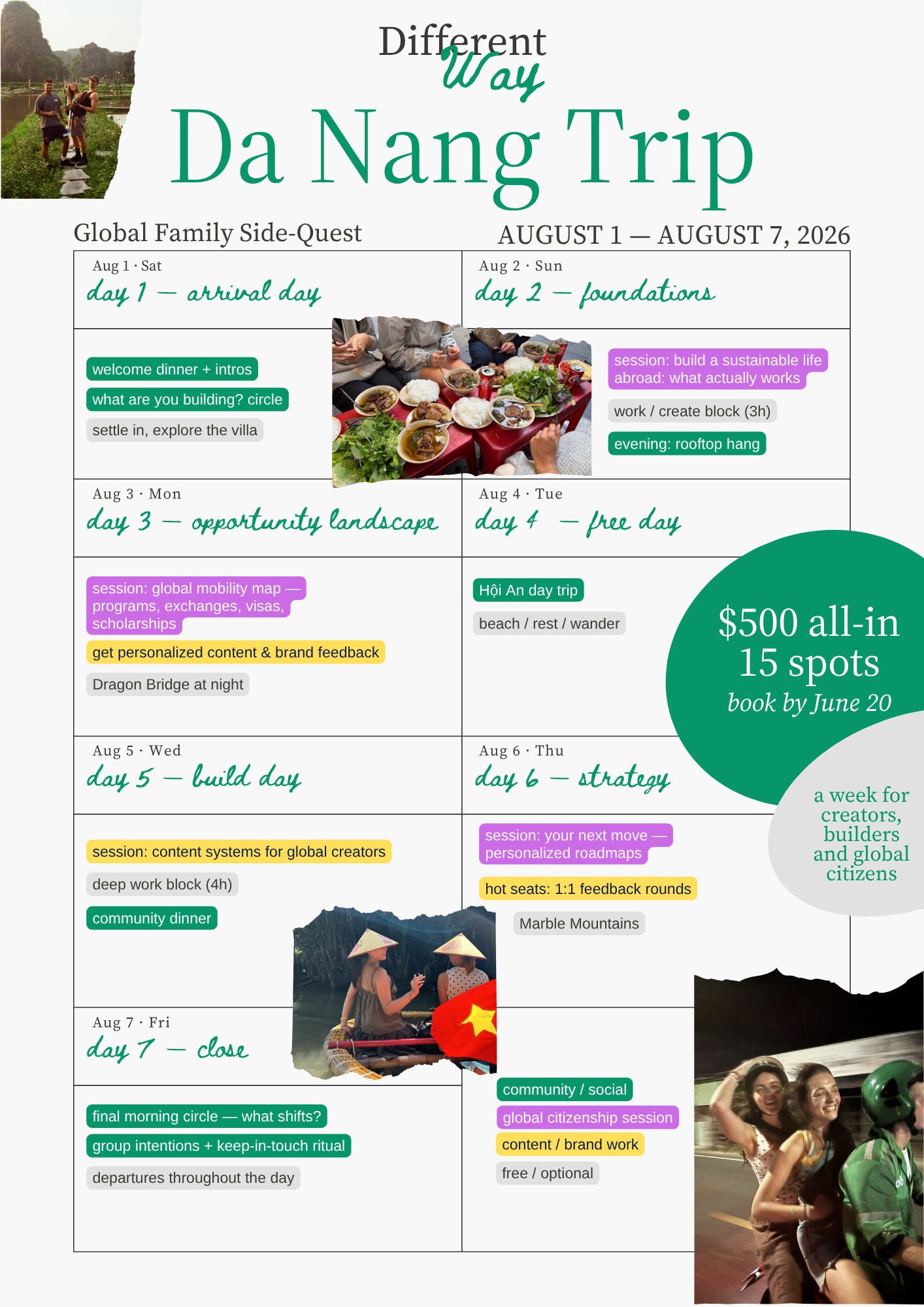
A week in a private house in Da Nang with 14 other people who are actually doing the thing. Accommodation + food included. Sessions on building a sustainable life abroad. Content strategy. Global mobility opportunities you should know about. And a lot of unstructured time to work, create, explore, and talk to people who don’t need you to explain what you’re building.
You handle flights. I handle everything else.
$150 to hold your spot before June 20. Remaining $350 before July 1.
This is for Different Wayers — you know if that’s you :)
DM to book and ask more questions 🫂
If you have a restricted passport and you want to build a global life, the sequence is roughly this:
Identify your passport’s actual accessible geography (not the vibe, the actual visa requirements) and build your first moves there — Southeast Asia, Latin America, Georgia, and the Caucasus are the most accessible regions for most restricted passports right now.
Get a TEFL/TESOL certificate if you’re a strong English speaker, because it converts your language skills into a legal presence mechanism in many countries.
Apply to funded scholarship programs — Erasmus Mundus, DAAD, Türkiye Bursları, GKS, Stipendium Hungaricum — which don’t require you to fight visa systems alone because the institution fights it with you.
Use work exchanges in accessible countries to reduce your cost of living while you’re there, which extends your runway, which makes the whole experiment more sustainable.
Apply for programs that sponsor your visa (teaching programs, PhD positions, structured volunteer placements with formal paperwork) rather than trying to acquire tourist visas to do things informally.
Budget for the costs explicitly — visa fees, application fees, the occasional rejection — as operational expenses rather than emergencies.
Use Georgia as a strategic base if you need a year of legal presence to get your next move together, because the visa-free year plus the low cost of living is one of the most functional combinations available for restricted-passport holders right now.
And through all of it: the goal is not a single country or a single program but a sequence of moves that builds toward more optionality over time — because every year abroad, every scholarship, every credential, every stamp in your passport makes the next application look different, and the trajectory is genuinely real even when individual steps are genuinely hard.
I’ve made 17 countries meaningful, not just visited, with a document that a lot of people told me was a problem, and the honest answer to how is: programs, not tourism, and patience with the process while being genuinely angry about the injustice of it.
You can hold both. I do, every day.
Rooting for you so hard,
Daria
ps. Where are you from, and what’s the most frustrating visa situation you’ve navigated?
I’m a global opportunities strategist — I help multipassionate, globally curious people figure out what to do with their lives internationally: which programs to apply to, how to relocate, which experiments are actually worth running given your passport, budget, and timeline.
No posts
Comments
Nothing yet. Say the first thing.
Sign in to join the conversation.