
Hello, world 🫂
I want to tell you about the ten conversations I had this week, because they were genuinely some of the favorites I’ve had in a while.

I ran Global Summer for the first time this year — 1-hour calls for people who sense that the next 3 months could be something more than a gap between semesters or a vague stretch before real life starts. The people who showed up were university students, new grads, and just people with a free summer and a mild sense of dread about what to do with it—each one with a different passport, budget, situation, and version of stuck.
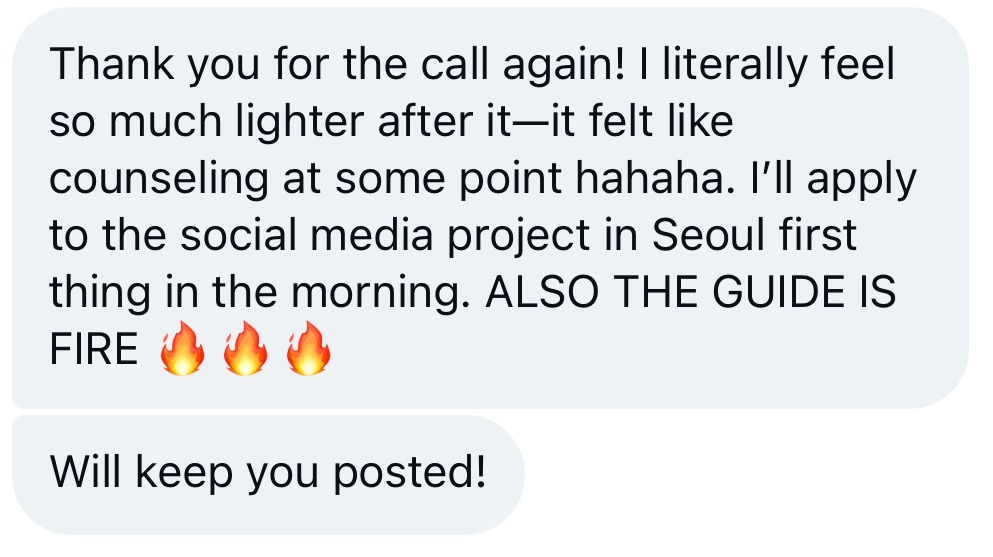
What I built with each of them was essentially a summer experiment: where to go, what to try, what they were actually trying to find out about themselves, what the next 3 months could teach them that staying put wouldn’t.
Not a vacation plan. A hypothesis.
And every single conversation, without exception, started from the same place:
I want this summer to mean something. I don’t know where to start. Is it too late?
(it wasn’t. It isn’t. That’s what this post is about.)
I’m doing Global Summer again next year because it was that good. But in the meantime, 6 things came up in almost every call, and rather than have this conversation eleven more times in my DMs, I’m writing them here.
I’ve written before about the soil problem: the idea that loneliness and stagnation aren’t always personal failures, they’re often just environmental ones. Wrong context, wrong people, wrong set of conditions for the kind of person you happen to be. The fix isn’t internal, it might actually be geographical.
Summer is the lowest-barrier version of that experiment available to most people. You have a natural start and end date, a built-in reason to try something weird, and often the fewest obligations you’ll have for years.
What matters isn’t the season though — it’s the structure. You go somewhere with a purpose, and it’s also what separates the six options below from just booking a flight and hoping something happens.
Your 20s are, from a pure opportunity-cost perspective, the cheapest time to run this experiment. I’m like a broken record at this point BUT IT’S TRUE.
I’m organizing these not just by what the opportunity is, but by what kind of summer you’ll actually have because that’s what people were really asking, even when they thought they were asking about visa requirements.
Every single person I talked to who had done any international experience at all had done this first, or wished they had.
Worldpackers, Workaway, HelpX, WWOOF — the basic model is the same: four to five hours of work a day in exchange for accommodation, often meals, and automatic immersion in a real place from day one.
I am doing this right now, in Vietnam. The reason it works isn’t the platform but the selection filter: everyone who shows up to the same placement chose it intentionally, from every possible option in the world, which tells you something true about them before you’ve exchanged a single word. That’s a different foundation than any app can build.
What’s still available for summer 2026: more than you’d think, especially if you’re flexible on location. Southeast Asia, Eastern Europe, and Latin America have the most open slots right now. Mediterranean placements fill earliest — if you’re set on Greece or Portugal, apply this week.
Platforms worth knowing:
Worldpackers (~$49/year) — my first recommendation for first-timers because of the support infrastructure. If a host situation goes wrong, they cover your accommodation while they find you an alternative, which matters more than people realize. → worldpackers.com
Workaway (~$49/year) — more volume, especially strong in Europe, but requires more careful vetting on your end. Read reviews and message previous volunteers before committing to anything. → workaway.info
HelpX (~$20 for two years) — cheapest option, solid listing base especially in Europe and Australia. → helpx.net
WWOOF (~$20–40/year per country) — specifically organic farming, accommodation and food in exchange for farm work. The most physical version of this experiment. → wwoof.net
What to look for across all of them: under 25 hours of actual work per week, a host who’s been active recently, and a clear written agreement before you arrive about what the role involves. r/Workaway and r/volunteersabroad have more accurate accounts of specific placements than any platform’s marketing page.
The underrated version of all of this and worth taking seriously if you want to be earning while you’re doing it.
Post-pandemic tourism across Europe means employers in beach resorts, hotels, and activity centers across Greece, Spain, Croatia, and Italy are genuinely short-staffed. The access is better right now than it’s been in years.
The community mechanism here is, if anything, stronger than work exchanges — because you’re not just working alongside people, you’re living with them. Staff housing in a place where nobody has a home to go back to and everyone is equally far from wherever they started. Pay for resort positions typically runs €1,000–€2,500/month depending on role and location, with accommodation and often meals included.
Global Work & Travel runs structured international placements across working holidays, resort jobs, teaching, and volunteering — with real support infrastructure throughout and a community of people arriving through the same program at the same time. Use my code DIFFERENTWAY for a $100 discount. → globalworkandtravel.com
Yseasonal — the best aggregator for European hospitality and resort work specifically, with details on pay, accommodation, and minimum commitments upfront. → yseasonal.com
SeasonWorkers — solid board with summer 2026 listings for Greek islands, Spanish coastal positions, and summer camp roles across Europe. → seasonworkers.com
Timing note: good placements fill faster than people expect. If you’re reading this in May, apply now rather than spending two more weeks researching.
A daily schedule, a reason to be in a specific city, and a group of people going through the same disorientation at the same time — the shared challenge (or very hard language trauma :0) element that I keep coming back to in everything I write, because the research on it is consistent: going through something novel and hard together builds closeness faster than almost any other mechanism.
The most expensive mistake people make here is going through a platform when they can go direct. A month of intensive Spanish in Medellín through a local school runs $200–400. The same course booked through a US-facing study abroad platform: $1,800 or more. You’re paying for a marketing layer and nothing else.
Search in the local language (”escuela español Medellín” instead of “Spanish school Medellín”) and you’ll surface schools that serve local students. Then check r/learnspanish, r/LearnJapanese, r/French — actual recommendations from people who’ve been, consistently more accurate than any review aggregator.
Government cultural institutes are subsidized and usually much cheaper than private schools:
Goethe-Institut — German, 98 countries, intensive summer courses running now through September. → goethe.de
Instituto Cervantes — Spanish, 52 countries, rolling intake. → cervantes.es
Alliance Française — French, 130+ countries, rolling start dates, plus a scholarship specifically for people with refugee or temporary protection status covering full tuition. → institutfrancais.com
Best combinations of language, cost, and community right now: Spanish in Medellín (~$200–400/month) or Oaxaca (~$150–300/month); Italian in Bologna or Palermo — Palermo especially is one of the most underrated affordable cities in Europe and nobody talks about it; Korean in Busan over Seoul (meaningful cost reduction, beach city, excellent infrastructure); German in Leipzig, cheapest major German city, huge student population, well-regarded Goethe-Institut.
One more worth naming specifically: Angloville runs English immersion camps across Eastern Europe and Southeast Asia where native or fluent English speakers participate as conversation partners for one to two weeks, with accommodation and meals covered and no payment required. You leave with friends in a way that’s almost structurally impossible to avoid. → angloville.com
If you know you want to go but keep getting stuck in the research loop, structured international placements exist specifically for you. The tradeoff of paying more is that someone else handles visa paperwork, housing, in-country orientation, and has a number to call if something goes sideways.
Projects Abroad still has summer 2026 slots in conservation, education, community development, and healthcare across Africa, Asia, and Latin America. → projects-abroad.org
IVHQ is a more affordable option with a similar range of destinations. → volunteerhq.org
Idealist is the most comprehensive board for finding direct placement opportunities if you’d rather approach organizations yourself. → idealist.org
Global Work & Travel sits in this tier too — structured, support-heavy, and particularly good for people who want the pre-built community effect to be even more deliberate. Use code DIFFERENTWAY for the $100 discount. → globalworkandtravel.com
The most underrated configuration on this list, and the one that came up most with people who already had some kind of online income — teaching, freelancing, content, consulting.
The logic is simple: keep the income, move your budget. If you make €1,500/month and relocate somewhere your rent is €300–400, you’ve freed up real financial breathing room to actually assess whether a place suits you, without the pressure that turns every hard week into proof you made the wrong choice.
Your city is shaping your baseline cognitive and emotional state every single day. Most people have never tested an alternative.
Cities worth testing in summer 2026: Da Nang, Vietnam — beach city, excellent wifi, I can personally confirm this, rent around $300–450/month, total $600–900; Tbilisi, Georgia — 90+ nationalities get a year visa-free, rent $400–600/month; Medellín, Colombia — spring climate year-round, strong creative community, $900–1,300/month all in; Tirana, Albania — Americans can stay a year visa-free, one of Europe’s most underrated budget cities.
Tools for comparing cities honestly: Nomad List (nomads.com) for real-time cost of living, internet speed, and safety data; Numbeo (numbeo.com) for granular cost comparisons.
This is the part of the opportunity map most people find out about by accident.
!!!! The programs below cover flights, accommodation, and meals. Your only investment is the application.
A transparency note before the list: this space has a spectrum. Some programs are long-established and genuinely prestigious — Erasmus+, One Young World, European Forum Alpbach. Others are newer, run by smaller organizations, and charge a small application fee ($15–20) to cover administration, which is unusual for the most competitive programs and worth knowing going in. I’ve flagged this where relevant. Cross-reference on r/volunteersabroad if anything feels off.
🇪🇸 One Future Conference — Barcelona, July 16–19, 2026 Deadline: May 25, 2026
Four days in Barcelona on AI, global diplomacy, human rights, entrepreneurship, and sustainability. Fully funded seats cover accommodation, meals, activities, and visa support. Flights not included in the fully funded tier. Open to ages 16–46, all nationalities, no specific background required. There is a $17.99 application fee for funded categories.
🇿🇦 One Young World Summit — Cape Town, November 3–6, 2026 Various scholarship deadlines, some still open.
The closest thing to a genuinely prestigious fully funded global youth summit that exists — 2,000+ young leaders from 190 countries, heads of state, major figures as speakers. Most participants attend through sponsored scholarships from companies, foundations, and governments. Multiple partner scholarships are available through different sectors and countries.
The OYW ICMM Young Leaders Scholarship — for people working in sustainability and responsible resource management — has a deadline of June 7, 2026. Other partner scholarships have rolling deadlines through summer.
→ oneyoungworld.com/summit/scholarships
🌍 Erasmus+ Youth Exchanges — rolling throughout 2026
The most accessible funded short program in the world for anyone under 30, and the one almost nobody outside Europe knows about — even though it covers young people from partner countries globally, not just EU citizens.
The format: 6–21 days, a group of young people from multiple countries gathering around a shared theme. Travel, accommodation, food, and activities fully covered by EU funding. You apply through a local youth organization or NGO already part of an approved project — not through a central portal.
How to find open exchanges right now: go to the European Youth Portal and search “youth exchanges” filtered by upcoming dates. Then find the participating organization in your country and contact them directly.
The funded conference landscape moves fast — new programs open monthly, deadlines pass quickly, and the best ones fill without much fanfare. Three aggregator sites worth bookmarking right now:
opportunitiescorners.com — the most regularly updated master list I’ve found. Covers funded youth summits globally with deadlines, dates, and direct links.
opportunitiesforyouth.org — broader scope including fellowships, residencies, and short courses alongside conferences. Good for finding the less obvious ones.
opportunitydesk.org — solid aggregator especially for UN and multilateral youth programs.
Almost universally: a clear answer to “what are you working on and why does this program make sense for you right now?”
They’re looking for people who are already doing something real in their own context — a student project, content, community work, teaching, research, anything — and can explain why the room they’re applying to is the right next step. The application essays essentially reward prior action, even small-scale action.
Which is, again, an argument for running some version of an experiment first. Anything is better than “I hope to someday.”
None of these require you to have it all figured out. They mostly just require you to have started.
None of the ten people I talked to had a research problem. They had a starting problem.
They had read enough. They knew enough. Some had actual plans drafted. What they were really asking — under the visa questions and the platform comparisons — was something closer to: is it okay to just go? Is this a reasonable thing to do with a summer? Will it count for something?
Yes. Yes. And yes, because what counts isn’t just that you went somewhere. It’s that you were actually in something. Placed, not passing through. Long enough to get past the novelty phase and into the part where ordinary days tell you something honest.
The soil doesn’t work if you only visit it.
I’m in Da Nang in late July with Worldpackers: July 29 to August 4 — photography and storytelling in nature, forests, sea fieldwork, Vietnamese cooking classes, sunset hangouts, and a group of people who all chose to show up to the same place at the same time for a reason.
Which, if you read any of this, you know, is exactly how the good stuff starts.
So you are invited :D
Join our WhatsApp chat to follow for updates — BOOKING STARTS MAY 14
I’m a global opportunities strategist — I help multipassionate, globally curious people figure out what to do with their lives internationally: which programs to apply to, how to relocate, which experiments are actually worth running given your passport, budget, and timeline. Basically, I’m the person you talk to when you have too many options and no idea where to start.
The Guide — a 60-minute strategy call followed by a personalised roadmap delivered within 72h. We map your background, goals, constraints, and every viable path open to you: visa logic, program options, and application strategy. For people who want a real plan, not a list of random ideas.
The Guide + Walkthrough — everything in The Guide, plus a second call where we go through your roadmap together and lock in your priorities and first steps. For people who don’t just want to receive a strategy — they want to actually understand it.
Full Support — everything above, plus three months of biweekly calls, accountability, application feedback, and a strategy that updates as things evolve. For people who want a thinking partner throughout the execution process, not just planning.
Hugs,
Daria 🤍🌏
ps. which of the six options sounds most like you? drop it in the comments — I read them all, and if enough people name the same one, I’ll write the full deep-dive on it.
No posts
Comments
Nothing yet. Say the first thing.
Sign in to join the conversation.