
Learning a language is one of the most beautiful ways I know to end up finding a home on the other side of the globe. I didn’t think about it too seriously until recently, when I started taking the whole idea of global citizenship more seriously and realized language is quietly doing two things at once.
First, it’s a legitimate and genuinely practical way into a new country, with an entire bureaucratic infrastructure already built around it: programs, schools, courses, visas, all of it. Some countries even count it as a real step toward citizenship.
Second, even if citizenship is nowhere on your radar, language is also one of the most fulfilling things you can do with your life, because the connection it gives you is so much deeper, immediately. My own goal, if not on paper, since I’ll always be legally attached to some made-up territory no matter what I do, is to at least be global in how I think. And that thinking is shaped by language more than almost anything else. I started learning Vietnamese recently, my fourth language, and I want to re-pick up Korean too.
Yes, as an adult, this is one of the most humbling things you can voluntarily sign yourself up for. You go from being a competent, articulate person in your first language to sounding like a small child in your new one, and there’s no way around that stage, you just have to walk straight through it. It kills your ego in the most useful way possible. It makes you patient with yourself in a way the rest of adult life almost never asks you to be. And on the other side of that discomfort is something genuinely rare: you stop just visiting a culture and start actually thinking inside it, which is a completely different thing. That, to me, is what actually makes someone a global thinker, the real ability to hold more than one framework in your head at once and switch between them without translating first.
A huge number of governments already understand all of this, and they’ve built actual policy around it. Language is soft power. A country that gets you to fall in love with its language gets a lifelong advocate, sometimes a future business partner, sometimes eventually a future citizen, and they know exactly what they’re doing, which is precisely why so many of them will fund you to learn it. This is also, quietly, one of the most legitimate and rewarding ways to actually relocate and build a real life somewhere else, sometimes all the way to citizenship eventually, though that’s genuinely a whole separate post I’ll get to another time.
For today, here’s what I actually found when I went looking properly.
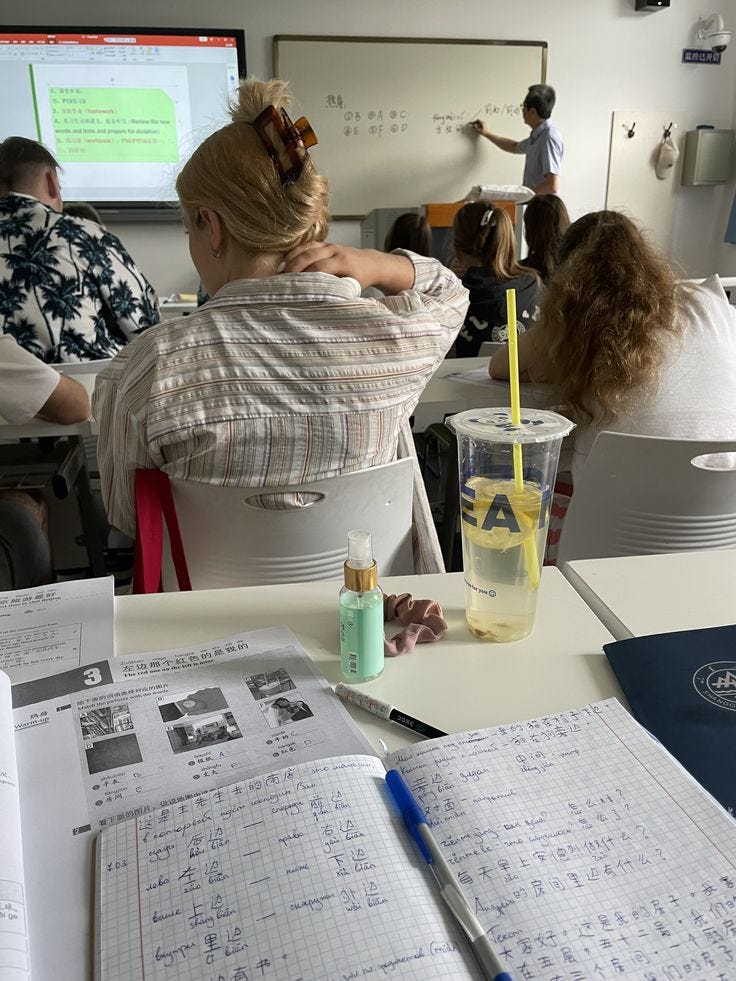
Taiwan. I already broke this one down in detail: the Huayu Enrichment Scholarship pays roughly $900 a month to study Mandarin, with no prior Mandarin required to apply. Full breakdown here, including the two application tracks nobody explains clearly:
so taiwan will pay you $900/month to learn mandarin?
·
Jul 15

I’m fully asia-maxxing this season of my life, if that wasn’t already obvious, and I want to start covering some of the niche ways to actually move here — not visit, MOVE. Studying a language abroad isn’t a new idea, obviously, but a few of my friends are doing a specific scholarship in Taiwan right now, and it genuinely surprised me how generous and ac…
Germany. Public universities charge no tuition at all, for anyone, and DAAD layers funded language and study grants on top of that for a wide range of nationalities (daad.de). This is the one people underestimate most, because “free tuition” doesn’t sound as exciting as a stipend, but free tuition in a country where rent isn’t extortionate adds up to more than most scholarships do.
China. The Confucius Institute Scholarship funds Chinese language study at more than 150 universities, covering tuition, dormitory housing, basic medical insurance, and a monthly living allowance of about 2,500 RMB, roughly $350. It runs short courses, one semester, and full academic year options, so you can test the waters before committing to a year.
Japan. The MEXT Japanese Studies Scholarship is specifically for language and culture study, not a full degree, and it pays a monthly stipend in the range of ¥117,000 to ¥145,000 on top of covering tuition and airfare. This is the one most people miss entirely because they only ever hear about MEXT’s degree-track scholarship and assume the language-only option doesn’t exist.
South Korea. The Global Korea Scholarship (formerly KGSP) is built around a full degree, but it comes with a fully funded year of intensive Korean language training before your coursework even starts, on top of tuition, airfare, housing, and a monthly stipend. If a full degree isn’t the goal, it’s still worth knowing this exists, because the language year alone is a genuine credential.
Indonesia. This is the one I’d bet almost nobody reading this has heard of. Darmasiswa is a non-degree scholarship, running since 1974, open to citizens of any of the 111+ countries that have diplomatic relations with Indonesia, and it exists purely to fund people studying Bahasa Indonesia, traditional music, dance, or craft, not a degree, not a career track, just the language and the culture around it. You pick a six month or a full year track, a monthly stipend of roughly IDR 4,700,000 lands in your account (somewhere around $290, depending on the exchange rate), and housing assistance is provided on top. Ages 18 to 32, no prior Indonesian required. I have genuinely never seen anyone in this space mention it, and I’ve been looking.
Turkey. Türkiye Bursları might be the single most generous program on this entire list, and it’s barely discussed outside scholarship-forum circles. Full tuition, free dormitory housing, a round trip flight, health insurance, and a monthly stipend that scales from 4,500 TL at bachelor’s level up to 9,000 TL for a PhD (roughly $100 to $150 depending on the exchange rate, though the free housing and tuition matter more than that number does). Anyone without a C1 Turkish certificate gets a full funded year of Turkish language study first, no exceptions, built into the program by default. The part that actually shocked me: you don’t apply to a university separately. The scholarship places you. One application, and Turkey handles the rest.
Romania. The Romanian Government Scholarship applies directly through the Study in Romania portal, no embassy or ministry acting as a middleman, which is rarer than it should be among government scholarships. For Romanian-taught programs, a free one-year Romanian language preparatory course is built into the award, alongside a monthly stipend of roughly €175 to €220. It’s not as flashy as Turkey’s package, and the stipend won’t stretch far in Bucharest on its own, but the directness of the application process is genuinely unusual.
Poland. The Banach NAWA Programme funds Master’s study in Polish or English, and if you go the Polish-language track, a full year of NAWA-funded preparatory language study comes first for anyone under B1 level. Monthly stipend of PLN 2,500 (roughly €580, around $620), plus a one-time travel allowance of the same amount, plus free tuition at public universities. The catch, and it’s a real one: this isn’t open to everyone. It’s specifically restricted to citizens of 36 to 37 countries under Poland’s official development aid list, mostly across Africa, Asia, Latin America, and parts of Eastern Europe, and it explicitly excludes most of Western Europe and Central Asia. Worth checking the eligible country list before you get attached to this one.
Egypt. The Egyptian Government Scholarship (EGYAID) runs a dedicated Arabic Language Centre track built specifically for people who need to build Arabic skills before anything else, open to citizens of any country, ages 15 to 27 for that track specifically. It covers tuition and a stipend, and it’s genuinely rare to find a national government scholarship built around Arabic specifically rather than Arabic as a side requirement for a broader degree. Worth knowing: Al-Azhar University separately runs an even more generous package, including a free Arabic foundation year, but it’s restricted to Muslim applicants, so it’s a different door than the EGYAID one.
India. The ICCR runs more than 20 different scholarship schemes covering tuition, accommodation, airfare, and a monthly stipend, and buried inside the general eligibility rules is the single strangest detail I found in this entire round of research: every ICCR scheme has an age cap except one category. Courses in Hindi, Sanskrit, or Indian performing arts have no upper age limit at all. Every other scholarship on this list, every single one, cuts you off somewhere in your twenties or thirties. This is the one exception I found anywhere. One real catch worth knowing: medical insurance isn’t included, you’re required to buy your own separately, which isn’t how most of the others on this list work.
Serbia. The “World in Serbia” scholarship is genuinely obscure outside the Balkans and I mean that as a compliment: a free intensive Serbian language course is a built-in prerequisite before you even start your degree, a monthly stipend of roughly 18,000 RSD (about €150, around $160) comes with it, tuition, accommodation, meals, and health insurance are all covered, and it’s open to citizens of 127 countries across the Non-Aligned Movement, Africa, Asia, and Central and South America. You cover your own flight, which is the one thing you’re on the hook for. It’s not the flashiest package on this list, but the sheer breadth of eligible countries, 127, is wider than almost anything else here.
Here’s where it gets specific…
which one I’d actually apply to, and why:
Go Taiwan if you’re drawn to Mandarin and want the fastest, most straightforward application on this list.
Go Germany if free tuition matters more to you than a stipend, and you’re open to a longer academic path afterward.
Go China if you want the most program flexibility, since the short courses let you test the language before committing a full year.
Go Japan if language and culture study is genuinely the goal rather than a means to a degree, since MEXT’s Japanese Studies track is built exactly for that.
Go Korea if you’re already thinking about a full degree eventually, since the language year quietly becomes the foundation for everything after it.
Go Indonesia if you want the lowest-pressure option on this entire list, since it’s explicitly not about a degree or a career outcome, just genuine curiosity.
Go Turkey if you want the single most generous financial package here and you’re comfortable committing to a real degree afterward, since the language year is just the entry point into something longer.
Go Romania if you want the most straightforward, least bureaucratic application process on this list and you’re not fussed about the smaller stipend.
Go Poland if your country is on the eligible list and you want a genuine Master’s degree with a language year folded in, not just a language program on its own.
Go Egypt if you want to learn Arabic specifically and none of the European or Asian options on this list interest you.
Go India if age is the thing that’s been quietly stopping you from applying to anything else on this list, since Hindi and Sanskrit are the one door here with no cutoff at all.
Go Serbia if you want the widest possible eligibility on this entire list and you’re not chasing the biggest stipend, since 127 eligible countries beats every other program here by a wide margin.
Rooting for you so hard,
Daria 🤍🌏
ps. if you’ve done any of these twelve, or a funded language program I haven’t mentioned, tell me in the comments which one and whether you’d do it again. I’m always collecting more of these for future breakdowns.
I’m a global opportunities strategist. I help multipassionate, globally curious people figure out what to do with their lives internationally: which programs to apply to, how to relocate, and which experiments are actually worth running given your passport, budget, and timeline.
andddd share this post with the friend who’s always saying they want to learn a language “eventually,” this is their sign
No posts
Comments
Nothing yet. Say the first thing.
Sign in to join the conversation.