
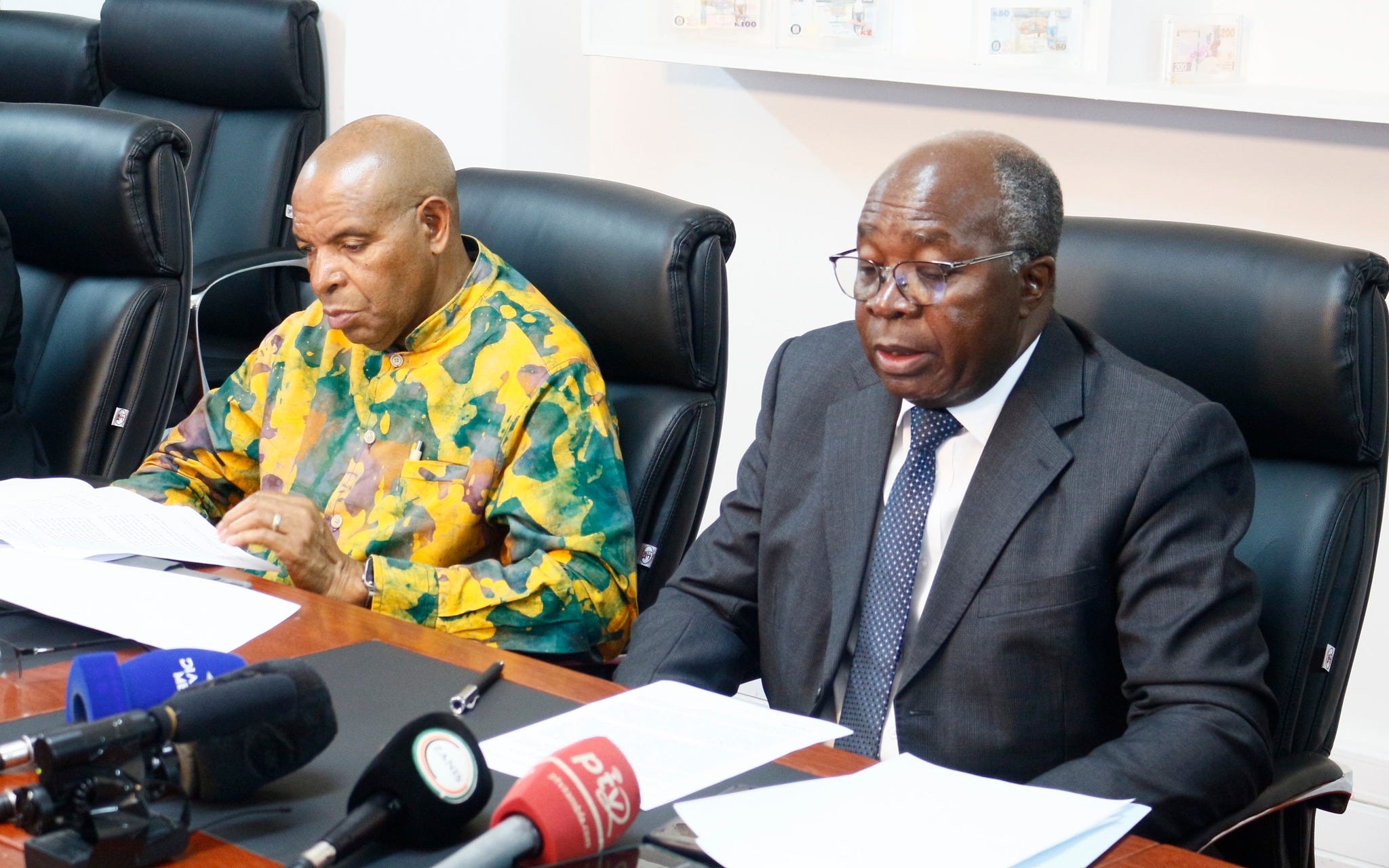
Earlier today news broke on international newswire services that the Zambian government had decided to shelve plans to extend the IMF’s Extended Credit Facility which has been in effect since October 2022. The news was subsequently confirmed by the minister of finance at a press briefing held about midday in Lusaka.
Zambia’s Extended Credit Facility (ECF) was supposed to last 3 years meaning that it should have expired last October. However, the government, as far back as last February, had indicated its intention to request a year’s extension beyond October and had, therefore, been in discussion with the IMF over the last two or so months. Today, in a move that caught many by surprise, the minister of finance announced that those plans had been suspended, at least for now.
Why the suspension? At today’s press briefing the minister of finance lauded praise on the IMF’s ECF arguing that it had met its objectives of restoring economic stability and, therefore, the government was looking towards engaging “the Fund on a successor framework” that would build on these achievements.
However, the likely reason why the government has announced the abrupt suspension is due to what Nobel prize winning economist William Nordhaus referred to as the Political Business Cycle. That is, the tendency for governments to suspend anti-poor policies when an election is looming. In other words, being in bed with the IMF in an election year can be fatal.
There’s now quite a mountain of evidence showing that the ECF, even though it might have restored some aspects of macroeconomic stability, has been nothing short of catastrophic for the social and economic lives of everyday Zambians. I have documented some of this evidence on this substack over the last 3 to 4 years as well as in a scholarly piece I co-authored earlier last year. For example, the cost of diesel and petrol have remained significantly high, even doubling at one point, largely due to the IMF programme. Consequently, high energy prices have translated into a historic cost of living crisis characterised by high food and transportation costs.
A chaotic agriculture policy in 2023, a result of the IMF’s mixed signals on agriculture subsidies, and an ‘export maize at all costs’ policy in the midst of a draught, encouraged by the IMF, resulted in a desperate shortage of food in 2024. Food prices, given that they are difficult to contain once they significantly increase (i.e., sticky downwards in economics speak), are yet to recover from this IMF-inspired policy disaster of 2023.
The same is also true for electricity supply. In addition to IMF-inspired increases in electricity tariffs, the country has suffered unprecedented power outages of, at times, up to 20 hours a day over much of the last 2 to 3 years. The absence of electricity at this scale has been devastating for Zambia’s urban poor many of whom eke out a meagre living in the informal sector running barber shops, hair dressers, grocery shops, restaurants, welding shops etc…where electric power is the most vital input.
The fundamental reason for the shortages in electricity is climate change-induced draught, but this situation has been made worse by a ‘profits over people’ policy, again encouraged by IMF neoliberal orthodoxy, whereby electricity exports have increased at a time when the country should have been doing the reverse. Data contained in the Bank of Zambia’s annual reports unsurprisingly shows that electricity became one of the country’s most important non-traditional exports during the time that the country has been facing historic power shortages.
On the other hand, the social and economic crisis wrought by the IMF’s ECF has been a godsend for the country’s politically connected elite who have made a pretty penny ‘solving’ the crisis whether it be importing emergency electric power or emergency food or emergency gasoline. Zambia’s giant foreign-owned mining sector has also had a field day over the life of the ECF from enjoying generous tax treatment and enjoying a privileged continuous supply of electricity at prices far below the commodity’s scarce value.
Given all this, the shock announcement by the Zambian government today should be seen as an admission on their part that dealing with the IMF is anti-poor policy. The minister of finance admitted this much in his statement today when he said the suspension would allow for “[the deliberate] transition towards a growth-focused agenda that accelerates investment, supports job creation, and expands the productive capacity of the Zambian economy.” In other words, IMF programmes are anti-growth, anti-investment and anti-jobs.
However, we should not be mistaken to think that the Zambian government’s suspension of the ECF is borne out of a principled position but out of a desperate need to win this year’s elections. Seen this way, the IMF will be back in town should the present government retain power after August’s elections.
Comments
Nothing yet. Say the first thing.
Sign in to join the conversation.