
There is an image from Qusra that I cannot get out of my head.
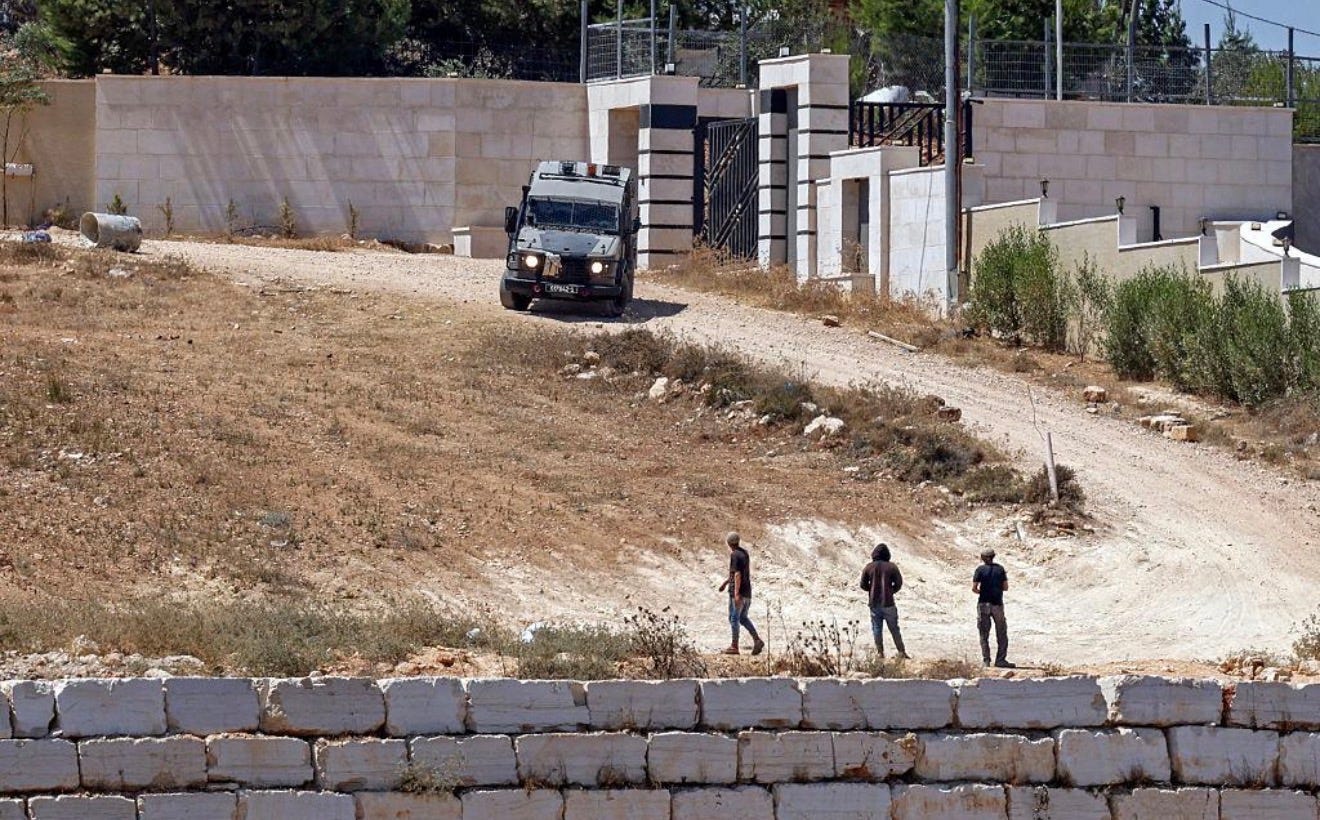
Three Palestinian families inside their homes. Settlers outside. The roads leading to them blocked. Water and electricity cut off. And the area surrounding them turned into what the Israeli military calls a closed military zone.
Not because these families entered land that was not theirs, but because they stayed in their homes.
What is happening in the Ras al-Ain area of Qusra, south of Nablus in the occupied West Bank, is not, to me, simply another story of “tensions” between Palestinians and Israeli settlers.
It is an example of how forced displacement can be produced. You do not always need to physically drag a family from its home. You can surround it, cut it off from the most basic necessities of life, make reaching the house a daily struggle, and then wait until leaving begins to look like the only option left.
But in Qusra, the three families have so far refused to give the settlers that ending.
For days, the residents of three Palestinian homes in Ras al-Ain have found themselves under siege after settlers moved onto the surrounding land and established an outpost close to their houses.
Settlers blocked or obstructed roads leading to the homes. Water and electricity were cut, and moving in and out became extremely difficult. According to international reports, the United Nations said 15 Palestinians, including two children, were left without basic services during the confrontation.
But behind the number “15 Palestinians” are entire lives.
There are children who need water. Families who need food. People who simply want to open their front door and leave their house without finding settlers outside.
Imagine being inside your own home, on your own land, and suddenly having to fight for things you once did without thinking.
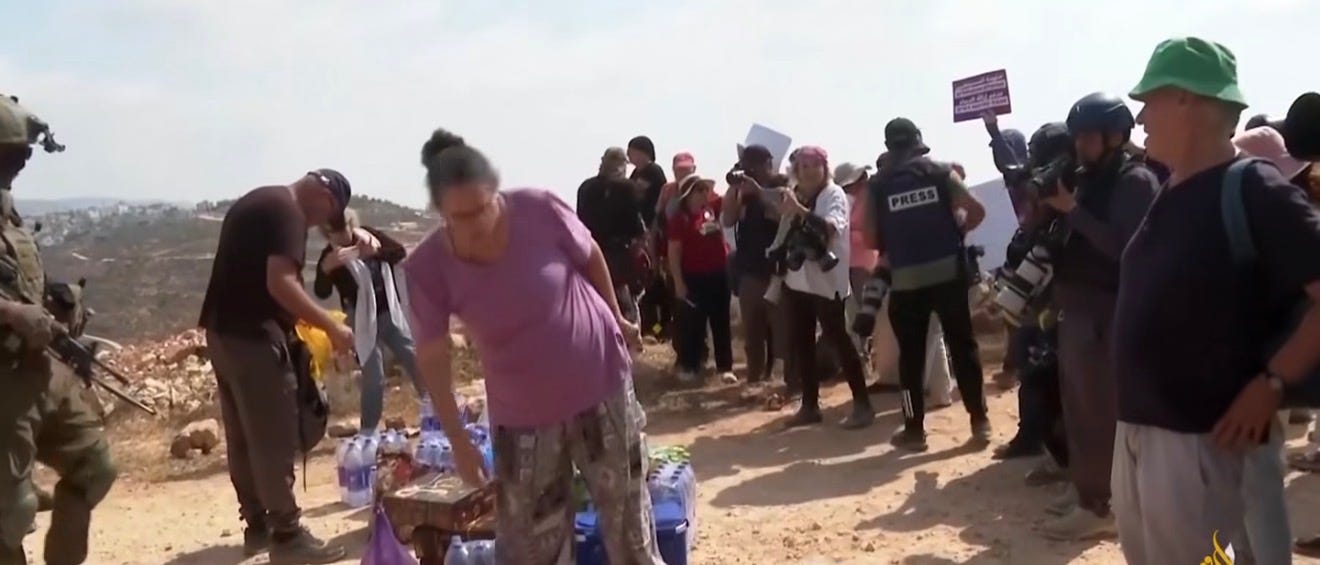
Perhaps the scene that best captures what is happening came when foreign and Israeli solidarity activists tried to reach the families.
They came carrying water, food and basic supplies.
Israeli forces prevented them from reaching the homes, saying the area had been declared a closed military zone.
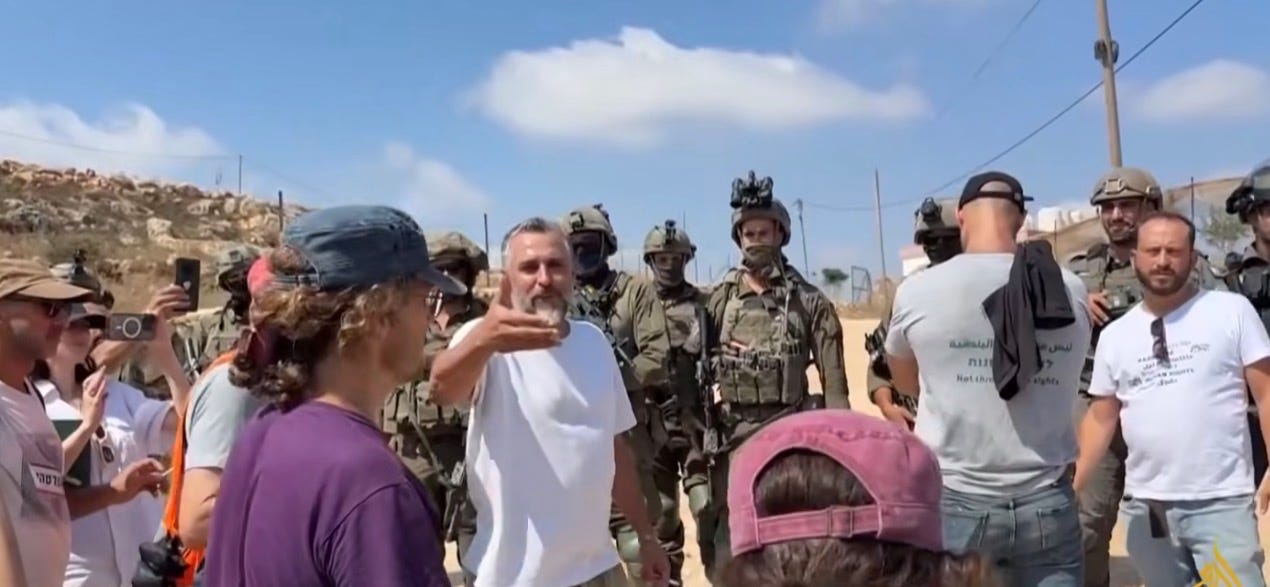
Think about the contradiction.
Settlers were able to reach the Palestinian homes and establish an outpost beside them. Roads to the families were blocked and their basic services were cut.
But when people arrived carrying food and water for the homeowners, they were stopped because the area was now a closed military zone.
Even a bottle of water had become difficult to deliver.
How can a settler reach the doorstep of a Palestinian home and establish an outpost nearby, while someone carrying water to the person who lives there is prevented from reaching them?
And what frightens Palestinians in Qusra is not simply the tent itself.
Palestinians in the West Bank know that taking control of land does not always begin with a large settlement surrounded by fences.
Sometimes it begins with a tent.
Then more settlers arrive. Another structure appears. Then a road. Then infrastructure. Eventually, something that began as temporary becomes another reality on the ground.
So when these families see settlers putting up a tent metres from their homes, they do not simply see a piece of fabric.
They see what may come next.
They see the land they could lose.
After the case drew international attention and pressure from the United States and others, the Israeli military sent additional troops and military convoys into the area, saying it was working to remove the outpost.
Structures were removed, and there were confrontations between Israeli forces and settlers during some attempts to clear the site.
But the settlers returned.
Orders were issued and repeated measures were taken against the outpost, yet they did not bring the settlers’ presence to a decisive end.
And that leaves me with a question that is difficult to ignore.
The military can declare the area a closed military zone.
It can deploy soldiers and military vehicles.
It can close roads.
It can prevent an activist carrying food and water from reaching a Palestinian family.
Yet after all of that, settlers can return.
If the outpost is illegal even according to the Israeli authorities, why is it the Palestinian who ends up living under restrictions while settlers continue trying to establish their presence on the land?
That, to me, is one of the cruellest contradictions in this story.
A family is inside its home.
Settlers arrive on the surrounding land.
Then the area becomes a closed military zone.
Then the homeowner becomes the person who cannot move normally, while the person trying to bring them water is the one prevented from passing.
This is why I cannot describe what is happening simply as “clashes” or “friction”.
Those words make it sound as though two groups arrived at the same place at the same time and began fighting over it.
But these families did not go to the settlers.
The settlers came to their homes.
And this is where, for me, the heart of the story lies.
Forced displacement does not always require a soldier standing at your door and giving you five minutes to pack your belongings.
There is another, slower way.
Close the road.
Cut the water.
Cut the electricity.
Put settlers outside the home.
Prevent people from reaching the family.
Make food and water difficult to obtain.
Surround the area with a military presence.
Then make a mother and father wake up every morning asking themselves: can we keep living like this?
Then wait.
If they do not leave today, increase the pressure tomorrow.
If they do not leave tomorrow, increase it again.
Until life itself becomes the instrument used to push them out.
And if the family eventually breaks and leaves, it can later be said that they simply “left”.
But a family has not left freely when everything around it has made staying almost impossible.
We should always remember what happened before the moment of departure.
Who blocked the road?
Who cut the water?
Who cut the electricity?
Who established the outpost?
Who turned simply remaining inside your own home into an act of endurance?
That is why what is happening in Qusra cannot be separated from what is happening across the occupied West Bank.
According to Peace Now data cited by Amnesty International, the number of Israeli settler outposts established across the West Bank had reached 363 by the end of April 2026.
Even more strikingly, 212 of them were established during the term of the current Israeli government, compared with 151 established between 1996 and the end of 2022.
The pace of outpost construction has accelerated dramatically in just a few years.
And it does not stop with what settlers establish themselves.
By July 2026, the current Israeli government had approved the establishment or recognition of 104 settlements in the West Bank, according to Peace Now.
Those decisions include entirely new settlements, previously unauthorised outposts being converted into settlements recognised under Israeli law, and neighbourhoods of existing settlements being given independent settlement status.
Those numbers are why a tent outside a Palestinian home in Qusra means much more than a tent.
Because today’s unauthorised outpost can become tomorrow’s officially recognised settlement under Israeli law.
Years from now, when we look at a map of the West Bank and see a settlement, it can appear as though it has always been there.
But how did it begin?
Perhaps with a small group of settlers.
A tent.
A dirt road.
A temporary structure.
Then Palestinian access to the land became more difficult.
A family left.
Infrastructure followed.
Protection followed.
Then official recognition followed.
Years later, what began with a tent became a permanent point on the map.
That is why I cannot look at Qusra as merely the story of three families.
This is how land can change, metre by metre.
The case also reached Washington because one of the besieged homes belongs to a Palestinian who holds US citizenship.
US Ambassador to Israel Mike Huckabee used unusually strong language to condemn the settlers involved in the siege, describing them as “Israeli terrorists”.
Reuters also reported that the United States pressed Israeli Prime Minister Benjamin Netanyahu to publicly condemn what happened.
And I find myself asking another question.
What if none of these homeowners had been American?
How many other Palestinian families can face the same thing without their story ever reaching an ambassador?
Without pressure from Washington?
Without cameras?
Without anyone outside Palestine ever learning their names?
Amid all these details, there is one fact I do not want to get lost:
The three families refuse to leave their land.
After the siege.
After the roads were blocked.
After the water and electricity were cut.
After settlers arrived beside their homes.
After troops were deployed and the area was declared a closed military zone.
After people carrying water and aid were prevented from reaching them.
They are still there.
Not because they do not understand the danger, but because they also understand what leaving could mean.
For a Palestinian, the word “temporary” is not a simple word when it comes to land.
Who can guarantee that if these families leave today, they will be allowed to return tomorrow?
Who can guarantee that they will not return to find a larger outpost, a new road or an entirely different reality on their land?
In filmed statements, some members of the families have expressed their determination to remain in the strongest possible terms, saying they would rather die on their land than leave it under pressure.
I do not mention this to romanticise death.
I mention it because it reveals the cruelty of the choice these people feel they have been given:
their land or their safety.
It is easy to look at a map and say: three homes, three families, one town south of Nablus.
But control over land does not always happen in a single night.
It happens metre by metre.
It begins with a tent.
Then an outpost.
Then a blocked road.
Then a family under siege.
Then basic services are cut.
Then the Palestinian can no longer freely reach the place where they have lived.
And if they eventually leave, the land remains.
Years later, we look at the map and ask: how did all of this happen?
This is how.
These families are not asking for new land.
They want their land.
They are not asking for new homes.
They want their homes.
They want their children to have water. They want electricity. They want the road to their houses open. They want someone carrying food and water to be able to reach them.
When I think about Qusra, I think about three families inside their homes, settlers around them, roads blocked, water and electricity cut, soldiers surrounding the area, and people carrying water being turned away because the area has been declared a closed military zone.
And still, the families remain.
Because they know that what is ultimately being demanded of them is simple:
Become exhausted.
Become afraid.
Make staying so painful that it can no longer be endured.
And then leave.
But so far, they refuse.
That, to me, is the heart of what is happening in Qusra.
The question is not only whether three families will remain in three houses.
The larger question is this: how did we reach a reality in the West Bank where a Palestinian has to fight for the most basic right imaginable — simply to remain on their own land?
No posts
Comments
Nothing yet. Say the first thing.
Sign in to join the conversation.