
While Camila Cabello’s first three solo albums orbit around the sound of her heritage—early single ‘Havana’ namedropped her birthplace, while Familia contained whole songs in Spanish—C, XOXO, her fourth, was the first to encapsulate the sound of her youth, having moved to Miami when she was around six. A loose sort-of concept album about coming back home, about lost love and fading innocence, C, XOXO conjures the sound of Miami filtered through light debauchery and hedonism, resulting in an album that takes alternate forays into Afrobeats, hyperpop and ballads. It is utterly singular, the work of an artist unbound from the shackles of industry expectation, free to make the most experimental and interesting music of their career thus far.
It also, without mincing words, crashed and burned upon release, becoming Cabello’s first solo album to debut outside of Billboard’s top ten, and receiving what can only be described as a chilly reception from critics. In a way, the record was dead-on-arrival, coming just three weeks after Charli xcx’s lime green magnum opus, the fairly straightforward Brat. Putting aside that C, XOXO is less interested in strong first impressions (a point I’ll return to later), lead single ‘I Luv It’ was perhaps unfairly compared to xcx’s work, a point she’d come to parody on her own TikTok page.
And, sure, ‘I Luv It’ sounds similar to Charli xcx if you’ve heard three hyperpop songs ever. But it is too left-field, too peculiar to ever belong to xcx, whose music—however brash or noisy—always is at least identifiably linear, and always reaches a satisfying conclusion. ‘I Luv It’ is simply bizarre in comparison to the safe club sound of Brat; the chorus interpolates Gucci Mane’s ‘Lemonade’, and features Cabello sound like she’s chasing the beat as she chants the title in staccato. The beat is absolutely phenomenal, and in a just world triggered a thousand TikTok dances. Playboi Carti shows up at the end and mutters something completely unintelligible. It is wonderful. Pitchfork and the New Yorker both listed it as one of 2024’s best pop songs; Variety panned it as one of the year’s worst.
This is music that is uninterested in meeting you halfway, instead digging its heels in the ground and sniffing around the bed it’s made for itself. At a point in popular music where ‘authenticity’ is in vogue, Cabello and her collaborators—principally, El Guincho and Jasper Harris—scoff and brush aside any notion of accessibility, instead crafting an embodied, rich world where no-one’s above the age of twenty, school’s out forever and the only things in your calendar are hanging out with your girls and meeting up with the cute guy from a few blocks over.
C, XOXO reveals itself in fits and starts, bursts of musical colour that sketch a story instead of drawing it plainly. If the stripy hyperpop of ‘I Luv It’ is a slight red herring for the album’s sonics, following track ‘Chanel No. 5’ is a useful access point. A Frankenstein’s monster of R&B, out-of-tune piano and stuttering beats, it functions as a kind of thesis statement on the persona Cabello adopts on the album: “Cute girl with a sick mind,” she sings. “I know just how to play my cards right.” It positions Cabello as someone who relishes control—a natural evolution from someone who spent half a decade under the thumb of Fifth Harmony’s PG-enforcing bosses—which makes the later loss of that control all the more devastating.

But, for now, a pin in that. I mentioned earlier that C, XOXO is uninterested in strong first impressions, the way an album like Brat makes its aesthetics immediately obvious, its creator naturally centred. Though the soundscape of C, XOXO is still identifiable—Miami, beach to the club, Spring Breakers—it is less concerned with its own importance, more comfortable existing in its own liminal humidity than loudly stating its purpose. Its collagist approach to sound and personality contributes to a portrait of a young woman who exudes confidence and glamour, but whose ambitions are continually undermined by a world set on tearing her down. It makes sense as an extended allegory for Cabello’s career, but also as a simple tale of a girl growing up.
The album is at its strongest when, as it so often does, it tries something new for Cabello, an artist who has usually stuck dutifully to Latin-influenced pop. ‘Dade County Dreaming’, featuring the now-disbanded City Girls, begins as a cool, dark electro-R&B track. JT and Yung Miami each come in on a spiky synth moment, waxing poetic about “the city where the streets ain’t pretty,” before the whole thing gets subsumed by a glistening, contemplative piano line atop which JT delivers the divine bars: “Show that ass, clap, up, down, left, right, fuck it up.” It is odd, yes, but strikingly beautiful, and it’s a miracle the whole thing coheres. That’s true of C, XOXO as a whole, too, a project that contains more stylistic variations than entire careers, but is tied together by a uniting vibe.
What vibe is that? Well, chiefly it is one of hedonism, of being sixteen and feeling like you rule the world. The terrific ‘Dream-Girls’—whose glitchy texture and The-Dream sample clash together to form a twerker you could imagine a teenage Cabello and her girls bumping on a speaker down by the Dairy Queen—masterfully embodies the kind of nonchalant freedom one comes into when they no longer have a bedtime and they can buy a vape for the first time. Cabello lists off friends like they’re items on a grocery list: “It was Keisha, it was Sonia, it was Tanya, it was Monique.” There’s an allusion in the song’s outro to growing up, but it’s from the perspective of wanting to grow up prematurely, of tasting the shiniest parts of adulthood (your first sip of alcohol, your first kiss) and diving headlong into it before you’re ready.
The other end of that spectrum, then, is the inevitable disappointment: of being stood up by a guy; of coming back home just to find it’s nothing like you remember; of realising that you are not flawless and are in fact capable of harming others. Fingerpicked ballad ‘Twentysomethings’ catches Cabello right before that epiphany, in the optimistic throes of believing that things will turn around: “And you laugh when I say, “You’re such a dick sometimes” / We might be alright, we might be alright / And I laugh when you say I’m such a bitch sometimes / We probably won’t work, but, baby, we just might.” Its plaintive but evocative lyrics use the scenario of an avoidant boyfriend to examine the naivety of this optimism, and raises the emotional stakes in the process.
But it’s ‘B.O.A.T.’, the record’s emotional centrepiece, that fully encompasses the early-twenties malaise the album builds toward—the loss of that control mentioned earlier. An electro-piano ballad built, incredibly, on a sample of Pitbull’s ‘Hotel Room Service’ (a choice that’s either sharply taunting or gently yearning, depending on how you interpret it), the song finds Cabello at an impasse, realising she is as to blame for a relationship’s demise as the other person is: “You were right / That I want you when you’re not mine […] And I fucked up, baby, big time.” Despite being one of the record’s simplest moments, it is also where Cabello shines the most as a songwriter, conjuring a palette of emotions that congeal into some unmistakably potent lines, as the best pop songs do.
On much of C, XOXO, the sonics do as much to create the humid, hedonistic soundscape as they do to signal Cabello’s own taste and sensibilities. Many, on release, criticised Cabello for genre-hopping, but to accuse her of being inconsistent is to belie one of the album’s core strengths: using a diverse range of sounds and moods to create a cohesive final product. Never mind that ‘He Knows’ could’ve been an Amaarae song, or that ‘June Gloom’ sounds like Lana del Rey with more bells and whistles; both are great tracks in their own right, but the mastery is in the cohesion between them—two wildly different pieces of the same puzzle.
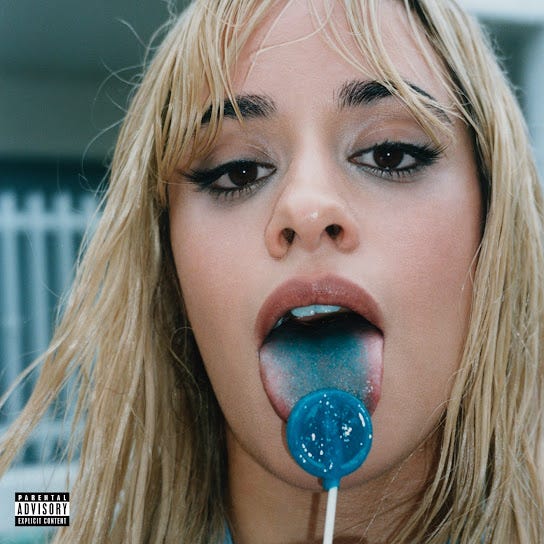
Besides, C, XOXO isn’t all that concerned with making its narrator the main character, instead letting her become another setpiece that adorns this tale of lost youth. The fact that some of it sounds like it could’ve been made by someone else is exactly why it couldn’t have; there’s not many mainstream pop artists that would be bold enough to string together such diverse tracks as ‘Pink Xoxo’ (a PinkPantheress-produced interlude), the aforementioned rollercoaster of ‘Dade County Dreaming (which is essentially three songs in one), and the out-and-out club track ‘Pretty When I Cry’. In not asserting her own self-importance, Cabello lets the tale become one we can see ourselves in, and makes the Miami of her youth analogous to any kind of nostalgic wasteland.
The album has a curious legacy; to many, it’s still as reviled as it was upon release (which, let’s face it, is a victim of bad timing; there’s a Drake feature on ‘Hot Uptown’ that perfectly marries his petty fuckboy persona with Cabello’s daisy-chain femininity, and it would’ve been a surefire hit had it not been released the month after ‘Not Like Us’). Yet, among some circles—the same that declare Madonna’s American Life as a prescient, postmodern classic—the album is appreciated for the misunderstood masterpiece it is. In fact, I’ve seen many a forgotten album be described as that artist’s C, XOXO (e.g. “Impossible Princess is Kylie Minogue’s C, XOXO”), giving Cabello’s record an intriguing legacy as a black sheep of the pop landscape that more and more listeners are coming to appreciate. I think describing it as her American Life is a sound assessment, too; both albums were derided on release and are enjoying a reevaluation among pop fans, but beyond that they both capture a kind of grief that beauty is ephemeral and people are capable of bad things. I think of ‘Nothing Fails’, one of American Life’s—and Madonna’s—finest songs: “I'm not religious, but I feel so moved / Makes me wanna pray, pray you'll always be here.” That kind of naïve optimism would’ve fit squarely on C, XOXO.
It isn’t perfect: Drake has a whole (not very good) song to himself, and while I can understand its inclusion as paying homage to the music Cabello listened to during adolescence, that function is already served on ‘Hot Uptown’. There’s also an interlude called ‘Koshi Xoxo’ that’s essentially a voicenote from a fan glazing Cabello, which is baffling in a bad way. But these flaws are also quirks in their own way, preventing an easy or linear understanding of the album, which itself presents a Cabello resistant to being understood or perceived. It’s startingly relevant in its narrative of unbridled youthfulness being corroded by the real world—who among us hasn’t been jaded by realising the world kinda sucks? Cabello doesn’t offer a permanent solution, but there’s an implication that the high is worth the pain: “Is it really love if it’s not this crazy?”, she asks on ‘June Gloom’, not long before being interrupted by a sweaty, filtered wallop that sounds like hitting rewind on that summer you spent in Miami.
No posts
Comments
Nothing yet. Say the first thing.
Sign in to join the conversation.