
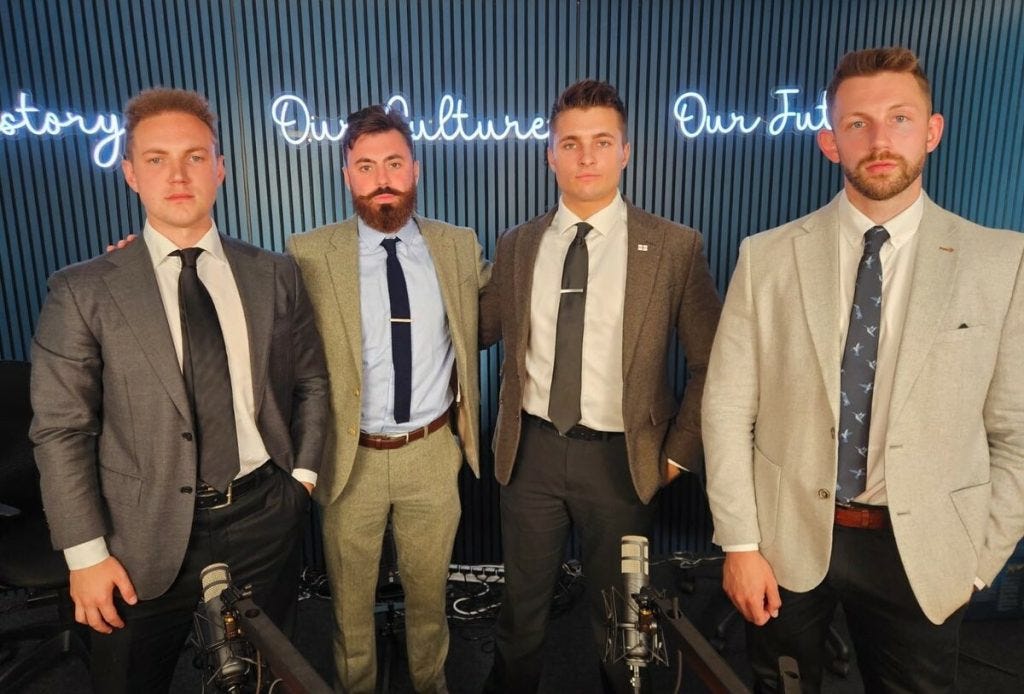
Earlier this year, on the evening of the council elections or a few days later, I cannot quite recall, I was standing outside the MoG with a bunch of friends, celebrating. A young man I had never met detached himself from a post New Culture Forum event group and walked up to me.
“You bore me, Gawain.”
Oh, interesting.
“Nothing you have ever said is of interest to me.”
I thought, this could be fun. “OK, I’ll bite. What could I say that would interest you?”
“You would have to agree with me whole-heartedly.”
“So you are the Messiah then?”
“Well yes, I am, up to a point.”
I wouldn’t have minded at all if there had been a smile there, a twinkle in the eye suggesting self-mockery. There was none. Absolute self-composure and certainty. People still mention the moment to me in amused disbelief.
The young man was Harrison Pitt, Senior Policy Fellow of Restore Britain, the party Rupert Lowe has built from the wreckage of his departure from Reform. I record the exchange complete because it is my own experience, witnessed, and because I have come to think it is not an anecdote at all. It is a doctrine. Interest requires whole-hearted agreement. Hold that thought, because everything that follows is that repeated at scale.
I have written before, in the Critic, about the Corbynista right, the tendency that has learned nothing from watching Labour devour itself except the receipt. Restore has that tendency with a solitary borrowed parliamentary seat. And around Rupert Lowe has gathered something more specific, which I have taken to calling the Ruparyans. The name is unkind. It is also, I will argue, earned.
Start with Charlie Downes, Restore’s co-founder and spokesman, aged twenty-five, fluent, presentable, the acceptable face. Is he maligned? Judge him by his own words, since nobody else’s are needed. He has declared that “Restore Britain believe that Britain is a people defined by indigenous British ancestry and Christian faith.” Sit with that definition for a moment. Anglo-Jewry has been here since Cromwell’s resettlement, three and a half centuries of Montefiores and Rothschilds and Disraeli’s baptised exception proving the rule, and the formula excludes the lot of them, along with every other minority, however many generations deep, one wonder about the Romany: the English Gypsies for example). This is not a hostile reading. It is what appears to be the meant sense of the argument. Downes has also said, on a friendly podcast, that many of those who came here legally, “and those who have been born here, they don’t belong here.” Not illegality. Birth.
Then, in February, Nigel Farage posted that he could not be bullied and could not be bought. Downes replied with a single uncaptioned photograph, Farage at the launch of the Reform Jewish Alliance, an event I was proud to attend, Star of David visible behind the podium. No words. None needed. It is the oldest detritus in the European gutter, money and hidden influence. Here delivered as an image precisely so that nothing could be quoted back at him. Nobody reaches for that reply by accident. He selects the event, the frame, the star. The method is insinuation engineered for deniability, and the deniability is the telling detail.
Now lets run the doctrine through its paces, because a test of belonging can be judged by who fails it. Lowe was asked on the BBC whether the King is a white Briton. He declined to say, murmuring about “different interpretations” of a definition requiring both parents born here. Consider what that hedge concedes. Prince Philip was born in Corfu. He joined the Royal Navy at eighteen, directed the searchlights at Matapan as a midshipman, was mentioned in dispatches, and stood in Tokyo Bay to witness the surrender. If that man’s son fails your Britishness test, your test is measuring something other than Britishness, which is of course its purpose. Churchill fails too, on account of Jennie Jerome of Brooklyn. Wellington was born in Dublin. A definition that unpersons Churchill and the Sovereign while nodding through the movement’s own street activists was not drafted in good faith to describe a nation. It was drafted to exclude particular people, with the collateral damage accepted as a cost of the required purity.
The reductio arrived in May, at a wedding. Lowe’s son Angus married Yasmin Mezran, British-born, daughter of a distinguished Libyan academic. Lowe’s own conduct was entirely decent. He posted a photograph of the couple and wrote that he was a very proud father, and I do not doubt it. His followers were less gracious. He was called a traitor. The word hypocrite flew about. Some could not contain their feelings about the grandchildren to come. And here is the thing those followers grasped more clearly than their leader. By the movement’s own two-parents test, Lowe’s grandchildren will fail. The activists his party will not disown, the ones who want Jews on the manifest as “foreign,” would in strict logic come for his own descendants. A party whose doctrine of belonging excludes its founder’s grandchildren and its King has not got a doctrine. It has a mob with a roster, and the mob knows its own mind better than the man strapped to the bowsprit.
Which brings us to how the Ruparyans handle criticism, and back to the MoG doctrine. In early August, Allister Heath wrote in the Telegraph that Lowe’s cheerleaders “can no longer hide their despicable extremism,“ and that these were people who would not have been uncomfortable with the Nuremberg race laws. Heath edits the Sunday Telegraph. He is an arch-Brexiteer who spends his working life fighting the left. If good-faith criticism from anywhere were admissible in the Ruparyan court, it would come from him. Lowe’s response was a sneer about “the 12th Restore Britain hit piece this week.” His outriders offered variations on “you seem a bit ruffled, chap.“ Not one of them engaged the charge.
When the critic cannot be called bought, there is a third setting on the dial. Alex Phillips, no leftist, has been sharply critical of Restore on air. Lewis Brackpool, one of Lowe’s inner circle, responded not with argument but with diagnosis. “I’ve long thought someone needs to intervene with Alex. The erratic outbursts, the on-air shouting, and the obsessive focus on Rupert and us lads in Restore are genuinely concerning.“ Faux-concern as a weapon, dissent reclassified as symptom, rather Soviet in its framing. Phillips returned fire at length, but strip out the heat and her diagnosis stands. “It’s cultish,” she wrote, a “warped self-indulgent identity of deluded crusaderism.“ Which is what Heath said. Which is what I concluded outside the pub. Which, deliciously, is what Lowe himself said when he left Reform, accusing Farage of “messianic“ tendencies. Eighteen months later his Senior Policy Fellow announces to a stranger, without a flicker, that he is the ‘up to a point’ Messiah. The accusation was a confession with an altered postcode.
So the ecosystem is closed at every aperture. Hostile journalists are doing hits. Friendly critics are mad. Farage is bought, see photograph. And agreement, whole-hearted, is the sole admission ticket. A movement with that immune response cannot correct itself, cannot build coalitions, cannot even hold a small raft steady, and Restore is a small raft, one MP, a scattering of councillors, factions already writhing aboard. The intellectuals want the new UKIP. The street tendency wants something older and worse. Nobody patrols the fence.
I know what patrolling the fence costs, because I myself did it for twenty-five years. UKIP survived as a (mostly) serious force precisely because the door swung both ways and the outward swing mattered more. The proscription lists, the expulsions, the absolute bar on the BNP-adjacent, all of it was crude, constant, thankless work, but was vital. A small insurgent party is defined less by its manifesto than by who it declines to throw overboard. Lowe has inverted the policy. One door, inward-opening, and no questions asked of anyone walking through it.
And this is where the sorrow hardens into something angrier. We are closer than we have ever been to breaking the legacy parties that have managed this country’s decline for a generation, closer than we were in the UKIP years, closer than at the referendum. That prize is within reach of the broad patriotic right, and it will be lost, as it has been lost before, if the public comes to believe the whole enterprise is a Trojan horse for the ancestry-testers and the photograph-posters. Every Downes insinuation, every unpatrolled fence, every critic diagnosed rather than answered, hands the legacy parties the only argument they have left. They cannot defend their record. They can only point at the Ruparyans and say, look, that is what change means. It is not. But the men who bore easily, and who require whole-hearted agreement before they will condescend to listen, are doing their level best to prove it so.
A party whose test of belonging flunks its own King has answered the question of whether it is a patriotic movement. You cannot restore Britain while deporting its future.
No posts
Comments
Nothing yet. Say the first thing.
Sign in to join the conversation.