
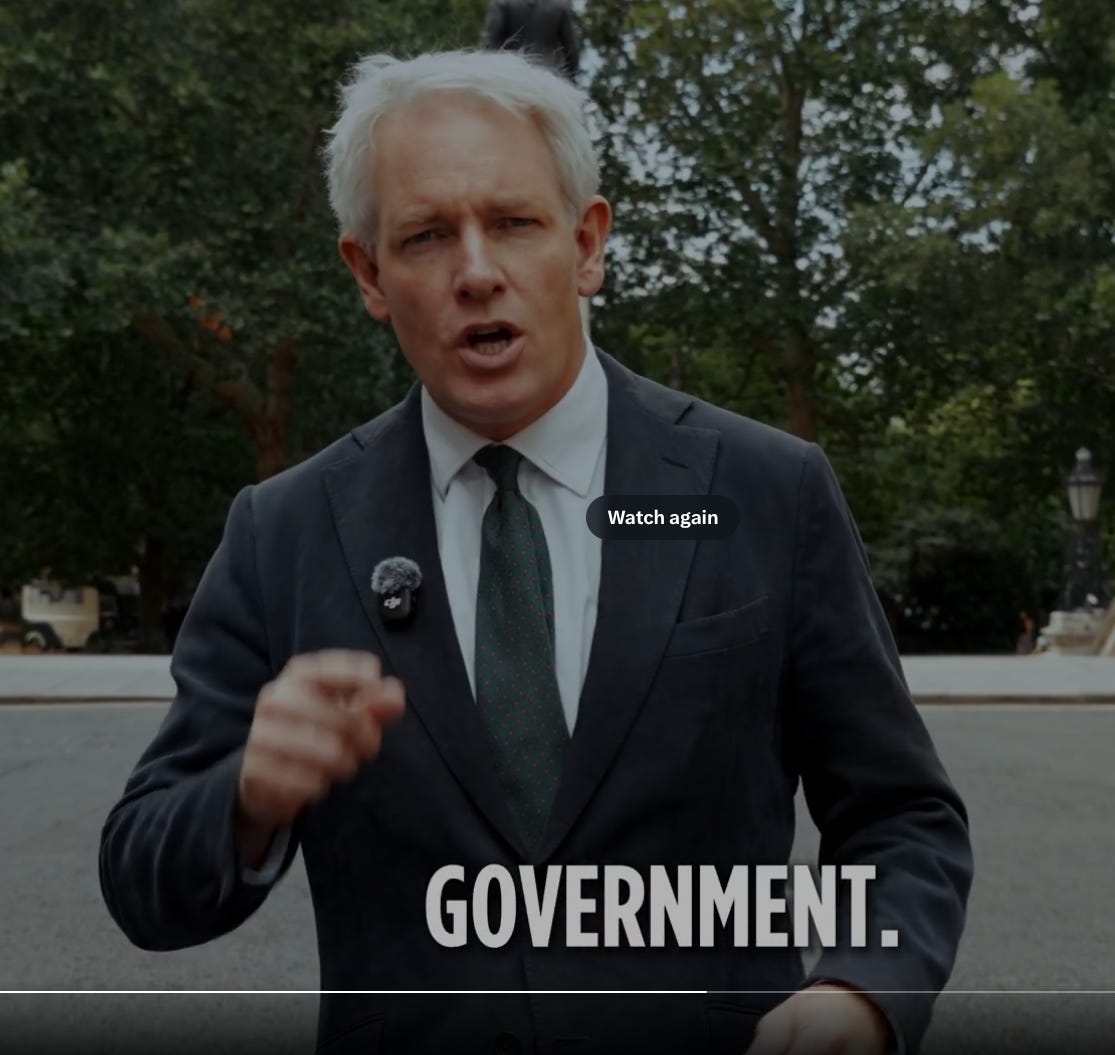
Danny Kruger has published the first of two pieces on what the state spends subsidising trade unions inside its own departments.
Across thirty-eight departments in 2024/25 the taxpayer paid £13.75 million for facility time, union work done in paid hours. The Ministry of Justice accounts for £3.3 million and 647 representatives. The Department for Work and Pensions funds 1,014 representatives at close to a million. HMRC funds 776 at £2.3 million. Twenty-six employees of the Scottish Prison Service perform no prison work at all. In total the public pays for the equivalent of 278 full-time posts entirely removed from public service, some 535,000 working hours a year.
That is the last validated figure we get. Since the Employment Rights Act 2025 came into force in February, departments have no legal obligation to publish the headcount, the hours or the cost. Ministers no longer hold the power to cap. The 0.1 per cent of paybill ceiling has become a suggestion. Paid leave now covers union conferences, internal elections and National Executive Committee meetings out of departmental budgets, with the Cabinet Office tasked not to allow such things but to actively encourage them. The requirement that unions meet the cost of collecting their own subscriptions through the public payroll is repealed. The rule that a representative spend at least half his hours on the job he is paid for can be waived by an individual HR department without a minister being aware. From October the framework extends to paid Equality Representatives and to guaranteed union access to departmental intranets.
Kruger’s proposal is to abolish facility time in the civil service, and, where other public bodies keep it, to legislate for a real-time searchable database of every hour and every pound.
Start with the money. £13.75 million is not a serious sum against a civil service paybill measured in billions. Alex Thomas at the Institute for Government made the point about Kruger’s earlier proposals and it lands again here. A hundred million of London property was lost in the rounding. This is smaller still. Eliot Wilson’s observation, that no politician has ever failed to overestimate the savings available from eliminating waste, has survived every government of the last forty years and will survive this one. Martin Stanley’s version is sharper, that going after civil servants is playing to the gallery, since they are an popular target and a tiny share of the workforce. If the argument for reform rests on the arithmetic, the argument is weak.
Then the word cover-up. Labour did not conceal anything. It stood on a manifesto commitment to repeal the Trade Union Act 2016, won an election, and legislated in the open through both Houses. One may think the result indefensible without calling it a blackout. Kruger’s charge is that the consequence is opacity, which is true, but the process was a vote, and describing a vote as a cover-up isn’t entirely fair.
Then the substance of facility time itself. Not all of it is campaigning. Statutory time off under the 1992 Act covers collective bargaining, health and safety representation, learning representation, and the representation of individual members in grievance and disciplinary cases. Employers who have tried removing it have generally found that the work does not disappear, it can migrate to HR at greater cost and lower goodwill. A pledge to scrap facility time in the civil service will collide with sections 168 to 170 of the same Act, and probably with ILO Convention 151, unless what is meant is the abolition of paid time for union activities as distinct from duties. Kruger should clarify which he means, because his critics will assume the wider reading, undermining his valid and substantive points.
And then the deepest objection, which the Institute for Government has now made twice. Whitehall contains no conspiracy and no all-powerful cabinet secretary. Thomas and Hannah Keenan argued that the Cabinet Office needs breaking up because it is too weak, not too strong, and that in looking for dragons Kruger had found a minnow. Ben Yong’s warning runs the same way from the other side. The civil service is no constitutional bulwark. Its permanence rests on convention and ministerial forbearance, and it tends to be over-responsive to new masters rather than obstructive of them.
Kruger is not the first man to count this money, but he does have the most practical response to the system..
The TaxPayers’ Alliance has been publishing on facility time since 2010. When it first identified the full-time union officials on public payrolls it christened them “pilgrims”. Its 2013 survey put the total subsidy at £108 million, £85 million in paid staff time and £23 million in direct payments, and noted then that public bodies were deducting union subscriptions through payroll without charging the unions for it. Its 2022 campaign was called ‘Stop Subsidising the Strikes’. Its most recent report, covering 2023/24, found at least 21,639 representatives across the public sector at a cost of £98.2 million, with 993 spending all of their working hours on union work and a further 438 spending between half and all of them. Bradford council alone had 42 full-time representatives, up from eleven the year before. Transport for London had the largest single bill at £7.9 million.
The Conservatives arrived at the subject in April, when Andrew Griffith cited that £100 million and announced that a Conservative government would repeal the Employment Rights Act, scrap mandatory paid facility time, ban public sector spending on union time off altogether, and end the closed shop.
Two things follow. The TPA number and the Kruger number are not the same number. Griffith’s £100 million is the whole public sector, councils, health bodies, TfL and the rest. Kruger’s £13.75 million is thirty-eight central departments.
And a promise to ban facility time outright is a far bigger promise than Kruger’s, which is why it is worth less. Griffith’s version requires disapplying statutory rights that have existed since 1975 across every public employer in the country. Kruger’s applies to the civil service, where the employer is the Crown and ministers can act, and offers transparency rather than prohibition everywhere else. The narrower proposal is the one that can actually be achieved in a parliamentary session.
Nothing in the underlying argument is new.
What he wants restored is the Trade Union Act 2016 which required public bodies to publish representative numbers, hours and cost. It gave ministers a reserve power to cap. It restricted check-off so that unions paid for the collection of their own subscriptions. The regulations came into force in April 2017 and rested on a theory of Francis Maude’s, that daylight is cheaper than confrontation and that an organisation obliged to publish a number will find itself moved to reduce it. For a while the theory held. The civil service brought facility time to 0.06 per cent of paybill and ministers cited the fivefold fall as proof.
Behind that sits the wider inheritance. The vocabulary of the blob is Michael Gove’s, minted at Education in 2013. The programme is Gove’s and Dominic Cummings’s, set out in the Ditchley lecture of June 2020 and codified in the Declaration on Government Reform a year later. External advertising of senior posts, prime ministerial oversight of permanent secretary performance, an evaluation unit at the centre, recruitment from outside. Set that declaration beside Kruger’s centre-of-government paper and you find the same list in different prose.
Kruger’s own thinking runs on a different track and he’s been thinking it longer. The New Social Covenant Unit, which he founded with former Conservative MP and Reform friendly presenter Miriam Cates, argued that welfare and public housing should reinforce local ties, family and national belonging, and that public provision carries reciprocal obligation rather than unconditional entitlement. The Centre for Policy Studies has made the allocation version of that case since the early 2010s, Policy Exchange and Onward the localist version. Reform’s papers on welfare and social housing are recognisably downstream of all of it.
Public employment is not a neutral transaction. Money raised by compulsion from the public carries an obligation towards the public, and a paid hour diverted to organising against the elected government breaks the covenant rather than merely costing £26 an hour. Kruger has been making that argument in one form or another for fifteen years. Facility time is a new front on an old line, and it explains why his framing is moral where Griffith’s is fiscal.
The Employment Rights Act took the Maude architecture apart in a single Bill. But look more closely at the decay, because it began before Labour touched it. The TaxPayers’ Alliance found that the number of public bodies filing their facility time returns for 2023/24 fell by half, while the legal duty to publish was still fully in force, and that among bodies which did report in both years the cost rose 15 per cent. In April 2024 the Cabinet Office minister Esther McVey wrote to local authorities calling on them to cap their facility time. ‘Calling’ on them. She held a statutory reserve power to impose a cap and she asked politely instead.
So the lesson is not that transparency failed. Transparency worked. What failed was a Conservative government that had legislated for it, boasted about it and then let it slide. Leaving it to be repealed by the next. A publication duty with no enforcement behind it turns out to be a courtesy extended by one administration to another, withdrawable at will and ignorable in the meantime.
Which is why the durable proposal in Kruger’s piece is not the £13.75 million. It is the searchable real-time database. A figure published annually in an appendix can be quietly discontinued and nobody notices for two years, as half the public sector demonstrated in 2024. A figure the public can look up on a Tuesday afternoon cannot go missing without someone asking why the page has gone.
Note also what the repeal costs the debate itself. The TaxPayers’ Alliance has been able to produce fifteen years of comparable figures only because the 2016 Act obliged bodies to publish them. That series now ends. Whatever anyone thinks of the TPA, a country that has just legislated away its own ability to know what something costs has not settled an argument, it has merely hidden the scoreboard.
Despite grandstanding about it now, the Conservative party never believed its own argument. It legislated the reserve power to cap facility time and never used it. It watched half the reporting bodies stop reporting and sent a letter. Gove gave the lecture, signed the declaration, and moved department. Cummings was gone within months of the ink drying. The think tank papers piled up in a party that read them and did nothing, and it is that party which now promises, from opposition, to ban outright what it declined to even cap when in office.
Reform has no such attachment. It has no alumni among permanent secretaries, no history of honouring the people it now proposes to overrule, and nothing to gain from the good opinion of an establishment that has never offered it. It cannot be flattered out of a fight.
The union has removed the last ambiguity. The PCS resolved at its own conference to embolden members against Reform’s abhorrent ideologies and debated sustained industrial action against a government the electorate has not yet had the chance to elect. Nobody need trouble about provoking PCS. It has declared, and a body that announces its political intentions while drawing a subsidy to organise them has made Kruger’s argument better than he could make it himself.
Sequencing matters too, and is easy to miss. Maude arrived in the Cabinet Office in 2010 and spent two years finding the levers. Gove took reform as a third portfolio in the middle of a pandemic. Kruger has one job and years in which to do it, before office rather than after. Whatever happens at the election, that is a more serious preparation than either of them enjoyed.
None of which settles it. Facility time is the easy case, a statutory matter with a dataset and a union that has volunteered as the villain. Next Wednesday Kruger turns to staff networks and a claimed £200 million, and there he walks into the question Alex Thomas set him last October and which he has not yet answered. Where does a poppy stop and a rainbow lanyard begin?
If he can draw that line in words a permanent secretary could apply without telephoning a special adviser, he will have done something no Conservative reformer managed. If he cannot, the minnow will get another outing, and it will be deserved.
No posts
Comments
Nothing yet. Say the first thing.
Sign in to join the conversation.