
Somebody published something last week proposing that the Crown Prosecution Service examine the conduct of British journalists and that police begin impounding their computers. The same passage assures us that this is not an attack upon a free press but an urgent defence of one.
The author is Will Self. The occasion is the death of Jason Arday. And there it is, the whole argument of the coming decade, delivered in a single clause by a novelist who once knew and definitely should know better.
Let me put my cards down before I say another word, because on this the ground is not contested and should not be.
A man of forty-one is dead. He was found in Battersea on the fourteenth of August, nine days after resigning from Cambridge. Simon Baron-Cohen, who spoke to him in his last hours, has written that he could not bear the loss of his career and his name. Baron-Cohen’s is the most honourable account published in the whole squalid business. Arday’s family have asked to be left alone and they should be. He has a partner, children, a mother. Whatever the truth of the allegations, and some of them look very bad indeed, nobody sane or decent wanted this. There has also been ugliness.
I would go further. Jason Arday always looked to me like a symptom rather than a cause. He was elevated at speed by institutions that wanted what he represented more than they wanted to check what he claimed. He was feted by a Vice-Chancellor’s office, a publishing house and a conference circuit. Then, when the questions came, dropped from a height by every one of them. Cambridge defended him until it could not. It then opened an investigation on the fifth of August. Three universities he had listed as employers said they had never heard of him. Nobody who put him on a platform has yet explained why they did not make a telephone call. He was manufactured, and then he was abandoned. Every single one of them is still in post.
So. Reflection is owed. Look at what is being demanded in its name.
Mr Self wants the police in the newsrooms. He adds, in case we had missed his meaning, that while he intends “no historical equivalence is intended between the activities of the British legacy media and Himmler’s SS there is nonetheless a revealing congruence”. Eh? A man who has spent forty years being lionised for his sentences has written that one, in public, about reporters. If there is a revealing congruence at all it is that not one of his admirers has asked him to withdraw it.
Jolyon Maugham’s Good Law Project got an open letter out at speed offering unwavering solidarity and pronouncing the accusations baseless. Baseless. At a point when no signatory on earth could have known whether they were. Mr Polanski now remembers signing a modest plea for due process. It was nothing of the kind, and he knows it.
The Green Party has tabled an emergency motion, eighty-nine members behind it, for two new state regulators to map and address racism and ableism in media output and to police harassment arising from coverage. Tabled two days after the death. Two days. Nobody drafts a such a thing (and has the 89 signatures to hand in a weekend. Somebody had that motion in a drawer and a corpse gave them the cover to take it out.
In Trafalgar Square on Monday, before thirty thousand people, Diane Abbott said that Arday had been hunted for three years by other professors who just didn’t believe that a black man should be a Cambridge professor. Not a rumour. Not a fringe voice. A Member of Parliament, a member of the governing party again, from a platform, imputing racial motive to a small and entirely identifiable group of academics whose offence was to read a CV. The Committee for Academic Freedom is writing to ask her to withdraw it. She should, and she will not.
Ibram X. Kendi has informed us that the media ‘lynched’ Jason Arday. Lynched. In a language that remembers precisely what that word was coined to describe, and precisely what was done to the men it was done to. Nobody hanged anybody. Some journalists asked a professor to substantiate his own account of himself.
And here is the part that ought to sober anybody who still believes the state should keep its hands off the presses. Before any of this, Jack Grove of Times Higher Education spent four months under police investigation, because Arday had complained that his questions caused distress. Not after the death. Before it. The one occasion in this entire affair when the machinery of the state was turned on a journalist for asking a question has already happened, and every person now demanding an inquiry into the conduct of the press has nothing whatever to say about it.
What makes me angriest is the timing.
On the 8th of July, Ann Widdecombe was beaten to death in her own kitchen at Haytor, on the edge of Dartmoor, by a man who drove two hundred and fifty miles to do it. Counter-terrorism officers lead the investigation. She was seventy-eight, she gave twenty-three years to the Commons, and she was my colleague and my friend. She demanded that nobody has a right to be protected from offence.
In December, Henry Nowak, eighteen years old, was stabbed to death in Southampton and handcuffed by police as he lay dying, because his killer, now serving life, told the officers a lie about racist abuse. And for a decade and more we have known, and known, and gone on knowing, what was done to girls in Rotherham and Rochdale and Telford by men the authorities were too frightened to name.
I do not offer these as a scoreboard. Grief is not a competition. But I am entitled to ask about consistency.
Where were the emergency motions? Which of these letters was signed for Henry? Which bishop stood up for Ann?
The Bishop of Croydon has written that she fears for a Britain lowering its standards of basic human decency, and I do not doubt for a moment that she means it. But her statement turns to Christ perhaps a dozen times and never once arrives at repentance, the only door through which forgiveness has ever been available.
Cranmer’s collects ask God for grace to amend our lives. They do not ask Him to validate our feelings. A Church that has mislaid the difference has nothing to offer a nation in trouble but the sound of its own sympathy, a vapid sound, appealing only to crepe-lined ears.
Which brings me to the thing these people imagine they are defending, and the thing they are actually dismantling.
They have it into their heads that faith stands on one side and cold empirical inquiry on the other, and that a decent person chooses feeling. It is the opposite of our history. Tyndale went to the stake in 1536 for the proposition that a ploughboy should be able to open the text and check it for himself. That is not piety against evidence. That is piety demanding evidence. Ad fontes. Go to the sources. The Reformation in England was, among other things, the largest fact-checking exercise ever undertaken in this country, and men burned for insisting on it.
A hundred and twenty years later the same nation founded the Royal Society and gave it a motto. Nullius in verba. Take nobody’s word for it. Anglicans and Puritans, most of them, praying men who had concluded that God had written two books and that the second one could be read with instruments. Boyle endowed lectures to defend Christianity and spent his weekdays measuring gases. Wren designed cathedrals and calculated orbits and saw no war between the two.
That is the inheritance. Faith and inquiry as the same habit of mind, the refusal to take anybody’s word for anything, applied to a bishop and a barometer alike. It is the engine that halved global poverty in thirty years, that put smallpox in a jar, that produced the freest and fairest society this island or any other has yet managed. It was not built by demanding enforced empathy and legislating for nice.
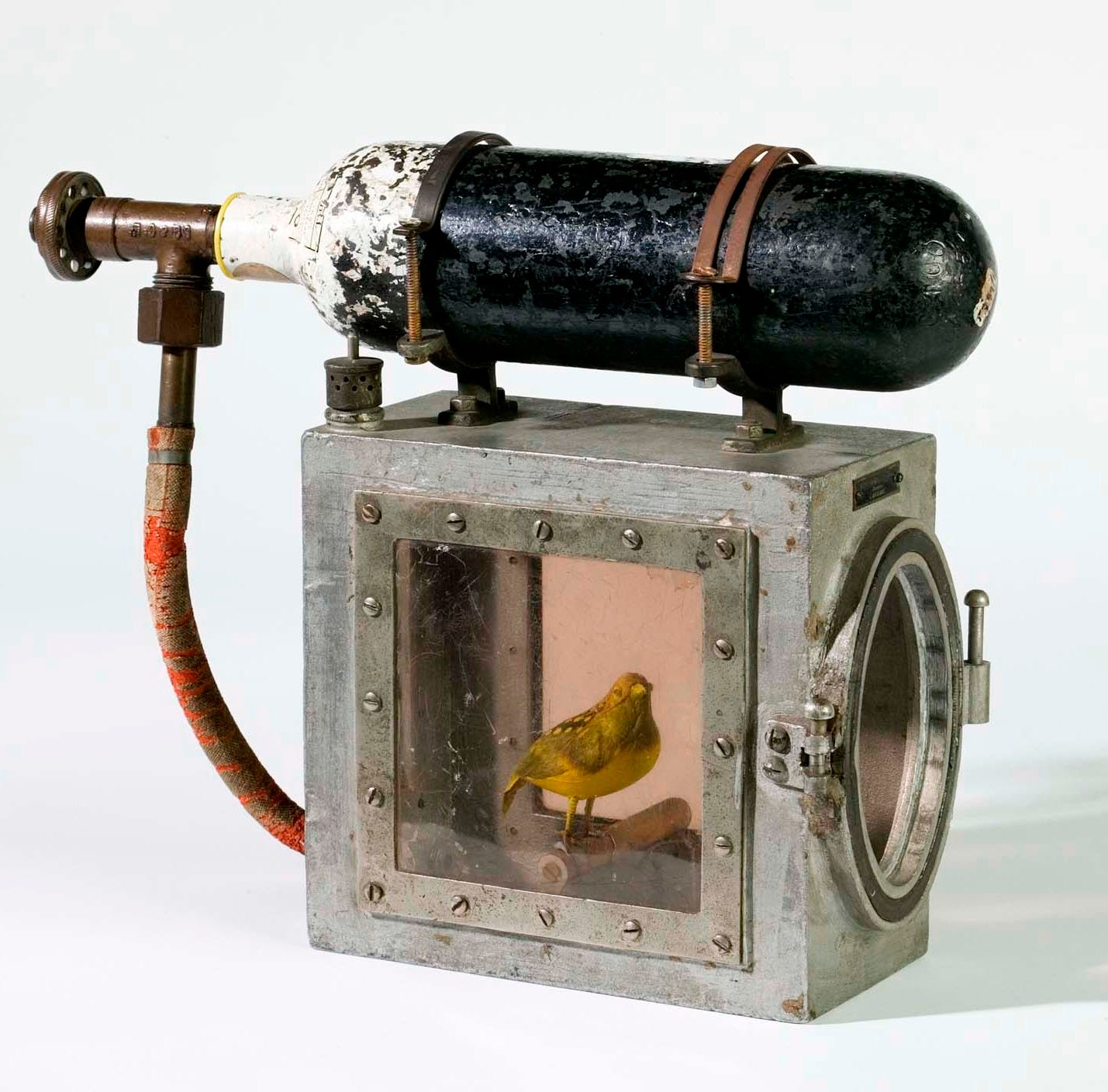
And it works by early warning. The press is the canary. Nobody ever pretended the bird was lovable. It is a noisy, stupid, ill-tempered creature and it sings for its own reasons rather than yours. But you carry it down the shaft because it registers what your senses cannot, and it has no opinions about the gas.
What is being proposed now is that we shoot the canary. That we prosecute the bird for the atmosphere. It will work of course. In the sense that the singing will stop.
The gas will still be there. The gas is a university that appointed a professor without ringing three switchboards. It is an awards panel, a publishing house, a hundred conference organisers, none of whom checked, all of whom are still drawing salaries. Kill the bird and none of that is fixed. You have simply arranged that the next man down the shaft goes in the dark.
I have spent twenty-five years being called things in print, most of them by people now composing letters about the dignity of public discourse, and I have never once wanted a policeman to knock on their door. They believe the powers they build will only ever be held by people like them.
There is a version of the reflection Andy Burnham asked for that would be worth having. It would ask how a university appoints a professor without verifying his claims. It would ask why a publisher and an awards panel failed the same simple test. It would ask, seriously and without flinching, how any of us conduct scrutiny of a person we have reason to think fragile, which is a genuinely hard question and deserves better than the answers it is getting. It would ask why a reporter spent four months under investigation.
That inquiry would embarrass a great many people currently signing letters.
Which is presumably why we are offered the other one, the one that ends with a constable at the door and a hard drive in an evidence bag, and a supposed elder statesman of letters explaining that this is what a free press looks like.
One question for the signatories, then, and I would like an answer before the motion goes to conference. When the regulator you are building is inherited, as every regulator eventually is, and the Minister appointing its board is Nigel Farage, whose computers do you imagine will be collected?
No posts
Comments
Nothing yet. Say the first thing.
Sign in to join the conversation.