
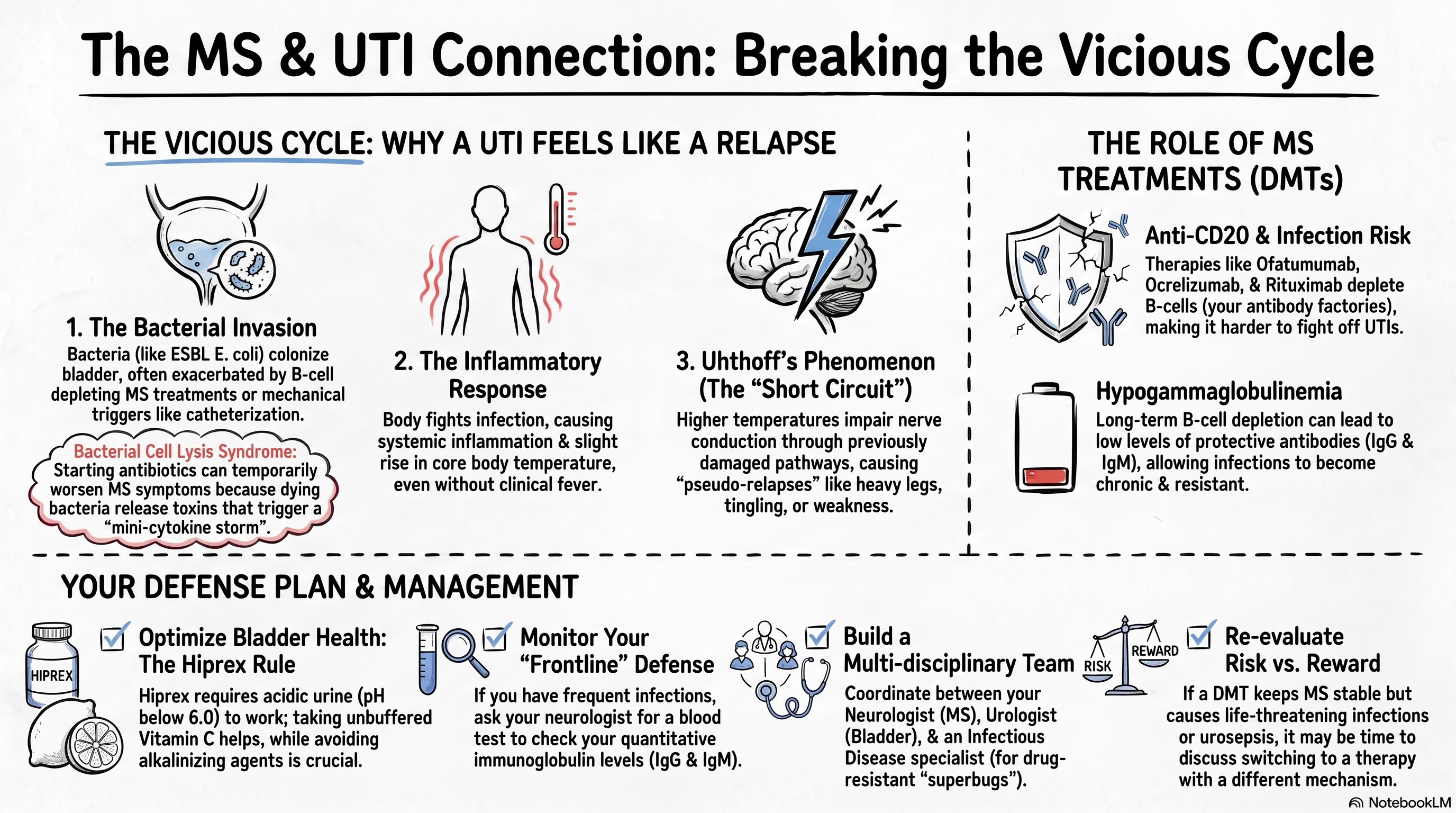
I am having frequent UTIs ( always E. coli with extended-spectrum beta-lactamase resistance, or ESBL), usually predominantly silent in relation to urinary symptoms except a moderate increase in urge incontinence, but with an increase in MS symptoms (heaviness in my legs, increased tingling and reduced sensitivity to my right side, particularly in my right hand and foot).
Most oral antibiotics for UTIs are ineffective, due to resistance, which gives me great concern. I am being treated with IAluRil instillation currently, as the urologist feels I am likely now colonised in my bladder with E. coli rather than an actual infection.
(iAluRil is an intravesical medical solution containing sodium hyaluronate, sodium chondroitin sulfate, and calcium chloride, used to repair and protect the bladder lining)
The plan is to try this treatment to repair the GAG lining of my bladder, but since starting the treatment using intermittent catheterisation for the initial 6 weeks, I have experienced 3 episodes of infection with worsening MS symptoms predominantly and an increase in urge incontinence that I term as being more ‘ leaky’. All have responded positively to pivmecillinam (not recently indicated as either sensitive or resistant in the lab for microscopy, culture, and sensitivity (MC&S)), but it has worked by eliminating nitrites from my urine and improving my MS symptoms.
(Pivmecillinam is an oral beta-lactam prodrug that breaks down into mecillinam, which kills bacteria by binding to penicillin-binding protein 2 (PBP2) to stop cell wall synthesis and cause cell bursting)
Last night, however ( day 2 of pivmecillinam treatment), after taking my bedtime dose, I was woken up by intense urinary symptoms alongside increased tingling and heaviness in my legs. So much so that I was concerned the oral pivmecillinam had failed me and I would need to attend hospital for possible alternative treatment (IV gentamicin).
(Gentamicin is a bactericidal aminoglycoside antibiotic that kills bacteria by inhibiting protein synthesis, causing mRNA misreading, and disrupting the bacterial cell membrane.)
I couldn’t manage a urinalysis check myself as I was passing minuscule amounts of stinging/ burning urine, so I went to hospital at 00.30. Whilst waiting to be seen following triage- a wait of 5 hours in a very cool ED waiting room my symptoms began to reduce, and by 04.30, after 4 hours, they were considerably improved. I saw the Dr at 05.15, who confirmed that urinalysis was indeed clear of nitrites and recommended continuing my pivmecillinam for the final day (x 3 doses).
Your post has made me wonder if the ambient temperature had an impact, as being cold in the waiting room was the only change overnight after being woken with urinary discomfort and increased MS symptoms.
I am a 57-year-old woman (a retired nurse, now working part-time). I was diagnosed in 2000 with RRMS; first symptoms occurred following the birth of my eldest daughter in 1997. I’ve been on Ofatamumab since January 2025, following a sensory relapse in late summer 2024 after 4.5 years following completion of Mavenclad treatment. Year 2, month 2 of this was April 2020.
I have been having the increased frequency of silent UTI infections since commencing Ofatamumab, and my recent MRI in June this year following a prolonged exacerbation of MS symptoms in May this year that I thought could have been a relapse showed no changes to brain MRI but x2 areas in thoracic, and I think lumbar spine where there were changes from the previous MRI the year before. The significance of these was unclear, and it was decided by my neurologist that I should continue Ofatamumab as it is too early to be a failure in treatment ( I commenced in January 2025)
Is IAluRil via intermittent catheterisation making this worse? The plan is / (was ) to continue with 12 x monthly instillations now after 6 x weekly instillations that completed last week ( end July)
Are the UTIs exacerbated by my DMT Ofatamumab? I have had many episodes since commencing the treatment that are now ESBL +ve
Is there another DMT I should consider?
Whilst awaiting review with the Dr in the ED in the early hours, I sent an email query to my MS team and urology team for advice.
My worry is twofold really ;
1: in relation to getting increased MS symptoms related in part to increasing frequency of UTIs since commencing Ofatamumab.
2: in relation to the UTIs and the limited oral treatment now available to me… the risk of urosepsis, I fear, is significantly increased. UTIs are always E. coli, and since last summer, ESBL has been present. I believe Fosfomycin shows sensitivity but is reported to be altered, and there is sensitivity to gentamicin but nothing else
When not having a UTI, I am fully ambulant, do not really have any fatigue symptoms, and my swallow, speech, memory, and mood are all good. Constipation managed with daily or alternate-day Movicol or similar, and a rectal irrigation system. Stress incontinence has been a constant, and I’m on Hyprex, d-mannose, Solifenacin and Betmiga for bladder as well as more recently the IAluRil instillation.
Your thoughts would be greatly appreciated.
NOTE: General Substack newsletters and the microsite are free; only Q&A sessions are restricted to paying subscribers. I can’t run and maintain the MS-Selfie microsite, so I must pay people to assist me. If people want to ask medical questions unrelated to the Newsletters or Podcasts, they either need to become paying subscribers or email (ms-selfie@giovannoni.net) to request a complimentary subscription.
Thank you for sharing such a detailed account. As a retired nurse, you already know how challenging it can be to balance overlapping conditions, and it is completely understandable that you are feeling anxious about the ESBL E. coli and the limited antibiotic options.
Comments
Nothing yet. Say the first thing.
Sign in to join the conversation.