
My mood dropped after reading a frightening article that has just been published in the British Medical Journal.
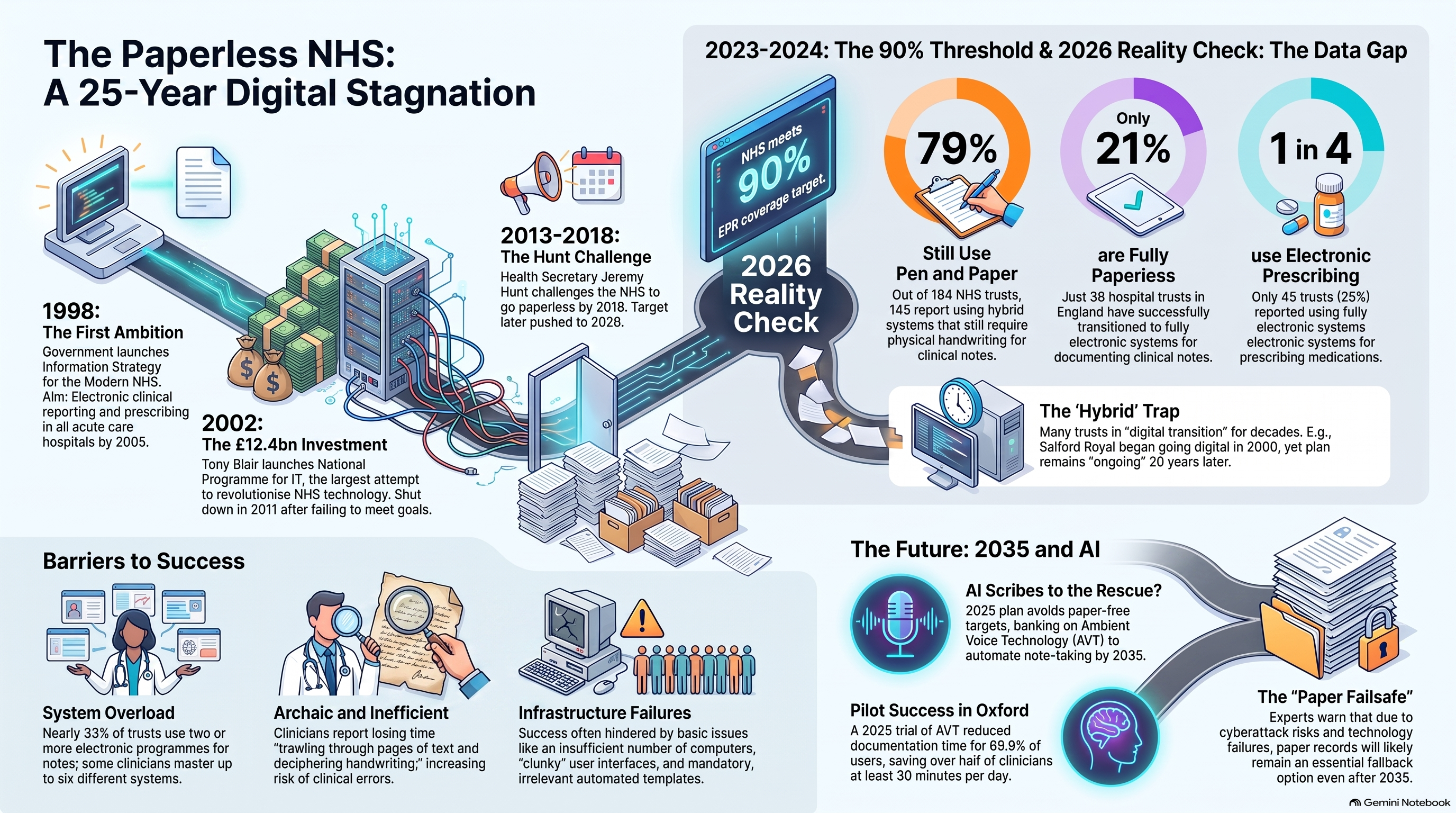
Summary: “An investigation by The BMJ reveals that nearly eighty per cent of NHS trusts in England still rely on physical paperwork, despite twenty-five years of government pledges to modernise. While most facilities have adopted some form of electronic patient records, the transition remains stalled by underfunding, fragmented software systems, and complex administrative burdens on clinicians. Many medical professionals report that using multiple, non-integrated digital platforms is overwhelming and can detract from patient care. To address these persistent delays, the government is increasingly looking to artificial intelligence and voice recognition technology to automate documentation by 2035. However, experts caution that paper files will likely remain a necessary safeguard against potential technical failures and cyberattacks for the foreseeable future. This report highlights a significant gap between the ambition of a paperless health service and the ongoing operational realities of hospital wards.”
The following is my take on the article and how it may affect MS management. I also provide some suggestions on what you can do to help.
The slow and fragmented digitisation of the NHS has direct, profound implications for patient care. The diagnosis, ongoing management, and future preventive strategies for neurological conditions rely heavily on seamless data integration, which is severely hindered by the current state of NHS IT infrastructure.
Digital stagnation affects the management of MS and other specialised areas of neurology.
Delayed diagnosis and symptom tracking: MS diagnosis requires tracking neurological symptoms and events over time. However, 79% of NHS hospital trusts still rely on pen and paper for clinical documentation to some extent. Relying on paper documentation means HCPS lose time locating notes, trawling through pages of text, and deciphering handwriting. Does this sound familiar to you?
Fragmented patient histories: MS is a lifelong disease, meaning patient documentation covers unusually long periods. Clinical information in the NHS is often fragmented across various platforms, requiring multiple logins. In some instances, HCPs may need to use up to six different programmes to record patient notes, making it difficult to quickly extract relevant historical data.
Increased risk of clinical errors: Managing MS often involves complex disease-modifying therapies and coordinated multidisciplinary care. Inefficient documentation practices, such as the use of paper systems, can lead to clinical errors. Safety is further compromised by the fact that only 45 NHS trusts use fully electronic prescribing systems.
Administrative burnout: Learning how to use multiple electronic systems is overwhelming and burdensome for rotating HCPs. Additionally, automated templates can force users to complete mandatory, irrelevant sections, which costs additional time and detracts from direct patient care.
I am particularly interested in implementing preventive neurology practice into routine NHS neurological services. The slow adoption of innovative tools will impact these plans.
Barriers to population data integration: Preventive neurology relies on identifying at-risk populations and aggregating large-scale health data. Electronic patient records provide the foundation for joining up disparate data across multiple healthcare organisations. The widespread reliance on hybrid and paper systems limits the ability to build the centralised databases required for proactive, preventive care.
Stalled technological implementation: The future of preventive medicine depends heavily on data-driven innovations. The government’s 2025 10-year health plan banks on clinical note-taking becoming obsolete by 2035 through the use of AI-powered ambient voice technology (AVT). However, a lack of investment and the need for significant overhauls of day-to-day working methods mean that long deployment timelines are still expected.
Poor usability hinders adoption: Even when NHS trusts implement digital systems for new services, clinicians’ attempts to use them can be scuppered by insufficient computers or clunky user interfaces. These usability problems breed resistance among clinicians, ultimately limiting the effectiveness of newly introduced preventive digital platforms.
Requirement for physical failsafes: A fully integrated digital preventive service may still be held back by infrastructure vulnerabilities. Experts warn that the ever-present risks of technology failure or cyberattacks mean paper systems are likely to remain an essential fail-safe option for maintaining services even after 2035.
Because of these failings, it is likely that some of the burden of managing medical information will continue to fall on you, the person with MS. This is particularly relevant when dealing with a complex, exhausting, and unpredictable condition like MS. It is understandable that pwMS feel overwhelmed by the idea that you have to manage your own data because the healthcare system’s infrastructure is lagging behind. However, given the reality of fragmented NHS systems and paper records, adopting a “defensive administration” approach is one of the most effective ways to protect yourself from clinical errors and ensure your specialist appointments are as productive as possible.
Here are some practical steps you can take to bridge the gaps in the system:
Since hospital trusts struggle to share data seamlessly, assume your neurologist might not have your latest scans or letters from other departments.
Create a physical or digital binder: Keep a chronological record of all clinic letters, MRI reports, blood test results, and discharge summaries.
Bring it to every appointment: If the hospital’s electronic system goes down or they can’t locate your paper file, you instantly become the most reliable source of truth in the consulting room.
With only a fraction of hospitals using fully electronic prescribing systems, medication errors are a real risk.
Document everything: Keep a single, continuously updated document listing your current disease-modifying therapies (DMTs), symptom-management drugs, over-the-counter medications, and supplements. Include the dosages and how often you take them.
Include a history: Briefly list past DMTs or medications you’ve tried, why you stopped them, and any adverse reactions or allergies.
Because MS documentation requires tracking symptoms over unusually long periods, recalling how you felt six months ago is difficult for you and virtually impossible for a doctor reading fragmented notes.
Use a symptom diary: Whether it is a dedicated MS tracking app on your phone or a simple paper calendar, log your fatigue levels, mobility issues, pain, or cognitive fog.
Identify patterns: This allows you to hand your neurologist clear data indicating whether your MS is stable, if you are experiencing a relapse, or if a specific treatment isn’t working.
While the NHS as a whole struggles with IT, there are patient-facing tools available that can give you more control.
Use the NHS App: Ensure you are fully registered on the NHS App (or your local equivalent). While hospital records might be fragmented, your GP records, current repeat prescriptions, and many test results are usually accessible here.
Sign up for local trust portals: Many individual hospital trusts have their own patient portals (like MyChart or PatientsLikeMe). Register for these to view upcoming appointments and direct correspondence.
HCPs are often battling clunky user interfaces and limited time. You can help bypass this friction by guiding the consultation.
Write a brief summary: Before you go in, write down a bulleted list of the top three issues you want to discuss, a quick summary of what has changed since your last visit, and any specific questions you have.
Hand it over: Giving this to the doctor at the start of the appointment helps them focus directly on your current clinical needs rather than having to scroll through multiple software programs to figure out why you are there. Some services will allow you to email this summary a week before. Ask for it to be filed in your notes and/or uploaded into your electronic record.
Most HCPs will allow you to record consultations. You can then use a voice-to-text conversion programme to make an easy-to-read summary that you can file. If you have problems remembering things, having your partner, friend, family member or advocate with you helps. They can be briefed to help ensure that you ask all the questions you want and that you have a clear plan at the end of the consultation. Having someone with you in the consultation provides some protection against medical gaslighting.
I would suggest you read my previous newsletters on medical gaslighting.
I have created an Excel spreadsheet or a Google Sheet to help you achieve this. I am aware that many of you have commented on the sheet before. It is still in beta testing, but this could be hacked and used as a symptom tracker as well. Please feel free to download the sheet, change it and use it if you think it can improve the service you receive from your MS centre. I am still looking for feedback to improve it. Please make comments, good and bad.
I assume many of you are already using other symptom-tracking apps. Which ones? Are they too intrusive? How do you rate them? Can you download a summary for your HCP? Are they easy to use?
If the NHS isn’t working for you, you need to adapt to make the most of what it has to offer, which is a lot. The grass may look greener on the other side of the fence, but it rarely is. Your responsibility is to fertilise and water your patch of grass, making it the best in the world. The NHS provides access to some of the best care in the world. However, you often have to make that happen yourself.
If you have been forwarded this email and are not an MS-Selfie subscriber, please consider subscribing and helping MS-Selfie expand its resources for the broader MS community. MS-Selfie relies on subscriptions to fund its curated MS-Selfie microsite, MS-Selfie books, MS-Selfie Infocards, and other activities that extend beyond the MS-Selfie Substack newsletters.
MS-Selfie newsletters and access to the MS-Selfie microsite are free. In comparison, off-topic Q&A sessions are restricted to paying subscribers. Subscriptions are being used to run and maintain the MS-Selfie microsite and other related activities, as I don’t have time to do this myself. You must be a paying subscriber to ask questions unrelated to the newsletters or podcasts. If you can’t afford to become a paying subscriber, please email a request for a complimentary subscription (ms-selfie@giovannoni.net).
If you have questions unrelated to the newsletters or podcasts, please email them to ms-selfie@giovannoni.net. Prof. G will try to answer them as quickly as possible.
🖋 Medium
Please note that the opinions expressed here are those of Professor Giovannoni and do not necessarily reflect the positions of Queen Mary University of London or Barts Health NHS Trust. The advice is intended as general and should not be interpreted as personal clinical advice. If you have any problems, please tell your healthcare professional, who can help you.
No posts
Comments
Nothing yet. Say the first thing.
Sign in to join the conversation.