
Many of you would have my newsletter on ‘Finding MS before it finds you’ (8-June-2026) about the FIND‑MS Early Detection Workshop that took place on the 4th-5th June 2026. Since attending the workshop, I have been thinking a lot about the aims of the meeting. I hope you have, too.
How many of you with MS or a positive family history of MS worry about your children or grandchildren developing multiple sclerosis? I think this anxiety is more common than one realises. Despite improvements in the diagnosis and management of the disease, MS remains both a disabling and stigmatising disease. It is therefore not surprising that people with skin in the game would want to prevent the next generation of people from getting the disease, and if they are destined to develop MS, then you would want them to be diagnosed and treated as soon as possible to prevent disability. This raises many questions about population screening and the diagnosis of asymptomatic or premanifest MS. Population screening can have unintended consequences. In this story, I try to show that screening for MS can have unintended consequences.
When Darren failed three of his GCSEs, I decided to put him through the PrevCure programme. PrevCure promised a diagnosis. It is a direct-to-consumer preventive healthcare company that provides risk profiles for a range of diseases that can be prevented or treated early, hopefully reducing the risk of severe disease. The company spun itself off from Eli Lilly’s consumer division seven years ago. I had hit a brick wall within the NHS, and I needed to know if the rapid fall-off in Darren’s academic performance was due to early multiple sclerosis.

My mother was diagnosed with MS when she was 28, which was less than a year after I was born. She lived in the pre-treatment era, which meant we had to watch her have recurrent attacks with numerous hospital admissions and witness her gradual but inexorable decline and premature death. By the time I was ten, she was confined to a wheelchair, and Peter, my brother, and I had to help her complete the simplest chores. As she became more disabled, her memory and ability to perform simple mental tasks failed. She would forget telephone numbers and friends’ names. She stopped playing card games with us as her mental capabilities shrunk. I was told that MS runs in families, which caused me to develop health anxiety; I was convinced I was going to develop MS myself and still do.
Shortly after our father walked out in my early teens, my brother Peter had his first breakdown and had to be admitted to a psychiatric hospital in South London. When he was discharged eight months later, he was a different person. Audrey, my aunt, explained to me that the medication he was being forced to take was what had changed his personality. My father had an affair and absconded. He then emigrated to Australia with a new girlfriend. As we were not coping at home as a family, I had to go and to live with my aunt. My mother was admitted to a nursing home so she could have around-the-clock care, and Peter was placed in a residential school in Kent. I later found out that this was a psychiatric institution.
I blamed my mother’s MS for everything: my father’s affair and him leaving home, his emigration to Australia, Peter’s mental breakdown, and me essentially becoming an orphan and having to live with my aunt and cousins. I was only 17 when my mother passed away; it was just before I did my A-levels. We were told her death was from pneumonia, a complication of her having MS. She had difficulty swallowing and had aspirated liquid into her lungs, which then developed into pneumonia.
In the end, my mother was almost mute, bedbound, catheterised, with longstanding bedsores, which is why her death was a blessing in disguise. MS had robbed her of most of her faculties. Once I turned 40, I knew that my odds of developing MS were dropping, but I still knew MS ran in families and could skip generations. So my own anxiety of developing MS was now transferred to Darren. I had read an article that MS develops many years before the first attack and that, in this ‘asymptomatic’ or ‘premanifest’ phase, it could affect cognition. I had convinced myself that Darren had early MS. I had come across several studies online that had shown that children with MS had smaller brains, poorer cognitive abilities and worse academic outcomes compared to their unaffected peers.
Health anxiety by proxy: Health anxiety by proxy is a psychiatric condition where a person experiences excessive, irrational worry that someone they care for, usually their child, has a serious, undiagnosed medical condition. Standard health anxiety, or hypochondriasis, involves fears about one’s own health; health anxiety by proxy projects those fears onto another person. It is important not to confuse health anxiety by proxy with factitious disorder imposed on another (widely known as Munchausen syndrome by proxy). In Munchausen by proxy, a caregiver intentionally fabricates, exaggerates, or actually induces illness in a child, usually to gain sympathy, attention, or comfort from medical staff. In health anxiety by proxy, the caregiver is not acting maliciously or seeking attention. They genuinely, intensely fear that their child is sick, and their actions are driven by severe anxiety. Parents with health anxiety by proxy often seek a medical diagnosis for their child.
Darren’s problems had started around 14. His problems didn’t come on overnight, but gradually crept up on us. When I attended parents’ evening at his school, his form teacher told me that Darren had lost interest in studying and had become withdrawn. He had had a few friends at school, but had become a loner and preferred to spend breaks alone. He was also becoming increasingly unkempt and was indifferent to discipline and punishment. More worrying was the drop-off in his academic performance. He was not completing his homework assignments, and when he did, they were of very poor quality. The deterioration in his handwriting was striking. When his teacher showed me his handwriting from Year 9 and compared it to now, it was as if he had regressed to being a seven- or eight-year-old. His written words were small and untidy, with numerous spelling mistakes.
Over the next two years, Darren’s behaviour worsened. He spent most of his time playing computer games, rarely left his room, and when he did, he appeared anxious. I noticed that he now seldom made eye contact when he was speaking and tended to fidget a lot. I had taken him to the GP and spoken to the practice nurse on several occasions, and they dismissed his problems as being due to adolescence; a developmental phase. “He will grow out of it”, the GP had said.
Around this time, adverts for PrevCure started appearing in the newspaper and on my social media feeds. PrevCure offered a detailed clinical assessment, whole-genome sequencing, and a wide range of additional tests, promising to diagnose a raft of medical conditions early and provide risk estimates for diseases one may develop in the future. The promise was that it was better to be informed than uninformed about what disease you may have or will potentially develop. The basic idea was that, armed with this information, you can adopt a different lifestyle or start treatments to alter the trajectory of future diseases before you develop them. Importantly, multiple sclerosis was one of the diseases on PrevCure’s screening list. PrevCure was not part of the NHS; it was a for-profit company that was run by a private equity group. In fact, GPs and the NHS were against PrevCure and other direct-to-consumer healthcare providers. GPs were complaining that it created extra work for them.
Direct-to-consumer Healthcare: Direct-to-consumer healthcare and genomic companies market themselves as empowering individuals to take charge of their health. They frequently create downstream bottlenecks for GPs and primary care physicians. By removing the doctor from the initial ordering process, these companies generate a massive amount of data that patients then bring to their local clinics for interpretation, validation, and reassurance. In traditional medicine, a doctor orders a test only for a clinical reason. Before the test, they explain what they are looking for, its limitations, and what the results might mean. Direct-to-consumer companies bypass this crucial step. Patients often receive complex data via an app or email, often with colour-coded high-risk warnings without any medical professional there to provide immediate context. As a result, anxious patients immediately book GP appointments to figure out what the results mean.
Many direct-to-consumer genetic tests use screening technologies that are less rigorous than clinically validated diagnostic tests. Research has shown that a significant percentage of the so-called pathogenic variants identified in direct-to-consumer tests are false positives. For example, if a direct-to-consumer test says you have a BRCA gene mutation, which is linked to breast cancer, your GP cannot legally or ethically act on that commercial result alone. Your GP must now order a confirmatory test, coordinate it with specialists, and also manage your anxiety while waiting for the official results.
Many direct-to-consumer genomic companies provide risk estimates for complex diseases like Alzheimer’s, type 2 diabetes, or heart disease. As you are aware, these conditions are caused by a mix of genetics, lifestyle, and environment. Knowing you have a slightly elevated genetic risk for a disease is often non-actionable, meaning there is no pill or surgery the GP can prescribe to fix it. The medical advice remains the same as before the test, i.e. eat well, exercise, and get enough sleep. Yet, GPs must now spend time explaining this limitation to you.
Genetics is a highly specialised, rapidly evolving field. Most GPs and primary care physicians are trained to diagnose and treat broad medical conditions, not to interpret raw genomic data or understand the methodologies of different commercial DNA laboratories. So when you hand over a 30-page DNA report from a direct-to-consumer genomics company, the GP is often forced to spend unpaid administrative time researching the specific test, the highlighted gene variants, and current clinical guidelines just to give the patient an informed and accurate answer.
PrevCure was part of Eli Lilly’s expanding direct-to-consumer division. After Eli Lilly launched its blockbuster weight-loss drug tirzepatide (Mounjaro/Zepbound) in 2022, it found that selling directly to the general public, bypassing the healthcare system, was easier and more lucrative. Eli Lilly’s shift toward direct-to-consumer distribution, through its LillyDirect platform, in early 2024 was a masterstroke designed to solve several logistical and financial bottlenecks at once.
What Eli Lilly found was that, rather than relying purely on traditional doctors and retail pharmacies, owning the entire patient journey was far more lucrative and efficient. First, they could bypass an entire tier of middlemen in the pharmaceutical supply chain. Second, they created and captured a massive, blockbuster self-pay market, which allowed them to squash their opposition, including compounding pharmacies selling copycat tirzepatide. Third, they discovered they could bypass family doctors, who were typically overbooked and often lacked specialised training in obesity medicine. By creating dedicated telehealth providers through LillyDirect, Eli Lilly created a frictionless pipeline. Patients could be evaluated online, prescribed the drug, and have it shipped to their homes in days. This new business model entirely removed the traditional hurdles of waiting months for a doctor’s appointment and avoided the medical stigma many people face when discussing weight in person with their family doctors.
Only later, when LillyDirect wanted to expand into areas not necessarily linked to Eli Lilly’s products, did senior management decide to sell the direct-to-consumer division, and PrevCure was born.
When I brought up using PrevCure with Darren, he was indifferent and agreed to be screened. In retrospect, I don’t think Darren thought much about it. I suspect he agreed to PrevCure to get me off his back, as I had been continuously harassing him about his schoolwork and his personal hygiene. The procedure for enrolling Darren with PrevCure was relatively simple; we completed an online form, linked it to the Government’s ID checker to confirm Darren was who he said he was, and then I made a credit card payment of £799 to cover the initial appointment. This payment covered the basic assessment, screening blood tests and his whole-genome sequencing. If this identified any problems, further screening investigations would be extra. I anticipated he would require an MRI of the brain to screen for MS. The list price for a brain MRI was an additional £1499, and an MRI of the spinal cord, if done in the same session, was another £999. If a spinal MRI was done separately, it would cost £1499. The list prices for follow-up specialist assessment were eye-wateringly high. I wonder how many people who use the NHS know what private medical care actually costs. If they knew the costs, they would appreciate its value.
I let Darren miss school so he could attend his PrevCure assessment on a weekday. We were told the initial assessment would take roughly three hours. The PrevCure clinic was in central London, in an ultra-modern, purpose-built building. The reception area was decorated in shades of white. I assume the colour white was chosen to convey sterility. Once Darren had proven who he was, they checked him in and ushered him to an assessment room. An administrator logged us into a terminal so he could complete a screening questionnaire. It included all his demographic information and family history. I had to help complete the latter, as Darren did not know his family history in detail. He was aware that his grandmother had died at a young age from pneumonia, but didn’t know she had MS. He was unaware that his uncle had had a mental breakdown and spent most of his life in sheltered accommodation. My brother had only recently been housed in a residential complex in the community. However, he still required daily supervision. Although social services describe Peter as living independently, he would not be able to survive very long without someone to supervise him. The questionnaire was very detailed, and I took it on myself to complete most of the form.
After completing the form, Darren was taken away for a physical assessment. He told me afterwards that a machine checked his blood pressure, pulse, temperature, and oxygen saturation, and an ECG was performed. He had what he thought was a lung function test, where he had to breathe in and out of a mouthpiece to test his lung capacity. I later read on the PrevCure’s website that they also analyse the exhaled air for bacterial metabolites to assess the microbiome.
Darren then put on virtual reality goggles and completed a range of tasks, some of which were like playing video games. Many of the tasks involved testing his memory and his ability to read, write, comprehend written text, and interpret sounds. A machine tested his balance, coordination and muscle strength. Once testing was complete, a robot performed phlebotomy, and Darren and I were free to go. We were told the results of the assessment, including the blood test and whole-genome sequencing, would be available in 5-7 days, and that we would be contacted if more tests were necessary.
The information package we were given said Darren had completed PrevCure’s proprietary physical and cognitive assessment. The company had moved to an automated system after an internal study showed that the reproducibility of their doctors’ assessments was so poor that they needed to standardise the examination. This was not unique to PrevCure. A recent BBC documentary had shown how automated medical assessments were being rolled out on the NHS. This allowed the NHS to reduce the number of doctors, as AI interpreted the results and patients were triaged for further medical assessment based on an initial battery of tests and AI screening. I suspect it won’t be long before doctors are taken out of the loop and made redundant.
On Monday morning, I got a call from PrevCure informing me that Darren’s initial assessment had been abnormal and that, to complete the assessment, Darren needed to have further investigations, including an EEG and MRI of the brain. They recommended having these investigations before seeing one of the consultants, who would review Darren’s results. I had prepared myself for this and was not surprised. I had to pay an extra £2099 for the two investigations. We were able to go to PrevCure that evening to have the EEG and MRI. I was surprised to hear from the radiographer that PrevCure ran a 24-hour service and that most of their clients were foreigners who flew into London for their assessments. PrevCure even owned a hotel around the corner to accommodate their clients. PrevCure was clearly part of London’s booming health tourism industry, so why not maximise the services on offer?
We were given a one-hour follow-up appointment for 10 am on Wednesday morning, where we would be seeing Dr Garcia, one of their doctors who specialises in genetic counselling and lifestyle medicine. We arrived 15 minutes early and had to wait in the all-white waiting area. Darren sat opposite me, glued to his mobile phone playing a game. It was only now, in the austere environment, that I noticed for the first time that he really couldn’t sit still. His head would nod forwards, and on occasion he would suddenly jerk his shoulder or leg. His hands and fingers would move almost as if he was fidgeting with something. I wondered if he was nervous, waiting to be told that he had some terrible disease. I can tell you I was nervous. The palms of my hands were clammy; I could feel my heart beating in my throat, and I had this tight knot in my stomach. I just knew, looking at Darren, that he had some serious neurological condition.
Literally on the hour, a very youthful woman walked into the waiting room and introduced herself as Dr Garcia. She had a soft Spanish accent. I suspect it had gradually softened from studying, living, and working in London for most of her life. She made eye contact with Darren, who immediately looked away. Dr Garcia didn’t know how lucky she was to be able to make eye contact with Darren. Darren tried to avoid eye contact as much as possible. Dr Garcia then led us through a door into a corridor and finally into a white consulting room with a large monitor on the wall and a large white table with four white, unholstered chairs around it. On the table was a white folder, open to the first page. It was Darren’s notes, with a picture of him near the top.
Dr Garcia asked us to sit down and asked if we still wanted to go through with the consultation and be given the results. I said and yes and Darren nodded. Darren looked nervous for the first time. I suspect he could tell from Dr Garcia’s tone of voice that bad news was coming.
As a reader, I would like you to pause here and imagine yourself in Darren’s or his mother’s shoes. Would you want to know the interpretation of your whole genome sequencing? This would include not only your ancestry but also the risks of diseases you may develop in the future. In adults, the number of genetic diseases that should be screened for is very few. In the general population, it is limited to three conditions: familial hypercholesterolaemia, Lynch syndrome and hereditary haemochromatosis. Familial hypercholesterolaemia is detected by checking your cholesterol levels and is usually associated with a positive family history. Lynch syndrome is caused by mutations in mismatch-repair genes; this syndrome leads to a significantly increased risk of early-onset colorectal, endometrial, ovarian, and other cancers. Again, it is usually associated with a positive family history. Hereditary haemochromatosis is one of the most common genetic disorders in the Western world, particularly among people of Northern European or Celtic descent and causes the body to absorb too much iron from the diet. Some of you may ask about hereditary breast and ovarian cancer, which is primarily caused by mutations in the BRCA1 and BRCA2 genes. Screening is only recommended for individuals with a family history of breast, ovarian, tubal, or peritoneal cancers, or those with Ashkenazi Jewish ancestry.
The list of diseases is small and limited simply because there are treatments for them; i.e., an intervention and/or regular screening can prevent the complications of having mutations in the relevant genes. I want to stress that there are currently no recommendations to screen for polygenic diseases such as multiple sclerosis. Therefore, Darren’s mother is going against current recommendations. Some of you may have already considered Huntington’s disease as a diagnosis for Darren. This is a neurodegenerative disease that presents with cognitive and neuropsychiatric problems and abnormal movements we call chorea. At present, it is untreatable, but this might change in the future. Would you want to know if you had an incurable neurodegenerative disease?
In the UK, the UK National Screening Committee (UK NSC) governs the introduction of population health screening programmes. The UK NSC evaluates potential screening programmes against the 1968 Wilson and Jungner criteria established by the World Health Organisation, updated to reflect modern medicine and genetics. Before a screening programme is rolled out across the NHS, it must meet criteria across four main domains. Firstly, the condition must be an important health problem, judged by its severity and/or frequency in the population. We also need to know the natural history of the disease, i.e. how it develops from a latent phase to declared illness. All other cost-effective primary prevention strategies (such as public health campaigns or vaccinations) should be implemented, as far as practicable, before considering screening. Second, the screening test must be simple, safe, precise, and validated. It must also be acceptable from sample collection to result delivery. The distribution of test values in the population must be known, and a clear, agreed-upon cut-off level must be defined for what constitutes a “positive” result. There must be an agreed policy on what happens next for individuals who test positive, including further diagnostic investigations. Third, there must be an effective, evidence-based treatment or intervention for patients identified through screening, and clear evidence that intervening at an early, pre-symptomatic phase leads to better outcomes than waiting until symptoms appear and providing usual care. Four, the primary purpose of the screening must be to benefit the person being screened. The overall benefits, be they reduced mortality or morbidity, must clearly outweigh the harms, such as false positives, overdiagnosis, psychological distress, and unnecessary invasive treatments. The population should be proactively invited and provided with high-quality information so they can make an informed choice about whether to participate in screening. Finally, the screening programme must be clinically and socially acceptable to the public and health professionals, and it must offer value for money to the NHS. There must be an effective system for identifying, contacting, and managing the screening records of the entire eligible cohort. If a proposed screening programme fails to meet these criteria, for instance, if a test yields too many false positives or if early treatment doesn’t significantly change the patient’s prognosis, the UK NSC will not recommend it. The point I am making is that the service that PrevCure is providing Darren and his mother is not in line with UK NSC guidance. Darren’s mother could be opening a Pandora’s box.
Dr Garcia cleared her throat and, looking at Darren, said that his screening had identified some problems. First, his cognitive testing placed him in the 8th percentile for his age, and based on his prior school results, it appeared he had regressed from around the 50th percentile to his current level of performance. His neurological testing revealed a problem with the rapid movement of his eyes called saccadic eye movements; he had poor coordination and a movement disorder with these jerky movements called chorea. At this point, Dr Garcia asked Darren if he had misused drugs, as some recreational drugs could cause these problems. Darren denied doing so.
I then interjected and asked whether the MRI was abnormal. “Were there any lesions to diagnose multiple sclerosis?” Dr Garcia replied, “There were no lesions suggestive of MS. The only potentially abnormal findings are in his prefrontal cortex and the superior temporal gyrus. These are specialised areas of the brain where the cortical thickness was below the third percentile for age. In addition, his functional MRI showed that the hippocampus appeared to be overactive at rest.” Dr Garcia then stressed, “That these MRI changes were very subtle and were likely normal variations and had no diagnostic significance on their own.”
“So he doesn’t have MS then?” I asked. “Yes, at present there is no evidence of him having MS”, replied Dr Garcia. “When taking into account his genetic data, his lifetime chance of developing MS is around 1-in-370, with a range from 1-in-280 to 1-in-460. For a male teenager of Darren’s age, this is only slightly higher than the general population risk.”
“So what is wrong with him then? Does he have a diagnosis?” I asked. “No, the tests have not revealed a diagnosis. I am also confident we have excluded all genetic causes of chorea or the abnormal movements. Reassuringly, he does not have the genetic fingerprint of a condition called Huntington’s disease,” she replied.
“So is that it?” I asked.
“No, the screening algorithm has shown that Darren is at very high risk of developing schizophrenia in the future. When combining his history, clinical and MRI findings, your family history and his genetic results, our PrevCure prediction algorithm gives him a 67%, or 2-in-3 chance of developing schizophrenia in the next 10 years, with a range of between 50 and 85%”, Dr Garcia replied.
I stammered, “Do you mean he has schizophrenia?”
“No, this does not mean he has schizophrenia. A diagnosis of schizophrenia requires a patient to have many more clinical manifestations”, replied Dr Garcia.
“What do you mean he does not have schizophrenia? Can’t you do a test to diagnose the condition?” I pleaded.
“There are no tests for schizophrenia; it is a diagnosis based on a set of psychiatric symptoms after excluding other potential diagnoses. To help you understand the risks, I have included in Darren’s file our literature on schizophrenia, which explains how it is diagnosed and treated. If you want a more detailed assessment, Darren will need to see a psychiatrist. I can arrange for that to happen via PrevCure’s network of consultants; alternatively, you could ask your GP to make an NHS referral”, which concluded Dr Garcia’s comments on schizophrenia. It was clear this was a well-rehearsed segue; PrevCure’s staff were well trained in the art of up-selling their services.
Dr Garcia moved on rapidly, “I want to reassure you, Darren, that the remainder of your whole genome screen is very reassuring. You have a slightly higher risk of developing cardiovascular disease as an adult. These risks could be somewhat mitigated by lifestyle optimisation.”
Dr Garcia then turned to me, “You are welcome to enrol Darren in PrevCure’s lifestyle programme. This is a comprehensive behavioural programme that involves face-to-face visits and regular interaction via our smartphone application. Enrollment requires an upfront fee of £999 and an annual subscription of £1800.”
I heard very little of the remainder of the consultation. All I could think of was schizophrenia, schizophrenia, schizophrenia. Dr Garcia explained to Darren that some of the results will be relevant to his future medical care. I heard something about variants in his liver enzymes that will need to be taken into consideration if he ever needs to be treated with certain medications. Fortunately, PrevCure had included a list of these medications in Darren’s file. Dr Garcia then spent an extraordinary amount of time going through Darren’s genetic ancestry and explaining that, although his grandparents were from English and Irish backgrounds, he also had a lot of Southern Mediterranean ancestry. All I wanted to ask about was his schizophrenia risk. Did Darren inherit the genes for schizophrenia from his father or me? Was there anything we could do to prevent Darren from developing schizophrenia? Whilst I was having these thoughts, Dr Garcia asked if Darren or I had any further questions. She then handed Darren his PrevCure portfolio, stood up and ushered us to the door.
As we were leaving, the receptionist informed us that if, after going through the portfolio, we had further questions, we could book a follow-up consultation to see Dr Garcia again. However, this consultation is not covered by Darren’s current service contract and would cost an additional £599.
This scenario highlights a few of the ethical issues linked to predictive medicine. This is why I do not support population screening to identify premanifest or presymptomatic MS even in high-risk groups, i.e., first- and second-degree relatives of someone with MS. Screening procedures can also identify other conditions that are not necessarily treatable.
I subsequently discovered that my brother, Peter, had been diagnosed with schizophrenia. It was my family, yes, me, who was to blame when it came to passing on schizophrenia at risk genes to Darren. I was very frustrated that nobody had bothered to tell me Peter’s psychiatric diagnosis. Is a diagnosis of schizophrenia so stigmatising that you would want to hide it from your next of kin? I then spent the next 18 months trying to get Darren an appointment to see a psychiatrist. Three different referrals had been rejected because Darren was only at risk of developing schizophrenia and did not have sufficient symptoms to warrant a formal psychiatric assessment. I finally managed to get Darren enrolled on a research study that was studying the prodromal phase of schizophrenia using MRI. Unfortunately, this was a non-interventional study, so nothing is being done to prevent him from developing schizophrenia.
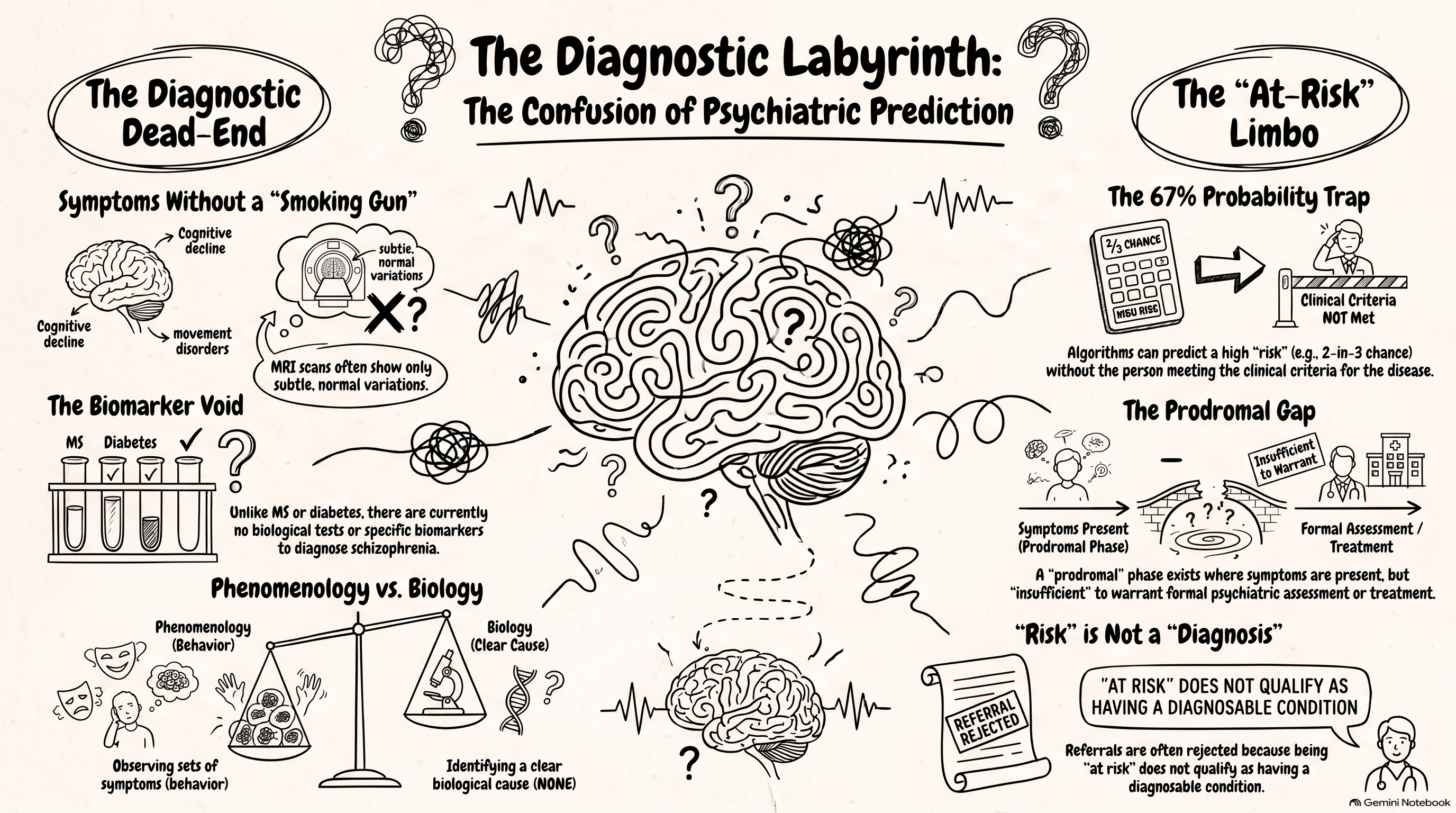
My question to you is: what would you be doing if you had a child who is likely in the prodromal phase of developing arguably the most stigmatising disease known to man, without a test to say he has the disease or not and with no disease-modifying therapies to prevent him from developing the disease? You may ask: why do psychiatrists still define schizophrenia using phenomenology? Why are there no schizophrenia-specific biomarkers? Why do we know so little about the cause and causal pathway in schizophrenia?
I am sure that many of you will have strong opinions about whether or not we should be finding people at high risk of MS or with prodromal or asymptomatic disease. What would you want for your family members?
If you have been forwarded this email and are not an MS-Selfie subscriber, please consider subscribing and helping MS-Selfie expand its resources for the broader MS community. MS-Selfie relies on subscriptions to fund its curated MS-Selfie microsite, MS-Selfie books, MS-Selfie Infocards, and other activities that extend beyond the MS-Selfie Substack newsletters.
MS-Selfie newsletters and access to the MS-Selfie microsite are free. In comparison, off-topic Q&A sessions are restricted to paying subscribers. Subscriptions fund the MS-Selfie microsite and other related activities, as I don’t have time to do this myself. You must be a paying subscriber to ask questions unrelated to the newsletters or podcasts. If you can’t afford to become a paying subscriber, please email a request for a complimentary subscription (ms-selfie@giovannoni.net).
If you have questions unrelated to the newsletters or podcasts, please email them to ms-selfie@giovannoni.net. Prof. G will try to answer them as quickly as possible.
🖋 Medium
Please note that the opinions expressed here are those of Professor Giovannoni and do not necessarily reflect the positions of Queen Mary University of London or Barts Health NHS Trust. This advice is general and should not be interpreted as personal clinical advice. If you have problems, please tell your healthcare professional, who can help you.
No posts
Comments
Nothing yet. Say the first thing.
Sign in to join the conversation.