
“Just then, they discovered thirty or forty windmills in that plain. And as soon as don Quixote saw them, he said to his squire: “Fortune is guiding our affairs better than we could have ever hoped. Look over there, Sancho Panza, my friend, where there are thirty or more monstrous giants with whom I plan to do battle and take all their lives, and with their spoils we’ll start to get rich. This is righteous warfare, and it’s a great service to God to rid the earth of such a wicked seed.”
“What giants?” said Sancho Panza. - Don Quixote
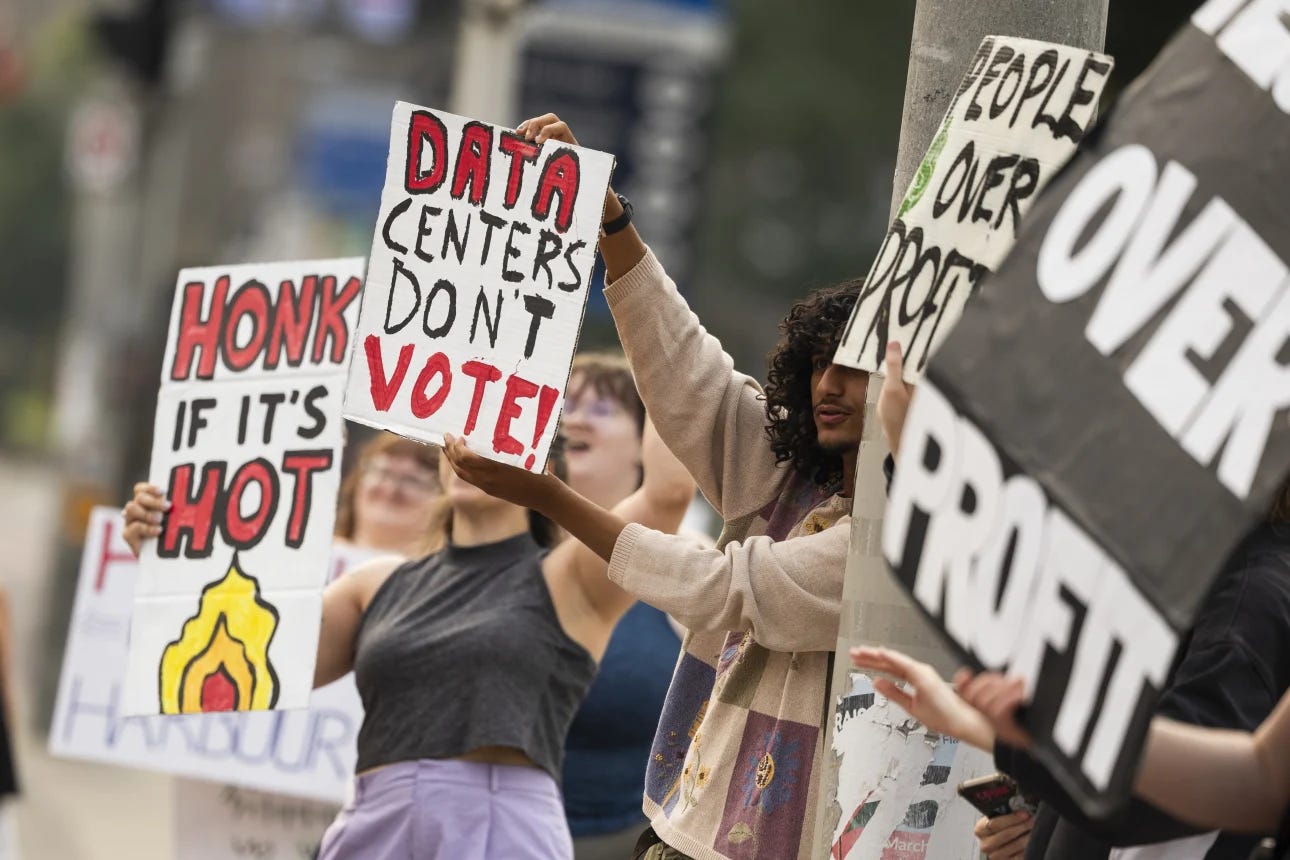
I want to be careful here, because the fight is not stupid. AI in its current form is a harm. Data centres — which have been around a long time — do drain water, drive up power, and hollow out the communities they land in. I’m not asking anyone to stand down. I’m asking a narrower question: when we charge the data centre, are we charging the giant, or the windmill it’s standing in front of?
AI is a tool. Every tool splits the same way — it makes something easier, and whatever it makes easier is the decision by someone else, for reasons that have nothing to do with the tool. The chemistry that pulled nitrogen out of the air and freed farming from its dependence on imported guano is the same chemistry that later helped arm a century of chemical horror in 1940’s Germany. Same tool. Different hands.
The tool was never the problem. The problem is in the hands that hold it.
This isn’t a metaphor I’m reaching for. It’s the whole history of technology, on a loop.
Eli Whitney gets called the father of American technology, but he’s really remembered for one patent: the cotton gin. It was a labour-saving device. By hand, a person could clean about a pound of cotton a day; with the gin, one person could clean fifty. That fiftyfold jump made a specific set of people — Northern textile mills, financiers, shippers — spectacularly rich. Cotton became the country’s leading export. People got rich, bitch.
And then the machine that was supposed to make the labour easier made the labour bigger. Ginning was the bottleneck; once you remove the bottleneck, you need far more cotton planted and picked to feed it. So you need far more enslaved people to plant and pick it. In the late 1700s there were six slave states. After the cotton gin, there were fifteen, and more than a third of the Southern population was enslaved.
A machine built to make the labour easier made slavery bigger.
Nobody in that story was fighting the Cotton gin. The gin did exactly what it was built to do. It was just minding it’s own business. The horror was in the hands, and the hands wanted needed profit.
Recently, in my hometown of Hamilton, Ont. a group of well-meaning activists rightly protested a data centre. For a moment it looked like they’d won — a one-year pause. Then, several days later and behind a closed door, the city reversed itself and voted to proceed. It came down to a handful of councillors not wanting McMaster University to take the city to court, because the project was apparently exempt from the very pause that was supposed to contain it.
“I think it will hold back Hamilton and reduce opportunity for many, many Hamiltonians and for generations to come,” Mayor Andrea Horwath said, voting against the moratorium.
Read that sentence again. The future — opportunity for generations — Every time I hear someone use a phrase like “generations to come”, I automatically think, thats not for people like me. Maybe it’s Pavlovian, or maybe its because, phrases like that are invoked to justify the thing being protested, and no one has to specify whose future, or what it costs, or who is at the table when it’s decided.
The windmill gets a public hearing. The hands get a closed door decision, for the benefit of “future generations”.
This is the part Mark Fisher would have loved. His line was that it’s become easier to imagine the end of the world than the end of capitalism.² We have accepted, as weather, a future where AI inevitably takes the jobs, drains the water, and spikes the hydro bill (can’t wait for that Star Wars movie. The Empire Strikes Back and now you can’t afford to run your fridge during peak hours.) — These people act as if the machine decided this, and not the people who own it.
And notice we can’t picture the alternatives. Wind. Solar. A public grid. We’re in a cost-of-living crisis, gas is insane, and we’re still kicking the tires on whether we even have an oil dependency. That’s not caution. That’s a failure of imagination, and it’s not accidental.
Capital hasn’t just failed us. It has eaten our ability to picture anything else.
Even the people rushing us to this “evitable” dystopian future, don’t have the imagination to see outside of it. Elon Musk said he designed the Cybertruck to look like it rolled out of Blade Runner. A 1982 film,³ adapted from a 1968 novel. I drive a 2010 Pontiac vibe that is litterally more futuristic than the cyber truck.
side note: The 2010 Pontiac Vibe comes with 115v outlet so you can plug in every day things like a toaster or shaver. To help understand how truly futuristic this car is, imagine yourself driving around with a smoke machine plugged in, pulling up to random people at bus stops, jumping out and yelling “Marty You have to come back to me to 1955, to save your parents!”
To these Technocrats and autocrats, Blade Runner isn’t a warning. They love this kind of SciFi, because it has them living far above the acid rain, the rest of us schlubs are forced to exist in.
So this is where we come back to the plain. AI is a boogeyman standing in front of the curtain, and the curtain is doing the real work: the demand for profit over human development, over care, over the water and the grid and the generations Horwath was so worried about. Fight the boogeyman all you want. It was placed there to be fought.
The decision about whether a data centre lands in your city should be a public one, held in the open. AI, if it’s going to reshape the water and the work and the wage, should be a public good, not a private draw on a public commons. Those are questions about hands. The windmill can’t answer them, because the windmill was never a giant.
Neither, it turns out, was the man on the horse willing to look down.
Footnotes
¹ Miguel de Cervantes, Don Quixote. The knight mistakes windmills for giants and charges them — literature’s cleanest image of misrecognizing the real adversary, and of a combatant who can’t see that the menace is his own frame.
² Mark Fisher, Capitalist Realism. Fisher’s argument that ideology now works less by persuading us capitalism is good than by foreclosing the sense that any alternative is possible — “easier to imagine the end of the world than the end of capitalism.”
³ Blade Runner (1982), adapted from Philip K. Dick’s Do Androids Dream of Electric Sheep? (1968). Dick’s novel and Scott’s film are the recycled source of the “future” now being sold back to us as new.
Comments
Nothing yet. Say the first thing.
Sign in to join the conversation.