
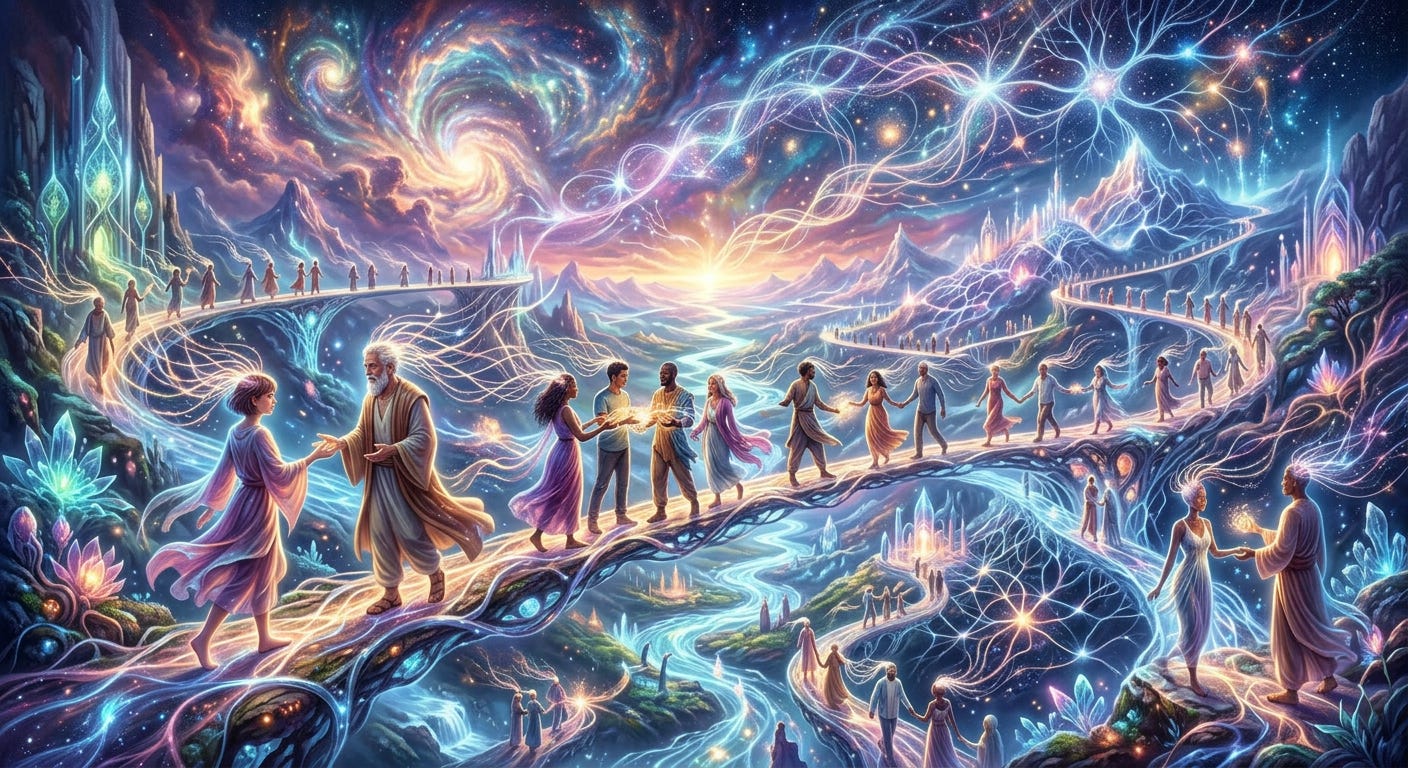
This is the first of several posts on the Middle.
The mysterious Middle is an emergent property of relationship, most prevalently in group settings with prescribed rules of engagement. The experience of the Middle is fueling deeper investigation into its source, nature and behavior—or even as source itself. Computational neuroscience may already be reducing the brain behavior signifying the Middle to mathematical equations, but in human relations, the complex of emotions comprising the elusive Middle are a representation of the potential for diverse psychologies to arrive at a common harmonic. Thus, the character of its emergence within intersubjective dialogue is a topic of intense speculation.
The Middle is typically invoked by adhering to rules of engagement, but even within that structure it can’t be engineered. The mere expectation of coherence is not sufficient to direct a group experience into coherence. The Middle behaves more like a photon. A photon is not a material phenomenon; what it will do or how it may appear in the next instant can only be approached by calculating probabilities. There is no objective way to say what a photon even is because its nature is changed in the looking. Indeed, a photon even challenges the meaning of is because there’s nothing fixed about it. Whatever we imagine is never stands still. In human relations, the Middle is potential, the immanence of the field. Is it there when we’re not looking? Who can say? In the meantime, it’s not so much what we see when we do look, it’s what we feel, or sense, as we scan and metabolize shifting nuances of a collective experience.
In Tibetan investigations of mind, existential unity, interdependence and insubstantiality are realized as features of relational emergence. The embodiment of imperturbable confidence in the porosity and transitional nature of open awareness is a prerequisite to attunement with the cognitive confusion that dominates global culture without being destabilized by it. If group practice were subject to the same conception of attaining personal transcendence it would only be reachable at the conclusion of an arduous climb on a moral ladder. For group practice, just as it is for individual practice, that conception would be an impediment because open awareness, like resonance, the Middle is always here. No climb is necessary. We are already embedded within it. So, we might as well become acquainted with its nature.
The Middle challenges the presumption that the default cognitive process reveals reality. Tracking the openness of the Middle is a bit like investigating the dharma, where we encounter challenging concepts like impermanence, interdependence, and emptiness at every turn. The dualistic principles that drive relative existence—separation, materiality, independence and permanence—are abstractions. They make us generally unaware of how out of contact we are with the in-betweenness of existence…until we look. And looking changes everything.
The Middle as Refuge, Sanctuary, as Absence
The term integral consciousness refers to seeing beyond competing ontologies, beyond growth or separation to the integration of all phenomena as an expression of fundamental unity. In contrast to a world as object, a world as subject is the implication of integral consciousness in the sense that in the Middle, boundaries soften, or even collapse. Identities do the same. When neurotic self-orientation is subdued, the existence of others becomes malleable. Not entirely overcome, perhaps, but we can begin to sense beyond othering. This ‘time between worlds’ arouses integral consciousness, a natural inclination to abide in a co-created sanctuary as a warming and reassuring response to the chaos, collapse and rebirth going on around and within us.
Intentional gatherings provide refuge in the safety and permission of a microcosmic laboratory, a fractal of a common future. They restore a measure of balance by re-grounding somewhere beneath collective tensions, especially because there is no such thing as opting out of the macro-disturbances of the planetary field. Opposition is held as natural, even necessary, turning divergence into strength, relieving epistemic distortions and recalibrating to a more resonant communal field. While the intersection of spiritual longing with the exigency of material existence can become stressful, even immobilizing, our Earthen nature of open-hearted moral clarity is restored in the wide-open space of the Middle. Listening with patience and reserve without having to grasp for certainty is the ear of integrity. Collective attunement is the sacrament of the alchemical center, where somatic memory and collective intention merge into a resonant landscape of ease.
The learned and acquired synchronicities of the Middle increase sensitivity, receptivity, confidence and trust in a field of spare and reflective exchange. Empathy, even telepathy, forge unconditional positive regard. We are (re)introduced to our bodies as pre-cognitive capacitors, as antennae, capable of listening beneath verbiage, of noticing somatic coherence as a more relevant message than any reflexive reliance on analysis or reason. In real time, we become sense-makers of intersubjective phenomena without resorting to conceptualizing the experience (as I’m doing here) until later. People who attend such gatherings share an implicit dedication to relational practice that implicates deeper, more coherent group process in other contexts. Once engaged, the space is sustained by implicit consent and mutual accountability.
We say the world is in transition because the systems that once upheld the illusion of permanence are breaking down. The same revelation extends to bodies. As a relational function in a time of transition, the Middle draws us into an acute experience of impermanence, reminding us that life and death are so intimately entangled as to be ambiguous.
A gross understanding of impermanence is inadequate because ego-consciousness is so afraid of ego-death, so focused on reconstituting self in every moment, habitually reifying experience and missing the insubstantial nature of phenomena. The essence of impermanence is revealed in sub-atomic space, in which causality collapses, where energy and matter trade places constantly and unpredictably. In fact, there is no true substance to be found anywhere, not even in time. Insubstantiality is the essence of everything.
The gestational discomfort we share in the space between worlds is akin to responding to a terminal diagnosis in the middle of labor. The openness of the Middle is unwavering and creative, open-hearted mutual recognition, acceptance, and absolute compassion. The purity of that compassion is grounded in the knowledge that there is only one Being because the sense of unity in Middle space is its strongest feature, yet it is so fragile it might disappear if we look too directly at it.
There doesn’t seem to be any known trigger of the Middle other than a willingness to be vulnerable. We can’t say the Middle arises from anything other than from whomever is present. No single person is responsible for it; all are responsible. That is its attraction. The Middle is a medium of relational becoming. Its spontaneity and delicacy are deeply seductive. It rises as a subtle flame whose appearance becomes a collective responsibility—except that there’s nothing to do in that regard. More likely, the Middle is sustained by non-doing—the Taoist principle of wu wei—non-acting while at the same time leaving nothing undone. Superficialities are subsumed because individual identity is no longer on the line.
In the Middle, the agenda you didn’t even know you had collapses. The ego-control that you came with, especially any expectation of mastery, relaxes. So also, any apprehension about how to engage—or even about who is engaging. The Middle raises the question of where the self begins or ends; how you can both be yourself and get out of yourself: nonduality within duality. The meaning of un-distracted nonmeditation, i.e. meditation without an object, creeps into view here. Non-discriminating compassion is more accessible. All because it’s not about you.
Objects we infer to exist do not exist in an objective time-stream. We might be temporarily fooled by our senses, but they are equally conditioned, illusory, and insubstantial. By our attachment to appearance, we remain captured by a vision of physics that was undermined a century ago. Objects are time itself, insubstantial representations of space.Being captured by materiality is an ontological trap. The origin of everything is not athing. Nor does it come from anything. It isabsence, what has no attributes whatsoever. Every possible description of absence is inadequate because it has no nature. It’s not nothing, yet paradoxically, everything arises from it. Not so unlike the Middle.
Comments
Nothing yet. Say the first thing.
Sign in to join the conversation.