
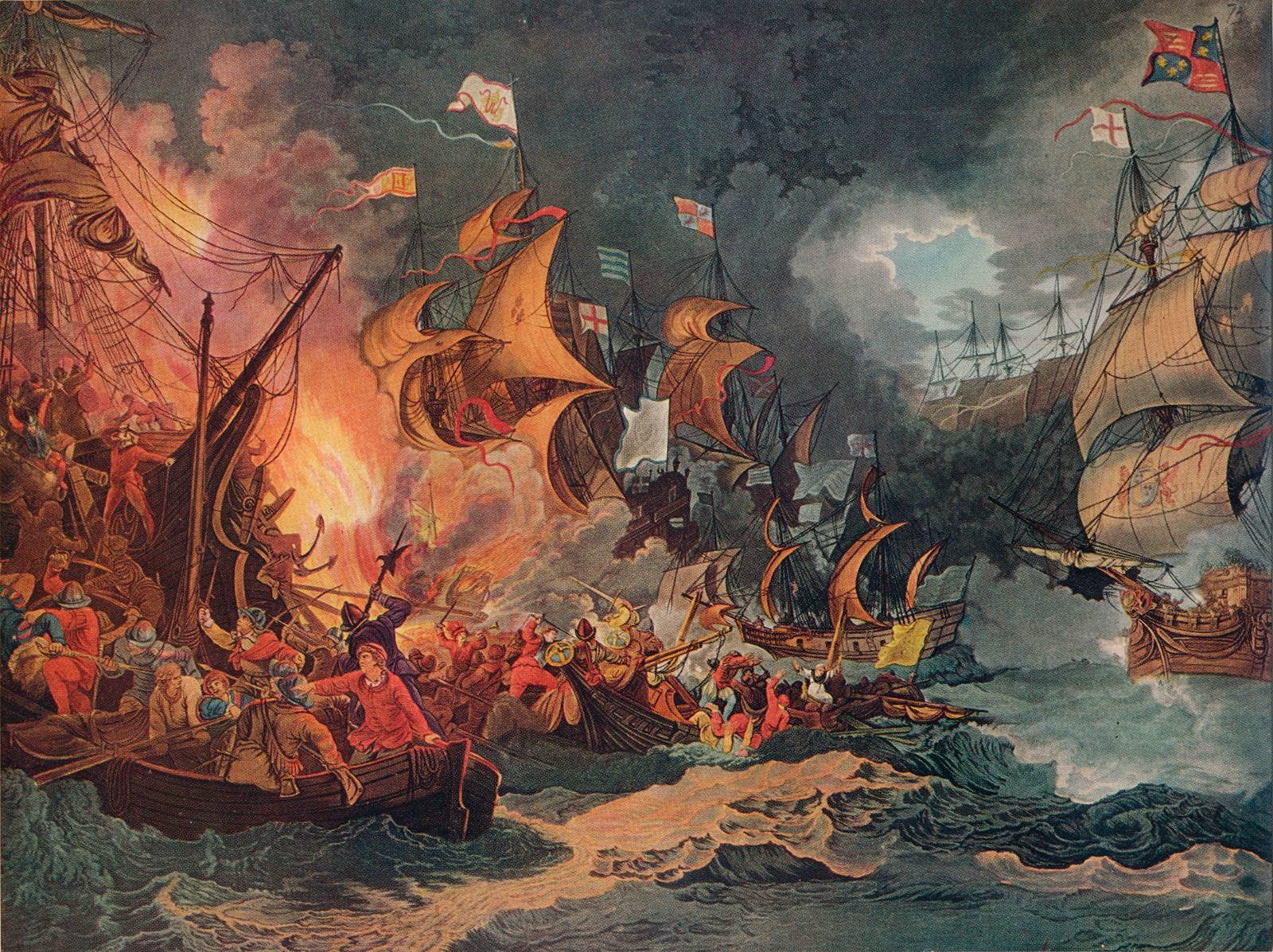
The destruction of the Invincible Armada in 1588 started the decline of the mighty Spanish Empire.
Two hundred and fifty years ago, on June 27, 1776, a Spanish colonizing party led by Lieutenant José Joaquín Moraga arrived near the site of present-day Mission Dolores in San Francisco. Moraga and his party were following in the footsteps of the great explorer Juan Bautista de Anza, who three months earlier had led 240 men, women, and children on an arduous, 1,200-mile trek from what is now Arizona to Monterey, California.
Anza and a smaller party had continued on as far north as San Francisco, where he camped on his first night at Mountain Lake in what is now the Richmond before choosing the sites for the two indispensable institutions of the Spanish colonial enterprise: the presidio, or fort, and the mission. Two days after he arrived at the site of the future mission, Moraga erected a crude chapel and celebrated the first Mass in the city’s history. In September 1776, the presidio was blessed and formally dedicated in the name of the king of Spain.
These events made San Francisco the most remote and far-flung outpost of the mighty Spanish empire. That empire, which had begun more than three centuries earlier, when Christopher Columbus landed on the island of Hispaniola, was the largest the world had ever seen, at its height covering 5.3 million square miles. It included not just Spain, the Netherlands, Milan, Naples, and Sicily but enormous stretches of North, South, and Central America and much of the Caribbean, as well as the Philippines, Guam, and other holdings. It was known as “the empire on which the sun never sets.”
But when Spain acquired San Francisco, its empire was already on life support. In 1810, just 34 years after Moraga raised the Spanish flag over the presidio, Spain’s New World colonies began to revolt. In 1821, New Spain, which comprised Mexico (including what is now California) and Central America, broke away. In the following four years, Madrid lost the rest of its once-vast New World holdings, except Cuba and Puerto Rico. The Spanish Empire was gone, never to return.
Just as the sun was setting on the Spanish Empire, it was rising on a new country that would become an even mightier world power: the United States. Just five days after the Spaniards celebrated the first Mass in San Francisco, British colonists on the opposite side of the continent declared their independence from their mother country. This historical coincidence raises some intriguing, if unnerving, questions: Can the U.S. suffer Spain’s fate? Are we too a superpower in decline? And if we are, are we repeating the mistakes of Spain?
In his classic 1963 study “Imperial Spain 1469-1716,” J.H. Elliott argues that the decline of the empire was caused by a number of factors, including an economic crisis brought on by an endless procession of ill-conceived wars; an ossified society dominated by a reactionary church and clinging to dysfunctional ideals; a stagnant intellectual life characterized by a rejection of science and the Enlightenment; extreme nativism and an obsession with racial purity; a society divided between the very rich and the vast majority, who were very poor; rampant cronyism; and a procession of incompetent monarchs.
Hmm. Does any of this sound familiar?
Let’s start with unnecessary wars. If there was a single event that started the Spanish empire on its death spiral, it was King Philip II’s disastrous decision to send an “Invincible Armada” to attack England in 1588. Philip and the Spanish church were filled with holy zeal to smite the English infidels. A Jesuit prelate named Pedro de Ribadeneira wrote, “I consider this enterprise the most important undertaken by God’s Church for many hundreds of years. Every conceivable pretext for a just and holy war is to be found in this campaign. … This is a defensive, not an offensive war; one in which we are defending our sacred religion and our most holy Roman Catholic faith.” The invasion abjectly failed, the ships destroyed by a combination of English cannon, fires, and storms, at a cost of 10 million ducats — three-fourths of Philip’s annual budget.
Wars imposed an insupportable financial burden on Spain, and its rejection of science and the Enlightenment prevented it from advancing alongside European nations that were open to new ideas. Spain’s stagnant intellectual climate was epitomized by a notorious episode that took place during the reign of Philip IV. When a junta of theologians was summoned to opine upon a proposed canal linking the Manzanares and the Tagus rivers, it declared that if God had intended the rivers to be navigable, He would have made them so. When progressive Spaniards embraced the humanist ideas of the free-thinking Dutch scholar Erasmus, the Inquisition, the powerful ecclesiastical institution charged with maintaining Catholic orthodoxy, accused him of heresy and forced him to recant his sins publicly and spend a year in seclusion in a monastery. Crucially, Elliott argues that Spain created the Inquisition precisely because Spain was more racially and religiously diverse than other European countries: “The intermingling of Christians, Jews, and Moors had created religious and racial problems of unparalleled complexity and had prompted the organization of a tribunal dedicated to a solution along the only lines that seemed feasible — the imposition of orthodoxy.” The Inquisition was driven not just by hatred of alien beliefs but by fear that even the slightest deviation from orthodoxy might open the floodgates to widespread heresy.
The Inquisition’s obsession with ferreting out heretics was indistinguishable from its obsession with exposing and denouncing those who were racially impure; namely, Jews and Moriscos, descendants of the Moors who conquered Spain in the 8th century and ruled it for centuries. Spain’s obsession with racial purity, or limpieza de sangre (“purity of blood”), drove it to expel first its Jews, in 1492, then its Moriscos, between 1609 and 1614. The Spanish crown feared, for good reason, that even Jews or Muslims who had converted to Catholicism often secretly clung to their old beliefs. But political and economic reasons also played a role. Many Jews had attained high positions in finance and trade, and some Spanish resented their success. Similarly, many so-called Old Christians (as opposed to the Moriscos, who were known as “New Christians”) disliked the Moriscos for, as Elliott writes, “spending too little, working too hard, and breeding too fast.”
Both expulsions had negative effects on the Spanish economy. So disastrous was the effect of the expulsion of the Moriscos that in 1633, the royal confessor wrote, “It is a very short time ago since the Moriscos were expelled — an action which did such harm to these kingdoms that it would be a good idea to have them back again, if they could be persuaded to accept our Holy Faith.” But as Elliott writes, “[W]hat was done could never be undone. The regime of the Duke of Lerma [the favorite of King Philip III, who effectively governed Spain during Philip’s reign] was never one to give much thought to the morrow, and the expulsion of the Moriscos aptly symbolized its general outlook in its total disregard for economic realities, its determination to adopt the easiest solution when confronted by admittedly intractable problems, and its tendency to give way before popular and sectarian pressures. Here was a regime that, at a time when Castile stood most in need of government, was content to follow where others led, a government that preferred panaceas to policies and had nothing but high-sounding phrases and empty gestures to offer a society that desperately needed a cure for its many ills.”
Spain in the age of empire suffered from extremes of wealth and poverty: It had virtually no middle class. The writer Gonzalez de Cellorigo lamented in 1600, “Our republic has come to be an extreme contrast of rich and poor, and there is no means of adjusting them one to another. Our condition is one in which we have rich who loll at ease, or poor who beg, and we lack people of the middling sort, whom neither wealth nor poverty prevents from pursuing the rightful kind of business enjoined by natural law.” Elliott notes that Spain lacked what other European countries were developing: “a middling group of solid, respectable, hard-working bourgeois to bridge the gap between the two extremes.” Elliott argues that Spain’s potential middle class was lured away from productive activities by a desire to emulate the lazy, decadent aristocracy. As he writes, they “had committed the great betrayal. They had been enticed away by the false values of a disorientated society — a society of ‘the bewitched, living outside the natural order of things.’ The contempt for commerce and manual labor, the lure of easy money from investment in censos and juros [financial instruments that further drained Spain’s collapsing economy], the universal hunger for titles of nobility and social prestige — all these … had persuaded the bourgeoisie to abandon its unequal struggle, and throw in its lot with the unproductive upper classes of society.”
Spain’s decline was exacerbated by the rise of so-called validos, or royal favorites, who for decades wielded the real power in the royal court — and used their influence for massive self-enrichment. We’ve already noted the disastrous decision by one of the most prominent of these favorites, the Duke of Lerma, to expel Spain’s Moriscos. Lerma not only gorged himself at the royal trough; he was also particularly prone to being conned by even more outrageous grifters. “Lerma’s choice of confidants was uniformly disastrous,” Elliott writes. “Easily deceived by plausible rogues, he elevated to positions of great importance the most unsavory characters.” Don Pedro Franqueza, a bureaucrat tasked by Lerma to run the treasury, stole almost unbelievable amounts of money from the royal coffers and managed to obtain the title of Count of Villalonga before he was caught in 1607. Once arrested, Don Franqueza was charged with no fewer than 484 offenses, including fraud, misappropriation, bribery, extortion, embezzlement of public funds, document forgery, violation of state secrets, influence peddling, and concealment of assets. He was sentenced to life in prison and forced to repay 1.5 million ducats, about a fifth of the Crown’s average annual expenditure.
Finally, some of Spain’s monarchs, especially the ones who were in power during the empire’s swan song, were even worse than the validos. Sovereigns like Carlos IV, who was interested only in hunting, and his despotic, vindictive son Ferdinand VII were dreadful rulers whose incompetence led Napoleon to depose them both. Historian Stanley G. Payne described Ferdinand — during whose 19th century reign Spain lost most of its empire and whose later period is referred to as “the Ominous Decade” — as “in many ways the basest king in Spanish history. Cowardly, selfish, grasping, suspicious, and vengeful, D. Fernando seemed almost incapable of any perception of the commonwealth.”
Spain’s decline was a long time in the making. When Anza proudly planted the Spanish flag on San Francisco soil in 1776, the great empire he represented had been rotting from within for more than a century and a half. But few could have predicted that it would collapse as suddenly as it did.
The United States isn’t Spain. But for anyone who follows the news, the parallels are inescapable — and ominous.
This piece appears in the San Francisco Standard.
No posts
Comments
Nothing yet. Say the first thing.
Sign in to join the conversation.