
Editor’s Note: This week, I’m going back to my roots. That means, I’m running a MUCH longer Postcard… over a series of three days. This is a little bit to a more reflective Postcards on the state of financial media.
This was always the kind of editorial voice that the origins had, and after a long weekend, I’m going to ramp this up a little bit to showcase just how absurd access journalism really is… and some reflections on hedge fund media.
In Part I, I talk about Situational Awareness, and the media’s round trip on him in just 52 days from AI genius to inexperienced investor.
In Part II, I will make this personal and ask you to consider what it is like psychologically as a member of the journalism profession where access is unlike anything you’ve ever experienced before, and the moment that made me shift my focus away from journalism and back toward quantitative analysis.
In Part III, I will give you a report on a company whose business model on this subject ultimately takes us from an extraction point into a chokepoint at times of financial stress.
As always, I appreciate your taking the time to read my articles. This will all run combined in the range of about 10,000 words across three three pieces.

“You either die a hero, or you live long enough to see yourself become the villain.”
Part I. Leopold and the Media
To Whom It May Concern (You):
The quote above comes from Harvey Dent in The Dark Knight…
I must say it also reminds me of the editorial calendar of a publication where I once worked… and the strangeness of hedge fund and financial media.
I’ve learned and seen that on Wall Street, in Silicon Valley, and in American politics, you don’t have a long shelf life before a story can flip around you.
Sometimes… 52 days are enough.
Over the last few days, I’ve been studying the collapse of Situational Awareness, a hedge fund run by reported AI whiz kid, Leopold Aschenbrenner.
The 5Ws of journalism will tell the story of a young man who used too much leverage and lost his public portfolio.
The Why is largely subjective… but there are plenty of accusations that range from arrogance to a misunderstanding of how leverage works in a market that can see that you’re bleeding in the water.
We could… and largely should all move on… because it’s just another day in the world of finance.
I’ve studied every financial crisis dating back to the Roman Empire.
I know all the frauds like Madoff, Bankman-Fried, Bill Hwang, the Match King… and Scottish mercenary Gregor McGregor who sold mosquito infested jungles to European elite. Those stories are long and historical, and worth occasional reflection when we think about how the world moves from crisis to crisis.
Then, I think of a genius who just failed, blown up by leverage or a crisis outside their control. There isn’t fraud, but perhaps arrogance or bad luck or survivorship bias, or whatever else it is that us behavioral economists cite.
I think of names like Niederhoffer, Meriwether, Hunter, and Larson, where using too much leverage and blowing up a hedge fund isn’t a crime… It just stings a lot… and makes the question “What have you been up to?” awkward.
But Leopold Aschenbrenner feels different.
I haven’t shaken off the Situational Awareness story yet because of what feels like a record setting trip around the sun on this kid’s financial career.
It was just eight weeks ago that my friend sent me a Wall Street Journal piece about Leopold, AI, and his performance.
When I asked about his strategy, I was told he was using a lot of leverage.
I said to my friend in Europe - this kid is going to “blow himself up in like late 2027 if the liquidity cycle implodes and all these names get crushed like the high-beta names did in 2022…”
That WhatsApp phone call happened… on June 10.
The financial media has had access to Leopold and this fund since the fund’s inception. And it could have talked to anyone in the financial ecosystem that helped him reach this level of leverage long before this fund’s collapse.
To some, this downfall is funny. To some it’s clickbait. To others it’s a pelt on the Wall of yet another “Occupy Wall Street” snicker… To others it’s just THE GAME.
Various sources say that Leo had four prime brokers, and if you go to any of them, off the record, they’ll tell you what they told me when a few other funds I investigated blew up in the past. “They wanted to borrow money, so we helped arrange the deal. We’re in the brokerage business...”
That’s the system.
That’s how it works.
It works as it’s designed. Margin calls happen. Leverage unwinds. Who are we or they to decide who wins and loses? Brokers collect fees and protect their capital. Who are the banks to warn about the dangers of leverage… though it’s part of a business model that has encouraged moral hazard?
Enough about the mechanisms on Wall Street, because this is about the media.
Who was the messenger about these reckless endeavors that are dressed up as the second coming of Warren Buffett or Peter Lynch?
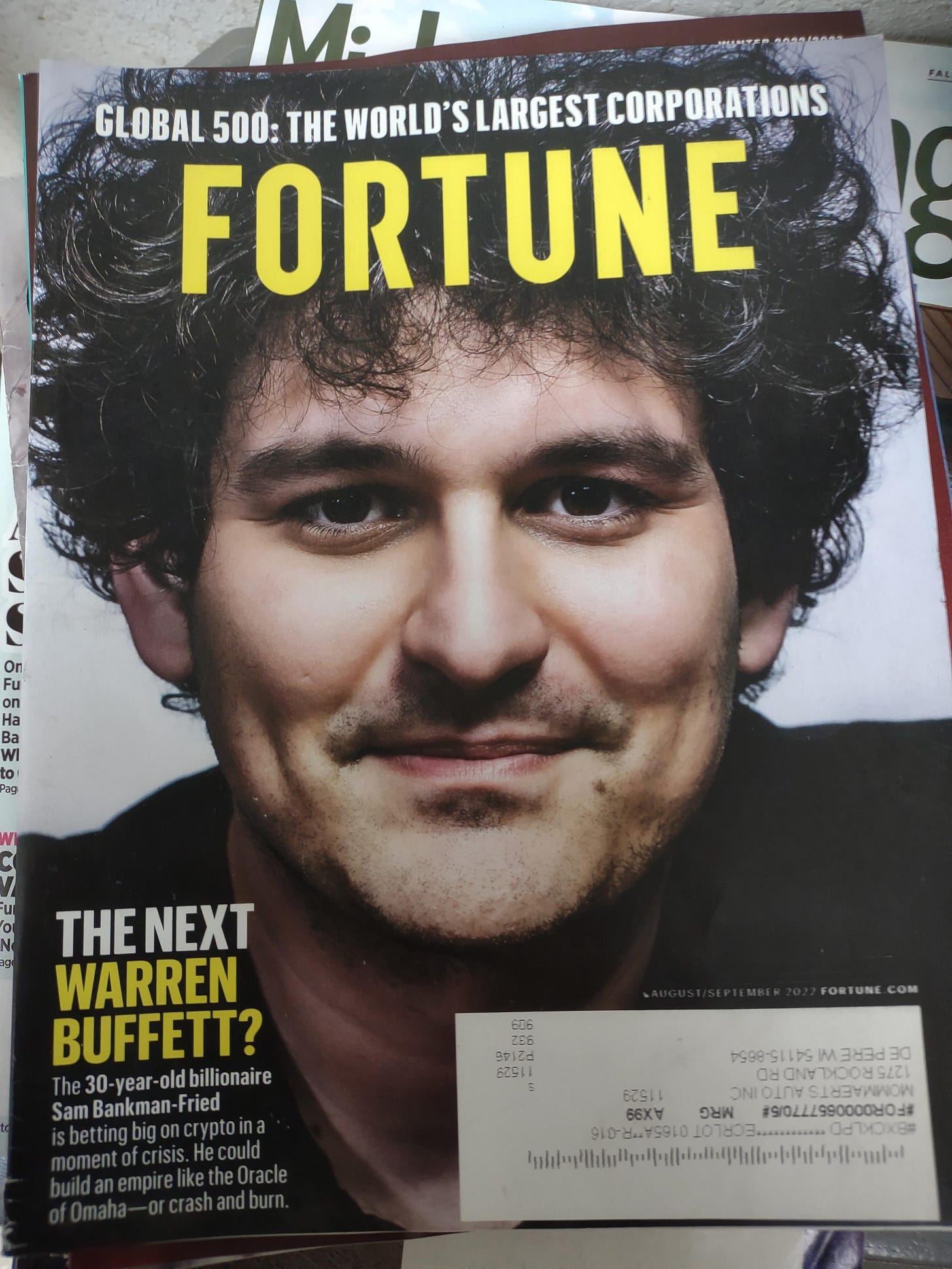
It’s the same newspapers and magazines that have for decades witnessed the same failures and the same leverage and the same bubbles over and over again and don’t take the time to do the risk assessment on their audience’s behalf.
They don’t challenge the narrative…
They don’t look at what the numbers say and ask…
“Hey, um… you know you’ve built a complete clown tower of risk for her pal, right? This is the type of thing that can take down an entire sector in an afternoon, and indirectly hurt a lot of other investors in the process… Right?”
I know that economists aren’t typically journalists… and journalists typically aren’t quants… and quants aren’t typically story-telling researchers...
But I’d like to think I’m all of the above… and I want to take a shot at my first love because again, this situation has bothered me for the better part of two months.
As the ink on the Situational Awareness autopsies dries, here’s my reflection.
First, let me preface, I went to college to study journalism - and I was eternally drawn to its ethics under Dick Schwarzlose at Medill.
When I screwed up something royally at the age of 20, he mentored me.
We largely realized that I wasn’t really built for the traditional financial newsroom because of my trust issues and problems with authority. It was clear that no matter what I did, I was never going to get a gig at the Wall Street Journal or Fortune… or Bloomberg… or Barron’s. It was never going to work because I’d be working in an ecosystem I couldn’t control… an editor would assign me stories or try to sand down my style and voice. That wasn’t going to happen. But I know plenty of people who did, and we’ve had this conversation…
This is all a peek into some corners of financial journalism you don’t know exist.

Over at Me and the Money Printer, I typically write about the film Margin Call when I want to explain leveraging and fire sales and VaR analysis.
I turn to Adam McKay’s The Big Short when I want to discuss journalism and the media. I wasn’t working in the media in 2008 as the world burned down.
But there’s a scene in the Big Short that speaks directly to this concept of “Access Journalism.”
That’s the process of building sources… getting scoops… having access to relationships that take months or years to build… a form of trust… that sometimes walks a very delicate line of ethics and professionalism.
In the scene, one of the traders working alongside Brad Pitt’s character challenges a journalist for not going out and telling the truth about what is happening with the ratings agencies and the real threats to the financial system.
The journalist pushes back and explains that he’s built relationships for years… and he has an apartment, and graduate loans, and he’s not going to blow it all up on a hunch that the agencies are cooking ratings, even if it’s a good story...
The journalist has stakes right now… and asking the wrong questions could not only upset the balance in the newsroom, but it can also cost him his sources and ultimately his livelihood.
This isn’t just journalism.
This is America today.
People ask all the time how someone gets away with things for such a long time, when it’s an open secret on Wall Street or in Hollywood or in some public company where the board member is an lunatic and no one ever challenges it.
No one wants career risk.
You don’t need a grand conspiracy. You just need enough people who look around and see their incentives and what they stand to lose. It’s a tragic thing to think about… but it’s deep human behavioral psychology… and a survival instinct.
Why would they stick their neck out to “do the right thing” if doing the right thing ends up getting them blackballed from their industry…
Whether it’s Harvey Weinstein or some financial crook … self-preservation - I’ve learned is a powerful thing.
The classroom version of Jordan Peterson has described this as the story about the Zebra and its stripes, and a desire to stay in the middle of the pack and not attract attention so that no predator picks you off. No one wants to be a target…
So, many journalists don’t go after the Pulitzer Prize or ask uncomfortable questions. They don’t go onto YouTube and scream into the void because that’s dangerous. Those are things that aren’t going to get you that dream job working at the Wall Street Journal… and the ability to gain access to that other world.
Publishing has that feel to it…
Why write the uncomfortable piece, when you can get assigned something that is a puff piece that acts as melatonin… and you don’t have to worry about upsetting some ex-Fortune 500 CEO who will throw a fit because you brought up his Golden Parachute from 20 years ago and he starts making phone calls and calling for your job (Yeah… this exact thing happened to me when writing a story about executive compensation back in 2016.)
Why not write what they tell you to write, and be happy for the privilege, and pay off your student loans and just go to the company part, and play the game?
Especially, when you have a mortgage, a kid in private school, and a salary that you might not be able to replace on your own… I preface all of this to talk about the pattern that we just witnessed with this hedge fund manager.
That’s for Part II. I’m going to give you a hypothetical - a story that combines a large number of different tales about access journalism and what it means…
But for now… let’s look at what happened here.
On June 8, a Wall Street Journal reporter wrote an article that landed on my phone two days later. The article went wide to introduce the world to this 24-year-old whiz kid who ran a long-leveraged hedge fund that was up 1,000%.
His regulatory filings had generated some buzz, and people were studying it like scripture. Those were the words of the opening paragraph…
His roster of clients included some of the most sophisticated and wealthiest members of the tech community and emerging finance.
Based on the way the article read, he’d gone into a cave and seen the future.
One famous podcaster had previously called him the Nostradamus of AI.
The article coincided with a pretty rough patch that week for the very stocks he’d been buying - the artificial intelligence names that were part of the great global buildout that has dominated this capital cycle.
However, they’d rebound and reach a peak in that crowded momentum trade on the back side of the Third Friday of June.
Not more than six weeks later, the entire narrative had turned on him.
The same media ecosystem that crowned him would - on the weekend of August 1 - run the opposite headlines. Business Insider ran this headline…
The Humbling of Leopold Aschenbrenner.
And a subhead that… I’m sure… the editors had wanted to put in capital letters.
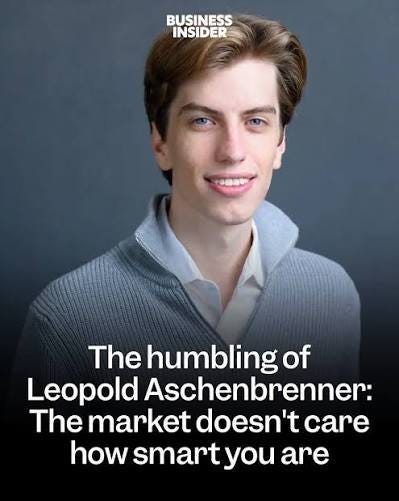
Leopold had - in a process of less than two months - gone from AI wiz savant to a humbled child. He devolved from an AI prophet to a cautionary tale about leverage. He went - like many others - from the smartest guy in the room to that naive trader who should have known better.
Now… I’m not defending Leopold, because I mourned his strategy in a WhatsApp call back in June. So, now that I’m miles down the road from the people just learning this story, I have to ask these questions.
What changed in those 52 days?
Did Leopold somehow Benjamin Button himself get younger?
Did Columbia take away his degrees?
Did his lack of financial trading and investing experience travel backward in time and un-happen in any way?
Did that turtleneck that he likes to wear suddenly turn evil?
No… none of these things occurred.
What happened was that the market fell… and fell fast - and the leverage breakout that everyone of these media outlets were celebrating at the start of April (after we got more policy driven action from our Treasury Department to drive away bond sellers in late March), now rearranged themselves around one price.
Forced deleveraging and margin calls became the main characters.
Keep in mind… Most journalists aren’t in the arena… and that’s not a knock on them. But they’re not trading. They’re not putting capital on the line. They’re not looking at economic models, and they’re not assessing momentum conditions and the impact of repo on semi-stocks. They are story tellers and great at it…
But they’re sometimes reporting weather… flying conditions, and who’s flying the planes. In this case, the market fell, the leverage broke, and their stories suddenly rearranged around new closing prices.
Back when the market was climbing in April (after policy actions in late March that, in my view, changed market mechanics), being 24 made Leo a prodigy.
When momentum broke and forced selling started (again, rarely reported through traditional financial media, but covered on sell-side desks or at ZeroHedge)… when short sellers started pounding his positions… and forced deleveraging hit his fund, being 24 made him naive and dangerous.
It’s the same guy… with the same background.
The media didn’t cover a different person.
It covered a different price, and the consequences of it.
And in the words of sports journalist Max Muncy in The Natural to Roy Hobbs…
“After today, whether you’re a goat or a hero, you’re gonna make me a great story.”
On the way up, he was a great story.
On the way down, he was a great story.
And the details of Leo’s life never changed.
Leo’s only the latest person cast in a part that Wall Street’s been filling for decades.
It almost always ends with the same ending to the same article.
In hindsight… people had concerns. Sure… those concerns existed.
The only question that matters in the world of journalism though is if anybody was ever willing to put those concerns in print before Leopold turned the villain.
Leopold didn’t get the Sam Bankman Fried treatment, the cover on Fortune asking if he was the next Warren Buffett.
It didn’t get the image of Elizabeth Holmes on Fortune telling us that she was out for blood, and then a second one where she has a turtleneck…
But Fortune is still calling Leopold and his now-wife the Power Couple of AI…
With Leopold, it seemed he was just getting started. There were a handful of serious pieces in a variety of credible publications. There were podcasts that seemed to vault his personal, and newsletters and copycat sites about his strategy. Eventually, a few larger profiles would create the atmosphere.
Fortune took the lead back in October 2025. It was then that they talked about a 23-year-old OpenAI researcher who had turned a viral essay into a $1.5 billion hedge fund. The image they used then (courtesy of Situational Awareness) would be the same image used in stories about his wedding, the same one where the author claimed that the fund’s fallout was due to a Black Swan… seriously?
That Black Swan sentence made me laugh… because it wasn’t one.
That said, going back and reading, these original profiles before the crash talked about him being a Columbia valedictorian at 19. How he wrote this AI manifesto and attracted elite backers. He talked about his private meetings with CEOs… and his bets on the coming super-intelligence economy.
This guy was no longer in the words on these pages a young kid who had an aggressive thesis on AI… and in some cases… likely TOO aggressive.
No… he was the prophet of this AI age.
By spring, Leopold was in full ascension… and it wasn’t like he was investing anymore. It was like he was walking on water.
The financial crowd started screening his quarterly 13F like he was Warren Buffett.
And there’s nothing drier than a 13F.
Retail investors were piling into many of the same AI names, including through leveraged products. They were treating this like a television season finale instead of what it is…
One of the most boring regulatory filings in the world… and little more than an opinion of where markets are heading…
By June 8, the Journal pulled it all together… it was a mythology that they were probably planning to get Michael Lewis to turn into a book… or sell it out to Hollywood so that when the movie was written, the original screen play would be “Based on the Article” by the author.
This whole thing was wild when I read it… This was the opening line…
Leopold Aschenbrenner’s forecasts about the future of artificial intelligence earned him a cult following on the internet, where his investment firm’s routine regulatory filings are studied like scripture.
He managed more than $20 billion and was up over 1,000% since his inception, but had lost some money in 2025, a fact that didn’t arrive until the final paragraphs. Jane Street, one of the world’s top quant shops, had backed him.
But… in the article, the writer pointed out that he had no previous professional experience. It was all in the black ink…
Aschenbrenner had no professional investing experience when he launched his AI-focused firm, Situational Awareness, less than two years ago, with a few hundred million dollars.
This was packaged like Wonder Boy… Look at this kid, he’s done stuff that no CFA ever has… and did so without coming up through the usual machine that chews and spits out so many professional traders.
That lack of experience wasn’t part of the autopsy… or the driver error when the National Highway Traffic Safety Administration investigates a car accident.
His lack of experience made the coronation a great story.
The article mentioned the nickname the Nostradamus of AI.
Someone else called him precocious at eFinanceCareers….
That’s an incredible word that people have to look up… and it’s one that can quietly turn into “inexperienced” without the need for one more birthday candle to be added in a 12-month period.
And then… there’s the pictures…
There’s a whole visual language to all of this too, if you’ve been around this shit for long enough or work with cameramen who take headshots and realize that they’re in on the presentation as much as you are…
Photojournalist Josh Edelson took images of Leopold for the hedge fund and viral AI manifesto. In that photoshoot, there’s an image that I love…
I love this so much that I might just carry it around in my wallet and tell people that it’s a picture of my fictitious “twin brother from when we were both 24.”

In this image, he’s wearing a dark Irish cable sweater before a washed out background. There’s softer light from one side to make it seem like this image was a Renaissance painting commissioned by a Silicon Valley venture fund.
Leopold doesn’t smile here, because smiling is for people who still need others to like him. Look at his eyes… just gazing off past the camera… in thought at something that we as the audience can’t see.
That photographer might say to him, “Think about the future of AI investing.”
SNAP!
“Think about your importance in delivering the necessary capital to a small village that requires fresh water in Mozambique after you turn your 1,000% gains into 4,000% gains.”
SNAP!
“Think about something that superintelligence will solve that not even you can.”
SNAP!
But now… months later, recognize that the white halo and the mugshot use the same lighting… and the same pictures from these shoots are framing the autopsy articles in his investment fund.
Before the fall, he was deeply thoughtful, as all profiles suggested.
He was intellectually fearless, and clearly blessed with a preternatural ability to see around corners.
Everyone around Silicon Valley can see around corners, just the same way that everyone in Shawshank prison was innocent, didn’t you know that?
But not a single one of them seems to have the ability to see how momentum breaks in markets easily and how margin calls enter without an RSVP.
Leo is and was brilliant, we know this.
And for the media, that’s exactly why these new stories work.
The profiles shifted his returns into evidence about his character… The 1,000% run meant that he was wise, and his wisdom meant the AI paper was correct, and if he was correct, then surely his returns would keep coming.
There is a circular logic to it all where no editor ever starts to think about fallacies, and instead starts to think about the one thing that will ultimately matter in my story: Access.
This is right around the time that a track record evolves into a religion, and where people stop asking if someone has properly sized their trades…
And instead of thinking about what stocks he’s chosen, the question is now whether or not HE is CHOSEN.
Sometimes, a postmortem will discover facts that no other writer or investigator has. Those facts will naturally change the story over time.
But that’s not what I’m talking about in this postcard.
His age, inexperience, connection to FTX, and his leverage were WELL KNOWN long before July 2026.
You can run this entire thing backward the moment that the price of AI stocks start to turn.
I’ve listened to people act like investors in South Korea somehow deserved their margin calls and liquidations because they’re — in the words of people I’ve spoken with - a “gambling culture.” Of course that ignores so much of what’s happening in that economy that I can’t begin to describe their tragedy.
But Leo’s leverage fell… that’s something else.
This guy wasn’t trying to trade in order to buy a house in a nation where it takes 14 years of salary to do so. He was doing fine, worked at the FTX Future Fund, and that was a single profile line the entire way up as the market rallied.
That whole line stayed in the background for most of 2026. But when the whole thing went down, it suddenly went from NOT BEING in the original Wall Street Journal profile to technically the FOURTH paragraph above the profile image in the most recent Journal article about the fund collapsing before his wedding.
But it was always in the biographies.
Fortune mentioned it several times when they first introduced him…
My point is that the biography didn’t predict the collapse, as some might actually think it did.
Instead, this recent collapse just rearranged his biography…
But there’s another element to this story… and that’s the story about access…
Tomorrow, in Part II of Leo and the Media, I will walk you through the psychology of access journalism…
Why does the moment that a young journalist on assignment first experience access to a place that they’ve never been before… behind the curtain… why do they not ask the hard question… why do they act nice… why do they find themselves unwilling to dive head first at the things that gnawed at them…
I think it’s simple for many people in the financial journalism world…
Because for the first time in your lifetime… while your other friends have gone on to make small fortunes at banks… and consulting firms… and. large software companies… you… on your reporter’s salary… finally have something to lose.
More on that tomorrow…
Stay positive,
Garrett Baldwin
No posts
Comments
Nothing yet. Say the first thing.
Sign in to join the conversation.