

To Whom It May Concern (You):
I apologize for the delay in this publication.
On Sunday, the Bank for International Settlements released its annual report, and that report is probably the most important thing I have to read and analyze all year.
In fact, I largely scrapped everything I’ve been working on to focus on the report…
I’ll be back on track for this Sunday, and I wish you all a Happy Fourth of July and 250th Anniversary of the American Experiment. I write this from the edge of my property today… reassessing the state of this economy.
I’ve long argued that our post-2008 world isn’t capitalism in its real form - and an increasing pattern of extraction continues to build across markets….
For example, I keep scratching my head at private equity extraction (why do I need to sign a service contract just to get pest control to my house… oh weird… Aptive is owned by… a private equity company… so they can stuff an extractive contract into my daily life and securitize my pest control… It would be funny if it weren’t serious and sad… but this is where we are.)
This weekend… I will discuss the false choice between politicians who treat whatever this leveraged and centralized system is as capitalism and the ones who now appear ready to rip it down across various cities across the nation…
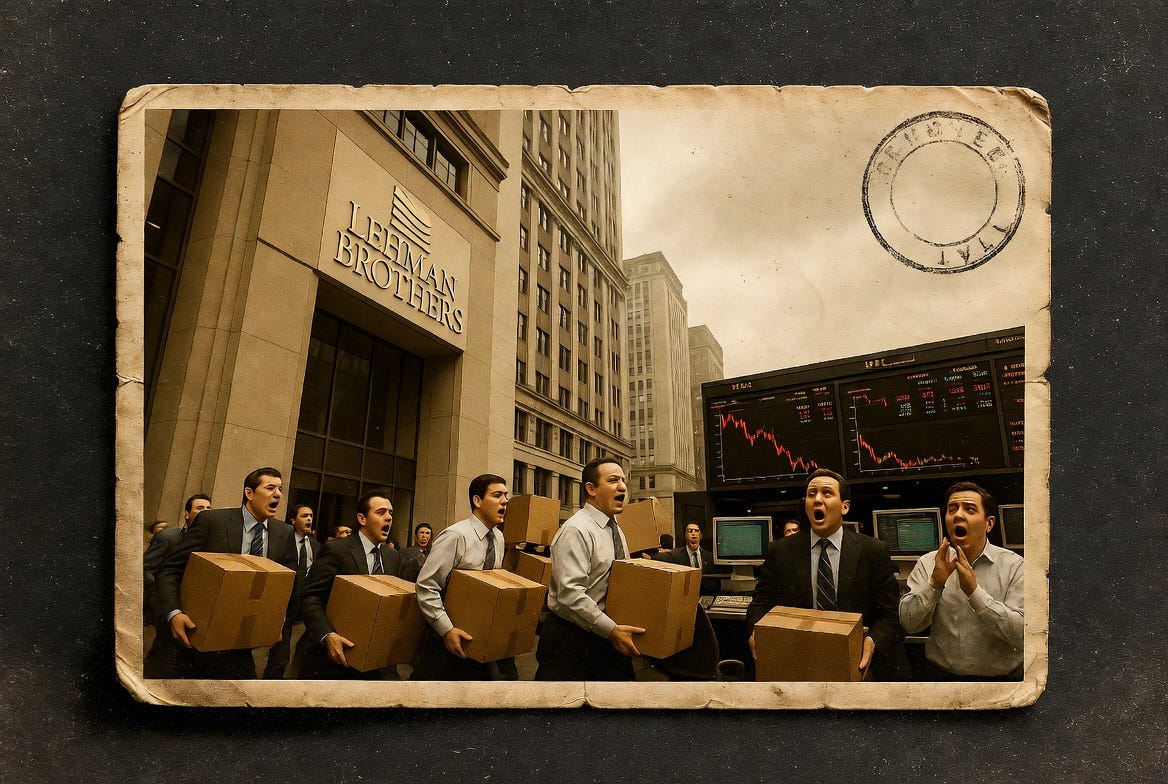
The BIS Annual Economic Report was quite sobering…
As you’ll find, few people actually read this very dry and technical manual on how central banks operate. But as I’ve said over the weekend, this entire annual report operated as a confession… one that showed us how the extraction feeds.
Of course, the BIS doesn’t use my language. It doesn’t call this a Cantillon machine. But the architecture it describes points in that direction…
As I’ll explain, it consists of rising sovereign debt, larger non-bank holdings of that debt, greater reliance on market-based finance, and more frequent pressure on central banks to step in when markets stop clearing.
Yes… every once in a while, the BIS publishes the blueprint of how the global financial system will be operated for the next decade.
Chapter 2 is the chapter that matters most in the BIS report… and the one that I want to approach from a Postcards conversation this week…
Central bankers write in policy-memo style. It doesn’t matter what it necessarily says… it’s how you interpret it after almost 20 years of reading these…
Again… when you know how money moves through a system… this does read to me like a confession.
The BIS has effectively described a financial architecture that, over the last 18 to 40 years, has produced, through incentives and financial engineering, a rescue machine that just won’t be turned off…
These rescues aren’t optional… as the burden of the rescues falls on central banks while politicians largely ignore the consequences.
These rescues, at their core, are structural rebuilds… and the institutions sitting closest to the rescue window end up getting paid first… every cycle… before prices reset for everyone else. No wonder private equity has its hands in everything - as they sit right up at the front of the food chain - and then have to put the money somewhere.
Woof…
But here’s the funny thing… for over 100 years… every single time that the U.S. financial system has called on someone to absorb as many banks as possible, one company has received a phone call…

Right now, advanced economies are sitting on the largest public-debt burden since the aftermath of World War II.
The forecasts project elevated debt levels well through 2031 and beyond.
As populations grow older, defense spending spirals up, public investment is demanded, and energy transition costs accelerate, this pushes the mountain of debt in the wrong direction. Tack on the rising costs of interest, and you see advanced nations that are persistently in debt.
The problem is that the fiscal policy has become what is known as “structurally asymmetric.”
Governments expand debt aggressively during downturns and consolidate almost nothing when the economy re-expands.
The BIS terms this phenomenon as “fiscal fatigue.”
What’s happened as a result is that non-bank financial institutions (NBFI) now control about 53% of advanced-economy sovereign debt, up from 44% in 2021.
Who are NBFIs? They are the funds that sit at the front of the food chain… they are pension funds, insurance companies, leveraged hedge funds, money market funds, open-ended bond funds, and stablecoin issuers with growing footprints in short-duration Treasury markets.
These aren’t the types of things that have the same oversight as traditional banks. The hedge funds running the leveraged sovereign intermediation are financed in the repo market, an overnight lending market where roughly $12 trillion of assets exist and between $1 trillion and $3 trillion exchange hands each day..
Repo lenders are, overwhelmingly, banks. The structure underneath the largest debt market in the world is now a twisted, leveraged chain that few Americans even know exists…
Basically a leveraged non-bank holds the bonds, a bank lends the non-bank the cash to hold the bonds, and the central bank backstops the bank when the chain breaks.
The BIS is not subtle about what comes next.
The BIS warns that, as sovereign debt markets become larger and more intermediated by non-banks, central banks may face more frequent pressure to intervene when market functioning breaks down.
In fact, that term “market dysfunction” appears constantly - and it’s now largely viewed as a permanent feature of the capital markets. The problem is that every new intervention might create stability, but it creates a situation where central banks struggle to address underlying inflation in an economy…
Political radicalism and populism… live downstream of all this… Wondering where an affordability crisis originates? It’s a policy outcome… and it’s a feature of the system…
Meanwhile, every repeated intervention, the BIS notes, “could encourage investors to take on more risk and borrow more, increasing the fragility of the financial system.”
It cautions that backstops should be “temporary, targeted and reversible.”
They won’t be… and they never are.
We have already watched four iterations of this cycle in 20 years.
The Great Financial Crisis, the September 2019 repo blowup, the March 2020 Treasury dysfunction, and the Bank Term Funding Program after Silicon Valley Bank.
Every one of them was sold as temporary.
And even when the specific facility wound down, the operating regime that followed left the central bank more central to market plumbing than before….
Meanwhile, I haven’t mentioned…
In December 2025, the New York Fed removed the aggregate operational limit on standing overnight repo operations and moved them to a full-allotment format.
This is the operating manual of the system itself...
Every intervention adds liquidity to the financial system in some manner...
Over the last six months… the Reserve Management Purchases program has lifted the Fed’s balance sheet even in the face of strong nominal economic growth and rising inflation in the economy.
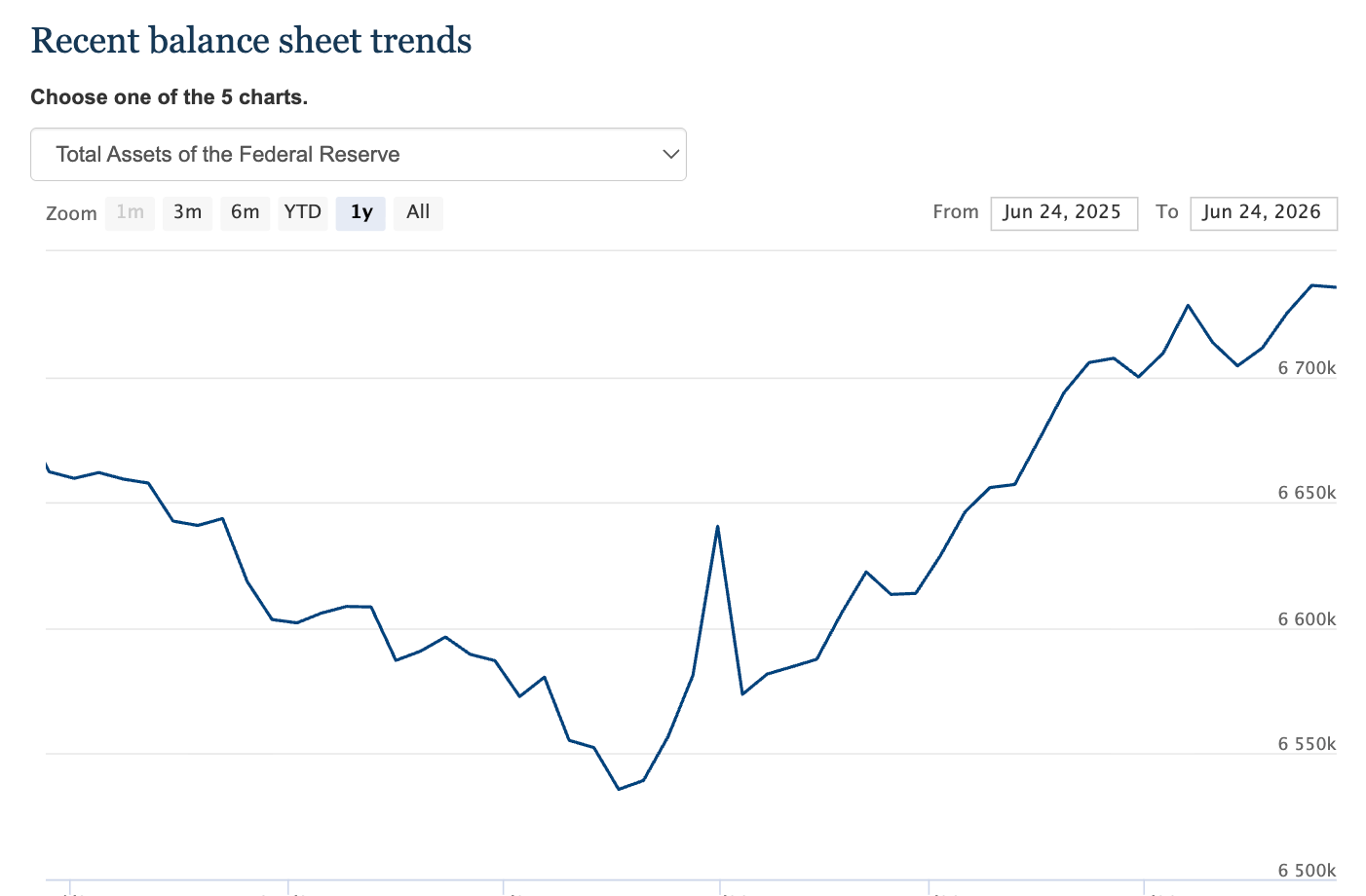
Where does the capital come from?
It doesn’t come from money on the sidelines… or money that is coming from consumer spending.
Now… this starts with the institutions that have direct access to the central bank window.
These are the primary dealers and the megabanks. These are the handful of “systemically important institutions” that operate the plumbing between the central bank and everything else that lives downstream...
It is these institutions that access capital first, at a lower price, before it has time to reset across asset prices for everyone else.
These upstream money players use that capital to absorb the inventory that the system needs absorbed to stabilize the system.
The banks in that chain earn the spread between what they pay for funding and what they earn on the assets. They sit between the public, who pay for the rescue through inflation and a higher cost of capital, and the assets, which they own and lend against.
This is the Cantillon effect, something I’ve outlined in previous chapters...
We know that new capital flows through very specific channels. It enriches the people who receive it early, while it usually ends up in the form of a debt payment for people at the bottom of the chain.
The architecture that the BIS outlines in Chapter 2 of its annual report is the most efficient Cantillon machine ever built.
Now, there are political factions that want to break the machine… but I couldn’t even begin to imagine what the world looks like with that much leverage unwound and no mechanism in place to resuscitate it…
So… I am assuming that all paths point toward more monetary expansion, fiscal repression, bailouts, and the machine protecting itself and its incentives.
Which means, the rational structural position is to own the early receivers and participants in the persistent machine...
After 2008, policy makers didn’t make the systemically important banks smaller.
They made them larger and more centralized. The four largest U.S. commercial banks emerged from the crisis controlling a much larger share of U.S. banking assets than they had going in.
The Dodd-Frank Act was sold to the public as a Wall Street accountability framework…
But it incentivized the creation of the machine we see today. This law hiked regulatory compliance costs to levels that small and mid-sized banks struggled to absorb.
Basel III piled additional capital and liquidity rules on top.
The combined effect made megabanks more durable and harder to displace.
The bank that was already sitting at the top… was the largest beneficiary, because the rules scale with size.
You have to go back to the foundation of who is… the original driver of American bailout policy… This wasn’t a 2008 invention…
In October 1907, the U.S. didn’t have a central bank.
During the Panic of 1907, in a string of different trusts and other financial firms that bear some resemblance to the worst leveraged operators of our time, markets faced a massive liquidity crisis.
Depositors were lining around the blocks to pull money out of the bank.
It was then that John Pierpont Morgan summoned the heads of the major New York banks to his library on Madison Avenue.
He locked the doors and demanded a private rescue.
The Treasury Secretary deposited federal funds in the New York banks to backstop the operation. Morgan eventually committed to absorbing the riskiest positions… and the system stabilized.
It was only six years later that the Federal Reserve emerged… the buyer of last resort. When the Federal Reserve Act passed, it became the public version of what Morgan did in a library.
And the Fed happened because one man with a library prevented a depression and concluded that the rescue mechanism needed to be institutionalized…
So, 101 years after the 1907 Panic, Bear Stearns would run out of cash…
The Fed would engineer the absorption of the failing bank.
Where’d they go to?
JPMorgan.
And in September… after Washington Mutual became the largest bank failure in American history, the FDIC seized it on a Thursday night…
It sold it to… JPMorgan Chase before the markets opened Friday.
In May 2023, when First Republic Bank couldn’t fund itself, the FDIC ran a weekend auction and sold the deposits and almost all of the assets to…
JPMorgan Chase.
For 116 years, the mechanism that started in a man’s library… evolved into a central bank with a balance sheet measured in the trillions.
The institution at the center of the absorption has never changed.
There’s a proud tradition in the financial newsletter business of pretending that this is some outrage…
That someone should fix it… and that you can FIGHT BACK by… buying gold?
Well… I don’t believe any of that. I don’t stand up each day shaking my fist at the sky… I don’t control any of this…
The system is just doing what it’s been designed to do. I judge systems by their outcomes… not their intentions or what people tell me that they wanted to achieve…
The Treasury wants a manageable banking system it can coordinate with in a crisis.
The Fed wants a small set of counterparties it can move liquidity through quickly.
The megabanks want a regulatory environment that protects them from competition.
The political class wants a financial sector that won’t blow up before the next election.
And they will keep riding that system until it breaks… either financially or politically…
Every relevant party has gotten what they wanted.
Voters were never invited to the discussion on how any of it works…
The chokepoint today still exists… It has owners… and it’s never going to be broken by the people who built and designed it…
That’s just the way it is…
Surprise… surprise…
I’m talking about JPMorgan Chase today…
It is… by any measure that matters, the official bank of the United States.
It’s the largest U.S. bank by assets, a primary dealer with direct access to the Federal Reserve’s open market operations… it’s one of the largest repo and securities financing businesses in the world.
It’s the institution the Treasury, the Fed, and the FDIC have repeatedly turned to when the system needs a private-sector counterparty large enough to absorb a collapse.
And every time… every absorption has left the firm larger, more diversified, and more central to the architecture the BIS describes.
Its leader Jamie Dimon has built the bank, deliberately, to be the institution the regulators trust. That was evident in their aggressive advocacy efforts at the onset of the Dodd-Frank (Be sure to look up the JPMorgan Ambassador’s Program in D.C.)
Dimon now calls the bank’s resulting capital position the “fortress balance sheet.” This is, of course, a marketing phrase, but the underlying reality is real.
JPMorgan carries more loss-absorbing capital, more diversified funding, and more regulatory standing than any other U.S. bank.
The recent financial profile reflects the architecture.
Its returns on tangible equity sit above 20%, it maintains a growing dividend, an active buyback program, and a book value compounding at a pace that has tracked or beaten the S&P over the last decade.
If the BIS is correct, JPMorgan benefits from each leg of the cycle.
That means higher rates lift net interest income, volatility lifts trading revenue, and deposit outflows from smaller banks flow to JPMorgan.
Meanwhile, crisis absorptions add assets at discounts, repo and securities financing volumes rise when the Fed steps in, and the bank is, in the most literal sense, an option on the continued operation of the system as it currently exists.
Of course… the real question is price.
JPMorgan can be the best-positioned institution in the system and still be a mediocre purchase if investors already pay for perfection. The bank closest to the rescue mechanism isn’t a costless trade.
Regulatory risk remains real, and political administrations rotate. The political appetite to break up the megabanks resurfaces periodically.
So, the probability of that happening isn’t zero…
And, as always, credit cycle exposure is real.
JPMorgan is the largest U.S. consumer lender by several measures. Consumer credit softens before recessions. Commercial real estate exposure exists, especially in office.
“Own it until it breaks” isn’t a slogan. The architecture has not been tested by a fiscal crisis at the scale current debt trajectories imply. A genuine loss of confidence in the U.S. fiscal position, a disorderly Treasury market, or a serious challenge to the dollar’s reserve status would test every assumption underlying the franchise.
But… if I’m going to own a bank in the U.S… it will remain JPMorgan… Why not?
It is the system… the beneficiary… the great rewiring that continues to compound. I see no reason not to buy this on the dips and to look at JPM as a buy when the Federal Reserve starts to activate its repo efforts or the Treasury Department fires up its six tools…
It was the same lineage, the same institutional role, and the same basic bargain…
When the system needs another shock absorber, Morgan’s machine gets the call.
So… own the perpetuity machine.
Until it breaks.
Stay positive,
Garrett Baldwin
Active… Portfolio Below
Comments
Nothing yet. Say the first thing.
Sign in to join the conversation.