
The Sunday GARMI Canon is a culture column featuring a book, movie, song, historical snippet, language reframe, experience, or other touchpoint that can help us build a shared cultural inheritance oriented toward liberation and healthy planetary futures.
Because if we want a different world – one that evolves us beyond extraction, exploitation, patriarchy, hyperindividualism, and the like – then we need a different canon. One that’s not rooted in the very things we yearn to evolve beyond. One that instead catalyzes a better world for all.
Note: There will be no GARMI Groundswell or GARMI Canon for the next two weeks! Hang tight — I’ll see y’all real soon.
Okay, so: imagine you’re in a city. But the buildings are draped in living green, rooftops thick with gardens, solar panels winking from every surface. The streets are walkable and full of people. The tech works with nature instead of against it. There’s no smog. There’s no all-powerful Muskian billionaire. Power is decentralized, communities are in charge of their own resources, and the dominant culture isn’t extraction — it’s reciprocity.
That’s the world solarpunk asks us to imagine. And imagining it might be one of the most radical acts available to us right now.
Solarpunk is a literary, artistic, and social movement that envisions what a sustainable, just future could actually look like — and then works backward to figure out how to get there. The name is a mash-up: “solar” for renewable energy and an optimistic orientation toward the future, “punk” for the countercultural, anti-capitalist, DIY ethos that refuses to accept the world as-is.
From what I understand, the term was first coined in 2008, in an anonymous blog post titled “From Steampunk to Solarpunk” that imagined a new speculative fiction subgenre. It grew through online art communities, researchers, and speculative practitioners. A 2019 Solarpunk Manifesto defines solarpunk as “a movement in speculative fiction, art, fashion, and activism that seeks to answer and embody the questions ‘what does a sustainable civilization look like, and how can we get there?’”
But the story of solarpunk is not one that temporally in the 21st century, and it’s also not one that starts geographically in Silicon Valley or Brooklyn. The ethos of solarpunk started in places that have been living with extraction’s consequences for a long time. In many ways, the practice of imagining the way out of extractive systems and towards equity and sustainability is a deep, centuries-long practice in the “Global South” (i.e. in Rich Nations — if you read a recent GARMI Canon about my pitch on geographic semantics).
Stylistically, solarpunk trends towards flowing organic lines, sinuous plant forms, blending in African and Asian and Native and Latin American artistic traditions, as well as traditions like Afrofuturism. Much like me, solarpunk loves color. It loves texture. It loves the meeting point between the handmade and the high-tech.
And the element of “punk” isn’t decorative. Solarpunk is an explicity political aesthetic, one of rebellious hope, cooperation, and imagination. It’s explicitly anti-capitalist, anti-colonialist, and committed to the idea that technology needs to be decentralized and community-owned to actually serve liberation. It’s not just green aesthetics slapped on an otherwise unchanged world — that’s greenwashing, and the solarpunk community is vocal about calling it out. Corporations borrowing the look while leaving extractive economies untouched? That’s not solarpunk. That’s aesthetic larceny.
Okay because here’s the thing: in mainstream media, the narrative that’s been doing the imaginative work for decades is dystopia. And it’s making us sick. Y’all know me — I hate dystopia. I think it functions to depress and disengage us, and it’s also always this horrible envisioning of a Western capitalist world in peril. Post-apocalyptic landscapes. Climate doom. Megacorporations controlling every last data point of our lives. These aren’t just stories — they’re almost like proposals or playbooks. They shape what we believe is possible. And when the dominant speculative imagination says “the future is collapse, and the best you can hope for is just getting by” people internalize that. Climate anxiety is already epidemic, especially among young people. And then we’re told we can’t hope for better. We can’t build better.
Dystopia also annoys me because so many people around the world are actually, as many Native folks say, “post-apocalyptic people,” meaning that they’ve survived the worst — and in many cases continue to live in a world that can feel dystopian for their culture and experience. This is something colonized people around the world understand. It’s something that people in war-torn regions today understand. It’s often something that women globally understand.
So dystopia to me feels like a Western way of saying: patriarchal, capitalist, colonial culture is inevitable, and if or when bad things happen to this kind of world that we’ve built with this worldview of ours, everything will be destroyed and horrible and there’s probably no reason to fight it or imagine better. Instead of imagining how to make the world better, then, let’s just consume stories of worst case scenarios.
Solarpunk is a direct intervention in that crisis of imagination. It says: the only other options are denial or despair, and we refuse both.
This isn’t naive optimism. It’s not utopia. (I don’t like that term either — who defines utopia? I’d argue that right now, we’re living in billionaire men’s utopia, and I’m not feeling it.) Solarpunk doesn’t pretend the crises aren’t real. It holds them, and then keeps building anyway.
What I love about solarpunk as a genre and as an approach to life is that it practices what theorists call prefigurative politics: creating spaces, communities, and stories that enact the principles of a better world right now, not waiting for some far-off revolution. Guerrilla gardens. Community solar co-ops. Open-source seed banks. These are all solarpunk in practice.
To fight for a new world, we have to imagine it. We have to practice it. In that process, we build it.
Here’s something the mainstream conversation about solarpunk sometimes glosses over: the movement’s deepest intellectual roots aren’t in Anglo-American tech optimism. They run through feminist theory, ecofeminism, and “Global South” thought, and understanding those roots changes what solarpunk means and who it’s for.
In Latin America, the concept that rhymes most with solarpunk is Buen Vivir, or “good living,” an Indigenous framework from Andean communities (particularly Quechua and Aymara peoples) that organizes life around harmony with nature and collective wellbeing rather than individual accumulation. Bolivia and Ecuador have both incorporated Buen Vivir into their constitutions — it’s apparently imperfect and contested, but is still worth naming as an actual instantiation of these ideas in law. Buen Vivir predates solarpunk, is not derived from it, and is arguably more radical. The best solarpunk thinking, in my opinon, is in dialogue with it.
If you want to understand how deep these feminist and “Global South” roots of solarpunk actually run, go back with me to 1905 and a short story I cherish called Sultana’s Dream, written by Begum Rokeya Sakhawat Hossain, a Bengali Muslim feminist, writer, and social reformer living under British colonial rule in what is now Bangladesh. In Hossain’s feminist utopia, women rule the world as society lives peacefully and prospers through their inventions of solar energy, flying cars, and cloud condensers offering abundant, clean water to the population of “Ladyland.” The men, deemed unfit for public life, are secluded indoors — a deliberate inversion of the purdah system that confined women like Hossain herself. Ladyland, with its two-hour workday (!!), solar technology, and flower-paved streets, all made possible by female scientists and leaders, is so visionary — and it’s over 120 years old. This is a woman writing feminist solar-powered utopian science fiction in colonial Bengal in 1905.
UNESCO recognized the work in 2024 as part of its Memory of the World register, noting that Hossain “imagined both helicopters and solar panels before they had been invented.” The solarpunk community talks a lot about imagining a future that doesn’t exist yet. Hossain was doing that from inside a zenana, writing in a second language she’d taught herself in secret. The term “solarpunk” didn’t exist then. The aesthetic didn’t exist. But guess what? The politics absolutely did.
The literary tradition of feminist perspectives is strong. I recently also learned about (but haven’t yet read) Marge Piercy’s Woman on the Edge of Time (1976), which many solarpunk reading lists include. The protagonist, Connie Ramos, is a poor Mexican American woman who has been unjustly committed to a psychiatric institution. From inside that institution, she makes contact with an envoy from the year 2137 and glimpses the future society of Mattapoisett — a decentralized, anarchist-inflected world that has achieved what Piercy describes as genuine ecological, racial, and gender equality. Mattapoisett is explicitly described in feminist scholarship as an ecofeminist society: “nonhierarchical forms of organization, recycling of wastes, simpler living styles involving less-polluting technologies, and labor-intensive rather than capital-intensive economic methods.” The novel insists that the future isn’t guaranteed. Instead, Connie, a person with zero institutional power, must fight for it. Super solarpunk.
From Brazil, the 2012 anthology Solarpunk: Histórias Ecológicas e Fantásticas em um Mundo Sustentável features South American authors who re-imagine old Mayan and Aztec cultures in new histories and futures. The antholoy moves from the context of communities that have already been living with extraction’s consequences — colonialism, monoculture agriculture, resource exploitation — and have therefore been fighting for different futures for a long time.
Nnedi Okorafor’s work feels so relevant here too. She’s on my to-be-read because I hear that her Afrofuturism explicitly decouples Black futures from both Western science fiction conventions and from white-centered solarpunk aesthetics. Her Binti series centers an Indigenous Himba girl from Namibia whose cultural knowledge and biological relationship with the living world is precisely what makes her capable of navigating conflicts that pure tech intelligence cannot solve. This is the ecofeminist narrative: the knowledge systems that have been dismissed as “primitive” or “irrational” or “emotional” or “feminine” are often the ones most attuned to what it takes to actually live on Earth.
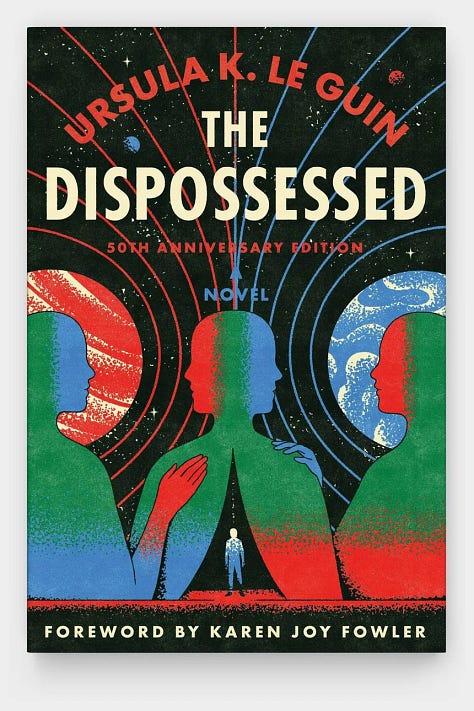
Another notable woman author here is Ursula K. Le Guin. Her book The Dispossessed (1974) portrays an anarchist society on the moon Anarres that has organized itself around sustainability and mutual aid over capitalism. It’s explicitly subtitled “An Ambiguous Utopia” — Le Guin wasn’t interested in perfect worlds, only honest ones. And her novel Always Coming Home (1985) imagines a future California society living in ecological balance, recovering from a prior civilization’s collapse. Neither of these are escapist fantasies. They’re philosophical arguments intended to push us towards action.


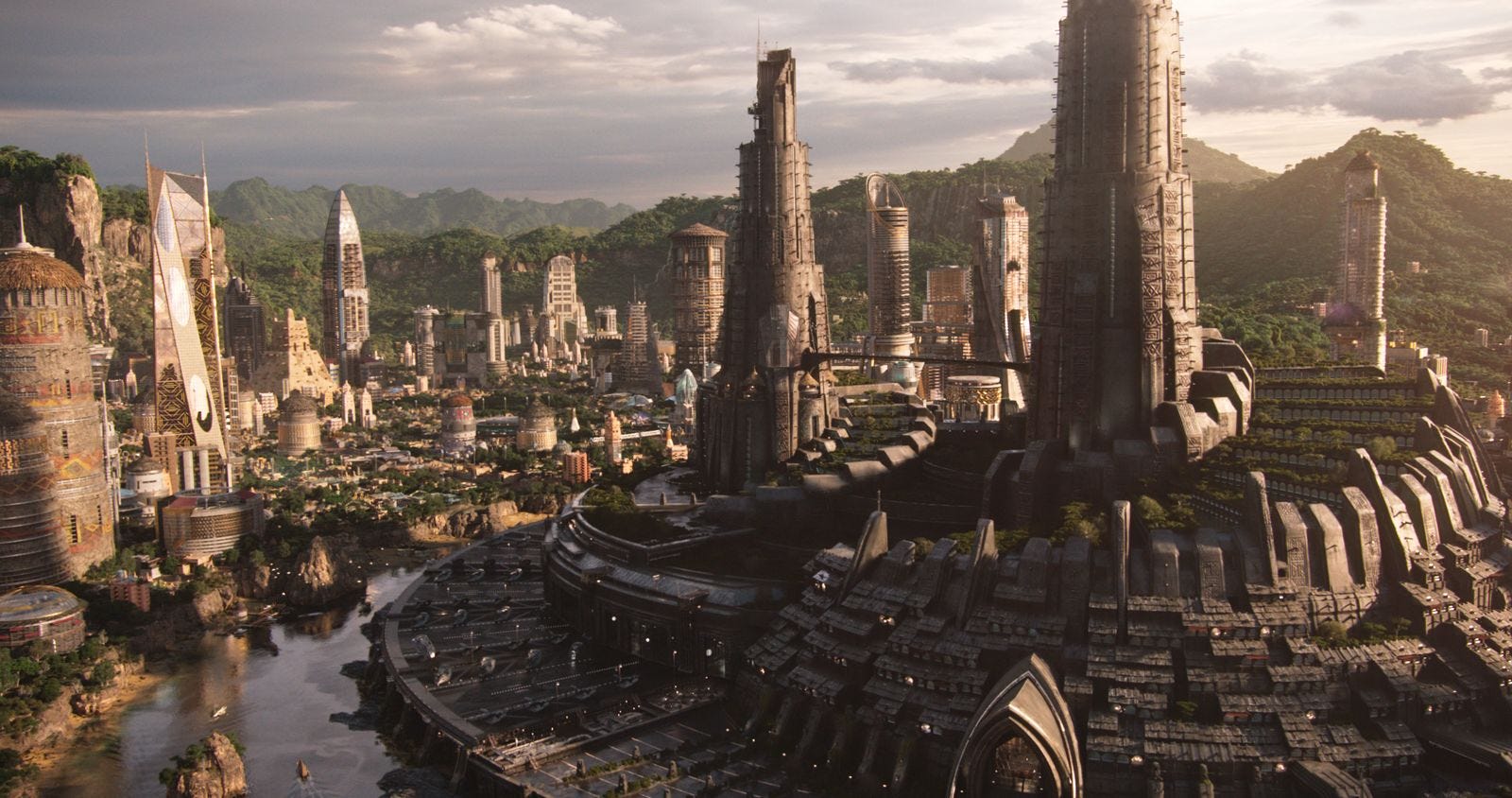
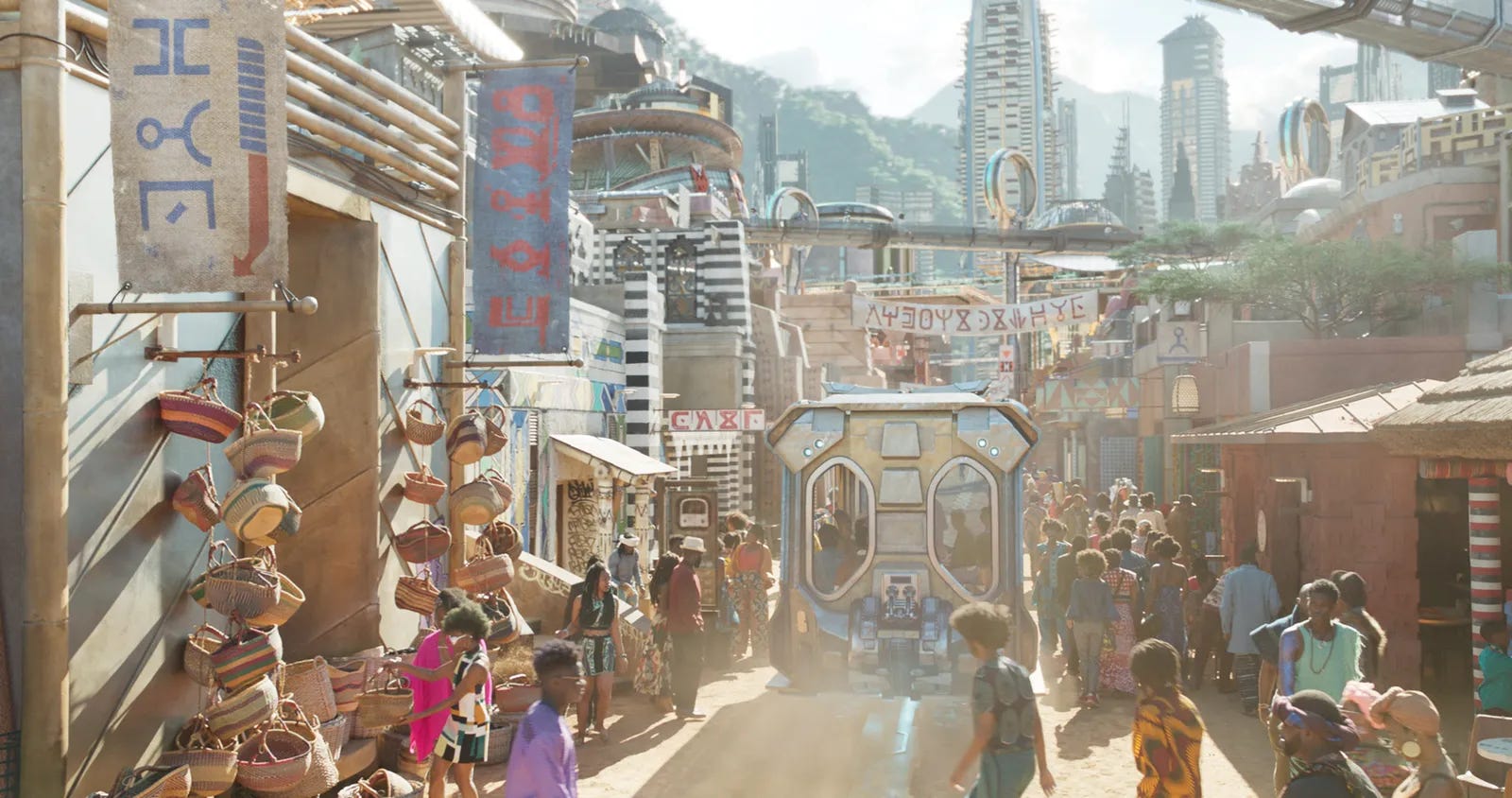
Visually, solarpunk has been circulating on Tumblr and Instagram for over a decade: luminous digital paintings of cities that breathe, concept art that makes you want to live somewhere that doesn’t exist yet.
In film, I’d cite Wakanda from Marvel’s Black Panther as an example of solarpunk. There’s also Studio Ghibli, the Japanese animated film studio which is often cited as a kind of solarpunk ancestor, especially Nausicaä of the Valley of the Wind, Castle in the Sky, and Princess Mononoke, all of which grapple with industrialization, ecological collapse, and the possibility of coexistence.
In technology, solarpunk is drawn to decentralized, open-source tools — community mesh networks, peer-to-peer platforms, open-source libraries, repair cafes, tool libraries. The ethos is: technology should increase local resilience and communal capacity, not extract data and concentrate power. Darius Kazemi’s projects — including Run Your Own Social, a guide to running small social network sites for communities of friends — are sometimes cited as examples of solarpunk-inflected tech thinking.
In architecture, Singapore’s Gardens by the Bay and Boeri Studio’s Bosco Verticale in Milan often come up as aesthetically adjacent examples. Ecovillages, urban farming collectives, community-owned solar projects, cooperative housing — these are all where solarpunk theory meets the built environment.
At the same time, there are contradictions. Solar panels and batteries still require extractive mining. Rare earth metals for green tech come from somewhere, and that somewhere is usually the Global South, and the labor conditions are often brutal. To me, part of solarpunk is imagining abundant clean energy with equitable ownership and supply chains. Otherwise, it’s just a future that looks equitable in imagery while reproducing the same injustices under a green color palette.
Robin Wall Kimmerer’s Braiding Sweetgrass — which I think should live on every solarpunk reading list even though it’s nonfiction — gets at this more honestly than most: Indigenous wisdom about reciprocal relationship with the land isn’t a vibe. It’s a whole different ontology. Solarpunk at its best is trying to reckon with that.
Here’s what I think is true: we cannot build futures we cannot imagine. And for a long time, the dominant imaginaries available to people who care about justice have been either dystopian collapse or incremental reform, aka catastrophe or managed decline. Neither one is actually motivating. Neither one is gorgeous.
It insists that the world we’re fighting for should be beautiful — not just livable, not just less bad, but genuinely worth wanting. That insistence is saying: Abundance is possible. Community is the infrastructure. Reciprocity is the economy. The sun is actually enough. If we step up, we got us.
It’s a counter-canon to the one we inherited — which, let’s be honest, has been pretty committed to the idea that the future belongs to whoever has the most weapons, money, or processing power. Yikes. Solarpunk says instead: what if the future belongs to whoever figures out how to live well with each other and the land?
That sounds pretty delicious to me.
⭐ Before I take your leave, I will submit to you an anthology in which you’ll find a story from me that I believe counts as solarpunk:
(published by Milkweed, edited by Grist)
In it, you’ll find my story Cabbage Koora: A Prognostic Autobiography: “Across generations and a changing world, an Indian family preserves its traditions through food, dance, and the latest communication fads.” The story features my mom and grandma, and my imaginary daughter and granddaughter. It’s a cozy one, and I hope you’ll enjoy the read.
👇🏽 You can also learn more about my process writing the story here in GARMI ramble #9. If you read the story itself, let me know what you think!
who you calling naive? (ramble #9)
·
January 29, 2024

Y’all know by now that I’m a dreamer. I just wrote you nearly 3000 words on radical imagination in the last ramble. It’s taken me time to understand radical imagination as the essential bedrock of a human future on this planet. Now that I understand, it’s in my head everyday. It’s the electrical current that sizzles through my veins, the snap in my SyNA…
No posts
Comments
Nothing yet. Say the first thing.
Sign in to join the conversation.