
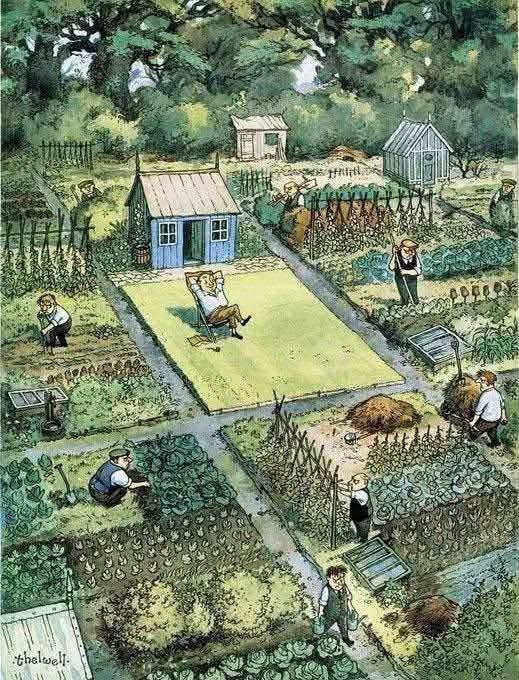
Someone in my garden group posted a painting. It was unattributed except for the signature. But such anonymity is no barrier to AI, which identifies it as a “1954 watercolor cartoon titled ‘On the Allotment’ by British artist Norman Thelwell.“ I imagine that it is well-known, but I can’t say that I’ve run across it before.
I commented thusly:
I imagine the reverse: Rows of lifeless properties, islands, each bereft of anything of interest save for a lonely person increasingly trapped in an empty, meaningless cycle of ease, unable to form connections with nature or sentience, ultimately swept away in a tsunami of nihilism. With one property in the midst of this sea of self-imposed despair, tended by a gardener, who finds the meaning of life in facilitating orderly growth in everything around her. And creating something from nothing rather than nothing from something.
Admittedly, part of me laughs and says, “Whoa, Tom, it’s an innocuous cartoon — just smile and move on, fella.”
But, of course, I am me. And I must seek deeper meaning in everything (except coffee — I’ve never sought a fundamentalist deconstruction of my love for the bitter bean. But it’s a rare exception). You certainly can’t toss a painting like this at me on a Sunday afternoon and expect silent assent. Other than letting AI (peace be upon it) do its identification thing, I have intentionally not asked the AI about possible interpretations. Had I inquired, I would almost certainly have reacted by removing the coatings on my tinted glasses. But I’d like to keep those intact for now, since they are part of my reason for writing this. The only way to understand one’s mental gullies is to let them fester, like a bacteria sample in a lab.
Reacting in my characteristic defensive mode, I saw the cartoon as honoring the guy in the lounge chair, as he blissfully ignores the senseless worker bees that surround him — those poor saps clearly have never read Ecclesiastes (or even listened to The Byrds), and do not see the futility of their toils.
Being a worker bee at heart, I will always defend the industry and nobility of the bees.
But is that what is in view here? Call me crazy, but I also see an allegory of modern feudalism. That guy looks a lot like a lord, with his castle centered within a manicured estate, too drunk on blissful ease to bother with the book and pipe cast aside on the lawn.
Or perhaps this is an anarcho-syndicalist commune, oblivious to the guy who lives in the nearby castle — a statement about the widening chasm between citizens and representatives in modern liberal democracies, as the competence of the ruling class dissolves into paralyzing, performative decay. As Terry Jones’ peasant character responds to King Arthur in the scene below, “No one lives there.” Or maybe someone lives there, but that person has become as irrelevant as s/he is affluent.
Or maybe it is scathing commentary on the futility of ease, given that that the guy can’t even enjoy what he has. Unconsidered abundance does have a way of destroying the soul. There’s only so much time in the day, and so much mental bandwidth, to allocate to one’s various toys.
I think I’ll stick with my first impression: A post-war paean to the final victory over the medieval mindset — science over tradition, industrial capacity over creativity, community at a distance, mass psychosis via radio. Civilized humanity had broken the shackles to earth, time and each other. It had earned the right to dehumanize. Those who forfeited such rights were backward.
As one often given to excess introspection, particularly while staring at the horizons beyond New Jersey shorelines, toes immersed in sand and excess SPF-60 on my forehead and shoulders, I will cheerfully concede that the human soul — or at least human souls like me — needs doses of such alone time... time to re-evaluate and correct course, time to reflect on both mistakes and epiphanies, and a time to laugh at toddlers negotiating the edges of vast oceans for the first time. We all need those grounding metamoments to manage and disarm the mental static.
But we still must reach some broader accommodation with the cruel regularity and scarcity of time, which is the one commodity that we may neither hoard nor recover, as a matter of physics rather than mere convention. At a human level, the universe dispenses each moment of time in the most egalitarian way possible, each second, minute and hour assigned exactly the same to everyone. Tick, tick, tick — each tick an opportunity too easily tossed into eternity’s landfill, as life’s largesse encroaches on the human need for relevance.
How should we then live? Others have famously asked that question, of course. But we now travel life’s highway in a newly-minted, hyper-libertarian civilization that leaves the answer entirely to individual judgment. And perhaps that is as it should be in a secular, constitutional republic. As for me, I’ll be the dude with the rake in his hand most days, save for those occasional, recalibrating metamoments with toes buried in the sand. I am thankful that it is my toes and not my head.
Thanks for reading.
First published 7/2/26. Lightly edited 7/3/26 at 9:45 AM.
NOTE: I frequently edit my writing after publishing it here. I realize that this is a curious habit, but such is the life of self-publishing on a shoestring. Pushing pieces out the door is my way of imposing deadlines and avoiding the perfection trap. Which is all to say… if you are an E-Mail subscriber, you will frequently find a slightly improved version of a piece on the substack site a few days (or hours) later. Going forward, I will add an end note when a piece has been edited since its first release.
No posts
Comments
Nothing yet. Say the first thing.
Sign in to join the conversation.