
MicroHabitat is an international company based in Montreal that installs farms in under utilized urban spaces like roofs and parking lots. These farms are designed to function like ecosystems so that in addition to providing food and green space for people, they are small havens for urban wildlife. This approach also makes the farms more resilient to the harsh conditions of the spaces they occupy. Cultivating a diversity of species and plant varieties ensures that even if some plants struggle, there are still benefits to reap. It’s a strategy that rewards clients with harvests like cucumbers, eggplants, cherry and heirloom tomatoes, herbs, radishes, peppers, beans and more.

Clients have several service options available through a year long or five year contract. About half of MicroHabitat’s clients participate in the food donation program which routes harvests to local food banks. Harvests can also be made available to tenants and employees. Corporate gifts equip community members to cultivate their own spaces. The newest offering from the company is access to myurbanfarm.ai, which is a platform designed to make urban farms and farming more accessible to clients and community members.
Alexandre Ferari-Roy, the founder and CEO of MicroHabitat, has long been interested in how nature can benefit humanity. His fascination became entrenched while he studied at McGill University. “I was interested in the food chemical component in terms of my specialization. I studied how chemicals like caffeine affects the brain, makes you smarter, makes you more agile. … my first class day of microbiology we learned how mushrooms and yeast were used to create the first antibiotics,” he said.
He further developed his conviction that plants can help people through a minor specialization in tropical horticulture with the University of the West Indies at the Bellairs Research Institute. After publishing A Preliminary Survey of Rubble Organisms at Two Disturbed Areas in Barbados with Barbados Interdisciplinary Tropical Studies, he was approached by a businessman. “The study was to determine how human activity affects organisms on the coast and looking at trying to find the organisms that are present in boardwalks versus organisms that are present in untouched portions of the beach, and then trying to determine the human impact on the organisms on the more natural parts of the island,” Ferrari-Roy explained, “I was approached by a businessman, and he was like ‘if ever you discover anything that you think we could utilize for the benefit of human kind, reach out to us.’ so that was my first experience trying to understand how nature can be used to benefit humans.”
Ferrari Roy found more inspiration through his friend Zachary Goldberg, who he described as “invested in trying to understand how ancestral ways of production can be revived and reused in today’s world.” Goldberg introduced Ferrari-Roy to the work of Masanobu Fukuoka, the author of One Straw Revolution. “Basically that book was the foundation stone for ecological farming,” Ferrari-Roy said, “It’s a type of farming where you don’t use chemicals, respect the environment, you try to grow a multitude of varieties, all complimentary, kind of recreating an agro-ecosystem. Permaculture was actually heavily inspired by him, his writings. … I was very interested in it because it talked about the powers of nature and how if we understand nature how we can use that to resolve global hunger.”
Implementing Masanobu Fukuoka’s techniques in urban settings quickly turned into a promising business model. “I realized these gardens that I was establishing on the small scale basis had a lot of positive impacts with the people I was partnering with for these projects. That’s how I created the model from which we started offering our services to restaurants and the Montreal region,” said Ferrari-Roy, “[Antonio Park] had two restaurants in the same building. One was Argentinian and one was Japanese, and I was growing vegetables on the rooftop for those two restaurants for a couple of years and that’s where I really defined the methods of production that we currently employ for MicroHabitat.”
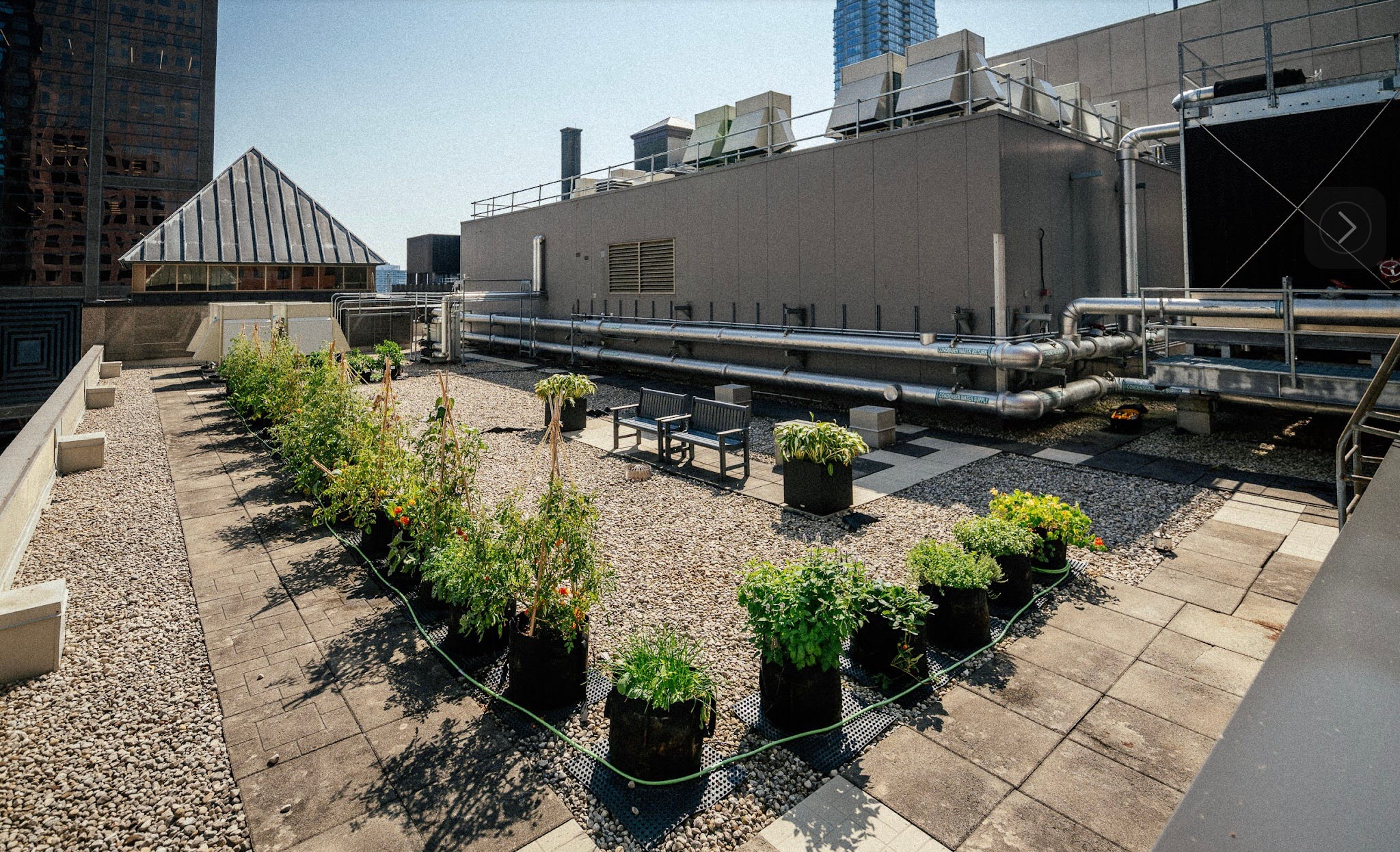
Personal and governmental investments allowed the business to get established. “It took definitely personal investments at the full on start, so that was a risk,” Ferrari-Roy explained, “Since I studied in agricultural sciences at McGill that gave me access to funding and support from the Quebec government. They have a lot of programs to help farming companies to get started, so we actually managed to get accepted within those programs and those programs helped us purchase some of the first equipments.”
Government programs also helped MicroHabitat survive economic hardship. Ferrari Roy said, “we did benefit from some relief programs during Covid, because our company was pretty impacted by the effect of Covid and that allowed us to stay in business during that really hard time as we were growing. It was really quite intense. I’m extremely happy we had access to that help.”
Now on the other side of that threat, MicroHabitat is enjoying promising growth. “We saw there was a large interest coming more from the real estate sector, commercial real estate, large business, and schools as well. So we started targeting new regions, new client types. We started to develop the Toronto market. That was a big success. We grew to Toronto very fast. We kept doubling the size of the company on a year to year basis. Now we’re at the point where we’re in 15 cities, we still operate with the same business model. We now have different packages, different offerings, and the company is actually moving into the tech industry,” Ferrari-Roy said.
As MicroHabitat Grows, its primary goals remain consistent, agriculturally and organizationally. “We try to go for really lush farms, vigorous plants, big harvests, [no] pests, deficiencies, disease, viruses,” explained Ferrari-Roy, “then from an organizational standpoint … employee satisfaction, client satisfaction, renewal, if clients are staying with us on a year to year basis.”
Ferrari-Roy credits three things for MicroHabitat’s ability to sustain these priorities at scale: “specialization, standardization, and automation. … If you have a standardized, replicable model, that’s automated, once that’s in place that definitely facilitates expansion and growth.”
While a default approach is a helpful reference, each site requires curation. “Like for example, our projects in Dallas versus in Montreal are very similar, but they are different in certain ways,” Ferrari-Roy elaborated, “like season length for example. Varieties being produced, accessibility of varieties, also the culture of the employees, of the talent that we’re onboarding can be very different. We’ve had some successes, and we’ve also had some losses throughout the year trying to achieve various things. It’s basically a lot of trial and error, and that’s what we tell our clients as well. Every environment is different. Every farm is different. Like an urban farm on a rooftop in Montreal can have a very different success rate than an urban farm on the ground in Montreal. You can be in the same city and have to deal with completely different environments.”
While methods based in creating resilient ecosystems, accommodating strains on the system with project design, reinforcing plants’ ability to withstand stressors, and choosing climate-adapted varieties are a large part of establishing new farms, much of the work is educational. “In the process of taking on a new client, how do you build that farm from scratch? How are you managing the expectations of those clients when it could look a lot different than their neighbor’s farm,” Ferrari-Roy said, “I think it’s a question of making the clients understand that we’re working with living plants, and we’re kind of giving them the opportunity of becoming farmers themselves.”
Offering agriculture itself as a service is a very different approach compared to the way food is traditionally produced. Most farms rely on up front investment from farmers, whose livelihoods hinge on the results of the season and what they can sell it for. Ferrari-Roy acknowledges the economic viability of MicroHabitat’s business model as an advantage of this approach to sustainable agriculture, food access, and conservation work.
“We still have to operate in the frameworks of what’s available to us in our society,” Ferrari-Roy said, “I was very interested in developing something that could be progressive and have an impact and also be viable for myself and my loved ones, people, and for people also working for the company. We’re trying to build careers out of this company, and I think it’s only really possible if in this current structure. So in our current societal structure, the possibility of building income for you and your family, and also providing careers is an advantage of scale when compared to some of the traditional approaches to making change in this field.”
Though MicroHabitat has an impressive number of permanent, year round employees, the seasonal nature of services makes it difficult to extend this advantage beyond senior positions. “Building a team that’s sustained throughout the year … that’s not possible in most cities and most of the positions we’re currently offering. It’s a seasonal business,” explained Ferrari-Roy, “we’ve managed to create permanent positions for more senior roles within cities that are really bigger cities of ours, and we’ve also created permanent positions for the founding departments, the pillar departments that support the company.”
Ferrari-Roy also views MicroHabitat as an example of constructive advocacy: “instead of being an activist denouncing, this really prompted us to move in the realm of doing things. The best type of economy is a sustainable economy.”
Still, he sees the company as a small part of a larger effort. “When it comes to sustainability, there has to be many people from different domains all working on the same front when it comes to making our cities better,” Ferrari-Roy elaborated, “It touches the citizens that live within that city, it touches the businesses that are established, it touches the municipalities, all those levels of society that form that ecosystem that we currently live in. It’s important that everyone participates in that movement. We decided that going the business route was the route for use because it allows us to differentiate ourselves from a lot of other initiatives that are already existing.”
Services from MicroHabitat attract a variety of clients, thus inviting different businesses, institutions, and communities into the work of making change.“What’s making our success is that our model is applicable to any type of institution, so it can be as much applied to schools and to full on large corporations with thousands of employees to municipalities to real estate companies,” explained Ferrari Roy,
Urban farms also facilitate collaboration between entities that would otherwise avoid conversation. “MicroHabitat is very much a service amenity to make buildings greener so that our clients can also adhere to all these green certifications … like for example GRESB [Global Real Estate Sustainability Benchmark], we have LEED [Leadership in Energy and Environmental Design], and we have BOMA [Building Owners and Management Association],” said Ferrari-Roy, “there’s a lot of certifications out there that support urban farming. By making urban farming available to our clients they’re able to participate in these large conventions, these large groups of green buildings and share knowledge, … although a lot of them are competitors in the same market they still come together to push that industry.”
Even at a corporate scale, urban farming as a business comes with challenges and limitations. One challenge is that agriculture doesn’t easily adapt to the primary goal of any business: growth. “It’s a hard model to replicate and expand throughout the world. It’s not a tech product to go and just market and generate traffic,” Ferrari-Roy explained, “There’s a lot of overhead required. It’s definitely not a business that’s as profitable as others.”
Agriculture is sensitive to economic stressors, so any business in that sector will only be as stable as the market. “Market dynamics can be challenging. Covid hit, that was a really big challenge. Currently now [it’s] all these tariffs, the economy that’s uncertain, and war as well,” listed Ferrari-Roy, “It’s not like we’re resolving an immediate need for these [clients]. They see it as a cherry on top of a sunday, so whenever funds or budgets are cut, usually these types of projects pass first.”
The last challenge Ferrari-Roy discussed was staffing: “recruitment is definitely a challenge for smaller regions where we’re trying to establish ourselves newly.”
Forecasts suggest that overcoming the difficulties of doing business will be rewarding, and MicroHabitat is growing to take advantage of these projections. “They’re expecting the urban farming market to grow in the multiple billions dollar mark in terms of market size. So we’re trying to grasp a portion of that market share,” Ferrari-Roy spoke of several strategies, “we’re basically trying to expand MicroHabitat throughout the world but also diversify our offerings. We’re trying to develop new business models that are aligned with MicroHabitat’s mission, that could stay with the same clientele types or possibly different clientele types but all within the sustainability realm.”
Expanding the company may require invitations for financial collaboration for the first time. “We never took on investors, and we are really trying to push this on our own, but now we’re at a point where we’re trying to find investors that have the same vision as us that can help us scale the project throughout the world,” Ferrari-Roy said, “because we’re seeing more and more interest coming from America, various cities in the US, from Europe, from Asia, from Australia.”
Growth won’t be strictly geographical, but will also involve new client types, like municipalities, as well as new models, and production approaches. Ferrari-Roy touched on several visions: “We’re trying to resolve larger problems that have to do with climate change and food production and food availability. We’ll be acting on various vertical farming initiatives that will be happening through the world transforming abandoned buildings into vertical farms. And also there’s a lot of potential to working with many different types of companies that have underutilized spaces outside of the cities and to transform environments into productive production zones that can be used by farmers.”
Sectors beyond agriculture present enticing opportunities as well. “I see MicroHabitat following into the AI industry, we’re falling into power energy production. Our services are quite complimentary to these types of renewable energies. You see more and more farms being built next to solar panel fields. There’s a lot of space for growth,” listed Ferrari-Roy.
The most recent leap for MicroHabitat has been into tech, “with this new platform we just launched called myurbanfarm.ai. Currently it’s a platform just to exhibit and promote the MicroHabitat Farms, but we’re working towards turning this platform into the reddit of urban farming as a whole where people can come together and participate in sharing what they’re doing in their projects in hopes of making urban farming more accessible, to push the movement forward. So we can share knowledge easier,” Ferrari-Roy said.
The platform functionalities make the farm and its conditions more visible for farmers and the beneficiaries of the farm. “It’s a project management platform for clients and employees, but there is a social media aspect to it where every farm has a live farm feed,” Ferrari-Roy explained, “it has a weather widget so you can see the weather at that farm. A farmer posts weekly about what is happening in farms. People can share that information to their community. Making urban farms a lot more accessible for our clients. For the tenants for example, if the farms are inaccessible on rooftops, the community can actually see what’s happening in the farm.”
The vision for myurbanfarm.ai includes Artificial Intelligence. “The goal would be to be able to utilize AI to help our urban farmers and our clients to understand what’s happening in farms,” said Ferrari-Roy,”the biggest aspect is from a reporting standpoint. We need to make all these reports for our clients to help them push and integrate these green sustainability associations. So currently all these reports are being generated through our technologies that we’ve developed internally.”
MicroHabitat demonstrates an approach to agriculture that promises viability, scalability, and sustainability in both the economic and ecological senses. A replicable, ecosystem style approach to cultivation provides resilient sources of produce. Framing farming as a service shifts the financial burden of production, and invites clients into the process in a way that can’t be replicated by transactions in a market. Business growth indicates that the ways in which this innovative model can create change have yet to be exhausted.
The Gardener’s Grimoire will always be free to read, but it isn’t always free to produce. Paid subscriptions help cover expenses like travel for tours and interviews, and materials for experiments. For as low as five dollars a month, help the Gardener’s Grimoire grow into a more valuable resource for all its readers.
The field book zines from the Gardener’s Grimoire are easy to reference, easy to annotate, and easy share.
If you enjoyed this article, please consider leaving a like. If you know someone who would enjoy it as well, please pass it along!
Questions? Suggestions? Concerns? Join the conversation!
No posts
Comments
Nothing yet. Say the first thing.
Sign in to join the conversation.