
“Might I,” quavered Mary, “might I have a bit of earth?”
“Earth!” he repeated. “What do you mean?”
“To plant seeds in — to make things grow — to see them come alive.”
FRANCES H. BURNETT, The Secret Garden
Ah the joys of new beginnings, a patch of bare earth with endless possibilities for creativity. Space for magic to happen.
It might be a brand new bed created or one extended, it might be an old and dying shrub that has to be pulled out creating new space, or an area stripped of a thuggish takeover of a ground covering plant, or on the allotment – a newly weeded and manured bed, raked to a fine tilth and ready for planting.
Just the thought of that makes me want to rub my hands together in anticipation. A bare expanse of brown soil is, for me, like a blank canvas or a new notebook, ripe with potential. No mistakes have been made yet, no gardening disasters have fallen, it’s all just ready and waiting for you to add colour and beauty. I only have to spot the smallest gap in my flower borders before I start to ruminate about what I could fill it with. Should I throw some annual flower seeds in there, buy a new plant or lift and divide something I already have? Mother Nature is probably eyeing it up at the same time as me, she abhors a vacuum almost as much as I do, so I have to get in there quick.
In recent weeks I have been pulling stinging nettles and ivy from the back of a north facing border in preparation for a new fence. The stinging nettles weren’t too difficult to pull out, but the ivy is a different beast. It had grown entirely over a 4ft high fence – admittedly not a very sturdy one – and then managed to bring it down with its weight. It regularly grows up and into my potting shed at one end, finding the tiniest gap to creep into it, like a slow green centipede, its roots gripping on like tiny feet along the stem. It has crept its way down the entire length of the garden, putting down thick roots at every fence post, and has grown up the outside walls of my office.
It has to go, but I’m not sure I’ll be able to find every last bit of root. The chap coming to install the new fence is going to dig out as much of it as he can (he seemed overly confident on this to me) but I wanted to get in there first and pull it from the border that it had smothered, so that I can see what is what, and hopefully (fingers crossed) not everything will get dug up.
After the best part of 2 days and a green wheelie bin filled twice over, I realised just how badly out of hand it had got. A few plants had sadly succumbed to the mighty ivy takeover and given up the ghost, others were getting strangled or smothered. The more ivy I pulled out, the more bare soil I exposed, and while mourning the plants I had lost, I also started to see the potential for new plants to be added.
I still have some perennial foxgloves, a giant scabious, a large fern and a couple of sedums, all underneath an acer, smokebush and spiraea. There are hellebores, primroses, pulmonaria and cyclamen - all shade loving stalwarts. Once the fence is sorted out, I’ll be able to get some nutrients back into the soil with fresh compost and start filling up the gaps. A gardener’s loss is also a gardener’s excuse for a trip to the garden centre for replacements. Or, at least, more propagating.
An update since I started this – the new fence is now complete, and happy as I am with it, there have been further plant losses in all the disruption. I hadn’t quite anticipated how much the remaining plants would get trampled on in the 2-day process. I eventually had to just turn a blind eye to the state of the plants and accept it was probably inevitable. Pretty much all of the perennials I listed in the previous paragraph have suffered, with the exception of the cyclamen which were safely growing underneath the spiky Wedding Wreath Spirea. I think the sedum will regrow, the hellebores will be back next year, and the fern was yet to really get started anyway. But I think I have completely lost the foxgloves and pulmonaria, and possibly some primroses. I’m not sure about the scabious, we’ll see.
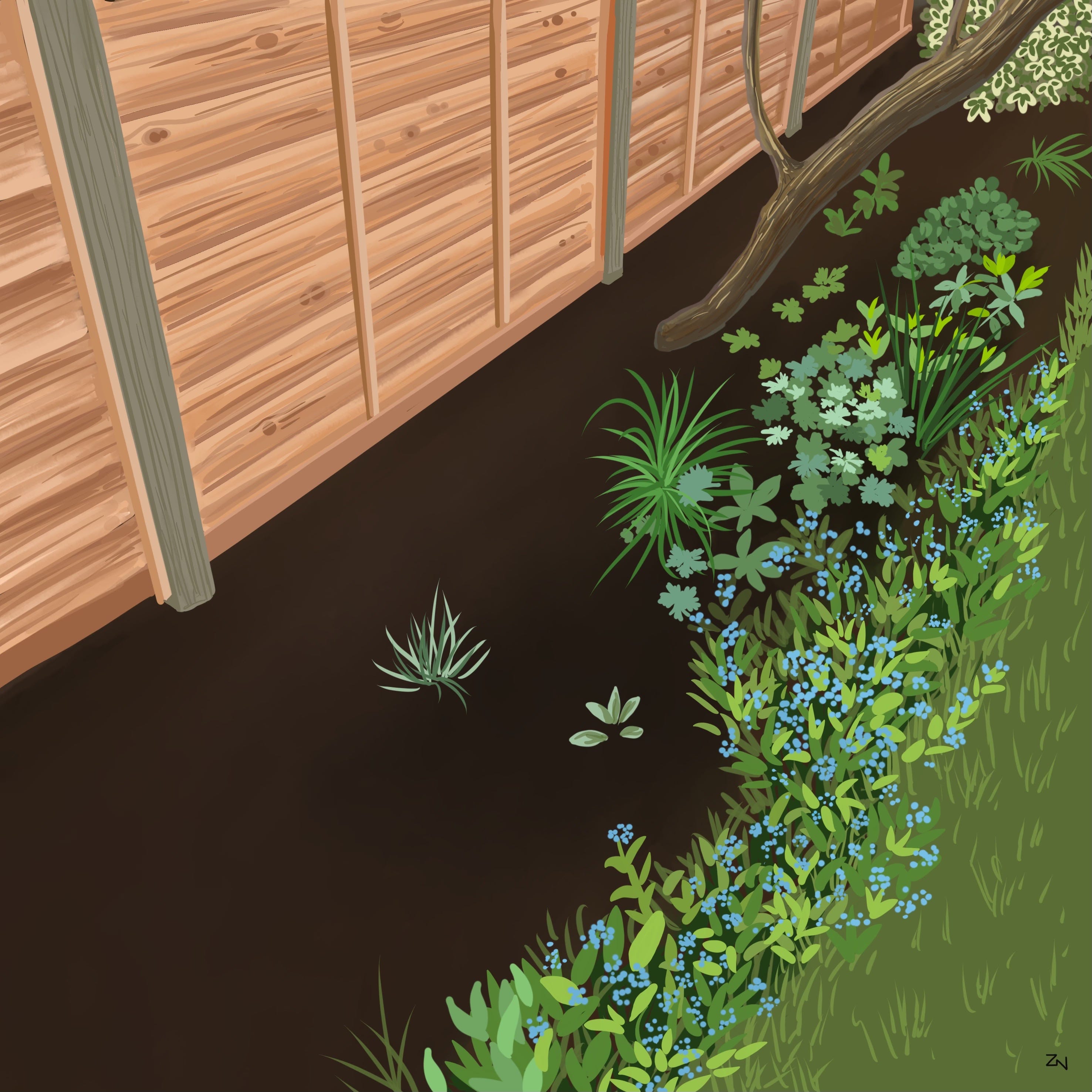
For now, I have transplanted some spares from the opposite border, some hardy geraniums (no shortage of those) some Oxeye and Michaelmass daisies, a few baby ferns and some Centaurea Montana. I’d really like some white foxgloves, so might seek some out, in the vain hope that the perennial ones resurrect next year. I also have seeds for some everlasting sweetpeas, and I’m wondering if they might tolerate a bit of shade?
Any gardener will tell you that a garden is never completed. Plants grow old and die, some get too big for their space and have to be divided, sometimes an area just isn’t working for whatever reason and needs a revamp. Sometimes plants get trodden on or wood/tools dumped on them by unaware workmen. It’s a bit like decorating a house, after a few years, some furniture gets moved around, some thrown out altogether, some new stuff brought in, a fresh lick of paint, a necessary renovation, and a garden is no different. But these are where the opportunities for creativity come in, and space for planting is like a freshly painted wall ready for new art to be hung.
Of course on the allotment this happens each and every year. So while I have been busy pulling up ivy, my partner has been busy on our allotment, clearing the beds of last year’s crops and weeds. He has cleared all of the beds, cut the edges clear of the grass path, and mowed the paths. When I visited last, it was a perfectly neat, brown blank canvas, ready for planting. What more could a girl want?
So, we start again, creating a new border and a new gourmet allotment. We can brush over previous years disasters, pretend there are no soil diseases, bindweed or ivy roots lurking below the surface, and live in hope that this year it will all be perfect. We’ve wiped the blackboard clean, got new sharp edged chalk, and we’ll use our neatest handwriting. This year we’ll definitely, absolutely keep on top of the weeds, without leaving little piles of them everywhere, we will keep the grass path edges clipped, and the plants will grow neat and orderly. And I will keep on top of that ivy … or I’ll try.
No posts
Comments
Nothing yet. Say the first thing.
Sign in to join the conversation.