

IBM announced it will commission a physical quantum computer in Amaravati, India, built around an IBM Quantum System Two with a 156-qubit Heron processor, targeting operational readiness by September 2026.
Heron r2 is a fixed-frequency transmon qubits on a heavy-hex lattice with tunable couplers, 156 qubits, ~5,000 CLOPS, two-qubit gate error ~10⁻³. Housed in a System Two package with dilution refrigeration and modular control electronics tightly coupled to real-time classical compute for error mitigation (e.g., probabilistic error cancellation) is not fault-tolerant. It relies on hybrid classical-quantum loops for utility-scale performance.
The installation gives India on-premises quantum hardware rather than cloud-only access, joining a small list of countries with a physically hosted quantum system.
Owning the hardware rather than renting cloud access to someone else’s is becoming the new marker of quantum computing sovereignty, the same way domestic chip fabs became the marker for semiconductor sovereignty a few years earlier.
WHY IT MATTERS
On-premises quantum hardware supports use cases are classified research, sensitive industrial data, national security applications. As it can be easily inferred that cloud-only quantum access cannot serve these use cases. India joining the small list of nations with physically hosted quantum systems is a meaningful marker in the broader race for quantum computing sovereignty.
STMicroelectronics Post-Quantum Security Chip
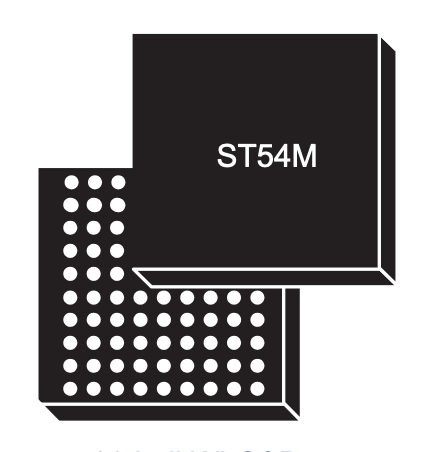
ST54M is a secure mobile chip integrating NFC, a secure element, and eSIM functionality alongside a dedicated hardware accelerator for post-quantum cryptography. It supports PQC algorithms ML-KEM and ML-DSA, enabling quantum-resistant security for payments, digital identity, and digital car keys. Sampling is available now, with production targeted for July 2026.
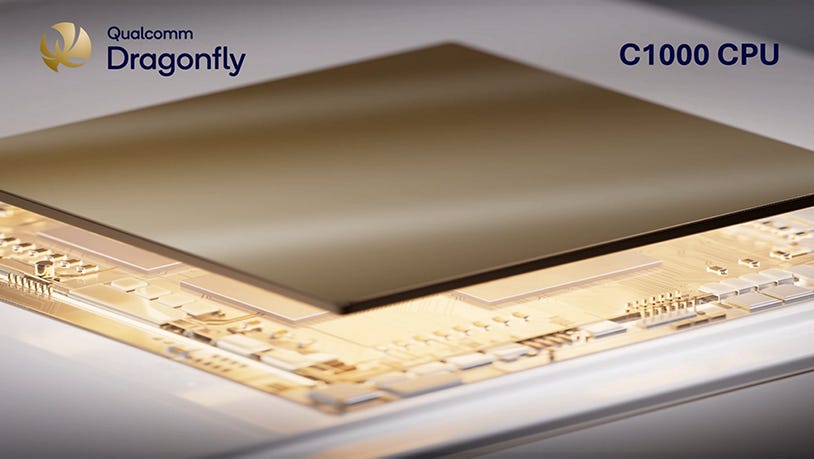
Qualcomm’s first data-center CPU (250+ cores) plus a new “High Bandwidth Compute” memory architecture that stacks LPDDR directly on the compute die, claiming 6x the bandwidth-per-watt of conventional HBM. Meta signed on as a multi-generation customer for the CPU. Skipping HBM entirely is either a genuine end-run around the memory shortage or a bet that nobody can verify yet.
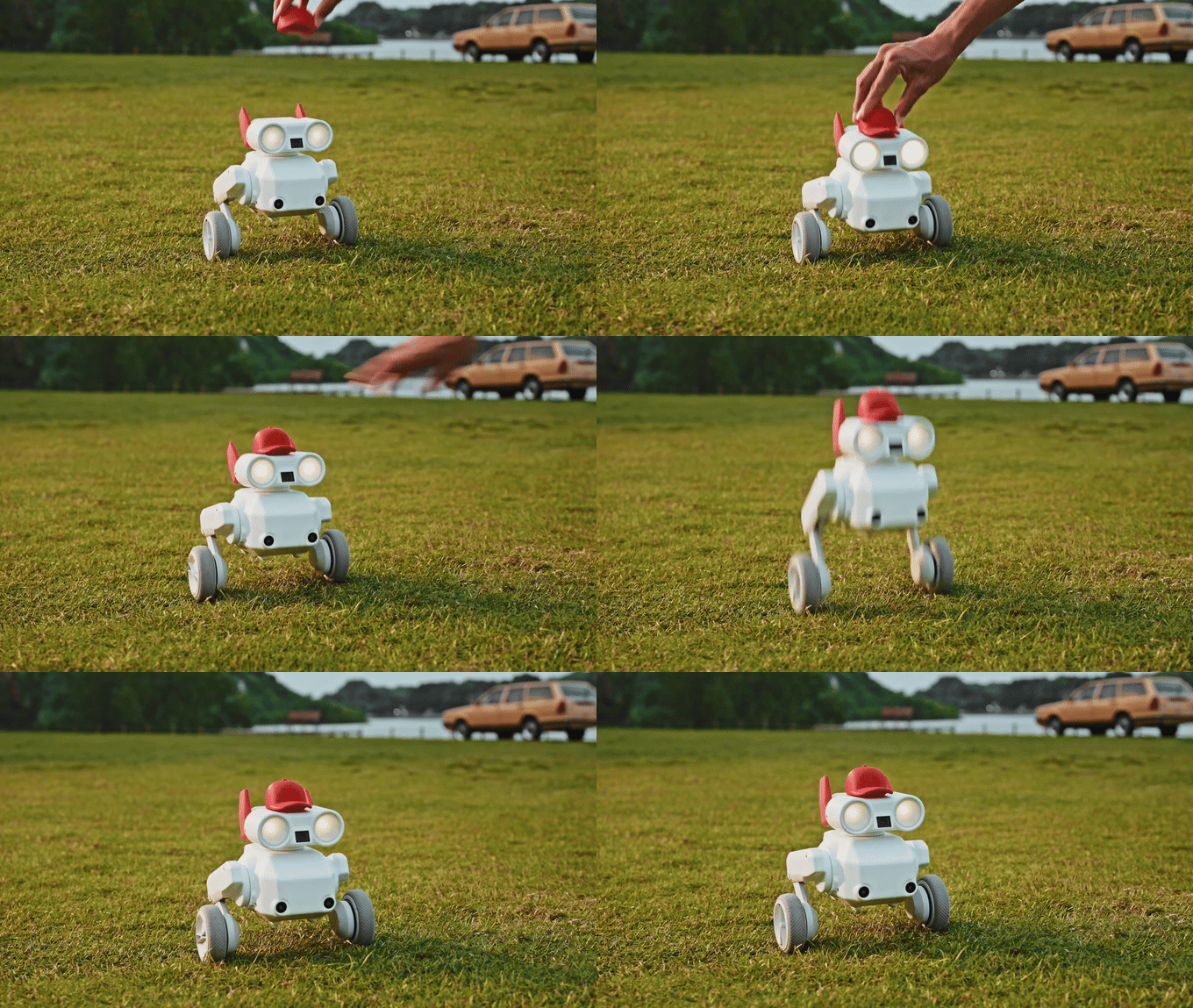
Meet Beni is an all-terrain camera robot built for outdoor content creation. It shoots 4K video, uses smart auto-following to track subjects hands-free, reaches speeds up to 17.9 mph, and can climb obstacles up to 10 inches tall using articulated legs instead of wheels. An onboard AI auto-edits footage into highlight reels, making it useful for vlogging, pet/wildlife filming, or rugged outdoor documentation without needing a human camera operator.
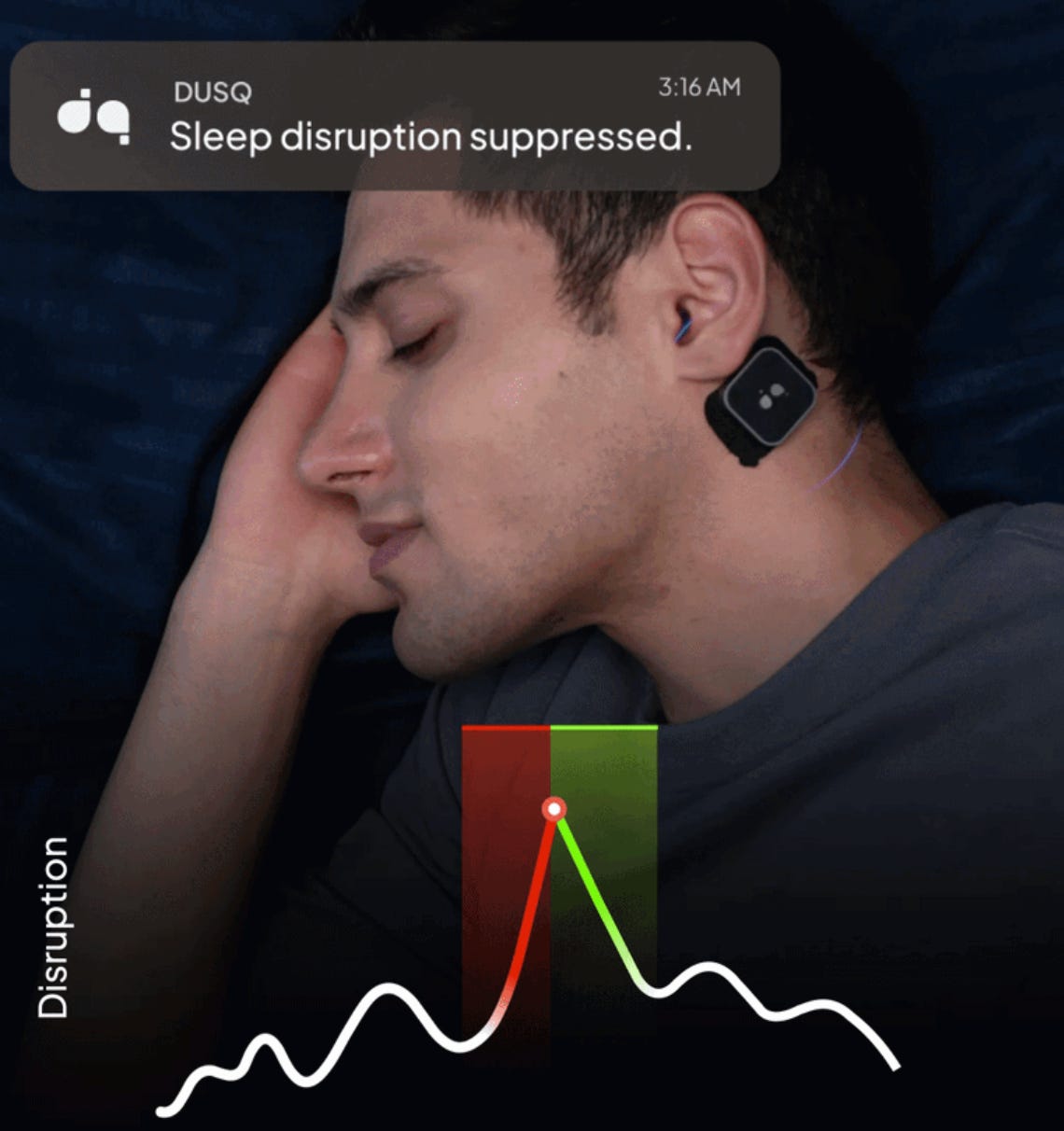
Every sleep tracker for the last decade has told people how badly they slept. This is the first mainstream device built to actually stop it from happening. A 12-gram wearable that sits behind the ear and reads the autonomic nervous system through electrodermal activity in real time. Instead of just scoring how badly you slept, DUSQ detects the exact moment sleep starts to fragment and intervenes immediately with adaptive vagus and vestibular nerve stimulation for better sleep. It is also backed by a completed clinical trial (31% more deep sleep, 38% better heart rate variability, 22% fewer awakenings) and FDA-cleared stimulation hardware.
MusicCam Pro is a bone-conduction headset with an integrated 4K point-of-view camera for hands-free recording.

It supports live preview and streaming over Wi-Fi 6, team talk between multiple units, offline music playback, and AI-assisted editing, all in an IP68 waterproof build. It’s aimed at cyclists, musicians, and adventure sports users wanting synced audio and first-person video capture.
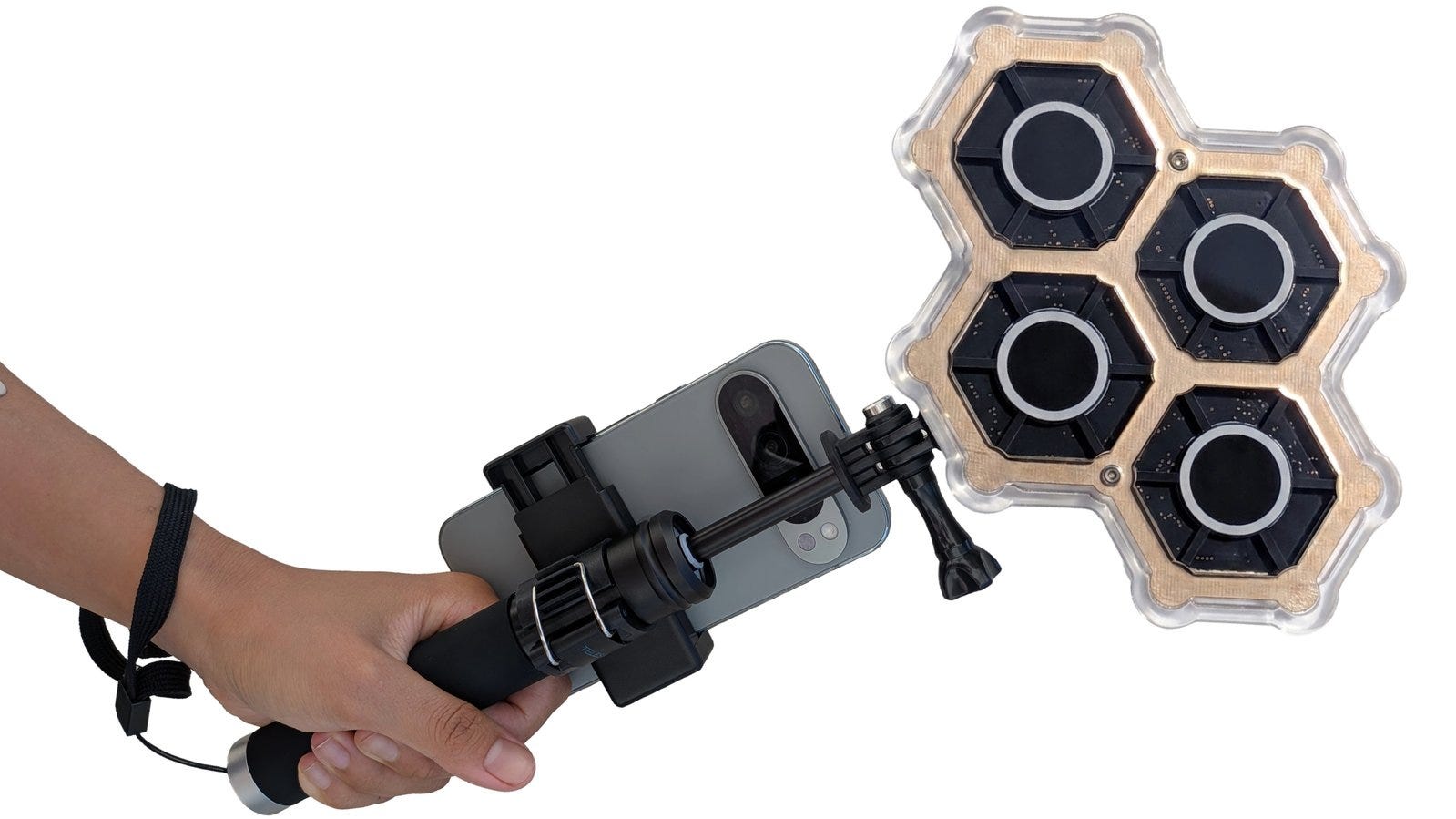
It is a 4x4 MIMO software-defined radio tile with an integrated Raspberry Pi 5 that functions as a real-time RF camera. Using four coherent antennas, it visualizes wireless signals like Wi-Fi, drones, and beacons as a live color-coded overlay on a phone or laptop at 30fps. Check out their page to see a really interesting video showcasing how the wireless signals are visualised & can be “seen”.
Jalapeño, OpenAI’s First Custom Inference Chip: OpenAI’s first in-house-designed silicon, an inference-focused “Intelligence Processor” built with Broadcom and reportedly assisted in its own design process by OpenAI’s models. Initial deployment is targeted for later this year. The company that popularized asking AI to write code is now letting it help design the chips that run it.
A free RISC-V platform wants to train the next-gen chip designers: Researchers at ETH Zurich, lowRISC, and the University of Bologna published an open-source RISC-V platform designed to take chip-design students from RTL code to actual working silicon, addressing a shortage of hands-on training as demand for custom AI silicon designers outpaces university curricula. The AI chip boom has created acute demand for engineers who understand silicon design end to end. Open, free training infrastructure lowers the barrier for smaller companies and universities outside the traditional chip-design hubs to build that talent pipeline themselves.
New method speeds up prediction of a critical chip contact property
Researchers from NIST, the University of Maryland, and Johns Hopkins developed a faster way to predict Schottky barrier heights, the junction property that controls how well metal semiconductor contacts conduct. Because this has been difficult to calculate from first principles, the advance could reduce trial and error in chip design and shorten the path to better transistor contacts.
QPerfect and BTQ bring one shot quantum signatures closer to reality
QPerfect and BTQ Technologies have published the first circuit level One Shot Signature scheme, turning a long theoretical cryptographic idea into executable quantum circuits. Built for local quantum cryptography with single use quantum keys and obfuscation safeguards, the work moves one shot signatures from concept toward practical use in quantum money and trustless random beacons.
Diamond colour centres clear a key step for modular quantum computers
QuTech researchers built a nanophotonic interface around diamond tin vacancy colour centres that crossed the coherent cooperativity above one threshold, meaning light matter coupling is now strong enough to beat environmental noise. That makes the link between stationary qubits and photonic qubits far more reliable, a concrete advance for modular quantum computers built from connected processors
Google’s TabFM skips training on your data and predicts tables in one pass
Google Research’s TabFM treats tabular prediction as in context learning, reading training rows and target rows together to make classifications or regressions without dataset specific tuning. Trained on hundreds of millions of synthetic tables, it is designed to challenge tuned tree models and remove one of applied machine learning’s biggest workflow bottlenecks.
Infineon’s new fab uses AI to speed approval and ramp up faster
Infineon says its Smart Power Fab was planned with a full digital twin, and that AI now helps approve new equipment on the live production floor. Linked with its One Virtual Fab setup, the company says this approach can cut ramp up time by about half compared with earlier generations
New Teleoperation Method Lets Humanoids Carry Real Loads
Researchers developed HEFT, a teleoperation framework that helps full size humanoid robots carry heavy payloads under noisy remote control. By combining physically plausible motion reconstruction with a payload training curriculum, the system kept a 175 cm, 65 kg robot stable on turns, squats, and walking while carrying up to 24 kg
Apptronik opens Robot Park to train humanoids with real world data
Apptronik has opened Robot Park, a nearly 90,000 square foot Austin facility where Apollo robots practice warehouse and retail tasks under human supervision. The point is not just training robots, but generating the interaction data that will improve the AI models behind future humanoid deployments.
AI finds four new SuperConductors : The breakthrough came from Alibaba DAMO Academy and the SuperC consortium. Alibaba’s Elements Claw screened millions of crystal structures in just 28 GPU hours and delivered experimentally validated superconductors. In parallel, the SuperC consortium used machine learning to pinpoint entirely new kagome superconductors by targeting flat band physics.
Semiconductor crystal growth test bed rides to orbit on a Starlink launch
A Falcon 9 rideshare mission carried semiconductor manufacturing test beds to space alongside Starlink satellites, letting researchers test whether microgravity can improve crystal growth for chip materials. Because gravity can disrupt formation on Earth, even short orbital flights can help prove whether space manufacturing offers a path to cleaner, higher quality semiconductors.
Robotic tug successfully reboosts NASA’s Swift telescope
Katalyst’s LINK spacecraft launched on July 3 and made contact with NASA’s Neil Gehrels Swift Observatory, demonstrating a commercial robotic servicing approach for spacecraft that were never built to be repaired or reboosted. If the mission completes as planned, it will show that aging science satellites can be given years of extra life at a fraction of the cost of replacement.
Researchers at the University of East Anglia found that pseudomonad bacteria naturally recruited by salt-stressed soybean plants trigger increased lignin production in roots, physically strengthening the plant rather than simply blocking salt uptake, a previously undocumented survival mechanism identified through the plant’s root microbiome. Considering Salt-affected farmland is expanding globally due to irrigation practices, climate change, and rising sea levels; a microbial mechanism that could be harnessed as a treatment offers a lower-cost path to protecting yields than re-engineering crops from scratch.
Lely’s AI eyes bring continuous welfare checks to dairy farms
Lely International’s AI eyes system uses automated image analysis to monitor the welfare of dairy cows, calves, and farm workers in real time. Presented at the FAO’s smart farming conference in Rome, it replaces periodic manual checklists with continuous observation of posture, movement, and behaviour, helping detect welfare issues earlier.
Thanks a lot for reading Innovation Snaps.
Please share your comments & this newsletter if you enjoyed it. Though tried my best to avoid mistakes, please remit for any typos/mistakes.
No posts
Comments
Nothing yet. Say the first thing.
Sign in to join the conversation.