
In early 2018, twenty people checked into a hospital ward in Bethesda, Maryland, and did not leave for a month.
They were not sick. They were there to be fed. For two weeks they ate one diet, for the next two weeks the other, and the whole point was that on paper the two diets were twins. Same calories on the tray. Same fat, same sugar, same sodium, same fibre, same protein. Nobody was told to restrict anything. Three meals a day plus snacks, and the instruction was simply: eat as much as you want, leave what you don’t.
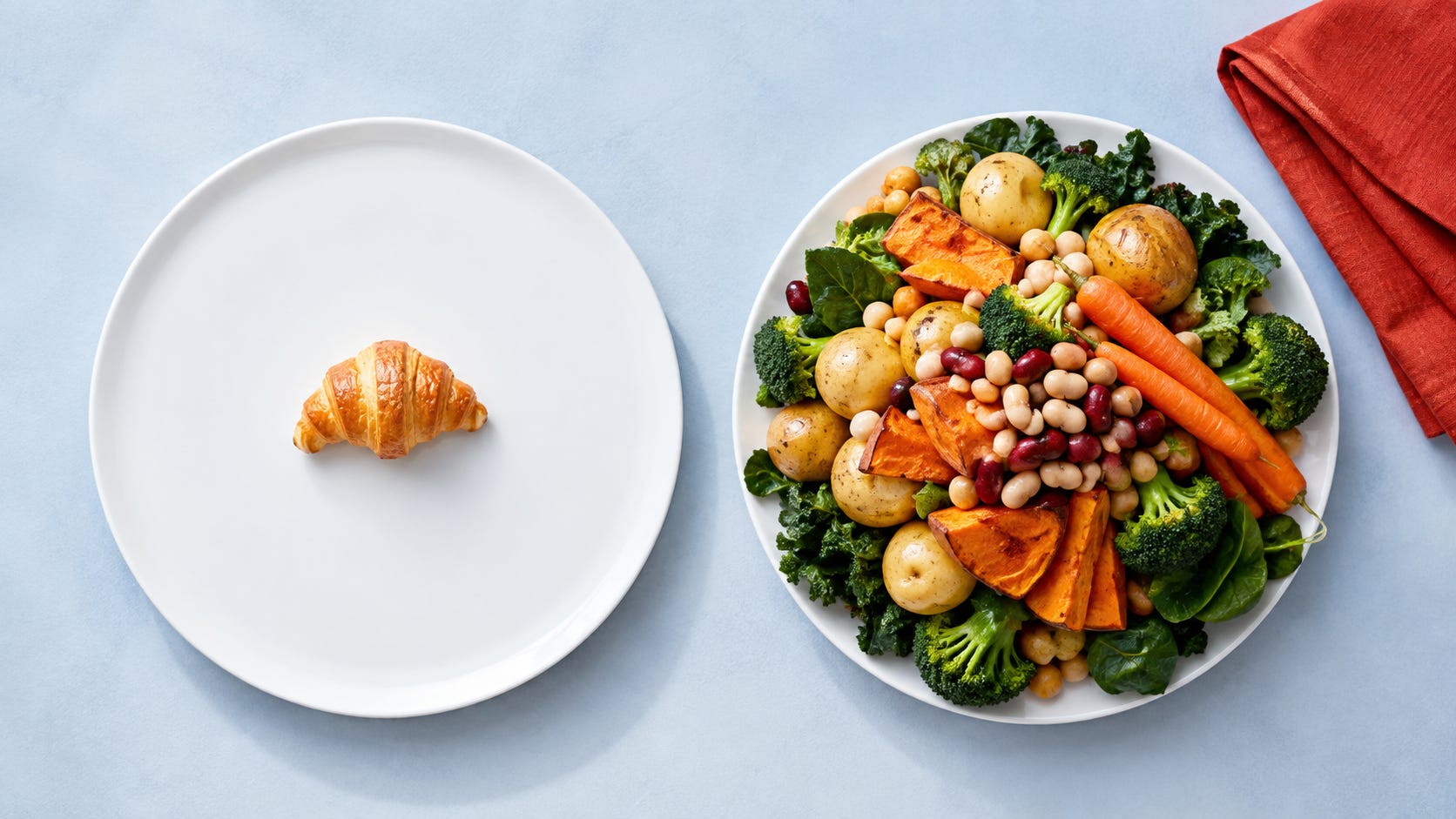
One diet was built from ultra-processed food. The other was built from food.
On the ultra-processed weeks, the same people ate roughly five hundred extra calories a day. Every day. They gained about a kilo in two weeks and lost it again on the other diet. And here is the part that should make anyone who has ever blamed themselves sit up: when asked, they rated both diets as equally pleasant. The processed food did not taste better. It just went down faster, about seventeen calories a minute faster, which at an ordinary twenty-minute dinner means the plate is empty long before the gut has finished sending the message that you are full.
Kevin Hall, the physiologist at the National Institutes of Health who ran it, called it this:
“the first study to demonstrate causality”
Kevin Hall, National Institutes of Health
Not that processed eaters happen to be heavier. That the food itself does it.
Twenty people is a small study, and Hall would be the first to say so. But it was a locked ward with weighed trays, which is about as clean as human nutrition research ever gets, and it lands a hammer on the single most damaging idea in this entire field: that the appetite is the problem. It is not. The appetite is doing exactly what it was built to do. Somebody just changed the food.
In 1990, around 929 million adults in the world were overweight or obese. By 2021 that number was 2.6 billion. Run the trends forward and the Global Burden of Disease team, publishing in The Lancet last year, gets to 3.8 billion adults by 2050, close to sixty per cent of every grown human alive. Emmanuela Gakidou at the Institute for Health Metrics and Evaluation, who led the adult analysis, did not describe it as a failure of appetite:
“a profound tragedy and a monumental societal failure”
Emmanuela Gakidou, Institute for Health Metrics and Evaluation
No country on earth has managed to bend this curve, which is a strange thing to keep blaming on individual weakness. Two and a half billion people did not simultaneously lose their character in the space of one generation. Something in the room changed.
That is where I want to leave the bad news, because standing in front of a number that large is not useful to anybody. What is useful is the flip side of Hall’s finding, and it is genuinely good news: if the food is doing the eating, then changing the food changes the eating. Not through willpower. Through arithmetic your body performs on your behalf while you get on with your day.
The best evidence we have on which specific foods move the needle over a real human lifetime comes from Dariush Mozaffarian and Frank Hu at Harvard, who in 2011 published something unusual in the New England Journal of Medicine. Instead of testing a diet, they tracked what 120,877 nurses and health professionals actually ate, and how their weight actually moved, in four-year blocks, for up to twenty years.
The average person in that dataset gained about 1.5 kg every four years. Slowly, invisibly, roughly a pound a year, the way almost everyone does. But the gain was not evenly distributed across the plate. Some foods travelled with weight gain and some travelled with weight stability, and the gaps were not small. One extra daily serving of crisps predicted an extra 0.77 kg per four years. Sugary drinks, processed meat, refined starch: all on the wrong side of the ledger. Several whole foods sat on the other side, and people who increased them gained less, not more.
Hu put the conclusion about as bluntly as a Harvard professor of nutrition ever puts anything. The idea that there are no good or bad foods, he said, is this:
“a myth that needs to be debunked.”
Frank Hu, professor of nutrition and epidemiology, Harvard
So: it matters what you put in the trolley. Which raises the only question worth the next four thousand words.
What follows is ten foods, with the amount, the form and the preparation exactly as they were tested, because in almost every case the form is the entire story and getting it wrong turns a real effect into nothing.
Two things before we start.
First, they are ordered by how solid the evidence is, from the shakiest at the top to the deepest at the bottom. Not by how much I like them. The early ones are small trials with real caveats and I will tell you the caveats, including the ones that undercut my own case. The later ones are backed by dozens of randomised trials and six-figure cohorts. If you only ever act on half this list, act on the second half.
Second, and this matters more: these work as a set, not as rivals. There is no single food that strips fat, and anyone who tells you otherwise is selling something. Add a bowl of lentils to a diet built on crisps and cola and the lentils will do almost nothing, because the mechanism here is displacement. Every one of these ten works partly by taking up the space, the appetite and the stomach volume that something worse was going to occupy. They are not ten competing answers. They are ten ways of crowding out the same problem, and they compound.
Right. Let’s go.
Comments
Nothing yet. Say the first thing.
Sign in to join the conversation.