
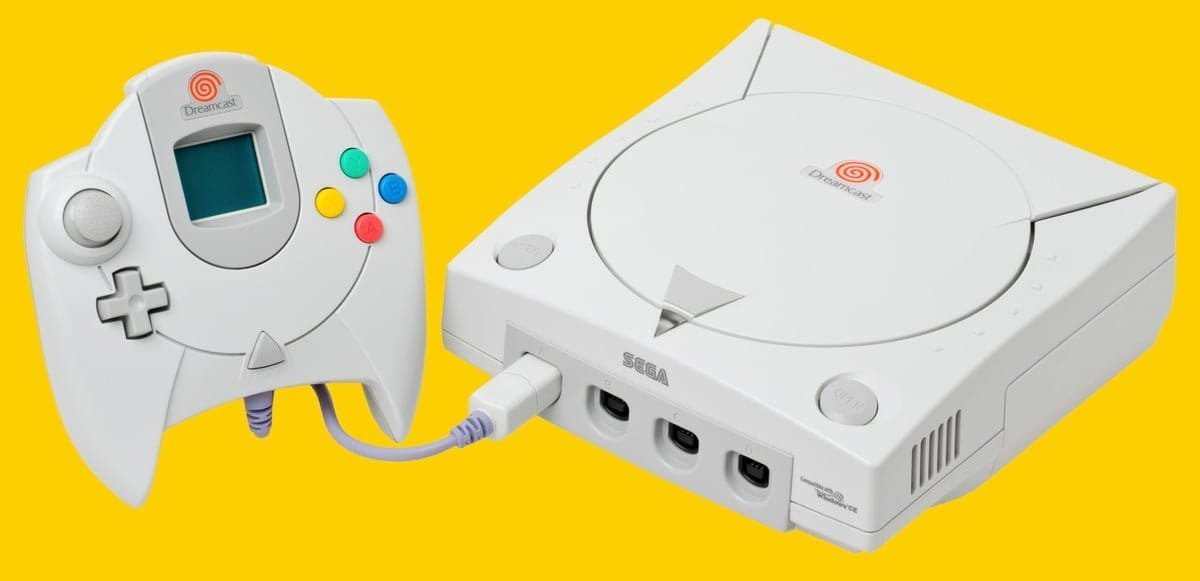
On May 21st 1998, Sega held their New Challenge Conference, an all-in-one boutique of apologies for their recent priors and a promise for the future. To stamp the point, they unveiled their 128-bit answer to the question of just what to do with a problem like Sega?
Their answer was simple; let Sega be Sega and let the Dreamcast be. It was a heck of an opening salvo and at the time I scanned the print media of the time looking over pictures of the new machine, the outstanding tech demo shots, and the various Sega alumni dragged out to give it the thumbs up.
In some pictures was Yuji Naka promising the return of Sonic, and in others, arcade legend Yu Suzuki promising to do all he could to spend all of Sega’s money developing his new RPG.
Neither would let the company down. Industry legends.
As the tale would tell it though, the road to Dreamcast would find the public by E3 of 1997 when then fresh head Sega of America, Bernard Stolar dropped the mother of all bombshells in front of a conference crowd.
The Saturn is not the future of Sega, he said in his most poised of transatlantic accents.
Mic drop.
The crowd couldn’t believe it. The same Saturn that had been selling by literally the tens in the West was not going to carry this large and complicated international company into the new millennium? Either he was a very astute man, or else a very silly one. Like I say, he had that Mid-Atlantic tone of voice thing going on that made his discernment difficult to pin down.
It only turned out that he was right, though. The Saturn wouldn’t do another commercial year in the West, despite always having been a machine as good at the time as it is remembered today.
But the heat was on; what would they do next?
We wouldn’t have to wait much time at all for signs of their interest. Sega had set up a polygon punch-up of a show-down between Hitachi and the American 3dfx team to decide which company’s chipset should be grafted into their new machine. Their likely last hope. So no pressure.
Hitachi had been Sega stalwarts for years, but 3-Dfx were the hot new trend with the iffy PC crowd. And those clowns were really sure about 3-Dfx. By the winter of 1997 though, it became clear that only Hitachi had ever been in the running.
But that didn’t matter because the real question of performance had already been dropped by Sega themselves a year before with Virtua Fighter 3 in arcades. It ran on Sega’s Model 3 hardware and was the future last word on fidelity at the time.
It was followed by Scud Race, and it was thus clear that Model 3 was satellite to all other hardware. Like Sega on absinthe. The colours…
So the real question was, how close to Model 3 was the new hardware going to be? Was that even a realistic expectation? For an old Sega bottom-feeder like me, you bet it was. It didn’t matter how difficult it would be to achieve, if the Dural, or Katana, or whatever else it wouldn’t end up being called couldn’t run Virtua Fighter 3 as good as proper, then what would be the hope? It had to do this, or next to near enough. Enough for whatever telly I would be running it through.
And I knew it wasn’t only me. The Saturn had built a steady and robust cult around itself for a few years and we knew Sega; we knew they were owed one. The output had been out there for the Saturn, it had been the reason for the cult in the first place. And much of their arcade IP was a natural one-up on that. If that could be done at home, then the job was done.
In terms of Sega’s survival, it wouldn’t matter what Sony or even Nintendo could bring if they could get the jump by twelve months and give it blue sky Sega from both barrels. It couldn’t be ignored, despite prior Sega ignominies.
Comments
Nothing yet. Say the first thing.
Sign in to join the conversation.