
I hope it won’t be a surprise to any readers that I used AI … a lot.
Indeed, as Claude praised me yesterday, one of the big predictive wins of this Substack thus far has been its early adoption of AI, with the start of AI Fridays in April 2023.
If only I’d been so timely with the blockchain gaming stuff!
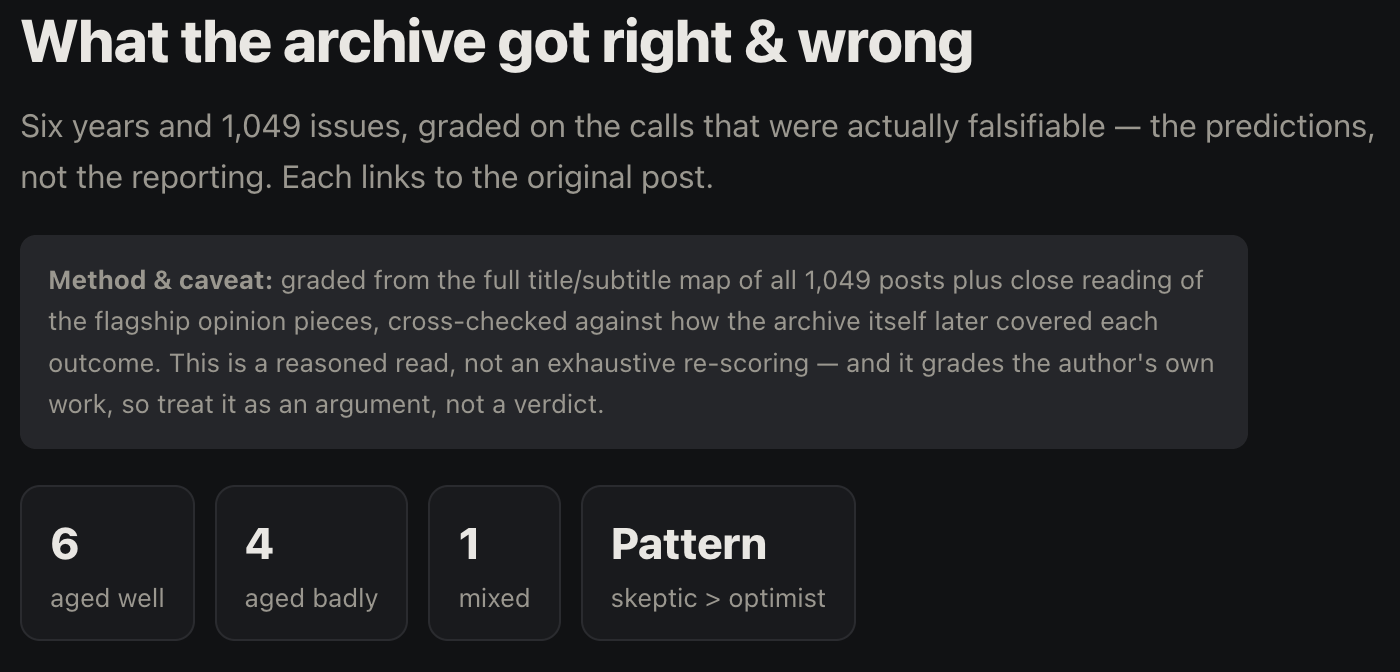
Which brings us onto Substack’s new AI crackdown. All posts from 21st July 2026, when accessed from the Substack app, can now be scanned for their use of AI, thanks to its integration with Pangram.
In conjunction with this, Substack provides all authors with the ability to make a formal disclosure statement, which it calls a “How I make this” statement.
I presume the reason is for the blowhards and poets to protest their words’ fully human origins. As for me, I just state:
“This article was produced by a stochastic system. Some of it also involved AI.”
The point is that while a few people still physically write everything out, and the odd novelist is keen to show off their typewriters, over the past 20 years, most of us have moved to word processing … with spell checkers … and Grammarly etc.
In that pipeline, AI is just another tool. As Tyler says, You’ll Learn To Love AI Writing.
But that’s not really the point. The point of working with AI is much more multifaceted. Here’s an example.
Over the past months, I’ve read various stories about South Korean outfit Nexus and its CROSS blockchain, recently renamed ONE to reflect its acquisition of the One Store; Korea’s primary domestic alternative to Google Play.
But I’ve never written anything up or had the time to work out how these stories fit together, or even if there’s any coherence.
Then the subject came up in one of the daily news digests I get Claude Opus 4.8 High to run, combining the X API and various micro-payment API search engines accessed through Stripe’s Tempo blockchain. The cost ranges from $0.04 to sub $0.001 depending on the service.
Some number of queries later, including some Korean-only searches — plus a couple of double-checking passes through GPT 5.6 Sol — I had the following article, which has been lightly edited.
The point is that this is something I would have never had produced without AI as a research and writing tool.
The second act of Jang Hyun-guk; Korea’s complex blockchain game guru
For a decade, Jang Hyun-guk has been Korean gaming’s most persistent advocate for putting games on blockchains.
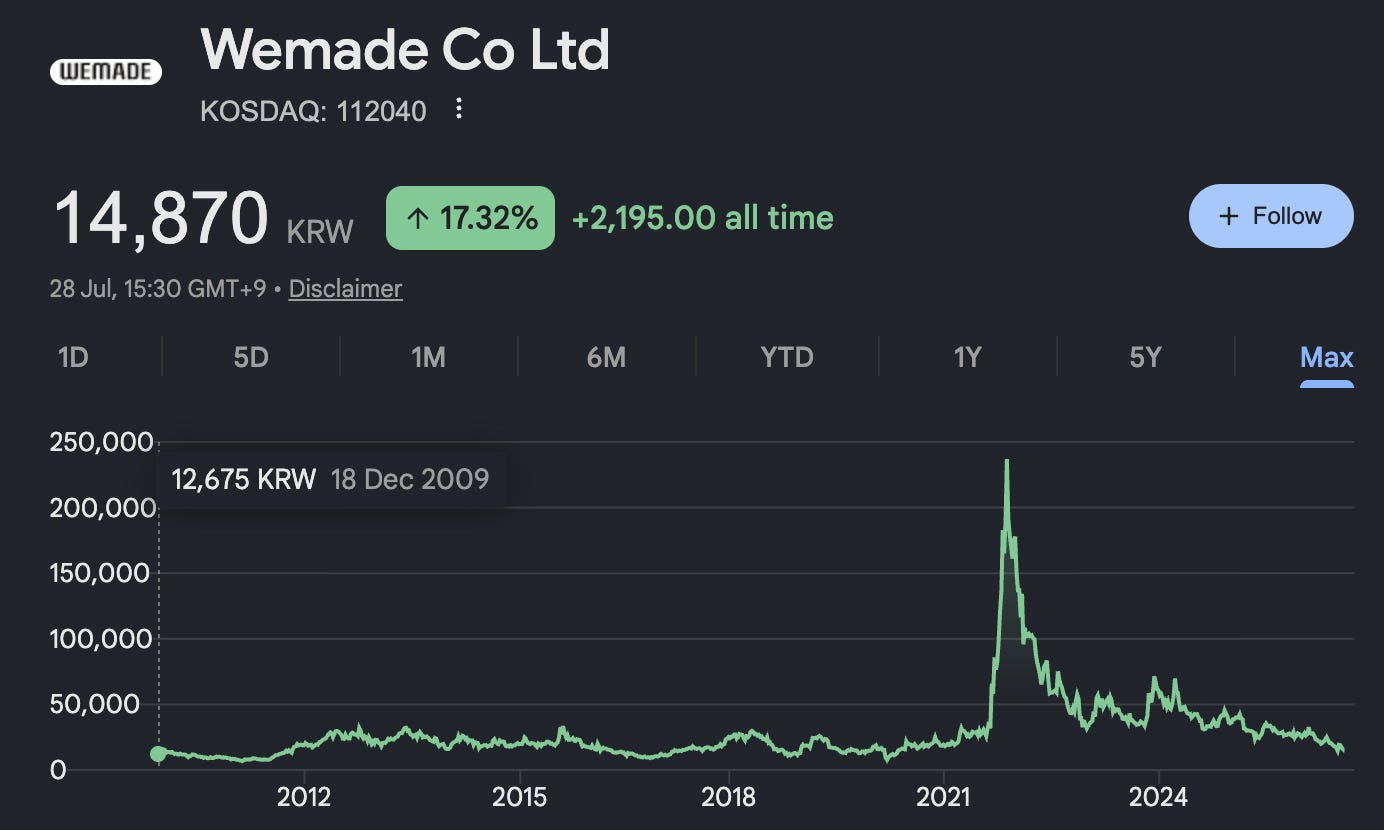
As chief executive of Wemade, he made WEMIX central to the company’s strategy and oversaw the international blockchain versions of MIR4 and Night Crows. At the height of the enthusiasm in 2021, Wemade’s market capitalization passed ₩5 trillion ($4.2 billion).
The reversal was equally dramatic. In November 2022, Korea’s major crypto exchanges decided to delist its WEMIX token, citing discrepancies in its reported circulating supply and inadequate or incorrect information given to investors. The token was removed from those exchanges on 8th December 2022 after Wemade failed to stop the decision in court.
A related but distinct criminal case followed. In August 2024, prosecutors indicted Jang and Wemade under the Capital Markets Act. They alleged that Jang had said WEMIX liquidation would stop while the company continued to use and liquidate tokens, and that the statement helped induce investment and support Wemade’s share price. Prosecutors later sought five years in prison and a ₩200 million fine.
Jang had already stepped down as Wemade’s chief executive in March 2024, becoming vice-chairman. He also resigned as chief executive of affiliate Wemade Max that September.
Nor did the criminal case end with the first acquittal. The Seoul Southern District Court found Jang not guilty on 15th July 2025. The court said the relevant financial product under the charge was Wemade stock, not WEMIX, and that prosecutors had not sufficiently established the required link between Jang’s statements, WEMIX and Wemade’s share price. Nexus shares closed 14.5% higher that day.
The Seoul High Court upheld the acquittal on 27th November 2025. The prosecution declined a final appeal, making the result final in December.
That distinction matters. The courts did not declare that every WEMIX circulation statement had been complete or accurate. They found that the specific Capital Markets Act case brought by prosecutors, centred on Wemade shares, had not been proved.
Jang did not build his second act from a conventional startup. In December 2024, Action Square announced that he would become co-chief executive from 1st January 2025. He invested ₩5 billion through a third-party share issue, then bought roughly another ₩600 million of stock in the market. By 7th January, his disclosed stake was 10.1%, making him the company’s second-largest shareholder, with a contractual route to acquire more.
Action Square was a listed game developer with a long record of operating losses. That was a liability, but its corporate structure and listing also gave Jang a platform from which to recruit and raise capital. At a February shareholder meeting, the company changed its name to Nexus; later that month Jang became sole chief executive.
Jang has described his departure from Wemade as involuntary. In a ChosunBiz interview published on 29th March 2025, he said he did not want to return to life as an employee and believed blockchain games were the field in which he had achieved the most. He also argued that the sector had made little progress since he left Wemade. Those statements are useful evidence of his motivation, but they are his assessment of the industry, not an established fact.
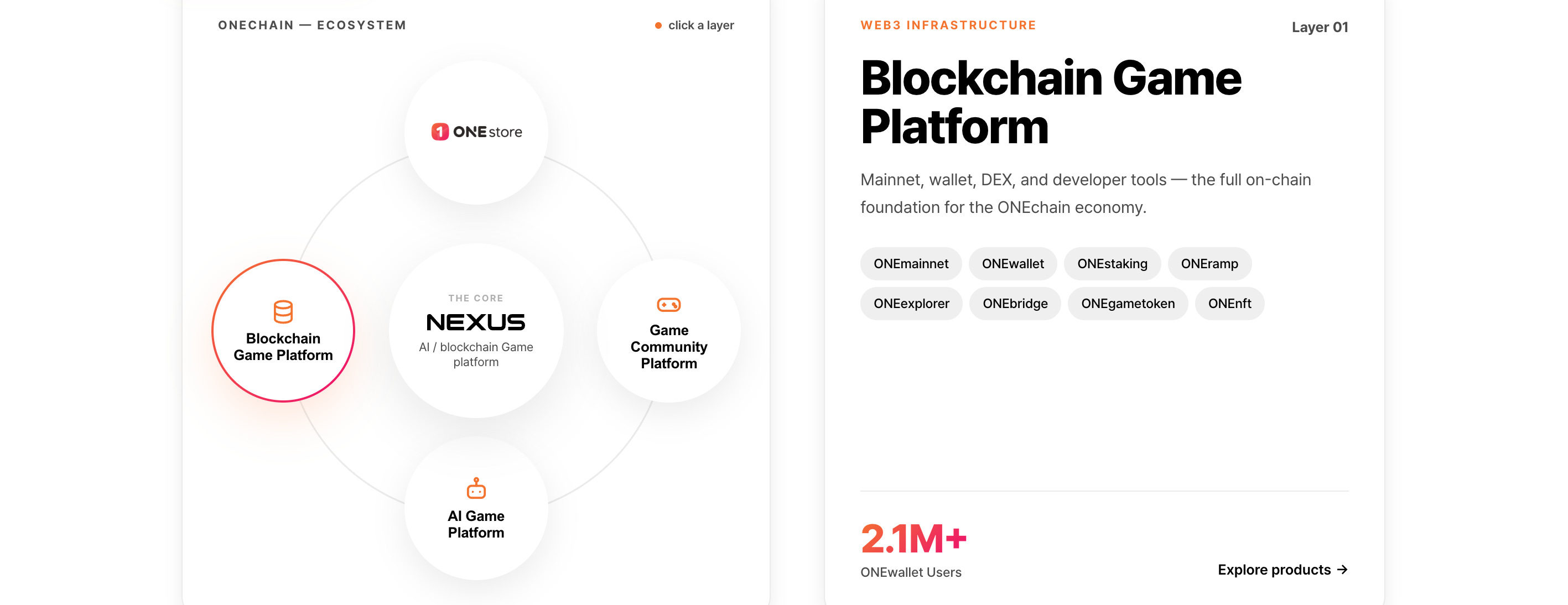
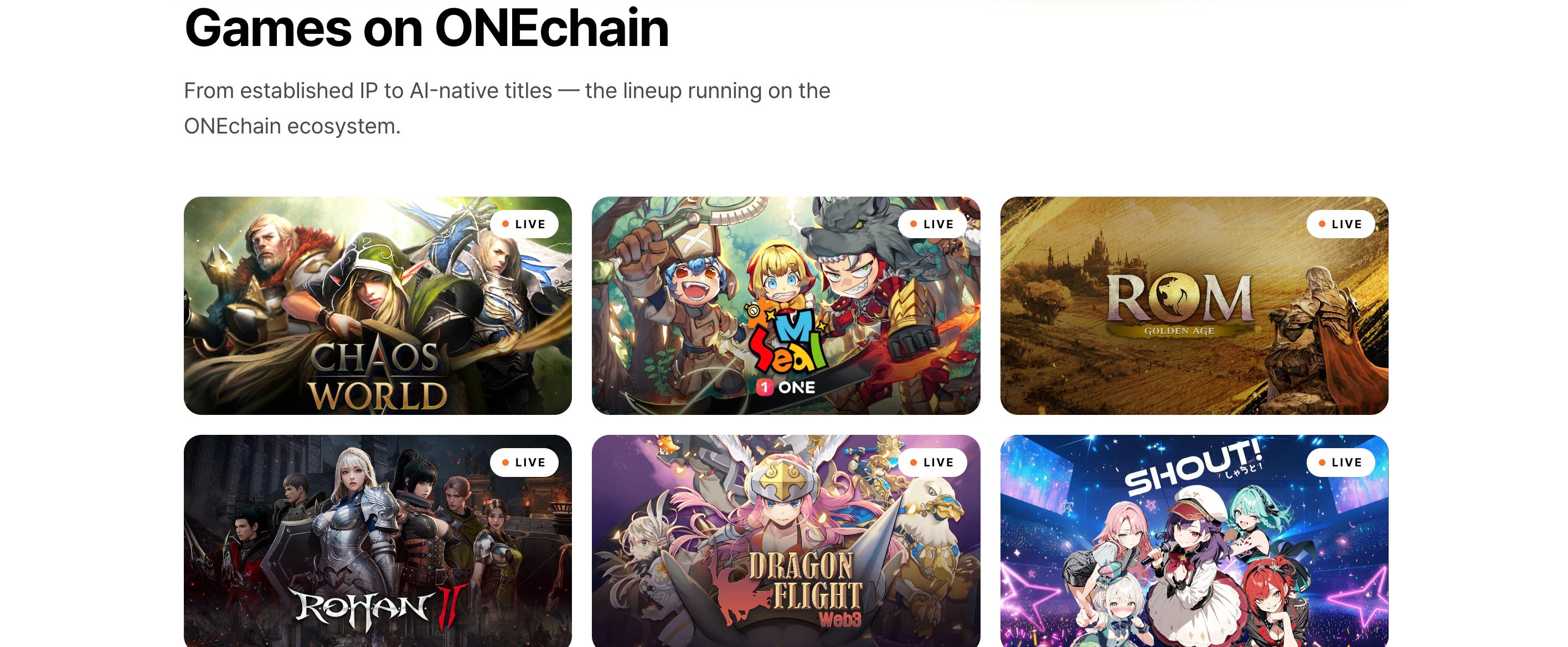
Nexus moved quickly. The OpenGame Foundation launched CROSS’s first mainnet, “Adventure,” on 23rd April 2025, with Nexus as its principal technical partner. Ragnarok: Monster World followed as the first onboarded game the next day.
Rohan 2 Global, co-published with Playwith Korea, launched on 30th September. The companies reported more than 3 million pre-registrations at launch, and Jang said in November that monthly active users were approaching 300,000. Those are meaningful signs of use, although the latter figure is management’s claim rather than an independently audited metric.
But the transaction that changed Nexus’s position was its acquisition of One Store, Korea’s home-grown alternative to Google Play and Apple’s App Store.
Nexus agreed in June 2026 to pay ₩63 billion ($41 million) for a controlling interest reported as 89%, buying shares from SK Square, Naver, a special-purpose company and Krafton.
More importantly, Jang did not personally write that cheque. Nexus financed most of the purchase with a roughly ₩39.5 billion third-party share issue and ₩21 billion of convertible bonds.
SK Square, Naver and Krafton sold their One Store shares while reinvesting substantial portions of the proceeds in Nexus through the new equity and convertible bonds. That continuing involvement gives Nexus more institutional substance than the average web3 gaming venture: the former owners did not simply take their money and leave.
The structure does not remove the financial risk. The $41 million purchase price was equal to about 165% of Nexus’s year-end equity, and the company relied heavily on shareholder dilution and convertible debt to complete it. Investors initially reacted badly: Nexus shares fell sharply after the acquisition and financing were announced.
Nexus now controls One Store, but it does not own it outright. One Store says its marketplace is installed on more than 38 million devices. An IGAWorks analysis placed it second in Korea for game transaction value, with a 12.6% share accumulated across the five years from the second half of 2020 to the first half of 2025. That makes it a substantial distribution asset, although it remains far behind Google Play on the same measure.
Nor has One Store demonstrated consistently profitable operations. It reported revenue of ₩113 billion in 2025 but an operating loss of ₩9.7 billion. Nexus has therefore acquired a real platform with established commercial relationships, not a proven profit engine. The investment case depends on whether combining that platform with Nexus’s games, payments and blockchain services can improve its economics.
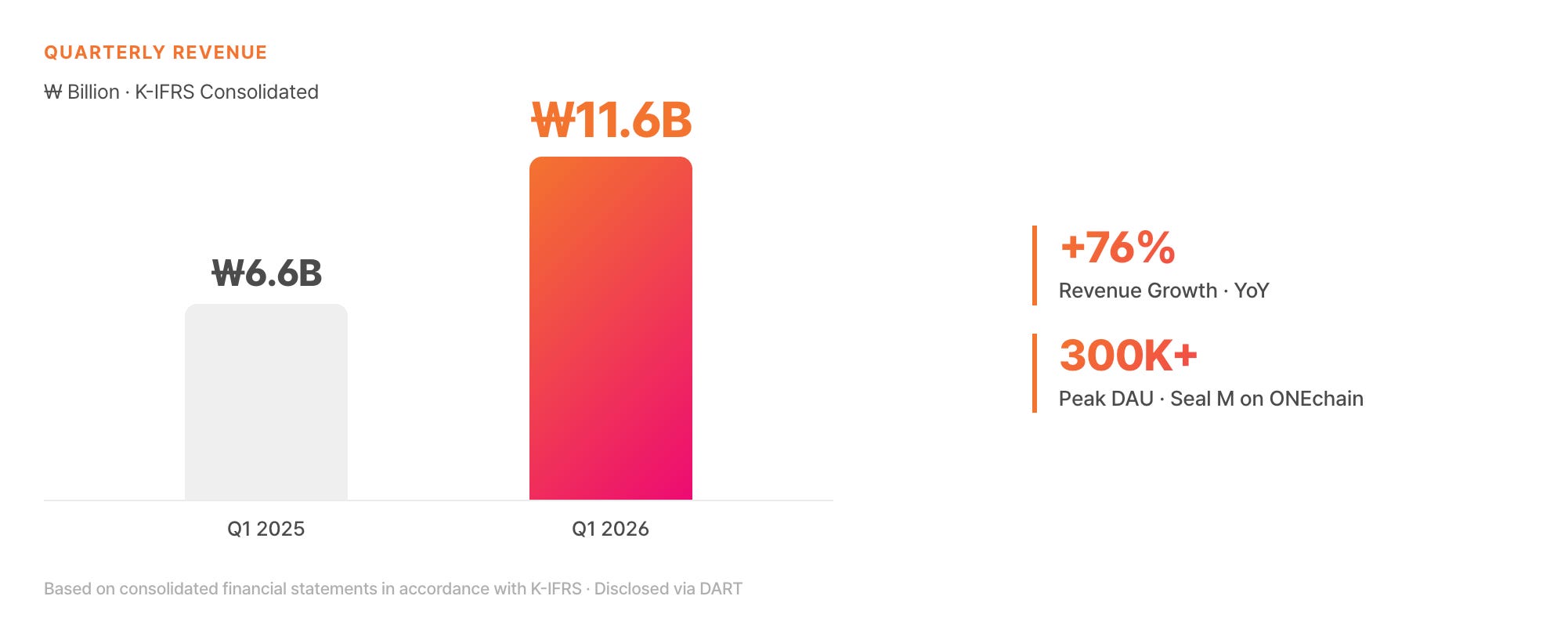
Nexus says it will combine One Store with its web shop, payments, community, rewards and blockchain services. The strategic logic is straightforward: at Wemade, Jang controlled games and blockchain infrastructure but not the store through which most mobile users discovered and paid for games. Nexus now controls a meaningful domestic distribution channel as well.
On 15th July, One Store joined CROSS Mainnet 2.0 as a validator, operating node infrastructure for block production, transaction verification and network security. The “Breakpoint” upgrade, launched on 1 June, uses Proof of Staked Authority and describes a top-21 active validator set.
This is real infrastructure integration, but it should not be mistaken for proof of mature decentralization. H Lab was announced as the first external independent validator. One Store is now another operator, while CertiK had signed a memorandum of understanding to participate.
Public announcements do not establish that only two validator nodes exist, because foundation-operated nodes may also be active. They do show, however, that the publicly identified set of independent operators remains limited. One Store may diversify the network operationally, but it is controlled by Nexus and therefore is not independent of the corporate group driving the platform.
The rebrand also predates the validator announcement. Nexus said on 18th June that CROSS would become ONEChain and its native token would change from $CROSS to $ONE; the ecosystem dollar was later named $ONEUSD. The purpose is to put the store, chain, payments and game services under a single ONE identity.
On 23rd July, Nexus launched Frost Kingdom, its first self-published title. The strategy game is available through One Store, iOS, Android, PC and an HTML5 version. In the global version, its $RDIA game token can be converted into the premium in-game currency, and Nexus says 5% of game revenue will fund rewards paid in ONEUSD to token holders.
That is a concrete product, but it is too new to demonstrate that the combined store-and-chain model works commercially.
Nexus is also building a Dubai presence. Its local entity co-hosted a gaming, AI and blockchain event with the Dubai Multi Commodities Center on 16th July, and the two organizations plan joint appearances at ChinaJoy in Shanghai and Gamescom in Cologne. The facts support a Korea-to-Dubai expansion strategy, though claims about the capital or studios it will attract remain prospective.
Jang’s clearest formulation remains the one he gave ChosunBiz in March 2025:
“Blockchain is not magic. The game needs to be fun first, then we add blockchain.”
His comeback is no longer hypothetical, and the criminal case is no longer hanging over it. But the One Store acquisition is not personal vindication, nor is a parent-controlled validator evidence of decentralization by itself.
Nexus has acquired a serious distribution asset and connected it to a functioning, if still concentrated, blockchain-game stack. It has also attracted continuing financial involvement from some of Korea’s largest technology and gaming companies.
That makes Nexus more substantial than the average web3 gaming venture. It does not yet make it a proven business.
The question is now more concrete than it was at Wemade: can Nexus turn its distribution, payment and blockchain infrastructure into durable games, users and cash flow—or will it produce another cycle of token-led expectations?
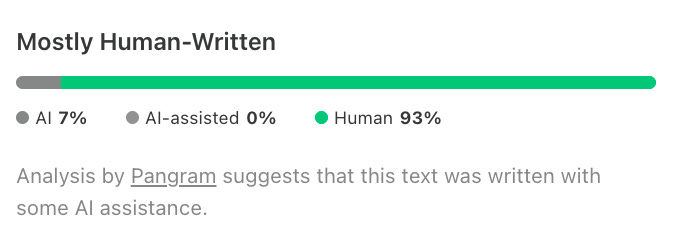
N.B. Pangram reckons this article is 7% AI, which is order-of-magnitude incorrect. You can’t trust anyone these days.
More at YouTube | Spotify | X | RegenRaygun
No posts
Comments
Nothing yet. Say the first thing.
Sign in to join the conversation.