
Part 1 of The Brand Game
I’ve been sitting on this one for a while.
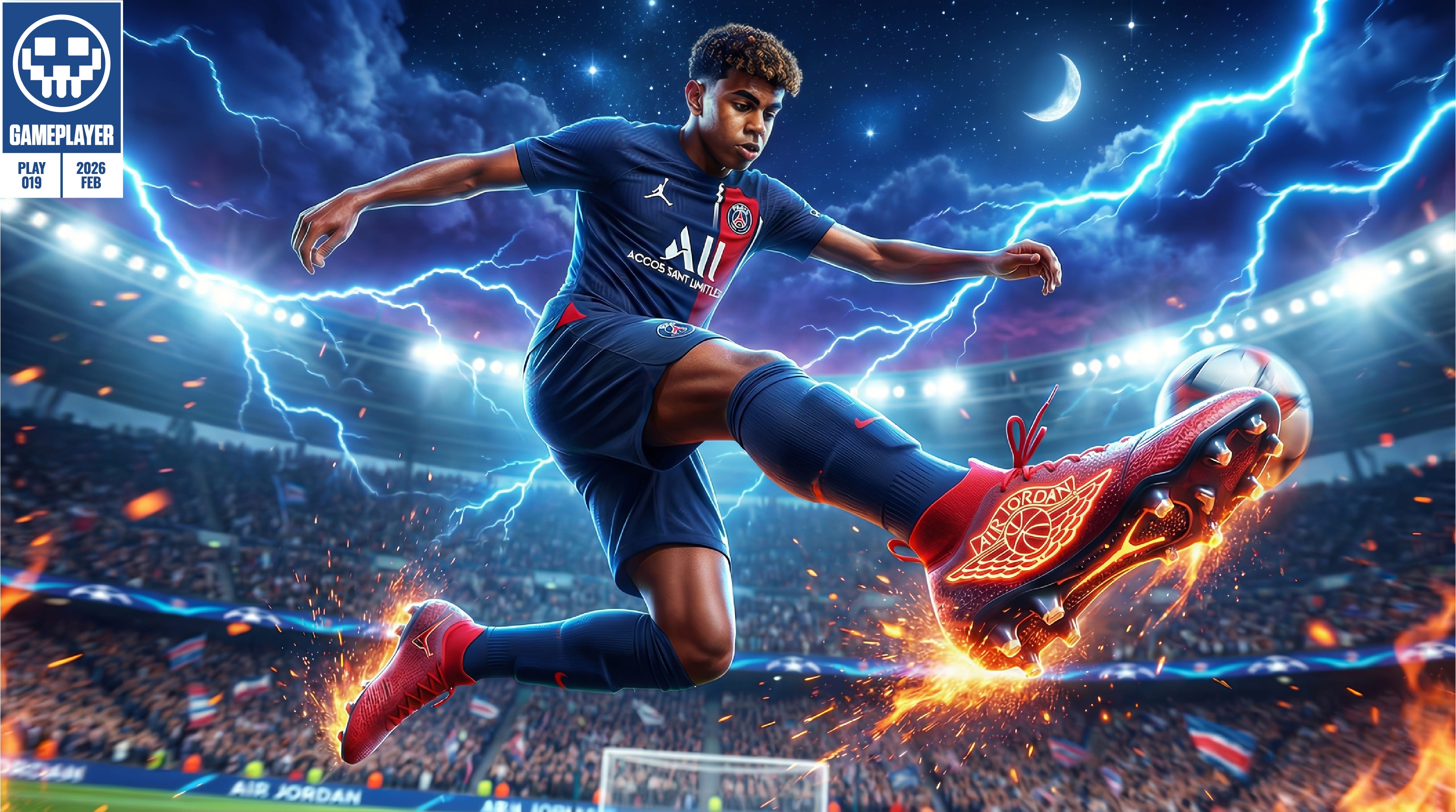
The Jumpman on PSG’s chest. Ousmane Dembélé, Ballon d’Or winner, an Adidas athlete, wearing it on this Champions League night. I watch from my sofa. Broadcasted to 200 other countries. Kids in Lagos, Jakarta, East London who couldn’t tell you the first thing about the 1992 Dream Team, wearing the kit.
And the more I sat with it, the more I realised it points to something much bigger than a kit deal.
Jordan is one of the most powerful cultural assets on earth. But in football, the world’s largest sport by a distance, it exists purely as an accessory to Nike’s infrastructure. One club. One logo placement. Seven years of PSG collaboration that proved the demand is insatiable, and yet the brand has not taken a single independent step into the sport. No athletes. No standalone boot deals. No competing with Adidas or the Swoosh for the next Vinicius Jr., the next Lamine Yamal, the next generational talent who will define football for the next decade.
Ask yourself why. Because the answer is the whole argument.
This is the corporate politics and structural reality of operating as a wholly-owned subsidiary inside a parent company with $46 billion in revenue that has deep, long-standing commitments across world football. Nike has Barcelona. Nike has France. Nike has Mbappé personally, or at least it's desperately trying to hold onto him before his contract expires in 2026. And that's exactly the problem.
Imagine Jordan wanted to sign Mbappé as its own athlete. A genuine flagship signing in the way MJ himself was Nike's flagship, built into the identity of the brand. It cannot do that though, as Mbappé is Nike's asset. The same Nike that Mbappé is in tense contract negotiations with right now. The same Nike that had to remove his image from a Real Madrid Adidas promotional campaign because the conflicting sponsorships created a legal headache. At Jordan HQ, they watch this entire dynamic unfold from the same building and yet have zero ability, or should I say permission, to move on it.
This is what corporate parenthood looks like in practice. It's not malicious. It's just architecture. Jordan doesn't lose freedom because Nike is bad. It loses freedom because Nike is Nike. And Nike's football relationships will always, by definition, come first.
So you get one club. You get a kit. You get a logo on a shirt. And you get a brand worth $7 billion a year that has proven, definitively, that the culture wants it in football and yet remains structurally unable to pursue that ambition at the speed or scale it deserves.
When the Jumpman first appeared on PSG’s Champions League kit in September 2018, debuted at Anfield of all places, it wasn’t just a commercial deal. It was a cultural event. PSG’s shirt sales in the US went up 470%. The kits weren’t just selling to football fans. They were selling to sneakerheads, to streetwear kids, to people who owned five pairs of Jordan 1s and had never watched a 90-minute match in their lives. The collaboration ran for over six years, spawned twelve kits, moved into Paris Fashion Week with the Jordan Wings x PSG collection in January 2025, and fundamentally changed what a football club’s relationship with fashion and culture could look like.
And in doing all of that, it proved exactly the problem. Jordan's football footprint across the entirety of its six-plus years in the sport is one club. The demand has been screaming for more. I am screaming for more, but the supply has been frozen. Clearly.
Free from Nike's constraints, an unchained Jordan doesn't make that mistake. Free from Nike's constraints, Jordan looks at the PSG proof of concept and moves on three more clubs within two years. An independent Jordan identifies the overlap between its core consumer, culturally connected, streetwear-led, 18 to 35, and the football supporter base in West Africa, Brazil, France, and the UK, and builds specifically for that audience. It doesn't just slap a Jumpman on a kit. It builds a football identity from scratch, the way it built a basketball identity from one man and one contract in 1984.
The Jordan brand hit $7 billion in revenue at its 2024 peak, before declining 16% the following year. It had doubled in size between 2020 and 2024. Michael Jordan himself earns approximately $300 million a year in royalties from a brand built around a player who hasn’t played professional basketball in over two decades. Nike’s overall market cap sits around $95 billion right now, a company in genuine structural distress, down more than 65% from its November 2021 high. Conservatively valued as a standalone entity, it would be worth somewhere between $20 and $25 billion on the open market. That’s not a sub-brand. That’s a business being managed below its ceiling by a parent company whose ceiling is lower.
The former Jordan president Craig Williams once said the brand is “turbocharged” by being inside Nike. I understand why he said it, and in 2019 he wasn’t entirely wrong. The supply chain, the distribution, the retail relationships. Those things matter. But turbocharging implies unlimited acceleration. What Jordan actually has is a speed limiter, installed quietly by the parent company’s commercial conflicts.
Basketball gave Jordan its mythology. But football is where the next chapter of cultural dominance gets written. The sport has 3.5 billion fans globally. Its fastest-growing audiences are in exactly the demographics where Jordan has the deepest resonance. The cross-cultural potential, the kid in Dakar who wears Jordan 4s to school and watches the Champions League on his phone, is not theoretical. It is real, it is enormous, and it is currently unaddressed by a brand that has done everything right except answer the most important question: why is the Jumpman only on one club’s shirt?
An independent Jordan answers that question on day one. It builds a football division with its own creative directors, its own athlete roster, its own boot line. It competes with Adidas, a brand doing $25 billion a year in revenue with deep football equity but nothing close to Jordan's cultural mythology. Though let's be honest, wherever Adidas goes, Nike follows, and vice versa. True independence from the Swoosh may never fully exist. But there is another version of this? One where Nike takes off the shackles, lets Jordan fly, and watches it actually catch air. Not a subsidiary. A co-existing force. The question is whether Nike is bold enough to try.
Nike won’t let Jordan go. Not now. Not while it’s rebuilding under Elliott Hill and Jordan is its most valuable card in the recovery. And maybe that’s right, in the short term.
But the longer Nike keeps Jordan earthbound, the more the opportunity cost compounds. Five or ten years from now, someone will look back at Jordan’s football hesitancy the way we now look at Blockbuster declining to buy Netflix. The cultural proof was stacked. The demand was deafening. And the decision to stay still was made not out of strategy, but out of fear.
The Jumpman was built to fly. Right now, Nike won’t let it leave the ground.
THE BRAND GAME
A two-part mini series on how brands are reshaping football.
This is Part I. Check out Part II below.
I don’t just write about the future of football, I help shape it. If this hit a nerve, I’m probably already thinking about how we could build something together.
Thanks for reading GAMEPLAYER.
Through CAOS, GAFFER, EDEN, and over 100 football contracts, transfers, brand deals, and equity-driven partnerships, I’ve seen power shift from clubs to investors, brands to athletes, and legacy to culture.
I break down what matters. Private equity takeovers, athlete-led media, billion-dollar sports IP, and the future of merchandising and streaming.
This isn’t just commentary. It’s about who’s making the real moves and what’s coming next.
Comments
Nothing yet. Say the first thing.
Sign in to join the conversation.